What’s Observed on September 11
Born on September 11: Virgo ♍
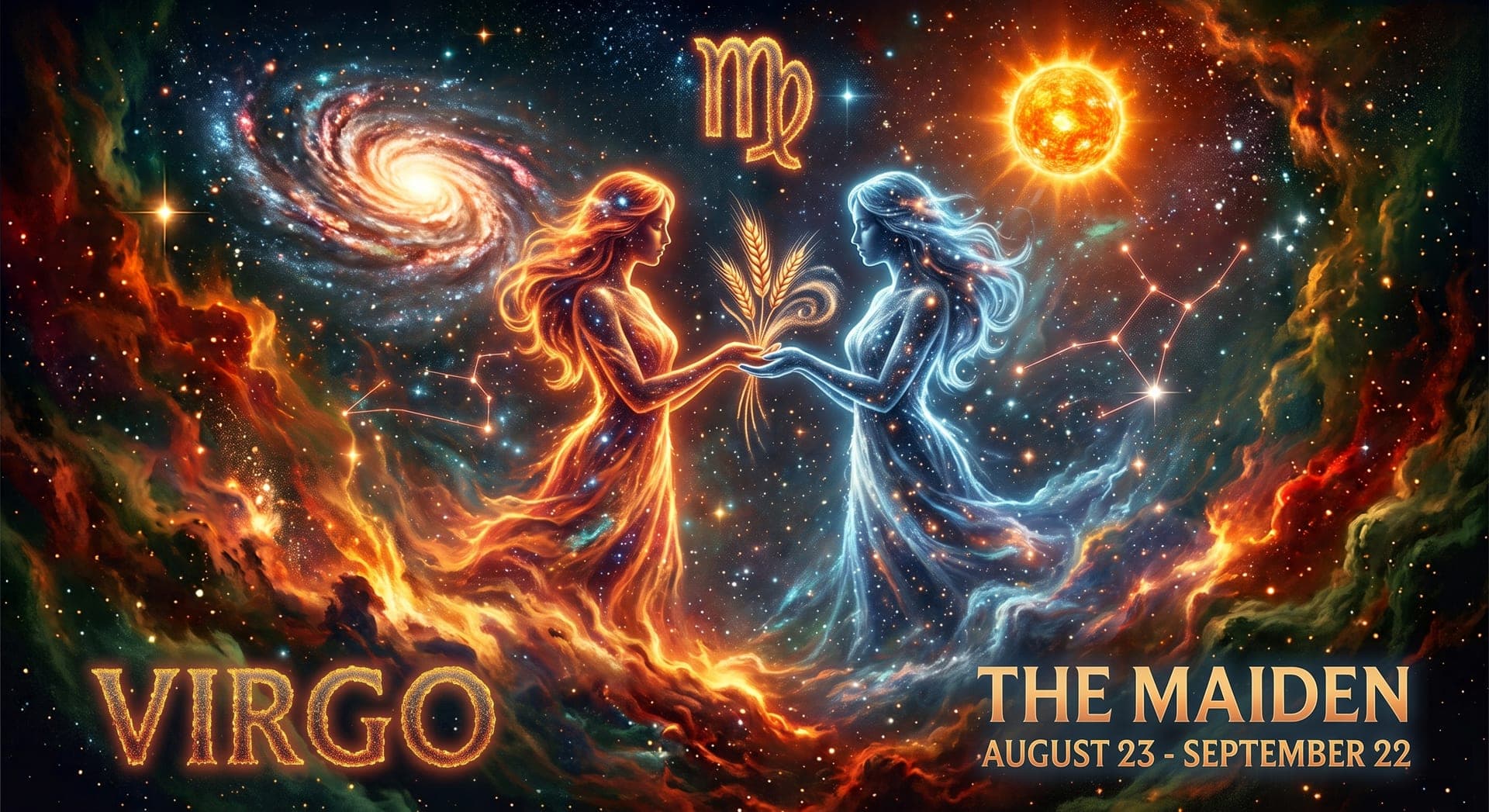
Virgo, the sixth sign of the zodiac, spans August 23 to September 22 and is symbolized by the maiden, often depicted holding a sheaf of wheat, representing purity, meticulous care, and the harvest. Ruled by Mercury, the planet of communication and intellect, Virgo channels its mental energy toward precision, analysis, and practical problem-solving rather than idle chatter. As an Earth sign, Virgo is grounded and detail-oriented, finding genuine satisfaction in organizing, refining, and perfecting the world around it. Its Mutable modality gives Virgo an adaptable, service-oriented nature, often finding purpose in quietly helping others and improving systems rather than seeking the spotlight. People born under this sign are frequently drawn to work requiring precision, research, or care for others, from science and medicine to editing and organization. Virgo's high standards make it an excellent problem-solver and a reliable presence others can count on, though that same perfectionism can turn inward as self-criticism or outward as an exacting, sometimes overly critical, eye toward the people and world around it.
Personality Traits
Strengths
- Highly organized and detail-oriented
- Reliable and hardworking
- Analytical problem-solver
- Genuinely helpful to others
- Modest and unpretentious
Weaknesses
- Prone to overcritical perfectionism
- Tends to worry excessively
- Can be overly critical of others
- Reserved to the point of aloofness
- Struggles to relax
Compatible Signs
Fun Facts
- Virgo's maiden symbol is often associated with Astraea, the Greek goddess of justice and purity, said to have been the last immortal to live among humans.
- Virgo is the only zodiac sign represented by a female human figure.
- Virgo and Gemini share Mercury as their ruling planet, though Virgo channels the planet's communicative energy toward analysis and precision rather than pure talkativeness.
- Notable Virgos include Beyoncé, Michael Jackson, Mother Teresa, and Stephen King.
- Virgo season falls at the tail end of summer, a period traditionally associated with harvest, meticulous preparation, and gathering resources for the colder months ahead.
Born on September 11
- 1700
James Thomson
Scottish poet and playwright best known for the poem cycle The Seasons and for writing the words to Rule, Britannia!
- 1711
William Boyce
English composer and organist celebrated for his church music and his collection of English cathedral music, Cathedral Music
- 1862
Julian Byng
English army officer and Governor General of Canada who commanded the Canadian Corps at the Battle of Vimy Ridge
- 1877
James Hopwood Jeans
English physicist, astronomer and mathematician known for his work on the kinetic theory of gases and cosmology
- 1885
D. H. Lawrence
English novelist and poet known for controversial works such as Lady Chatterley's Lover and Sons and Lovers
- 1899
Jimmie Davis
American singer and Governor of Louisiana
- 1913
Bear Bryant
American college football coach
- 1917
Ferdinand Marcos
President of the Philippines
- 1917
Jessica Mitford
English-born journalist and author known for her investigative writing, including the exposé The American Way of Death
- 1935
Arvo Part
Estonian composer known for minimalist classical music
- 1940
Brian De Palma
American film director
- 1945
Franz Beckenbauer
German footballer and manager
- 1962
Matthew Stevens
Welsh professional snooker player who reached the World Championship final in 2000 and 2005
- 1967
Harry Connick Jr.
American musician and actor
On This Day in History
- 9
Germanic tribes annihilate three Roman legions at the Battle of the Teutoburg Forest, halting Roman expansion east of the Rhine.
An alliance of Germanic tribes led by Arminius ambushed and annihilated three entire Roman legions marching through dense forest terrain in what is now northwestern Germany, one of the most catastrophic defeats in Roman military history. The disaster convinced Rome to abandon further expansion east of the Rhine River, establishing a lasting frontier boundary.
- 9
The Battle of the Teutoburg Forest ends with Germanic tribes annihilating three Roman legions, one of the greatest defeats in Roman military history.
The ambush, orchestrated by the Germanic chieftain Arminius, destroyed roughly 20,000 Roman soldiers under governor Publius Quinctilius Varus in dense forest terrain near the Rhine frontier. The disaster halted permanent Roman expansion east of the Rhine and helped shape the future linguistic and political boundary between Roman and Germanic Europe.
- 1275
An earthquake strikes southern Great Britain, causing multiple deaths and destroying St Michael's Church on top of Glastonbury Tor.
A rare and destructive event for medieval England, the quake is one of the earliest seismic events in Britain to be documented in surviving records. The ruined church tower was later rebuilt, and the roofless structure now standing atop Glastonbury Tor, a well-known English landmark, dates from that later reconstruction.
- 1297
Scottish forces under William Wallace defeat English troops at the Battle of Stirling Bridge.
Scottish rebel forces under William Wallace achieved a stunning victory over a much larger English army by exploiting the narrow crossing point of Stirling Bridge, funneling English troops into a bottleneck where they could be overwhelmed. The victory made Wallace a celebrated Scottish national hero and temporarily secured Scottish independence.
- 1297
Scottish forces led by William Wallace and Andrew Moray defeat an English army at the Battle of Stirling Bridge.
The victory came when the Scots attacked English troops as they crossed a narrow wooden bridge over the River Forth, trapping and slaughtering a large portion of the force. The win made Wallace a national hero and a leading figure in the early Scottish Wars of Independence against King Edward I of England.
- 1565
Ottoman forces withdraw from Malta, concluding the Great Siege of Malta.
After an exceptionally brutal four-month siege that decimated both the defending Knights Hospitaller and the attacking Ottoman forces, the Ottomans finally abandoned their campaign to capture the strategically vital island of Malta. The successful defense is often credited with halting further Ottoman expansion into the western Mediterranean.
- 1609
English explorer Henry Hudson, sailing for the Dutch East India Company, arrives at Manhattan Island and meets its indigenous inhabitants.
The voyage, aboard the ship Halve Maen, was Hudson's attempt to find a northeast passage to Asia on behalf of his Dutch employers. His exploration of the river that now bears his name laid the groundwork for Dutch territorial claims to the region that became New Netherland, later renamed New York.
- 1649
Oliver Cromwell's Parliamentarian forces capture the Irish town of Drogheda after a short siege and execute much of its garrison.
The assault, part of Cromwell's campaign to subdue royalist and Catholic resistance in Ireland, resulted in the deaths of most of the garrison and an uncertain number of civilians. It remains one of the most controversial episodes of the Cromwellian conquest of Ireland, remembered as a byword for brutality in Irish historical memory.
- 1683
A coalition led by Polish King John III Sobieski lifts the Ottoman siege of Vienna.
A coalition of Polish, Austrian, and German forces led by Polish King John III Sobieski launched a decisive relief attack that broke a two-month Ottoman siege of Vienna, a battle widely regarded as a turning point that halted Ottoman expansion into Central Europe.
- 1776
A peace conference on Staten Island between British and American representatives fails to prevent continued war.
Representatives of the Continental Congress met with British General William Howe on Staten Island in a last diplomatic attempt to resolve the growing conflict, but the talks collapsed over Britain's refusal to recognize American independence as a starting condition for negotiation.
- 1776
A peace conference between British commissioners and American representatives on Staten Island fails to halt the escalating American Revolutionary War.
The meeting, held shortly after the British capture of New York, brought together Admiral Lord Howe and an American delegation that included Benjamin Franklin and John Adams. Howe's offer fell well short of recognising American independence, the delegates' minimum condition, and the two sides parted ways with the war continuing for seven more years.
- 1814
American forces achieve a decisive victory at the Battle of Plattsburgh during the War of 1812.
American naval and land forces achieved a decisive combined victory over invading British troops at Plattsburgh, New York, forcing a British retreat back into Canada and significantly strengthening the American negotiating position in the peace talks that soon concluded the War of 1812.
- 1941
Construction begins on the Pentagon building outside Washington, D.C.
Construction began on what would become the world's largest office building by floor area, designed to consolidate the rapidly expanding U.S. War Department's scattered offices into a single, efficient headquarters ahead of America's anticipated entry into World War II. The massive five-sided structure, built in just sixteen months on a tight wartime schedule, remains the headquarters of the U.S. Department of Defense today.
- 1973
A military coup led by General Augusto Pinochet overthrows Chilean President Salvador Allende.
Backed covertly by the United States amid Cold War anti-communist policy, General Pinochet led a military coup that overthrew Chile's democratically elected socialist president, Salvador Allende, who died during the assault on the presidential palace. Pinochet subsequently ruled Chile as a military dictator for the next seventeen years.
- 1973
A military coup led by General Augusto Pinochet overthrows Chile's democratically elected president, Salvador Allende.
The coup, backed covertly by the United States amid Cold War tensions over Allende's socialist government, saw Allende die during the military assault on the presidential palace. Pinochet subsequently ruled Chile as a dictator for 17 years, a period marked by severe human rights abuses and significant free-market economic restructuring.
- 1989
Hungary announces that East German refugees are free to cross into West Germany, an early crack in the Iron Curtain.
As part of a symbolic "Pan-European Picnic" event, Hungarian authorities opened the border with Austria, allowing thousands of East German citizens vacationing in Hungary to cross into the West, an early and significant breach in the Iron Curtain that helped accelerate the collapse of East Germany's government.
- 1997
Scotland votes in a referendum to establish its own devolved parliament within the United Kingdom.
The result, with nearly 75 percent in favour, followed an earlier failed devolution attempt in 1979 and reflected growing demand for Scottish self-governance. The Scottish Parliament opened in Edinburgh in 1999, marking one of the most significant changes to the United Kingdom's constitutional structure in the modern era.
- 2001
Terrorists hijack four commercial aircraft in coordinated attacks that kill nearly 3,000 people in New York, Washington, and Pennsylvania.
Nineteen terrorists affiliated with al-Qaeda hijacked four commercial passenger jets, crashing two into the World Trade Center towers in New York, one into the Pentagon, and a fourth into a field in Pennsylvania after passengers fought back, killing nearly 3,000 people in the deadliest terrorist attack in world history.
- 2001
Coordinated terrorist attacks by 19 al-Qaeda hijackers using four passenger aircraft kill 2,977 people in New York, Washington, D.C., and Pennsylvania.
The attacks destroyed the World Trade Center's Twin Towers, struck the Pentagon, and brought down a fourth plane in a Pennsylvania field after passengers fought back against the hijackers. They triggered the US-led War on Terror, including the invasion of Afghanistan, and reshaped global security policy for decades afterward.
- 2023
Two dams collapse above the Libyan city of Derna after torrential rain from Storm Daniel, unleashing floods that kill thousands.
The dams, long neglected due to years of civil conflict and divided governance in Libya, burst overnight and sent a wall of water through the city centre. The death toll, estimated at over 4,000 with thousands more missing, made it one of the deadliest flood disasters anywhere in the world in the 21st century.