What’s Observed on August 23
Born on August 23: Virgo ♍
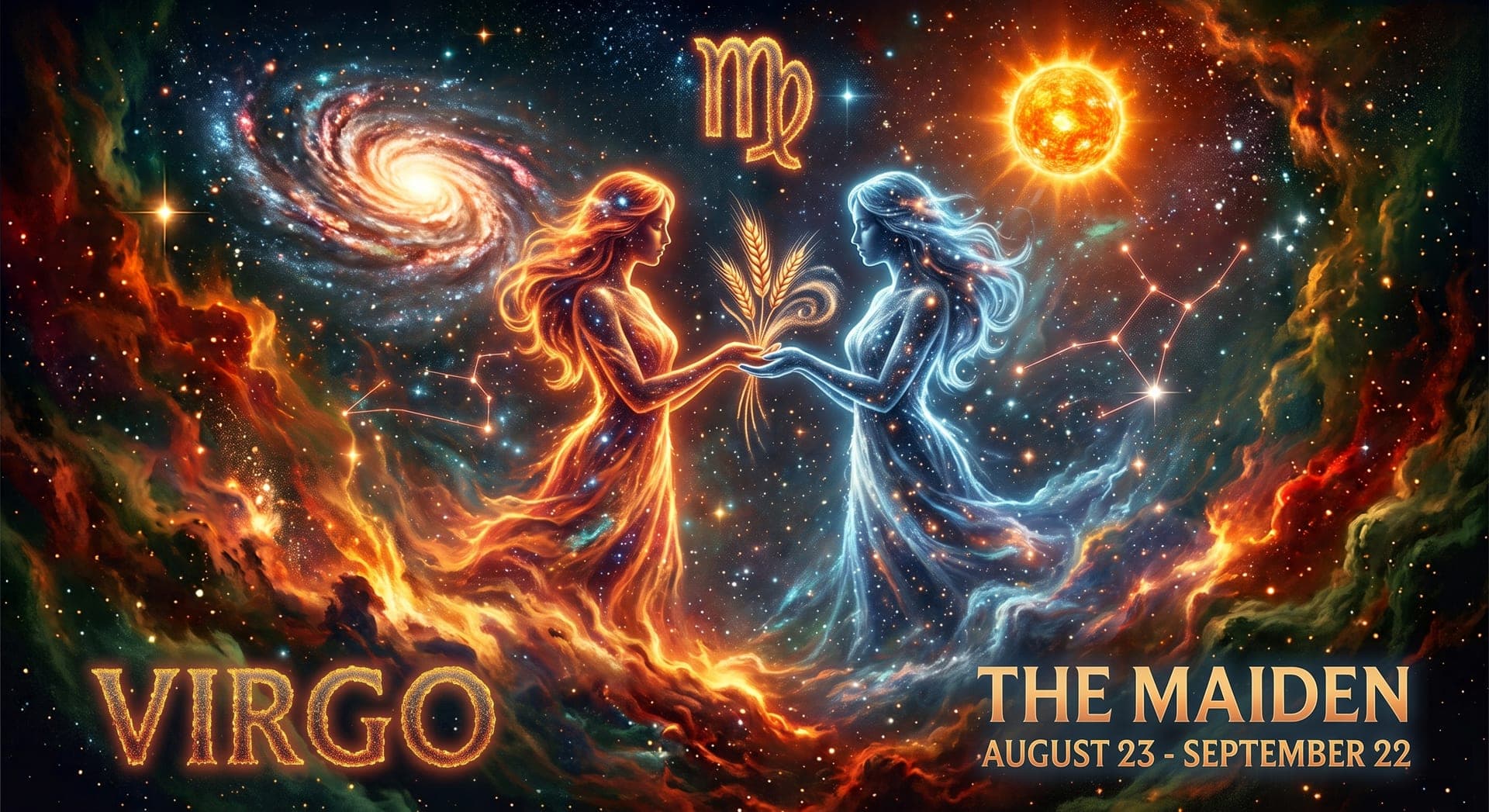
Virgo, the sixth sign of the zodiac, spans August 23 to September 22 and is symbolized by the maiden, often depicted holding a sheaf of wheat, representing purity, meticulous care, and the harvest. Ruled by Mercury, the planet of communication and intellect, Virgo channels its mental energy toward precision, analysis, and practical problem-solving rather than idle chatter. As an Earth sign, Virgo is grounded and detail-oriented, finding genuine satisfaction in organizing, refining, and perfecting the world around it. Its Mutable modality gives Virgo an adaptable, service-oriented nature, often finding purpose in quietly helping others and improving systems rather than seeking the spotlight. People born under this sign are frequently drawn to work requiring precision, research, or care for others, from science and medicine to editing and organization. Virgo's high standards make it an excellent problem-solver and a reliable presence others can count on, though that same perfectionism can turn inward as self-criticism or outward as an exacting, sometimes overly critical, eye toward the people and world around it.
Personality Traits
Strengths
- Highly organized and detail-oriented
- Reliable and hardworking
- Analytical problem-solver
- Genuinely helpful to others
- Modest and unpretentious
Weaknesses
- Prone to overcritical perfectionism
- Tends to worry excessively
- Can be overly critical of others
- Reserved to the point of aloofness
- Struggles to relax
Compatible Signs
Fun Facts
- Virgo's maiden symbol is often associated with Astraea, the Greek goddess of justice and purity, said to have been the last immortal to live among humans.
- Virgo is the only zodiac sign represented by a female human figure.
- Virgo and Gemini share Mercury as their ruling planet, though Virgo channels the planet's communicative energy toward analysis and precision rather than pure talkativeness.
- Notable Virgos include Beyoncé, Michael Jackson, Mother Teresa, and Stephen King.
- Virgo season falls at the tail end of summer, a period traditionally associated with harvest, meticulous preparation, and gathering resources for the colder months ahead.
Born on August 23
- 1754
Louis XVI
King of France during the French Revolution
- 1768
Astley Cooper
English surgeon and anatomist renowned for his pioneering work in vascular surgery.
- 1785
Oliver Hazard Perry
American naval commander in the War of 1812
- 1849
William Ernest Henley
English poet and critic best remembered for his poem "Invictus," written while recovering from a leg amputation.
- 1852
Arnold Toynbee
English economist and social reformer whose lectures on the Industrial Revolution helped popularize the term.
- 1912
Gene Kelly
American dancer and actor known for "Singin' in the Rain"
- 1921
Kenneth Arrow
American economist and Nobel laureate
- 1924
Robert Solow
American economist and Nobel laureate
- 1931
Barbara Eden
American actress known for "I Dream of Jeannie"
- 1946
Keith Moon
English drummer known for his wild, powerful playing style with the rock band The Who.
- 1947
Willy Russell
English playwright and composer known for "Blood Brothers" and "Educating Rita."
- 1959
Edwyn Collins
Scottish singer-songwriter and record producer, formerly of the band Orange Juice.
- 1974
Konstantin Novoselov
Russian-British physicist who won the 2010 Nobel Prize in Physics for pioneering research on graphene
- 1978
Kobe Bryant
American professional basketball player
- 1980
Joanne Froggatt
English actress known for playing Anna Bates in the television series "Downton Abbey."
- 1989
Lianne La Havas
English singer-songwriter and guitarist known for her soulful blend of folk, jazz, and R&B.
On This Day in History
- 79
Mount Vesuvius begins stirring on the Roman feast day of Vulcan, days before its catastrophic eruption.
On the Roman feast day honoring Vulcan, the god of fire and forges, Mount Vesuvius began showing early signs of volcanic activity, an ominous prelude to the catastrophic eruption that would bury the nearby cities of Pompeii and Herculaneum in volcanic ash and pyroclastic material just one day later.
- 476
Germanic general Odoacer is proclaimed King of Italy by his troops, an event traditionally marking the fall of the Western Roman Empire.
As the Western Roman Empire crumbled under mounting external pressures, the Germanic military commander Odoacer led a mutiny of Roman troops and deposed the last nominal Western Roman emperor, having himself proclaimed King of Italy, an event traditionally marking the definitive end of the Western Roman Empire.
- 1244
Jerusalem falls to Khwarazmian forces, ending Christian control of the city for centuries to come.
After a prolonged siege by mercenary Khwarazmian forces fleeing the advancing Mongol conquest, Jerusalem fell and was thoroughly sacked, permanently ending the periods of intermittent Christian control that had persisted, with significant interruptions, since the First Crusade captured the city over a century earlier. The loss shocked Christian Europe and helped spur the launch of the Seventh Crusade shortly afterward.
- 1305
Scottish rebel leader William Wallace is executed in London for high treason against the English crown.
Scottish resistance leader William Wallace, captured after years evading English forces following his earlier victories against King Edward I, was subjected to a brutal public execution in London for treason, a punishment that instead helped cement his lasting status as a Scottish national hero and martyr.
- 1305
Scottish rebel leader William Wallace is executed in London after being convicted of treason against the English crown.
Captured near Glasgow the previous month, Wallace was tried at Westminster Hall, where he denied treason on the grounds that he had never sworn allegiance to King Edward I of England. He was hanged, drawn, and quartered at Smithfield, his gruesome execution intended to deter further Scottish resistance. Instead, Wallace became a lasting symbol of Scottish independence, later inspiring Robert the Bruce's continued fight against English rule.
- 1514
Ottoman Sultan Selim I defeats Shah Ismail I at the Battle of Chaldiran, securing Ottoman control over eastern Anatolia.
Ottoman Sultan Selim I's forces, employing effective artillery and firearms against the Safavid Persian army's more traditional cavalry-based tactics, decisively defeated Shah Ismail I at Chaldiran in eastern Anatolia. The victory secured lasting Ottoman control over the contested region and established a bitter religious and territorial rivalry between the Sunni Ottoman and Shia Safavid empires that persisted for centuries.
- 1572
Mob violence against thousands of Huguenots in Paris erupts into the St. Bartholomew's Day massacre.
Catholic mobs, incited by royal and religious authorities following a failed assassination attempt on a Protestant leader, launched a coordinated wave of violence against Huguenots gathered in Paris for a royal wedding, killing thousands in one of the deadliest episodes of France's brutal Wars of Religion.
- 1628
George Villiers, 1st Duke of Buckingham, is assassinated in Portsmouth by disgruntled army officer John Felton.
Buckingham, the powerful and widely unpopular favorite of King Charles I, was stabbed to death while preparing to lead a naval expedition to relieve French Protestants at La Rochelle. His killer, embittered over unpaid wages and Buckingham's mismanagement of military campaigns, was hailed by many as a hero. The assassination removed one of the most controversial figures in early Stuart politics.
- 1775
King George III issues a Proclamation of Rebellion, declaring the American colonies to be in open revolt.
As tensions between Britain and its American colonies escalated following incidents like the Boston Tea Party, King George III issued a formal proclamation declaring the colonies to be in a state of open rebellion against the crown, closing the door on peaceful reconciliation.
- 1775
King George III issues a Proclamation of Rebellion, declaring Britain's American colonies to be in open revolt.
The proclamation formally acknowledged that the colonies were beyond the control of civil authority and ordered British officials to suppress the rebellion by force, effectively closing the door on reconciliation ahead of full-scale war. Issued four months after the battles of Lexington and Concord, it marked a hardening of the British government's stance toward the American Revolution.
- 1839
The United Kingdom captures Hong Kong as a military base in preparation for the First Opium War against Qing China.
British forces seized the island as a staging point to protect trading interests after tensions over the opium trade with China escalated into conflict. The resulting war ended with the Treaty of Nanking in 1842, which formally ceded Hong Kong to Britain. The territory would remain a British colony for more than 150 years, until its handover to China in 1997.
- 1873
The Albert Bridge, an ornate suspension bridge across the River Thames in Chelsea, London, opens to traffic.
Designed by engineer Rowland Mason Ordish, the bridge was built as a toll crossing linking Chelsea to Battersea. Structural weaknesses became apparent within years of opening, requiring later reinforcement by Sir Joseph Bazalgette. Known for its distinctive pink and gold paintwork and its illumination by thousands of lightbulbs at night, the bridge remains one of London's most recognizable Thames crossings.
- 1914
Japan declares war on Germany, entering World War I on the side of the Allies.
Honoring its alliance treaty with Britain and France, Japan formally declared war on Germany, seizing the opportunity to capture German colonial territories and commercial interests across the Pacific and in China's Shandong province during the opening months of World War I.
- 1914
The British Expeditionary Force and the French Fifth Army begin the Great Retreat from the German advance on the Western Front.
Following costly clashes at Mons and Charleroi, exhausted British and French troops fell back nearly two hundred miles over two weeks to avoid encirclement by the advancing German armies. The retreat, fought in scorching heat, tested the discipline of Britain's small professional army in its first major campaign of the war and set the stage for the eventual Allied counterattack at the Marne.
- 1921
The British airship R-38 breaks apart over Hull and crashes into the Humber Estuary, killing most of its crew.
The airship, being tested for eventual transfer to the United States Navy, suffered structural failure during high-speed maneuvers, snapping in two and catching fire before falling into the river. Of the forty-nine British and American crew aboard, only four survived. The disaster, one of the deadliest airship accidents to that point, badly damaged confidence in large rigid airship designs.
- 1939
Nazi Germany and the Soviet Union sign the Molotov-Ribbentrop non-aggression pact.
In a diplomatic move that stunned the international community given their ostensibly opposed ideologies, Nazi Germany and the Soviet Union signed a non-aggression pact including secret protocols dividing Eastern Europe into respective spheres of influence, clearing the way for Germany's invasion of Poland just days later.
- 1939
Nazi Germany and the Soviet Union sign the Molotov-Ribbentrop Pact, a non-aggression treaty with secret protocols dividing Eastern Europe.
Negotiated by foreign ministers Vyacheslav Molotov and Joachim von Ribbentrop, the public treaty pledged neutrality between the two powers, while a secret protocol carved Poland, the Baltic states, and other territories into German and Soviet spheres of influence. The pact cleared the way for Germany's invasion of Poland just over a week later, which triggered the outbreak of the Second World War.
- 1942
The Battle of Stalingrad begins as German forces launch their assault on the Soviet city on the Volga River.
Massive Luftwaffe bombing raids reduced much of Stalingrad to rubble as German troops pushed into the city, beginning months of brutal, house-to-house fighting. The battle would become one of the largest and bloodiest confrontations in history, ultimately ending in a decisive Soviet victory in February 1943 that marked a major turning point in the Second World War on the Eastern Front.
- 1991
The World Wide Web is opened to the public for the first time.
British physicist Tim Berners-Lee's World Wide Web project, developed at the CERN research facility, was formally opened to public access outside the institution, marking the beginning of the web's transformation into the globally transformative communication and information platform it became.
- 1991
The World Wide Web is opened to the public for the first time.
Built on protocols developed at CERN, the Web allowed linked documents to be accessed over the internet through simple browser software. What began as a tool for sharing scientific research among physicists rapidly expanded into a global information system that would transform communication, commerce, and culture over the following decades.