
What’s Observed on August 24
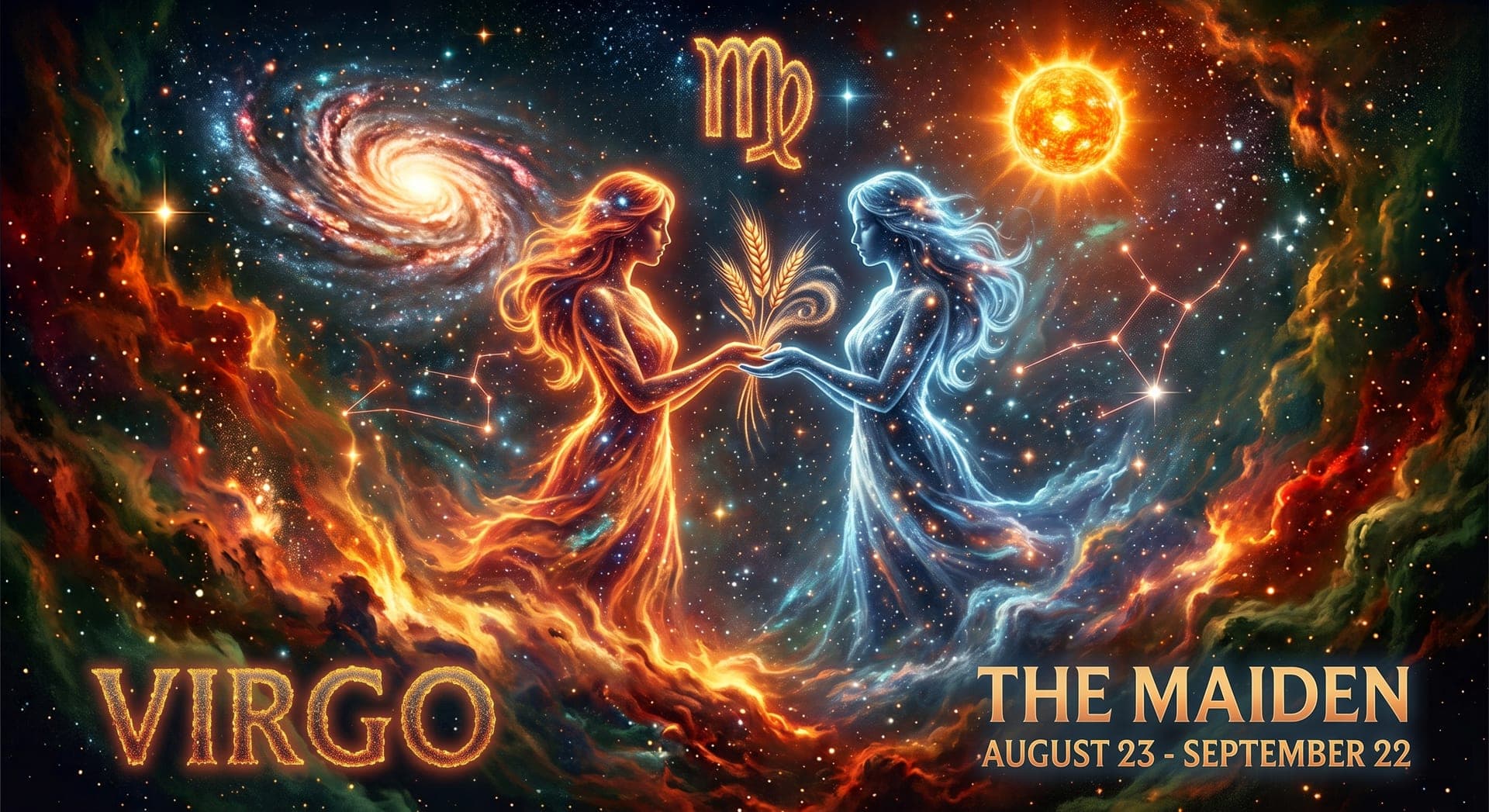
Born on August 24: Virgo ♍
Virgo, the sixth sign of the zodiac, spans August 23 to September 22 and is symbolized by the maiden, often depicted holding a sheaf of wheat, representing purity, meticulous care, and the harvest. Ruled by Mercury, the planet of communication and intellect, Virgo channels its mental energy toward precision, analysis, and practical problem-solving rather than idle chatter. As an Earth sign, Virgo is grounded and detail-oriented, finding genuine satisfaction in organizing, refining, and perfecting the world around it. Its Mutable modality gives Virgo an adaptable, service-oriented nature, often finding purpose in quietly helping others and improving systems rather than seeking the spotlight. People born under this sign are frequently drawn to work requiring precision, research, or care for others, from science and medicine to editing and organization. Virgo's high standards make it an excellent problem-solver and a reliable presence others can count on, though that same perfectionism can turn inward as self-criticism or outward as an exacting, sometimes overly critical, eye toward the people and world around it.
Personality Traits
Strengths
- Highly organized and detail-oriented
- Reliable and hardworking
- Analytical problem-solver
- Genuinely helpful to others
- Modest and unpretentious
Weaknesses
- Prone to overcritical perfectionism
- Tends to worry excessively
- Can be overly critical of others
- Reserved to the point of aloofness
- Struggles to relax
Compatible Signs
Fun Facts
- Virgo's maiden symbol is often associated with Astraea, the Greek goddess of justice and purity, said to have been the last immortal to live among humans.
- Virgo is the only zodiac sign represented by a female human figure.
- Virgo and Gemini share Mercury as their ruling planet, though Virgo channels the planet's communicative energy toward analysis and precision rather than pure talkativeness.
- Notable Virgos include Beyoncé, Michael Jackson, Mother Teresa, and Stephen King.
- Virgo season falls at the tail end of summer, a period traditionally associated with harvest, meticulous preparation, and gathering resources for the colder months ahead.
Born on August 24
- 1591
Robert Herrick
English poet and Church of England cleric best known for the lyric poem "To the Virgins, to Make Much of Time."
- 1759
William Wilberforce
English politician and philanthropist who led the decades-long campaign to abolish the British slave trade.
- 1872
Max Beerbohm
English essayist, caricaturist, and parodist known for his wit and satirical drawings of Edwardian society.
- 1890
Duke Kahanamoku
American swimmer and pioneer of modern surfing
- 1899
Jorge Luis Borges
Argentine writer known for short fiction and essays
- 1934
Kenny Baker
English actor best known for physically portraying the droid R2-D2 in the original "Star Wars" trilogy.
- 1936
A. S. Byatt
English novelist and Booker Prize winner best known for her novel "Possession."
- 1957
Stephen Fry
English actor, writer, and broadcaster known for "Blackadder," "Jeeves and Wooster," and hosting "QI."
- 1960
Cal Ripken Jr.
American Major League Baseball shortstop
- 1961
Jared Harris
English actor known for roles in "Mad Men" and "Chernobyl."
- 1973
Dave Chappelle
American comedian
- 1988
Rupert Grint
English actor known for playing Ron Weasley in the "Harry Potter" film series.

On This Day in History
- 367
Eight-year-old Gratian is named co-Augustus by his father, Roman Emperor Valentinian I.
Roman Emperor Valentinian I elevated his eight-year-old son Gratian to the rank of co-Augustus, a common late-imperial practice intended to secure dynastic succession and provide administrative continuity across the vast and increasingly difficult-to-govern Roman territories. Gratian later assumed full imperial responsibilities following his father's sudden death just two years afterward.
- 410
Visigothic forces under King Alaric I begin sacking the city of Rome.
Visigothic forces under King Alaric I breached Rome's defenses and began three days of pillaging the city, the first time in nearly 800 years that Rome had fallen to a foreign enemy, an event that profoundly shocked the Roman world and symbolized the empire's accelerating decline.
- 1200
King John of England marries Isabella of Angoulême at Angoulême Cathedral in France.
John's marriage to the young heiress Isabella, who was already betrothed to a powerful French nobleman, provoked outrage among the Lusignan family and their allies. The resulting dispute gave King Philip II of France a pretext to confiscate John's continental territories, triggering a war that would strip John of Normandy and much of his family's Angevin lands within a few years, weakening the English crown considerably.
- 1215
Pope Innocent III declares the Magna Carta invalid, reigniting conflict between King John and his barons.
Amid his ongoing conflict with King John over the terms of the Magna Carta, Pope Innocent III issued a papal bull declaring the charter null and void, having been extracted under duress, reigniting the baronial rebellion that continued until John's death the following year.
- 1215
Pope Innocent III issues a papal bull declaring Magna Carta null and void just weeks after it was sealed.
King John had reluctantly agreed to Magna Carta at Runnymede in June 1215 under pressure from rebellious barons, but he immediately sought to have it annulled. The Pope, as John's feudal overlord after John had submitted England to papal authority, obliged, condemning the charter as shameful and illegal. The annulment triggered renewed civil war between John and the barons, known as the First Barons' War.
- 1217
An English fleet defeats a French fleet at the Battle of Sandwich, ending French hopes of securing the English throne.
The battle, fought off the Kent coast, destroyed a French relief fleet bringing reinforcements and supplies to Prince Louis of France, who had invaded England to press his own claim to the crown during the First Barons' War. The English victory, led by Hubert de Burgh, cut off Louis's support and forced him to abandon his campaign, securing the throne for the young King Henry III.
- 1482
The town and castle of Berwick-upon-Tweed is captured from Scotland by an English army.
The strategically vital border town had changed hands numerous times over the centuries between England and Scotland. An English force led by the Duke of Gloucester, the future Richard III, seized Berwick during a campaign against Scotland, and it has remained under English control ever since, making it the northernmost town in England today.
- 1516
The Ottoman Empire defeats the Mamluk Sultanate at the Battle of Marj Dabiq, securing control of Syria.
Ottoman forces under Sultan Selim I decisively defeated the Mamluk Sultanate's army near Marj Dabiq in northern Syria, a victory that opened the way for the Ottoman conquest of Syria, Egypt, and the holy cities of Mecca and Medina within the following two years.
- 1608
The first official English representative to India arrives, landing at the port of Surat.
Captain William Hawkins led the East India Company mission that established England's first direct trading contact with the Mughal Empire, seeking permission to set up a trading post. Though initial negotiations with Mughal authorities were difficult, the visit marked the beginning of a commercial relationship that would grow over the following centuries into British colonial rule over the Indian subcontinent.
- 1812
A coalition of Spanish, British, and Portuguese forces succeeds in lifting the two-and-a-half-year Siege of Cadiz during the Peninsular War.
French forces had blockaded the strategic Spanish port city since early 1810, but Cadiz held out with the help of British naval support and troop reinforcements. The eventual French withdrawal, prompted by Wellington's advances elsewhere in Spain, preserved Cadiz as the seat of the Spanish liberal government-in-exile and marked a significant setback for Napoleon's occupation of the Iberian Peninsula.
- 1814
British troops capture Washington, D.C., and set fire to the White House and other government buildings during the War of 1812.
During the War of 1812, British forces marched into Washington, D.C., largely undefended after American militia collapsed at the Battle of Bladensburg, and set fire to the White House, the Capitol, and other government buildings in retaliation for earlier American attacks on Canadian settlements.
- 1814
British troops capture Washington, D.C. and burn the Presidential Mansion, the Capitol, and other public buildings.
The raid came in retaliation for earlier American attacks on Canadian towns during the War of 1812. British forces under Major General Robert Ross met little resistance after defeating an American militia at Bladensburg, and set fire to government buildings including the White House, whose charred walls had to be repainted white after reconstruction. It remains the only time a foreign power has captured the US capital.
- 1857
The Panic of 1857 begins, triggering one of the most severe financial crises in American history to that point.
The collapse of the Ohio Life Insurance and Trust Company triggered a rapid loss of confidence in American banks and railroads, precipitating a severe nationwide financial panic and economic depression that persisted for several years, exacerbated by the extensive telegraph network that by then connected major American financial centers, enabling faster spread of alarming financial news.
- 1870
The Wolseley expedition, a British military force, reaches Manitoba to suppress the Red River Rebellion.
Led by Colonel Garnet Wolseley, the expedition marched more than 600 miles through difficult wilderness terrain from Ontario to reach the Red River Settlement, aiming to reassert Canadian and British authority after Métis leader Louis Riel's provisional government took control of the region. The rebels dispersed before fighting occurred, and the expedition paved the way for Manitoba's entry into the Canadian confederation.
- 1949
The treaty establishing the North Atlantic Treaty Organization takes effect.
Following ratification by its twelve founding member states, including the United States, Canada, and several Western European nations, the treaty establishing NATO as a collective mutual-defense alliance officially took effect. The organization's core principle, that an attack on one member constitutes an attack on all, formed a cornerstone of Western security policy throughout the Cold War and remains central to transatlantic defense strategy today.
- 1995
Microsoft releases Windows 95 to the North American market.
Microsoft launched its Windows 95 operating system with an unprecedented marketing campaign, including licensing the Rolling Stones song "Start Me Up," introducing millions of users to innovations like the Start menu and taskbar that shaped personal computing conventions for decades.
- 1995
Microsoft releases Windows 95 to the public in North America.
The operating system introduced major changes for everyday computer users, including the Start menu, taskbar, and plug-and-play hardware support, and was backed by an unprecedented marketing campaign. Its launch was accompanied by long lines outside computer stores and extensive media coverage, and it went on to become one of the best-selling and most influential operating systems of the personal computer era.
- 2006
The International Astronomical Union reclassifies Pluto as a dwarf planet.
Meeting at their general assembly in Prague, members of the International Astronomical Union voted to adopt a new formal scientific definition of "planet" that excluded Pluto based on its failure to gravitationally clear its orbital neighborhood, reclassifying it instead as a "dwarf planet." The controversial decision sparked considerable public debate and lingering popular resistance, with many Americans in particular continuing to informally regard Pluto as the solar system's ninth planet.
- 2006
The International Astronomical Union redefines the term 'planet,' reclassifying Pluto as a dwarf planet.
Meeting in Prague, astronomers voted to adopt a new formal definition of a planet requiring a body to have cleared the neighborhood around its orbit, a criterion Pluto did not meet due to its location within the debris-filled Kuiper Belt. The decision, which reduced the solar system's official planet count from nine to eight, proved controversial and remains debated among some scientists and members of the public today.
- 2016
A magnitude 6.2 earthquake strikes central Italy, killing approximately 300 people.
A powerful earthquake struck the mountainous Lazio and Marche regions of central Italy in the middle of the night, severely damaging or completely destroying numerous historic hillside towns, including the medieval settlement of Amatrice, renowned for its centuries-old architecture. The disaster killed approximately 300 people and left thousands homeless in one of the country's deadliest seismic events in recent decades.