What’s Observed on August 25
Born on August 25: Virgo ♍
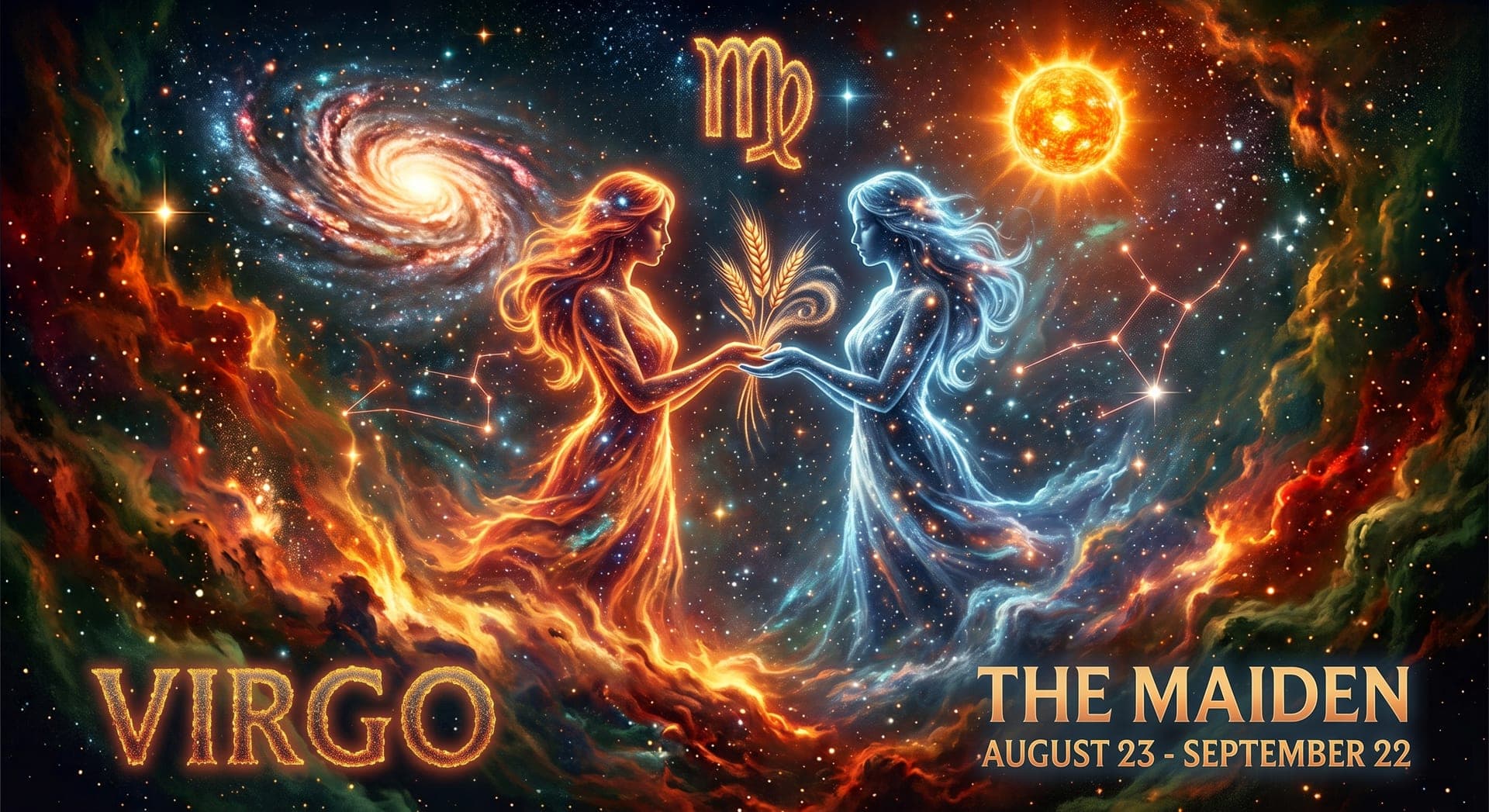
Virgo, the sixth sign of the zodiac, spans August 23 to September 22 and is symbolized by the maiden, often depicted holding a sheaf of wheat, representing purity, meticulous care, and the harvest. Ruled by Mercury, the planet of communication and intellect, Virgo channels its mental energy toward precision, analysis, and practical problem-solving rather than idle chatter. As an Earth sign, Virgo is grounded and detail-oriented, finding genuine satisfaction in organizing, refining, and perfecting the world around it. Its Mutable modality gives Virgo an adaptable, service-oriented nature, often finding purpose in quietly helping others and improving systems rather than seeking the spotlight. People born under this sign are frequently drawn to work requiring precision, research, or care for others, from science and medicine to editing and organization. Virgo's high standards make it an excellent problem-solver and a reliable presence others can count on, though that same perfectionism can turn inward as self-criticism or outward as an exacting, sometimes overly critical, eye toward the people and world around it.
Personality Traits
Strengths
- Highly organized and detail-oriented
- Reliable and hardworking
- Analytical problem-solver
- Genuinely helpful to others
- Modest and unpretentious
Weaknesses
- Prone to overcritical perfectionism
- Tends to worry excessively
- Can be overly critical of others
- Reserved to the point of aloofness
- Struggles to relax
Compatible Signs
Fun Facts
- Virgo's maiden symbol is often associated with Astraea, the Greek goddess of justice and purity, said to have been the last immortal to live among humans.
- Virgo is the only zodiac sign represented by a female human figure.
- Virgo and Gemini share Mercury as their ruling planet, though Virgo channels the planet's communicative energy toward analysis and precision rather than pure talkativeness.
- Notable Virgos include Beyoncé, Michael Jackson, Mother Teresa, and Stephen King.
- Virgo season falls at the tail end of summer, a period traditionally associated with harvest, meticulous preparation, and gathering resources for the colder months ahead.
Born on August 25
- 1530
Ivan the Terrible
First Tsar of Russia
- 1724
George Stubbs
English painter renowned for his anatomically precise depictions of horses, most famously the portrait Whistlejacket.
- 1836
Bret Harte
American short story writer and poet
- 1845
Ludwig II of Bavaria
King of Bavaria known for building fairy-tale castles
- 1918
Leonard Bernstein
American composer and conductor known for "West Side Story"
- 1927
Althea Gibson
American tennis player, first Black Grand Slam champion
- 1930
Sean Connery
Scottish actor best known as the first performer to portray James Bond on screen, beginning with Dr. No in 1962.
- 1938
Frederick Forsyth
English journalist and thriller writer celebrated for meticulously researched novels such as The Day of the Jackal.
- 1949
Martin Amis
Welsh-born English novelist known for darkly satirical works including Money and London Fields.
- 1951
Rob Halford
English heavy metal singer-songwriter, frontman of Judas Priest and known as the 'Metal God.'
- 1954
Elvis Costello
English singer-songwriter and guitarist whose sharp lyricism defined albums such as My Aim Is True and This Year's Model.
- 1958
Tim Burton
American filmmaker known for "Edward Scissorhands"
- 1987
Amy Macdonald
Scottish singer-songwriter who broke through with the album This Is the Life and its title-track single.
On This Day in History
- 1537
Henry VIII granted a royal charter establishing what became the Honourable Artillery Company in London.
The charter created the Fraternity or Guild of St George, a body of citizen archers and gunners drilled to defend the City of London. Now known as the Honourable Artillery Company, it is the oldest surviving regiment in the British Army and the second-oldest military corps in the world still in existence, tracing an unbroken line of service back to this founding.
- 1609
Galileo Galilei demonstrates his telescope to Venetian lawmakers, showcasing its military and scientific potential.
Galileo Galilei demonstrated his significantly improved telescope design to the Venetian Senate from the campanile of St. Mark's Basilica, impressing lawmakers by allowing them to spot distant ships hours before they became visible to the naked eye. The military reconnaissance applications so impressed the Senate that they secured Galileo a lifetime academic appointment at the University of Padua along with a substantial salary increase.
- 1651
Parliamentarian forces crushed a Royalist army at the Battle of Wigan Lane in Lancashire, effectively ending Royalist resistance in north-west England.
Colonel Robert Lilburne's Parliamentarian troops intercepted James Stanley, 7th Earl of Derby, as he marched to join Charles II's invading army. The Earl's force was routed and he was badly wounded before escaping, though he was later captured and executed. The defeat came just days before the decisive Battle of Worcester brought the English Civil War to a close.
- 1758
Frederick II of Prussia defeats Russian forces at the Battle of Zorndorf during the Seven Years' War.
Prussian King Frederick the Great achieved a costly but strategically significant victory over invading Russian forces at Zorndorf during the Seven Years' War, a brutally fought engagement noted for exceptionally high casualties relative to the modest number of troops actually involved on both sides. Frederick himself later described the battle as among the bloodiest and most difficult of his entire military career.
- 1814
British troops burned the United States Treasury and War Department buildings in Washington, D.C., during the War of 1812.
Having already torched the White House and the Capitol, including the Library of Congress, the previous night, British forces under Admiral Sir George Cockburn continued destroying the American capital's public buildings in retaliation for the earlier burning of York, present-day Toronto. A sudden storm on the 25th helped extinguish the fires and forced the British to withdraw from the city.
- 1875
Captain Matthew Webb becomes the first person to swim across the English Channel, completing the crossing in under 22 hours.
Though swimming the English Channel had long been considered physically impossible by many observers, English merchant navy captain Matthew Webb proved otherwise, completing the grueling unassisted swim from Dover to Calais using only the breaststroke over nearly 22 exhausting hours. His pioneering achievement was not successfully repeated by another swimmer for 36 years.
- 1875
Captain Matthew Webb became the first person recorded to swim across the English Channel without assistance.
The English merchant navy captain swam from Dover to Calais in around 21 hours and 45 minutes, battling strong currents that forced him to cover far more than the direct 21-mile distance. His feat made him a national hero, and no one else matched it for 36 years. Webb later died attempting to swim the rapids below Niagara Falls in 1883.
- 1916
The United States establishes the National Park Service to oversee the nation's growing system of parks and monuments.
Responding to growing public concern over the unregulated commercial exploitation and destruction of America's most spectacular natural landmarks, Congress established the National Park Service within the Department of the Interior to professionally oversee and preserve the nation's growing collection of national parks and monuments. The agency's founding director, Stephen Mather, went on to shape park management practices for generations.
- 1939
The United Kingdom and Poland signed a formal treaty of mutual military assistance in London.
The Anglo-Polish Agreement converted an earlier British guarantee into a binding alliance, committing each country to support the other if attacked by a European power. News of the pact reportedly led Hitler to postpone his planned invasion of Poland by several days, though he ultimately proceeded on 1 September, triggering the Second World War and Britain's declaration of war on Germany.
- 1939
An IRA bomb hidden in a bicycle basket exploded in Coventry city centre, killing five people and injuring around seventy.
The device detonated on Broadgate, one of the city's busiest shopping streets, as part of the IRA's 'S-Plan' sabotage campaign against British targets. The dead included a 15-year-old boy and an 82-year-old man. Two men were later convicted of the bombing and hanged, in an attack that came just over a week before the outbreak of the Second World War.
- 1940
The Royal Air Force carried out its first bombing raid on Berlin.
In retaliation for a German raid that had mistakenly hit London the night before, RAF Bomber Command sent aircraft to strike targets around the German capital. The raid caused little material damage but was a major propaganda blow, reportedly enraging Hitler and contributing to the Luftwaffe's shift toward bombing British cities, a change that helped precipitate the Blitz.
- 1941
British and Soviet forces launched a joint invasion of Iran to secure its oilfields and supply routes.
Operation Countenance saw Britain and the USSR occupy Iran to protect Anglo-Iranian oil interests, safeguard the supply corridor for Allied aid to the Soviet Union, and forestall German influence at the court of Reza Shah. The brief campaign ended organised Iranian resistance within days and led to the Shah's abdication in favour of his son, Mohammad Reza Pahlavi.
- 1944
Allied forces liberate Paris from four years of Nazi occupation.
As German occupying forces retreated in the face of advancing Allied troops and an armed uprising by the French Resistance, Free French and American forces entered Paris, ending four years of harsh Nazi occupation. The liberation sparked jubilant citywide celebrations, with crowds lining the streets to greet the arriving Allied soldiers and vehicles.
- 1944
Paris was liberated from four years of German occupation as Allied forces entered the city.
French and American troops, spearheaded by General Philippe Leclerc's 2nd Armoured Division, accepted the surrender of the German garrison after an uprising by the French Resistance. Charles de Gaulle led a triumphant march down the Champs-Élysées the next day, and the liberation became a defining symbol of France's recovery of its capital in the final year of the Second World War.
- 1960
The Games of the XVII Olympiad open in Rome, Italy.
The first Summer Olympics held in Italy opened in Rome, notably marking the first Games broadcast live on television across much of Europe and featuring the barefoot marathon victory of Ethiopian runner Abebe Bikila, who became the first sub-Saharan African athlete to win an Olympic gold medal, doing so while running without shoes through the historic streets of Rome.
- 1981
Voyager 2 makes its closest approach to Saturn, transmitting detailed images and data back to Earth.
NASA's Voyager 2 spacecraft made its closest approach to Saturn during its historic grand tour of the outer solar system, capturing detailed images of the planet's intricate ring system and several of its moons that dramatically expanded scientific understanding of the gas giant, building on data previously gathered by its sister probe Voyager 1 two years earlier.
- 1989
Voyager 2 makes its closest approach to Neptune, the last planet visited during its grand tour of the outer solar system.
Concluding its remarkable twelve-year journey through the outer solar system, Voyager 2 made its closest approach to Neptune, providing humanity's only close-up images of the distant ice giant and its largest moon, Triton, to date. The flyby revealed Neptune's dynamic atmosphere, including its famous Great Dark Spot, before Voyager 2 continued outward toward interstellar space.
- 1991
Finnish student Linus Torvalds announces the first version of the Linux operating system kernel.
Finnish computer science student Linus Torvalds posted a modest public announcement on an internet newsgroup about a new, free operating system kernel he was developing as a hobby project, describing it as "just a hobby, won't be big and professional." That kernel grew into Linux, now one of the most widely used operating systems underlying much of the internet's global infrastructure.
- 2005
Hurricane Katrina made its first landfall in Florida before strengthening into the catastrophic storm that would devastate the U.S. Gulf Coast.
Katrina crossed southern Florida as a moderate hurricane, killing several people and knocking out power to over a million residents, before moving into the Gulf of Mexico where it rapidly intensified. Days later it made a second, far more destructive landfall near New Orleans, becoming one of the deadliest and costliest natural disasters in American history.
- 2012
Voyager 1 enters interstellar space, becoming the first human-made object to leave the solar system's heliosphere.
Launched in 1977 alongside its twin Voyager 2, the Voyager 1 spacecraft crossed the heliopause, the boundary where the constant stream of charged particles flowing outward from the Sun gives way to the interstellar medium, becoming the first human-made object to leave the solar system's protective heliosphere. The probe continues transmitting data from interstellar space using a radioactive power source expected to last into the 2030s.