What’s Observed on August 26
Born on August 26: Virgo ♍
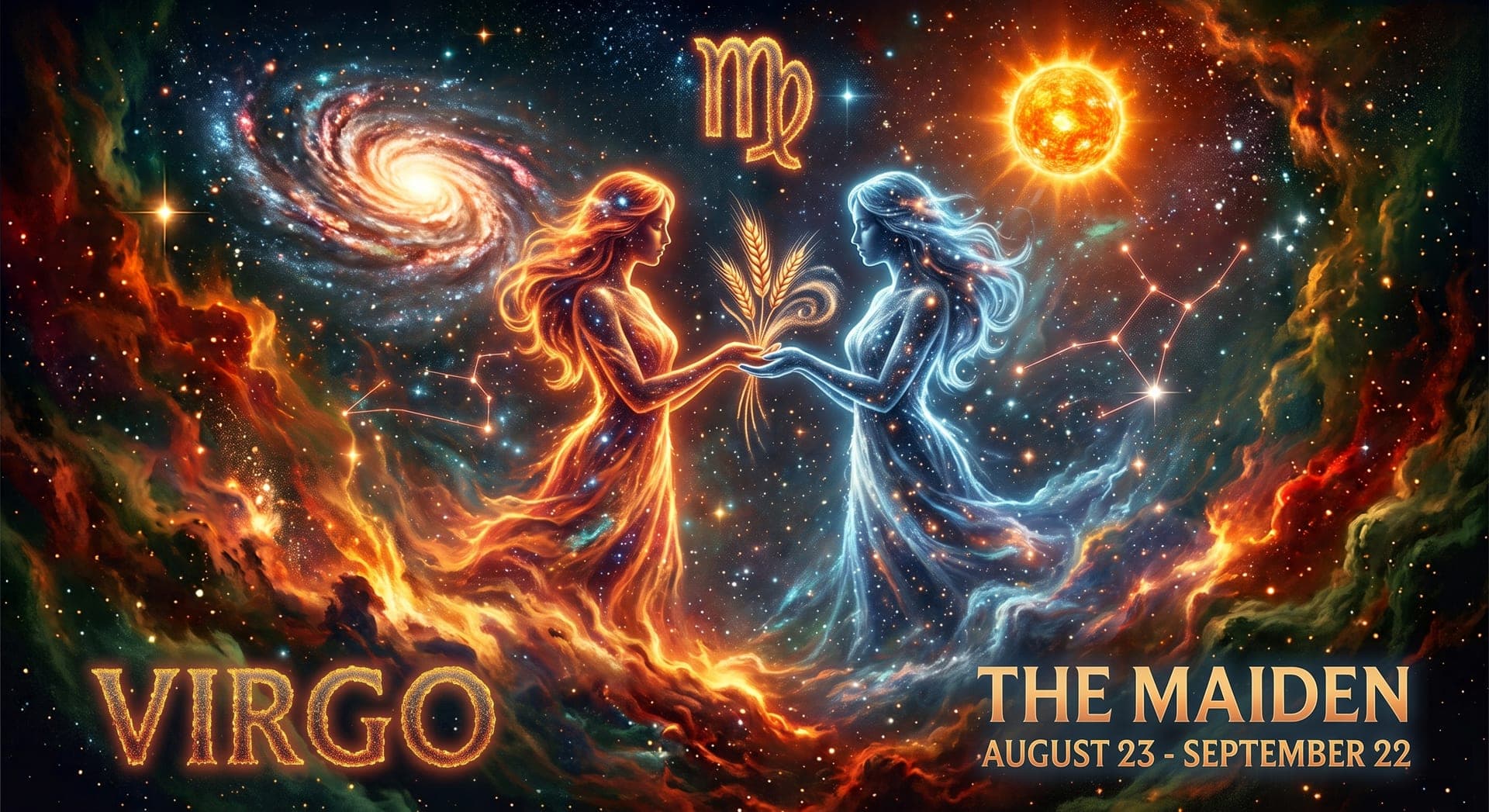
Virgo, the sixth sign of the zodiac, spans August 23 to September 22 and is symbolized by the maiden, often depicted holding a sheaf of wheat, representing purity, meticulous care, and the harvest. Ruled by Mercury, the planet of communication and intellect, Virgo channels its mental energy toward precision, analysis, and practical problem-solving rather than idle chatter. As an Earth sign, Virgo is grounded and detail-oriented, finding genuine satisfaction in organizing, refining, and perfecting the world around it. Its Mutable modality gives Virgo an adaptable, service-oriented nature, often finding purpose in quietly helping others and improving systems rather than seeking the spotlight. People born under this sign are frequently drawn to work requiring precision, research, or care for others, from science and medicine to editing and organization. Virgo's high standards make it an excellent problem-solver and a reliable presence others can count on, though that same perfectionism can turn inward as self-criticism or outward as an exacting, sometimes overly critical, eye toward the people and world around it.
Personality Traits
Strengths
- Highly organized and detail-oriented
- Reliable and hardworking
- Analytical problem-solver
- Genuinely helpful to others
- Modest and unpretentious
Weaknesses
- Prone to overcritical perfectionism
- Tends to worry excessively
- Can be overly critical of others
- Reserved to the point of aloofness
- Struggles to relax
Compatible Signs
Fun Facts
- Virgo's maiden symbol is often associated with Astraea, the Greek goddess of justice and purity, said to have been the last immortal to live among humans.
- Virgo is the only zodiac sign represented by a female human figure.
- Virgo and Gemini share Mercury as their ruling planet, though Virgo channels the planet's communicative energy toward analysis and precision rather than pure talkativeness.
- Notable Virgos include Beyoncé, Michael Jackson, Mother Teresa, and Stephen King.
- Virgo season falls at the tail end of summer, a period traditionally associated with harvest, meticulous preparation, and gathering resources for the colder months ahead.
Born on August 26
- 1676
Robert Walpole
English statesman generally regarded as Britain's first Prime Minister, dominating government under George I and George II.
- 1743
Antoine Lavoisier
French chemist known as the father of modern chemistry
- 1819
Albert, Prince Consort
German-born Prince Consort of Queen Victoria who championed education and science and helped organize the Great Exhibition of 1851
- 1873
Lee de Forest
American inventor of the Audion vacuum tube
- 1875
John Buchan
Scottish novelist and statesman best known for the adventure thriller The Thirty-Nine Steps, who later served as Governor General of Canada.
- 1880
Guillaume Apollinaire
French poet and art critic
- 1904
Christopher Isherwood
English novelist whose Berlin stories chronicling the rise of Nazism inspired the musical and film Cabaret.
- 1910
Mother Teresa
Albanian-Indian nun and Nobel Peace Prize laureate
- 1935
Karen Spärck Jones
English computer scientist whose pioneering work on inverse document frequency laid the foundation for modern search engines and information retrieval.
- 1966
Shirley Manson
Scottish singer-songwriter best known as the lead vocalist of the alternative rock band Garbage.
- 1967
Michael Gove
Scottish-born British journalist and Conservative politician who has held numerous UK cabinet posts, including Education Secretary and Justice Secretary.
- 1968
Chris Boardman
English cyclist who won Olympic gold in the individual pursuit and later wore the Tour de France's yellow jersey.
- 1970
Melissa McCarthy
American actress and comedian
- 1980
Macaulay Culkin
American actor known for "Home Alone"
- 1980
Chris Pine
American actor known for "Star Trek"
- 1989
James Harden
American professional basketball player

On This Day in History
- 1071
Seljuk Turks defeat the Byzantine army at the Battle of Manzikert, gaining control over much of Anatolia.
A poorly prepared Byzantine army under Emperor Romanos IV suffered a catastrophic defeat against Seljuk Turkish forces near Manzikert in eastern Anatolia, a disaster that opened Anatolia to sustained Turkish settlement and permanently altered the region's demographic and political character.
- 1071
The Seljuk Turks decisively defeated the Byzantine army at the Battle of Manzikert, opening Anatolia to Turkish settlement.
The Byzantine emperor Romanos IV Diogenes was captured after his forces collapsed against the Seljuk sultan Alp Arslan near Lake Van. The defeat triggered years of civil war within the Byzantine Empire and allowed Turkic peoples to move into Anatolia in large numbers, permanently altering the region's demographic and political makeup and setting the stage for centuries of conflict with Byzantium.
- 1278
Rudolf I of Germany defeats and kills King Ottokar II of Bohemia at the Battle on the Marchfeld.
German King Rudolf I of Habsburg decisively defeated and killed his rival, Bohemian King Ottokar II, at the Battle on the Marchfeld, establishing Habsburg dominance in Austria that would eventually grow into one of Europe's most powerful and enduring royal dynasties.
- 1346
English forces decisively defeat a much larger French army at the Battle of Crecy during the Hundred Years' War.
Despite being significantly outnumbered, English longbowmen under King Edward III inflicted a devastating defeat on French forces at Crecy, demonstrating the longbow's battlefield superiority over heavily armored knights and marking one of the opening major engagements of the Hundred Years' War.
- 1346
An English army under Edward III won a decisive victory over a much larger French force at the Battle of Crécy.
Fighting in northern France during the early stages of the Hundred Years' War, Edward III's forces, outnumbered roughly two to one, used disciplined longbowmen to devastating effect against French knights and crossbowmen. The victory, in which the young Black Prince played a prominent role, shattered French military prestige and opened the way for the English siege of Calais the following year.
- 1542
Francisco de Orellana completes his journey down the Amazon River, reaching its mouth at the Atlantic Ocean.
Spanish explorer Francisco de Orellana completed an unplanned but historic journey down the entire length of the Amazon River after becoming separated from a larger expedition, becoming the first European known to navigate the river's full course to the Atlantic Ocean.
- 1768
Captain James Cook departs England aboard HMS Endeavour on his first voyage of Pacific exploration.
Captain James Cook set sail from Plymouth, England, aboard HMS Endeavour on the first of his three famous voyages of Pacific exploration, a journey that would result in the first detailed European charting of New Zealand's coastline and eastern Australia.
- 1768
Captain James Cook set sail from Plymouth, England, aboard HMS Endeavour on his first Pacific voyage.
Commissioned partly to observe the transit of Venus from Tahiti, Cook's expedition went on to chart the coastlines of New Zealand and eastern Australia, claiming the latter for Britain. The voyage marked the beginning of Cook's career as one of history's most influential explorers and had lasting consequences for the Pacific region and British imperial expansion.
- 1789
France's National Constituent Assembly approves the Declaration of the Rights of Man and of the Citizen.
France's National Constituent Assembly adopted a foundational statement of individual rights and liberties inspired by Enlightenment philosophy, establishing principles of liberty, equality, and popular sovereignty that became a cornerstone document of the French Revolution and later human rights declarations worldwide.
- 1789
The National Constituent Assembly of France approved the Declaration of the Rights of Man and of the Citizen.
Drafted in the early months of the French Revolution, the declaration proclaimed that all men were born free and equal in rights and set out principles of liberty, property, and popular sovereignty. It became a foundational document of modern human rights law and profoundly influenced constitutional and revolutionary movements across Europe and the Americas in the centuries that followed.
- 1883
The volcanic island of Krakatoa entered the final, most violent stage of its catastrophic 1883 eruption.
Over the following day the eruption produced some of the loudest sounds ever recorded, generated tsunamis that killed tens of thousands of people around the Sunda Strait, and ejected ash that lowered global temperatures for years afterward. The disaster, in the Dutch East Indies, remains one of the deadliest and most studied volcanic events in recorded history.
- 1914
The German colony of Togoland surrendered to French and British forces, becoming the first German territory lost in the First World War.
After a brief twenty-day campaign, colonial forces from British Gold Coast and French Dahomey overran the poorly defended German protectorate. The swift Allied victory secured a key wireless station at Kamina and gave Britain and France an early, morale-boosting success in a war that had only just begun.
- 1914
British troops under General Sir Horace Smith-Dorrien fought a successful defensive stand against pursuing Germans at the Battle of Le Cateau.
During the British Expeditionary Force's retreat from Mons, Smith-Dorrien's II Corps turned to fight a costly rearguard action that stalled the German advance and allowed the rest of the BEF to withdraw in better order. Though British losses were heavy, the stand at Le Cateau is remembered as a crucial episode in the early, desperate weeks of the war on the Western Front.
- 1920
The 19th Amendment to the U.S. Constitution, granting women the right to vote, is formally certified.
Following ratification by the requisite number of U.S. states, culminating with Tennessee's decisive vote weeks earlier, the Nineteenth Amendment guaranteeing women's constitutional right to vote was formally certified by the Secretary of State. The certification, achieved without ceremony to avoid controversy, culminated over seventy years of organized suffrage activism dating back to the 1848 Seneca Falls Convention.
- 1920
The Nineteenth Amendment to the United States Constitution, granting women the right to vote, was formally certified.
The certification by Secretary of State Bainbridge Colby followed decades of campaigning by the American women's suffrage movement and Tennessee's ratification just days earlier, which provided the final state needed for adoption. The amendment enfranchised millions of American women and remains a landmark moment in the country's long struggle for equal political rights.
- 1944
Charles de Gaulle leads a triumphant procession into Paris following the city's liberation from Nazi occupation.
Free French leader Charles de Gaulle led a triumphant procession down the Champs-Elysees following Paris's liberation, delivering a defiant speech proclaiming that Paris had liberated itself "by her own people with the help of the armies of France," a statement that notably downplayed the significant Allied military support that had actually made the liberation possible.
- 1972
The Summer Olympic Games open in Munich, West Germany.
The Summer Olympic Games opened in Munich, West Germany, an event carefully staged to showcase a modern, open, and democratic Germany distinct from the militaristic 1936 Berlin Games. The optimistic atmosphere was later overshadowed just over a week in by the tragic hostage crisis and massacre of eleven Israeli athletes and coaches by Palestinian militants.
- 1978
Cardinal Albino Luciani was elected pope, taking the name John Paul I.
Chosen after a brief papal conclave following the death of Pope Paul VI, the Italian cardinal became known for his warmth and simplicity, earning the nickname 'the Smiling Pope.' His papacy lasted only 33 days before his sudden death, making it one of the shortest in the history of the Roman Catholic Church and prompting a second conclave that same year.
- 2014
The Jay Report into the Rotherham child sexual exploitation scandal was published, exposing large-scale institutional failures in England.
The independent inquiry, led by Professor Alexis Jay, found that an estimated 1,400 children had been sexually abused in the town of Rotherham between 1997 and 2013, and that local authorities and police had repeatedly failed to act on warnings. The report triggered resignations, a national reckoning over child protection, and further investigations into grooming gangs across England.
- 2021
A suicide bombing at Kabul's airport kills 13 U.S. service members and roughly 170 Afghan civilians during the evacuation.
As chaotic evacuation efforts continued at Kabul's airport following the Taliban's swift takeover of Afghanistan, a suicide bomber affiliated with an ISIS affiliate detonated an explosive device amid the crowds, killing roughly 170 Afghan civilians and thirteen American service members.