
What’s Observed on August 27
Born on August 27: Virgo ♍
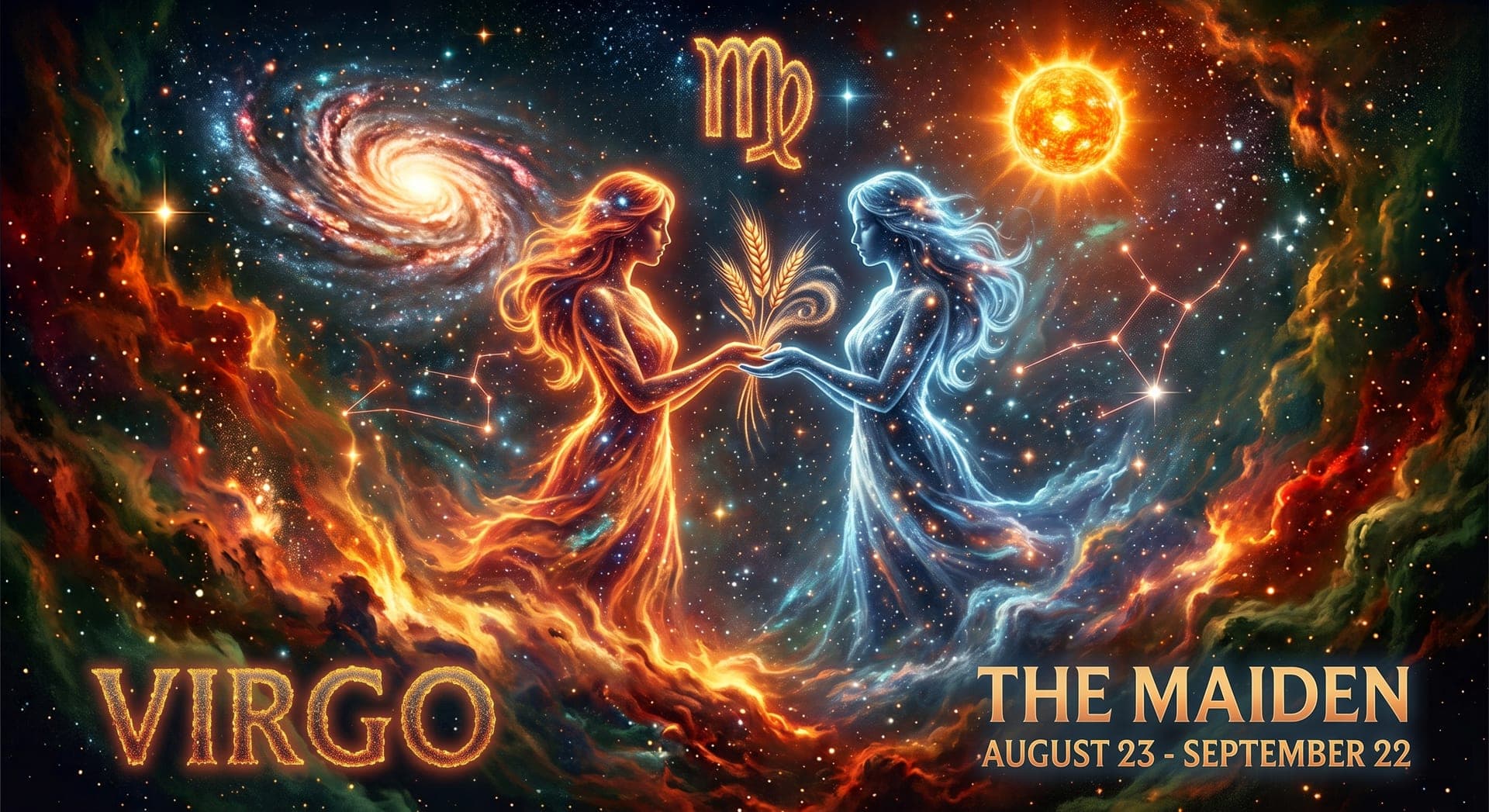
Virgo, the sixth sign of the zodiac, spans August 23 to September 22 and is symbolized by the maiden, often depicted holding a sheaf of wheat, representing purity, meticulous care, and the harvest. Ruled by Mercury, the planet of communication and intellect, Virgo channels its mental energy toward precision, analysis, and practical problem-solving rather than idle chatter. As an Earth sign, Virgo is grounded and detail-oriented, finding genuine satisfaction in organizing, refining, and perfecting the world around it. Its Mutable modality gives Virgo an adaptable, service-oriented nature, often finding purpose in quietly helping others and improving systems rather than seeking the spotlight. People born under this sign are frequently drawn to work requiring precision, research, or care for others, from science and medicine to editing and organization. Virgo's high standards make it an excellent problem-solver and a reliable presence others can count on, though that same perfectionism can turn inward as self-criticism or outward as an exacting, sometimes overly critical, eye toward the people and world around it.
Personality Traits
Strengths
- Highly organized and detail-oriented
- Reliable and hardworking
- Analytical problem-solver
- Genuinely helpful to others
- Modest and unpretentious
Weaknesses
- Prone to overcritical perfectionism
- Tends to worry excessively
- Can be overly critical of others
- Reserved to the point of aloofness
- Struggles to relax
Compatible Signs
Fun Facts
- Virgo's maiden symbol is often associated with Astraea, the Greek goddess of justice and purity, said to have been the last immortal to live among humans.
- Virgo is the only zodiac sign represented by a female human figure.
- Virgo and Gemini share Mercury as their ruling planet, though Virgo channels the planet's communicative energy toward analysis and precision rather than pure talkativeness.
- Notable Virgos include Beyoncé, Michael Jackson, Mother Teresa, and Stephen King.
- Virgo season falls at the tail end of summer, a period traditionally associated with harvest, meticulous preparation, and gathering resources for the colder months ahead.
Born on August 27
- 1770
Georg Wilhelm Friedrich Hegel
German philosopher
- 1809
Hannibal Hamlin
15th Vice President of the United States
- 1877
Charles Rolls
English engineer and aviator who co-founded Rolls-Royce with Henry Royce and became the first Briton killed in an aeroplane accident.
- 1890
Man Ray
American visual artist associated with Dada and Surrealism
- 1899
C. S. Forester
English novelist best known for the Horatio Hornblower series of naval novels and for "The African Queen"
- 1908
Don Bradman
Australian cricketer widely regarded as the greatest batsman
- 1908
Lyndon B. Johnson
36th President of the United States
- 1909
Lester Young
American jazz saxophonist
- 1916
Martha Raye
American actress and comedian
- 1925
Nat Lofthouse
English footballer nicknamed the 'Lion of Vienna,' who starred for Bolton Wanderers and captained England.
- 1932
Antonia Fraser
English historian and biographer best known for works such as Mary Queen of Scots and The Six Wives of Henry VIII.
- 1952
Paul Reubens
American actor known for creating Pee-wee Herman
- 1956
Glen Matlock
English bassist and songwriter, a founding member of the punk band the Sex Pistols.
- 1959
Jeanette Winterson
English novelist known for Oranges Are Not the Only Fruit and other works exploring identity and sexuality.
- 1969
Reece Shearsmith
English actor and comedian celebrated for dark comedy work including The League of Gentlemen and Inside No. 9.
- 1972
Denise Lewis
English heptathlete who won Olympic gold at the 2000 Sydney Games.
On This Day in History
- 410
The Visigothic sack of Rome, led by King Alaric I, concludes after three days of pillaging.
After breaching Rome's walls days earlier, Visigothic forces under King Alaric I concluded their sack of the city, having plundered its wealth over three days, an event that sent shockwaves throughout the Roman world as the first foreign capture of the city in centuries.
- 1172
Henry the Young King and Margaret of France are crowned as junior monarchs of England.
Henry, the eldest surviving son of King Henry II of England, was crowned as a junior co-king alongside his father in a controversial arrangement intended to secure succession, though the younger Henry's frustration with his limited actual authority later contributed to a significant family rebellion.
- 1172
Henry the Young King and his wife Margaret of France were crowned together at Winchester, cementing his status as junior king of England.
Henry II's eldest surviving son had already been crowned king in 1170, but that ceremony had excluded his wife, provoking anger from her father, Louis VII of France. This second coronation was intended to smooth over the diplomatic insult, though it did nothing to resolve the deeper tensions between the Young King and his father, which erupted into open rebellion less than a year later.
- 1353
A combined Aragonese-Venetian fleet decisively defeats the Genoese navy at the Battle of Alghero.
A combined fleet from the maritime republics of Aragon and Venice decisively defeated the naval forces of rival Genoa near Alghero on the island of Sardinia, contributing to the broader struggle for Mediterranean commercial dominance among Italy's competing maritime powers.
- 1557
Emmanuel Philibert secures his position as Duke of Savoy through military victory.
Following military conflict with rivals seeking to seize control of his territory, Emmanuel Philibert successfully secured and consolidated his hereditary claim to the Duchy of Savoy, later relocating the Savoyard capital from Chambery to Turin and beginning significant modernization of the state's administration, legal code, and military organization that strengthened Savoy's regional standing.
- 1776
British forces under General William Howe outflank and defeat the Continental Army at the Battle of Long Island.
British forces under General William Howe executed a successful flanking maneuver against General George Washington's Continental Army positions on Long Island, forcing a costly American retreat that nearly resulted in the destruction of Washington's entire army early in the Revolutionary War.
- 1776
British forces under General William Howe defeated George Washington's Continental Army at the Battle of Long Island.
In the largest battle of the American Revolutionary War, Howe's troops outflanked and routed the poorly prepared Continental Army in Brooklyn, inflicting heavy casualties and capturing hundreds of prisoners. Only a skilful nighttime evacuation across the East River saved Washington's remaining forces from destruction, allowing the war to continue despite this early, decisive British victory.
- 1793
Royalist rebels at Toulon opened the port to British and Spanish fleets, prompting a lengthy siege by revolutionary French forces.
Fearful of the radical Jacobin government in Paris, the citizens of Toulon invited an Anglo-Spanish fleet under Admiral Samuel Hood to occupy the strategic naval base. The subsequent siege by Republican forces became famous for the role of a young artillery officer, Napoleon Bonaparte, whose tactics helped force the British and their allies to evacuate the city that December.
- 1798
French and Irish rebel forces routed British Crown troops at the Battle of Castlebar during the Irish Rebellion of 1798.
A small French expeditionary force under General Jean Humbert, joined by Irish United Irishmen, put a much larger British and militia garrison to flight in County Mayo. The rapid, humiliating retreat became known as the 'Castlebar Races.' The rebels briefly held the town before British reinforcements crushed the rebellion in the weeks that followed.
- 1810
The French Navy inflicted a rare defeat on the British Royal Navy at the Battle of Grand Port off Mauritius.
French frigates trapped and destroyed or captured four British warships in the shallow, reef-strewn harbour of Grand Port, the only French naval victory ever inscribed on the Arc de Triomphe. Despite the loss, Britain went on to seize Mauritius from France just months later, ending French naval power in the Indian Ocean for the remainder of the Napoleonic Wars.
- 1859
Petroleum is discovered near Titusville, Pennsylvania, launching the modern commercial oil industry.
Edwin Drake's successful drilling operation near Titusville, Pennsylvania, struck oil at a shallow depth of roughly 69 feet using a pioneering drilling technique adapted from salt-well boring methods, launching the modern commercial petroleum industry. The subsequent regional oil boom transformed American energy production and rapidly established Pennsylvania as the birthplace of the global oil age.
- 1883
A series of massive volcanic explosions nearly destroys the island of Krakatoa, generating tsunamis that kill tens of thousands.
A series of massive volcanic explosions tore apart most of the Indonesian island of Krakatoa, generating an eruption heard thousands of miles away and devastating tsunamis that killed tens of thousands of people across the surrounding coastal regions of Java and Sumatra.
- 1896
The Anglo-Zanzibar War, the shortest recorded war in history, concludes in under an hour.
Following a diplomatic dispute over succession to the Zanzibari throne after the death of a British-favored sultan, Royal Navy warships bombarded the sultan's palace, destroying it within approximately 38 minutes and forcing the rival claimant's surrender, making the Anglo-Zanzibar War the shortest recorded war in documented military history.
- 1896
Britain and the Sultanate of Zanzibar fought the shortest war in recorded history, lasting under 40 minutes.
After Sultan Khalid bin Barghash seized power without British approval, the Royal Navy bombarded his palace, and the fighting ended in roughly 38 minutes with Khalid fleeing and several hundred Zanzibari casualties. British forces then installed a more compliant sultan, tightening their control over the island as part of the wider scramble for influence in East Africa.
- 1914
The Royal Munster Fusiliers fought a costly delaying action against advancing German forces at the Battle of Étreux.
During the British Expeditionary Force's retreat from Mons, the battalion held off a much larger German force for most of the day near the French village of Étreux, buying time for other British units to withdraw. Nearly the entire battalion was killed, wounded, or captured, and the stand became one of the notable early sacrifices of the British Army in the First World War.
- 1939
The world's first jet-powered aircraft, the Heinkel He 178, completes its maiden flight in Germany.
Germany's Heinkel He 178, powered by a revolutionary turbojet engine developed by engineer Hans von Ohain, completed the world's first flight of a jet-propelled aircraft, though the technology's true military and commercial potential would not be fully realized for several more years.
- 1955
The first edition of the Guinness Book of Records was published in Britain.
Commissioned by Guinness Brewery managing director Sir Hugh Beaver after a dispute over the fastest game bird in Europe, the reference book compiled by twin researchers Norris and Ross McWhirter became an instant bestseller. It grew into an annually updated global phenomenon, now known simply as Guinness World Records, cataloguing extremes of every kind.
- 1956
Calder Hall in Cumbria, England, became the world's first nuclear power station to supply electricity commercially on a large scale.
Opened by Queen Elizabeth II, the plant fed power into the national grid, marking a milestone in the peaceful use of nuclear energy after its wartime origins in weapons research. Though later criticised for also producing plutonium for Britain's nuclear arsenal, Calder Hall operated for nearly half a century and helped establish Britain as a pioneer of civil nuclear power.
- 1979
The IRA killed 18 British soldiers in a bomb ambush at Warrenpoint and assassinated Lord Mountbatten in a separate bombing the same day.
The Warrenpoint ambush, using two roadside bombs in quick succession, was the deadliest single attack on the British Army during the Troubles. Hours earlier, a bomb hidden aboard Lord Mountbatten's boat off Mullaghmore, County Sligo, killed the former Viceroy of India and three others, including his 14-year-old grandson, in one of the IRA's most high-profile assassinations.
- 2011
Hurricane Irene strikes the U.S. East Coast, causing approximately $15.6 billion in damages.
Hurricane Irene made landfall along the U.S. East Coast, causing widespread flooding and significant wind damage across a dozen states stretching from North Carolina to New England, resulting in approximately $15.6 billion in total damage and dozens of storm-related deaths, prompting one of the largest coastal evacuations in American history at the time.