
What’s Observed on August 22
Born on August 22: Leo ♌
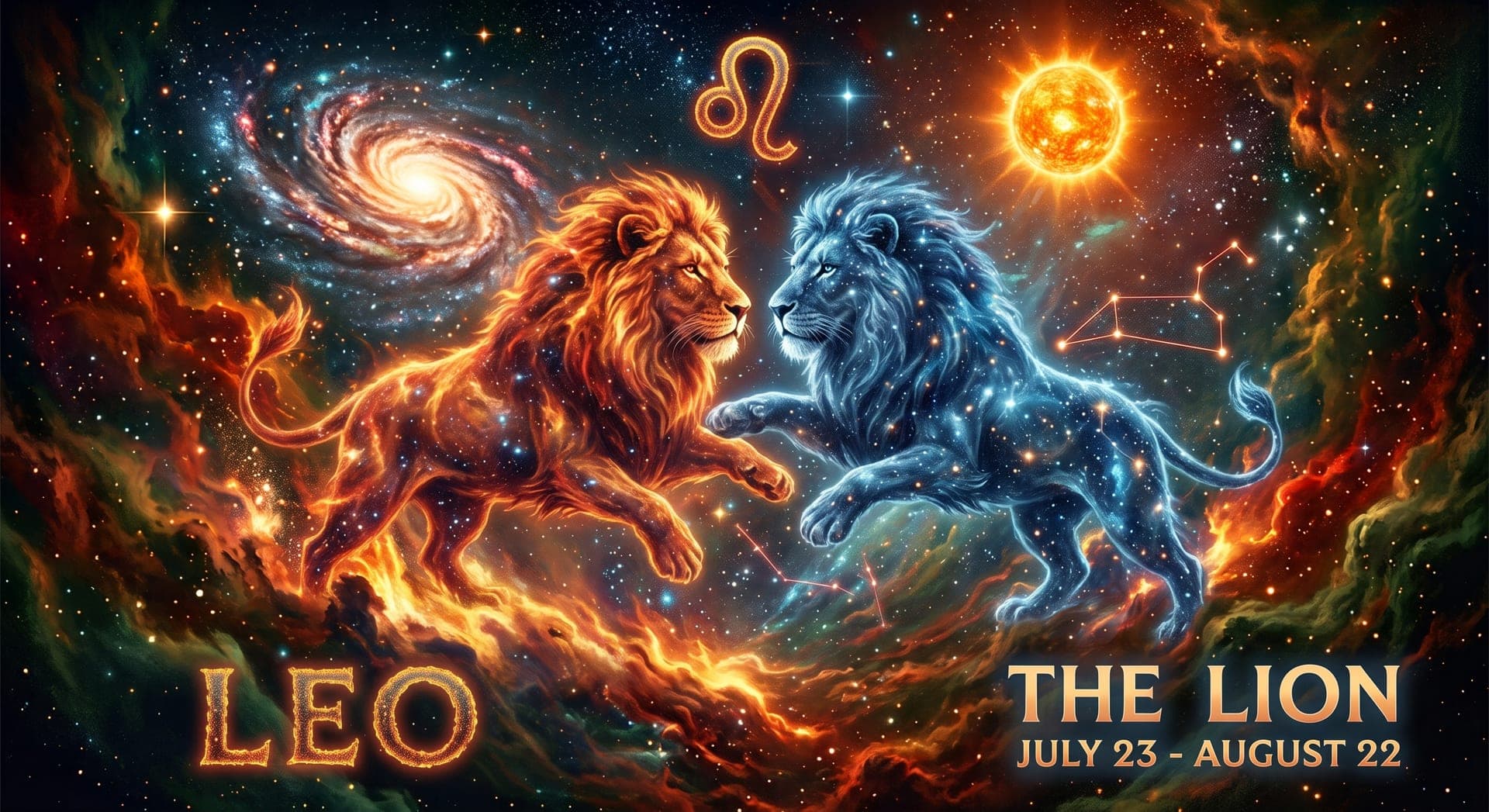
Leo, the fifth sign of the zodiac, spans July 23 to August 22 and is symbolized by the lion, an animal long associated with courage, pride, and natural leadership. Ruled by the Sun, the center of the solar system and the source of light and life, Leo is widely regarded as one of the most confident, warm, and charismatic signs of the zodiac, naturally drawn to the spotlight. As a Fire sign, Leo approaches life with passion, enthusiasm, and a flair for the dramatic, rarely content to blend quietly into the background. Its Fixed modality gives Leo a strong sense of loyalty and consistency, along with a stubborn streak once its mind is made up. People born under this sign are often natural performers, leaders, or creatives who thrive when appreciated and celebrated by those around them. Leo's generosity and warmth make it a beloved friend and steadfast ally, though its genuine need for recognition and admiration can tip into vanity or a demand for center stage if left unchecked.
Personality Traits
Strengths
- Naturally charismatic leader
- Generous and warm-hearted
- Confident and self-assured
- Creative and expressive
- Loyal to friends and family
Weaknesses
- Prone to arrogance
- Craves attention and validation
- Stubborn once decided
- Can be domineering
- Sensitive to criticism of their ego
Compatible Signs
Fun Facts
- Leo's lion symbol connects to the Greek myth of the Nemean Lion, slain by Hercules as the first of his twelve labors.
- Leo is ruled by the Sun, the only zodiac sign ruled directly by a star rather than a planet or moon.
- As a Fixed Fire sign, Leo season falls at the height of summer, when the sun's warmth and intensity are strongest in the Northern Hemisphere.
- Notable Leos include Barack Obama, Madonna, Jennifer Lawrence, and Napoleon Bonaparte.
- Leo rules the heart in traditional medical astrology, reflecting the sign's association with vitality, courage, and life force.
Born on August 22
- 1771
Henry Maudslay
English engineer and inventor regarded as a father of modern machine-tool technology for his precision screw-cutting lathe.
- 1862
Claude Debussy
French composer
- 1904
Deng Xiaoping
Paramount leader of the People's Republic of China
- 1908
Henri Cartier-Bresson
French photographer and pioneer of photojournalism
- 1920
Ray Bradbury
American science fiction author
- 1925
Honor Blackman
English actress best known for playing Pussy Galore in the James Bond film "Goldfinger" and Cathy Gale in "The Avengers."
- 1934
Norman Schwarzkopf Jr.
American general who led coalition forces in the Gulf War
- 1939
Carl Yastrzemski
American Major League Baseball player
- 1943
Alun Michael
Welsh politician who served as the first First Secretary of Wales following devolution.
- 1957
Steve Davis
English professional snooker player who dominated the sport in the 1980s, winning six World Championship titles.
- 1961
Roland Orzabal
English musician and songwriter, co-founder of the band Tears for Fears.
- 1963
Tori Amos
American singer-songwriter and pianist
- 1971
Richard Armitage
English actor known for playing Thorin Oakenshield in "The Hobbit" film trilogy.
- 1978
James Corden
English actor, comedian, and television host known for "Gavin & Stacey" and hosting "The Late Late Show."
- 1995
Dua Lipa
English singer-songwriter known for hit songs including "New Rules" and "Levitating."

On This Day in History
- 851
Erispoe defeats Charles the Bald at the Battle of Jengland, halting West Francia's expansion into Brittany.
Breton forces under their leader Erispoe successfully repelled an invasion attempt by the West Frankish king Charles the Bald, securing Brittany's continued political autonomy from the fracturing Carolingian empire. The peace settlement that followed forced Charles to formally recognize Erispoe's royal title, an unusual concession that acknowledged Brittany's effective independence for generations to come.
- 1138
English and Scottish forces clash at the Battle of the Standard in northern England.
Forces loyal to Scotland's King David I clashed with an English army near Northallerton in Yorkshire, with the battle notably featuring English troops rallying around a ship's mast mounted on a wagon and bearing consecrated religious banners from several northern English cathedrals, giving the engagement its distinctive name, the Battle of the Standard.
- 1138
English forces defeat an invading Scottish army at the Battle of the Standard near Northallerton in Yorkshire.
King David I of Scotland invaded northern England in support of his niece Matilda's claim to the English throne during the civil war known as the Anarchy. An English army, rallying around a ship's mast mounted with religious banners that gave the battle its name, routed the larger Scottish force. The victory checked Scottish incursions into England during the chaotic reign of King Stephen.
- 1153
Crusader forces led by Baldwin III capture the fortress of Ascalon from Egyptian control.
Crusader forces led by the young King Baldwin III, supported by military orders including the Templars and Hospitallers, successfully captured the heavily fortified Egyptian coastal stronghold of Ascalon after a prolonged siege, securing the southern frontier of the Crusader Kingdom of Jerusalem.
- 1485
King Richard III is killed at the Battle of Bosworth Field, ending the Plantagenet dynasty and the Wars of the Roses.
In the final major battle of the decades-long Wars of the Roses, King Richard III was killed in combat against the forces of Henry Tudor, who subsequently claimed the throne as Henry VII, ending the Plantagenet dynasty and founding the Tudor line.
- 1485
Richard III of England is killed at the Battle of Bosworth Field, ending the Plantagenet dynasty and bringing Henry Tudor to the throne.
Richard's death in the thick of fighting, betrayed by allies who switched sides mid-battle, marked the last time an English king died in combat. Henry Tudor's victory ended the Wars of the Roses and established the Tudor dynasty, which he founded as Henry VII. The battle is traditionally seen as a symbolic close of the English medieval period.
- 1639
The British East India Company founds Madras, now known as Chennai, in India.
The British East India Company established a fortified trading settlement on India's southeastern Coromandel Coast that grew steadily into the major city of Madras, now officially known as Chennai, becoming one of the company's three key presidency strongholds in its expanding Indian commercial and territorial network alongside Bombay and Calcutta.
- 1642
King Charles I raises his royal standard at Nottingham, formally beginning the English Civil War.
Charles's declaration of war followed years of escalating conflict with Parliament over taxation, religion, and the limits of royal authority. Few troops initially answered the call, and the standard reportedly blew down in a storm that night, an inauspicious omen. The ensuing civil war would last until 1651 and ultimately result in Charles's execution and a brief period of republican government.
- 1711
Britain's Quebec Expedition suffers disaster as eight ships wreck on rocks in the St. Lawrence River, killing hundreds.
A large British fleet under Admiral Hovenden Walker had been sent to capture French Quebec during the War of the Spanish Succession, but navigational errors in fog drove several transport ships onto rocks near Pointe-aux-Anglais, drowning close to nine hundred soldiers, sailors, and camp followers. The catastrophe forced the abandonment of the campaign and remains one of the worst disasters in British naval history.
- 1770
James Cook lands on Possession Island and formally claims the eastern coast of Australia for Great Britain.
At the northern tip of Cape York, Cook raised the British flag and, in the name of King George III, claimed the entire eastern Australian coastline he had charted during his voyage aboard HMS Endeavour. The claim, made without regard to the Aboriginal peoples already inhabiting the land, laid the legal groundwork Britain later used to establish its first Australian penal colony.
- 1777
British forces abandon their siege of Fort Stanwix in New York after rumors spread of approaching American reinforcements.
The siege, part of a British campaign to split the rebellious colonies along the Hudson River corridor, had already been weakened by an ambush of British-allied Iroquois and Loyalist forces at the Battle of Oriskany. Panic spread through the besieging camp over exaggerated reports of a relief column, prompting a disorderly retreat that contributed to the wider failure of the British Saratoga campaign.
- 1780
James Cook's ship HMS Resolution returns to England, bringing news that its famous captain had been killed in Hawaii.
Cook had been killed in a violent confrontation with Hawaiians at Kealakekua Bay in February 1779, partway through his third and final Pacific voyage. His crew completed the voyage under new command before finally returning home, delivering the shocking news of Cook's death to a Britain that had followed his celebrated explorations of the Pacific with great public interest.
- 1851
The yacht America wins the inaugural race that later becomes known as the America's Cup.
The yacht America decisively outraced a fleet of British vessels around the Isle of Wight, winning a trophy that was later renamed the America's Cup in the vessel's honor, launching what remains one of the oldest ongoing international sporting competitions.
- 1864
Twelve nations sign the First Geneva Convention, establishing protections for wounded soldiers in armed conflict.
Delegates from twelve European nations meeting in Geneva, Switzerland, signed the First Geneva Convention, establishing the first internationally recognized legal framework obligating armies to care for wounded soldiers regardless of nationality and to respect the neutrality of medical personnel and facilities. The foundational treaty, championed by Swiss businessman Henry Dunant, laid the groundwork for the modern Red Cross movement and subsequent international humanitarian law.
- 1864
Twelve European nations sign the First Geneva Convention, establishing the first international rules protecting wounded soldiers and medical personnel in wartime.
Inspired by Swiss businessman Henry Dunant's account of the suffering he witnessed after the Battle of Solferino, the convention obligated signatory armies to care for wounded combatants regardless of nationality and to respect the neutrality of medical staff and facilities marked with the Red Cross emblem. It became the founding document of modern international humanitarian law and the Red Cross movement.
- 1922
Irish revolutionary leader Michael Collins is assassinated during the Irish Civil War.
Michael Collins, a key military and political leader in Ireland's struggle for independence who had helped negotiate the controversial treaty establishing the Irish Free State, was ambushed and killed by anti-treaty forces during the subsequent Irish Civil War. His death, at just 31 years old, robbed the fledgling Irish state of one of its most capable early leaders.
- 1934
Australian captain Bill Woodfull becomes the only man to twice regain the Ashes as Australia clinches the Test cricket series against England.
Woodfull's side sealed victory in the deciding Test at the Oval, reclaiming the Ashes after Australia's controversial defeat in the infamous 1932-33 'Bodyline' series in England. The Ashes, contested between the English and Australian cricket teams since 1882, remains one of the sport's oldest and most storied rivalries, and Woodfull's achievement of regaining the urn twice as captain is unmatched.
- 1985
British Airtours Flight 28M suffers an engine fire at Manchester Airport, killing 55 people from smoke inhalation.
A British Airtours charter jet suffered an engine fire shortly before takeoff at Manchester Airport, and though the aircraft never left the ground, delays in evacuation and the rapid spread of toxic smoke through the cabin resulted in 55 fatalities.
- 1985
British Airtours Flight 28M catches fire during takeoff at Manchester Airport, killing fifty-five people.
An engine fire broke out as the Boeing 737 accelerated down the runway; the pilots aborted takeoff, but the aircraft's fuselage was quickly engulfed in flames after stopping. Most of the fifty-five deaths resulted from smoke inhalation during a chaotic evacuation. The disaster prompted major reforms to aircraft cabin safety standards, including improved evacuation procedures and more fire-resistant cabin materials, across British and international aviation.
- 2006
Mathematician Grigori Perelman is awarded the Fields Medal for proving the Poincare conjecture but declines to accept it.
Russian mathematician Grigori Perelman was awarded the Fields Medal, mathematics' most prestigious honor, for his proof of the century-old Poincare conjecture, but he declined both the award and its accompanying prize money, later withdrawing almost entirely from public mathematical life.