
What’s Observed on July 23
Born on July 23: Leo ♌
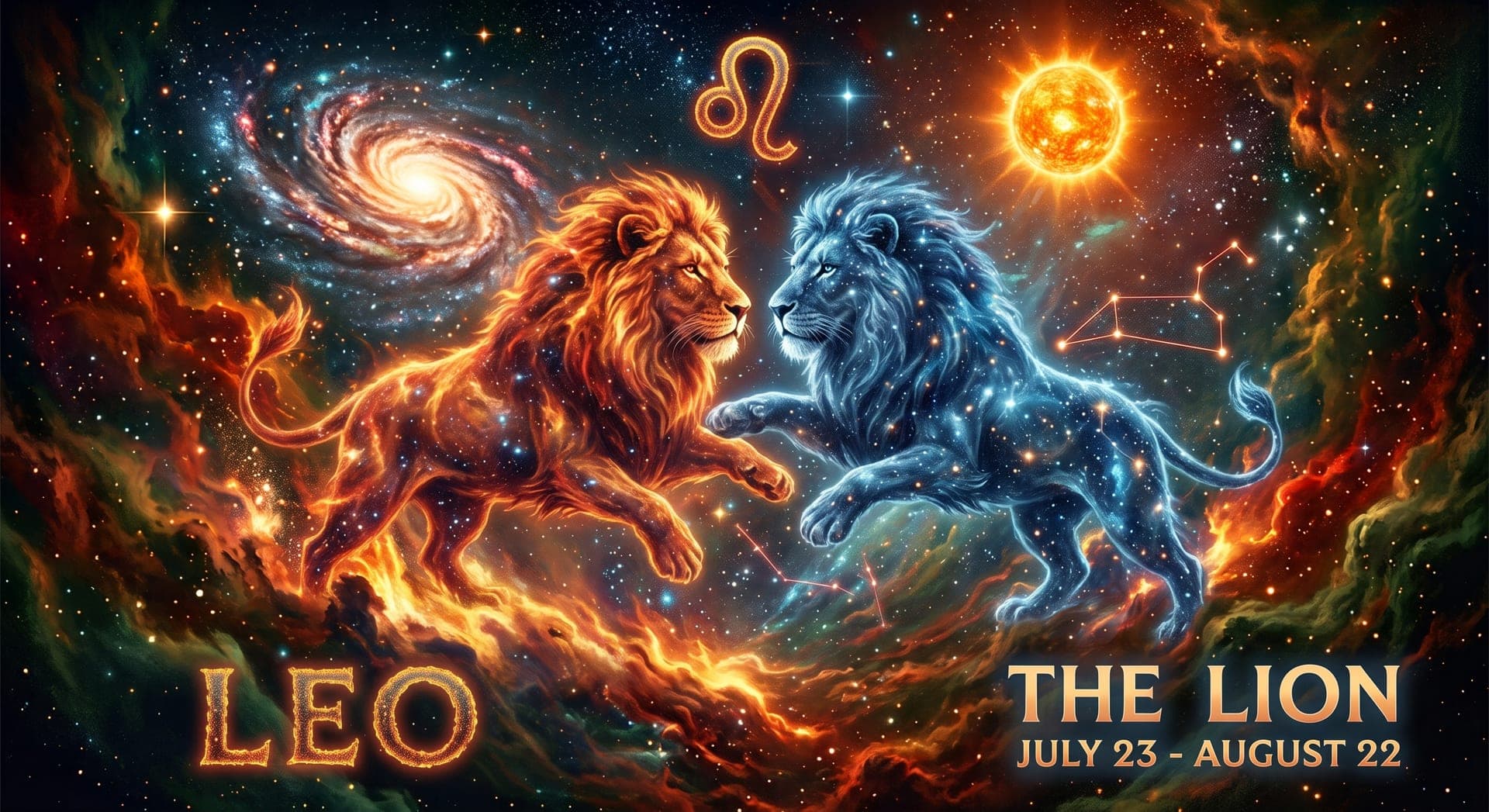
Leo, the fifth sign of the zodiac, spans July 23 to August 22 and is symbolized by the lion, an animal long associated with courage, pride, and natural leadership. Ruled by the Sun, the center of the solar system and the source of light and life, Leo is widely regarded as one of the most confident, warm, and charismatic signs of the zodiac, naturally drawn to the spotlight. As a Fire sign, Leo approaches life with passion, enthusiasm, and a flair for the dramatic, rarely content to blend quietly into the background. Its Fixed modality gives Leo a strong sense of loyalty and consistency, along with a stubborn streak once its mind is made up. People born under this sign are often natural performers, leaders, or creatives who thrive when appreciated and celebrated by those around them. Leo's generosity and warmth make it a beloved friend and steadfast ally, though its genuine need for recognition and admiration can tip into vanity or a demand for center stage if left unchecked.
Personality Traits
Strengths
- Naturally charismatic leader
- Generous and warm-hearted
- Confident and self-assured
- Creative and expressive
- Loyal to friends and family
Weaknesses
- Prone to arrogance
- Craves attention and validation
- Stubborn once decided
- Can be domineering
- Sensitive to criticism of their ego
Compatible Signs
Fun Facts
- Leo's lion symbol connects to the Greek myth of the Nemean Lion, slain by Hercules as the first of his twelve labors.
- Leo is ruled by the Sun, the only zodiac sign ruled directly by a star rather than a planet or moon.
- As a Fixed Fire sign, Leo season falls at the height of summer, when the sun's warmth and intensity are strongest in the Northern Hemisphere.
- Notable Leos include Barack Obama, Madonna, Jennifer Lawrence, and Napoleon Bonaparte.
- Leo rules the heart in traditional medical astrology, reflecting the sign's association with vitality, courage, and life force.
Born on July 23
- 1883
Alan Brooke
British Army field marshal who served as Chief of the Imperial General Staff and Churchill's chief military adviser during WWII
- 1888
Raymond Chandler
American crime novelist
- 1892
Haile Selassie
Emperor of Ethiopia
- 1894
Arthur Treacher
English actor known for playing dignified butler roles in Hollywood films, including in Mary Poppins.
- 1913
Michael Foot
English journalist and politician who led the Labour Party and served as a prominent left-wing intellectual voice in British politics.
- 1933
Richard Rogers
Italian-born British architect known for pioneering high-tech architecture, including the Pompidou Centre and Lloyd's Building
- 1936
Don Drysdale
American Major League Baseball pitcher
- 1946
Andy Mackay
English musician and founding member of the art rock band Roxy Music, known for his saxophone and oboe playing.
- 1947
David Essex
English singer and actor who became a teen idol in the 1970s with hits like 'Rock On' and starred in the film That'll Be the Day.
- 1957
Jo Brand
English comedian and writer known for her deadpan stand-up style and television appearances on panel shows.
- 1961
Woody Harrelson
American actor
- 1961
Martin Gore
English musician and principal songwriter for the electronic band Depeche Mode.
- 1965
Slash
English-born guitarist best known as a founding member of Guns N' Roses.
- 1971
Alison Krauss
American bluegrass singer and fiddler
- 1973
Fran Healy
English-born singer-songwriter and frontman of the Scottish rock band Travis.
- 1976
Judit Polgár
Hungarian chess grandmaster
- 1989
Daniel Radcliffe
English actor known for "Harry Potter"

On This Day in History
- 1319
The Knights Hospitaller achieve a decisive naval victory over the Aydinid fleet near the island of Chios.
The naval forces of the Knights Hospitaller intercepted and defeated a fleet belonging to the Turkish beylik of Aydin near the Greek island of Chios, disrupting raids against Christian shipping in the Aegean Sea and reinforcing the Hospitallers' growing naval power in the eastern Mediterranean.
- 1711
The Ottoman and Russian empires sign the Treaty of Pruth, ending a brief war between the two powers.
Following a brief conflict sparked by disputes over Ottoman vassal states, representatives of the Ottoman and Russian empires signed a peace treaty along the Pruth River, with Russian Tsar Peter the Great agreeing to relinquish recently gained territory in exchange for the safe withdrawal of his surrounded army.
- 1813
Sir Thomas Maitland was appointed the first Governor of Malta, formally establishing British colonial administration on the island.
Maitland's appointment converted Malta's status from a British protectorate, established after the island came under British control during the Napoleonic Wars, into a Crown Colony with a more centralized governing structure. Known for his firm and sometimes autocratic style, Maitland also served as a colonial administrator in the Ionian Islands. Malta remained under British rule for more than 150 years, gaining independence in 1964.
- 1829
William Austin Burt patents the typographer, an early precursor to the modern typewriter.
American inventor William Austin Burt secured a patent for his "typographer," an early mechanical writing device considered by some historians to be a forerunner of the modern typewriter, though it was slow and cumbersome compared to later, more successful designs that emerged decades afterward.
- 1840
The British Parliament passed the Act of Union, merging the colonies of Upper and Lower Canada into a single Province of Canada.
The legislation followed the Rebellions of 1837-38 and aimed to assimilate French Canadians into English-speaking governance by joining the two colonies under one legislature, as recommended by Lord Durham's influential report. The union created lasting tensions between English- and French-speaking populations that shaped Canadian politics for decades. The Province of Canada eventually became a founding component of the Canadian confederation in 1867.
- 1862
Rioting broke out in London's Hyde Park after police attempted to block a demonstration in support of Sunday trading rights.
Crowds clashed with police who had been ordered to prevent a mass gathering, leading to injuries and arrests amid the disorder. The unrest reflected wider working-class discontent over restrictive Sunday trading laws and the policing of public assembly in Victorian London. Hyde Park continued to be a flashpoint for political demonstrations throughout the nineteenth century.
- 1914
Austria-Hungary issues an ultimatum to Serbia during the July Crisis, a critical step in the chain of events leading to World War I.
Following the assassination of Archduke Franz Ferdinand weeks earlier, Austria-Hungary delivered a deliberately harsh ultimatum to Serbia containing demands designed to be difficult to accept in full. Serbia's response, though largely conciliatory, was deemed insufficient, triggering a rapid chain of alliance-driven declarations of war that culminated in World War I.
- 1914
Austria-Hungary delivered a harsh ultimatum to Serbia, setting in motion the diplomatic crisis that triggered the First World War.
The ultimatum followed the assassination of Archduke Franz Ferdinand in Sarajevo a month earlier and demanded sweeping concessions from Serbia, including allowing Austro-Hungarian officials to participate in the investigation. Serbia's response, though conciliatory on most points, fell short of full compliance, giving Austria-Hungary a pretext for war. The crisis rapidly escalated through a web of alliances, plunging Europe into the First World War within weeks.
- 1921
The Chinese Communist Party formally establishes itself at its first National Congress.
Delegates gathered in Shanghai to formally establish the Chinese Communist Party's organizational structure at its First National Congress, building on the earlier founding meeting held days before. The nascent party, then numbering only a few dozen members, would grow over the following decades into the ruling force of modern China.
- 1943
British destroyers HMS Eclipse and HMS Laforey sank the Italian submarine Ascianghi in the Mediterranean after it torpedoed the cruiser HMS Newfoundland.
The action took place during the Allied invasion of Sicily, as Royal Navy warships hunted Axis submarines threatening the invasion fleet. Ascianghi had struck Newfoundland with a torpedo, damaging the cruiser before being tracked down and destroyed by the escorting destroyers. The engagement was one of many small but vital naval actions that helped secure Allied control of the waters around Sicily during the campaign.
- 1952
A group of army officers known as the Free Officers Movement seized power in Egypt, forcing King Farouk to abdicate.
Led by figures including Muhammad Naguib and Gamal Abdel Nasser, the coup ended the Egyptian monarchy and the lingering influence of foreign power in the country. Farouk left Egypt aboard the royal yacht days later, and the country was declared a republic the following year. The revolution reshaped the modern Middle East, with Nasser eventually emerging as a dominant Arab nationalist leader.
- 1962
The Telstar satellite relays the first live transatlantic television broadcast, and Jackie Robinson is inducted into the Baseball Hall of Fame.
The Telstar satellite relayed the first live transatlantic television signals between the United States and Europe, a technological milestone in global communications. On the same day, baseball legend Jackie Robinson, who broke Major League Baseball's color barrier in 1947, was formally inducted into the National Baseball Hall of Fame.
- 1962
The Telstar satellite relayed the first live transatlantic television broadcast, connecting audiences in North America and Europe.
The experimental communications satellite transmitted images and a brief address from American journalist Walter Cronkite across the Atlantic in real time, a technological feat that had seemed like science fiction only years earlier. Telstar demonstrated the feasibility of satellite communications for television, telephone, and data transmission. The achievement paved the way for the global satellite communication networks that followed in subsequent decades.
- 1967
A police raid on an unlicensed bar in Detroit sparked five days of rioting that became one of the deadliest urban uprisings in United States history.
The unrest erupted after police raided an after-hours drinking club in a predominantly Black neighborhood, igniting long-simmering tensions over racial discrimination, housing conditions, and policing. Violence, arson, and looting spread across the city, prompting the deployment of National Guard and federal troops before order was restored. The riots left 43 people dead and thousands more injured or arrested, and accelerated Detroit's population decline in subsequent decades.
- 1972
The United States launches Landsat 1, the first satellite dedicated to observing Earth's land resources.
The United States launched Landsat 1, the first satellite specifically designed to systematically observe and photograph Earth's land surfaces from orbit. The mission inaugurated a long-running program of Earth observation satellites that has since provided decades of invaluable data for agriculture, urban planning, and environmental monitoring.
- 1974
Greece's military junta collapses, and Konstantinos Karamanlis returns to lead a new civilian government.
Following the collapse of Greece's military junta amid the crisis over Cyprus, exiled politician Konstantinos Karamanlis returned from self-imposed exile in Paris to form a new civilian government. His return began the country's careful transition back to parliamentary democracy after seven years of repressive authoritarian rule under the Colonels' regime.
- 1974
Greece's ruling military junta collapsed, paving the way for a return to civilian democratic government.
The regime, which had seized power in a 1967 coup, unraveled after a disastrous attempt to unite Cyprus with Greece triggered a Turkish invasion of the island. Former prime minister Konstantinos Karamanlis returned from exile to lead a transitional government. The collapse ended seven years of military rule and began Greece's transition to the stable parliamentary democracy it has maintained since.
- 1983
Air Canada Flight 143 runs out of fuel mid-flight and makes a dramatic unpowered landing near Gimli, Manitoba, later dubbed the "Gimli Glider" incident.
A routine flight from Montreal to Edmonton ran completely out of fuel at cruising altitude due to a metric conversion error during refueling. The pilots managed an unpowered glide to a safe landing at a former air force base in Gimli, Manitoba, an extraordinary feat of airmanship that became known as the "Gimli Glider" incident.
- 2005
A series of coordinated bomb blasts struck the Egyptian resort town of Sharm el-Sheikh, killing at least 88 people.
The bombs targeted hotels and a market area crowded with tourists and local residents in the popular Red Sea resort. It was one of the deadliest terrorist attacks in Egypt's history, striking a city that depended heavily on international tourism. The attacks were claimed by a group linked to al-Qaeda and prompted a major security crackdown across Egypt's Sinai Peninsula.
- 2018
Wildfires in East Attica, Greece, become the deadliest in the country's history, killing more than 100 people.
A combination of extreme drought conditions and strong winds fueled rapidly spreading wildfires in the coastal region east of Athens, trapping residents in vehicles and homes as flames swept toward the sea. The disaster became the deadliest wildfire event in modern Greek history, prompting scrutiny of the country's fire prevention and emergency response systems.