
What’s Observed on July 22
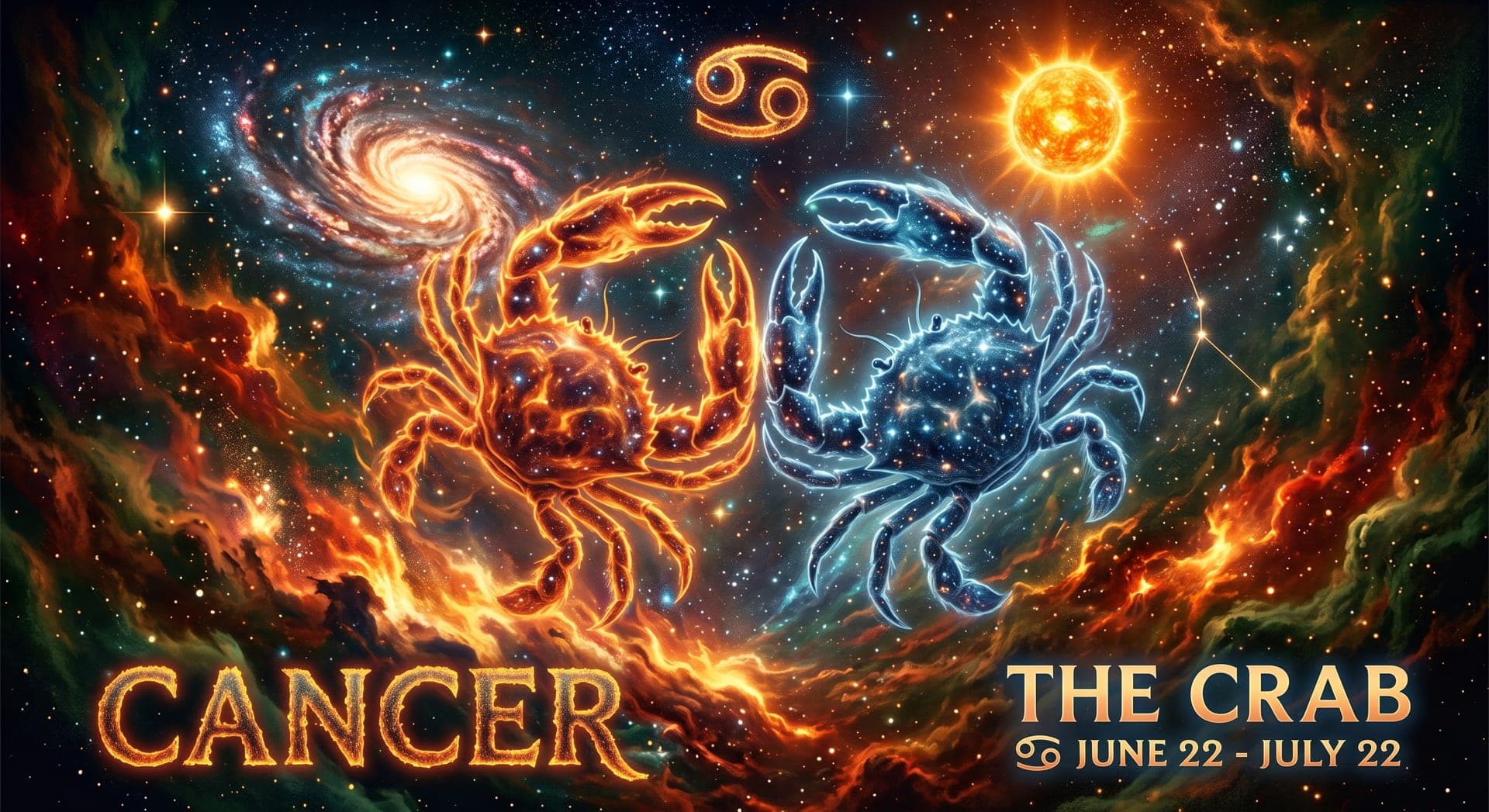
Born on July 22: Cancer ♋
Cancer, the fourth sign of the zodiac, spans June 21 to July 22 and is symbolized by the crab, an animal known for carrying a protective shell while remaining soft and vulnerable underneath. Ruled by the Moon, the celestial body long associated with emotion, intuition, and the subconscious, Cancer is widely regarded as one of the most nurturing and emotionally attuned signs of the zodiac. As a Water sign, Cancer navigates the world through deep feeling, often forming strong emotional bonds and an acute sensitivity to the moods of others. Its Cardinal modality places it at the start of summer, beginning right at the June solstice, reflecting an instinct to initiate and create, especially around home and family. People born under this sign tend to be deeply loyal, protective of loved ones, and drawn to creating a comfortable, secure home environment. Cancer's emotional depth is a genuine strength, but it can also make the sign prone to moodiness or withdrawal when hurt, retreating like a crab into its shell until it feels safe enough to re-emerge.
Personality Traits
Strengths
- Deeply caring and nurturing
- Highly intuitive
- Fiercely loyal and protective
- Strong sense of family and tradition
- Emotionally perceptive
Weaknesses
- Prone to moodiness
- Overly sensitive to criticism
- Can be clingy
- Tends to hold grudges
- Retreats when hurt
Compatible Signs
Fun Facts
- Cancer's crab symbol comes from Greek mythology, where the goddess Hera placed a crab that had fought Hercules among the stars.
- Cancer is ruled by the Moon, the only zodiac sign ruled by a celestial body other than a planet.
- As a Cardinal sign, Cancer initiates summer, beginning at the June solstice, the longest day of the year in the Northern Hemisphere.
- Notable Cancers include Princess Diana, Tom Hanks, Ariana Grande, and Nelson Mandela.
- The crab's hard shell and soft interior are often used as a metaphor for Cancer's protective exterior guarding a deeply sensitive emotional core.
Born on July 22
- 1621
Anthony Ashley Cooper, 1st Earl of Shaftesbury
English statesman who served as Lord Chancellor and was a leading figure in Restoration-era politics, later associated with the founding of the Whig party.
- 1844
William Archibald Spooner
English clergyman and Oxford don whose habitual slips of the tongue, swapping the initial sounds of words, gave rise to the term 'spoonerism.'
- 1862
Cosmo Duff-Gordon
English baronet and Olympic fencer, best known for surviving the sinking of the Titanic amid controversy over his lifeboat's conduct.
- 1882
Edward Hopper
American painter known for "Nighthawks"
- 1887
Gustav Ludwig Hertz
German physicist and Nobel laureate
- 1889
James Whale
English film director best remembered for directing classic horror films including Frankenstein and Bride of Frankenstein.
- 1890
Rose Kennedy
Matriarch of the Kennedy political family
- 1898
Alexander Calder
American sculptor who invented the mobile
- 1926
Bryan Forbes
English actor, screenwriter, and director known for films such as The L-Shaped Room and The Stepford Wives.
- 1928
Jimmy Hill
English footballer, football administrator, and television pundit who helped modernize English football and became a fixture of BBC football broadcasting.
- 1932
Oscar de la Renta
Dominican-American fashion designer
- 1938
Terence Stamp
English actor known for roles including General Zod in Superman II and his Academy Award-nominated performance in Billy Budd.
- 1946
Danny Glover
American actor and activist
- 1965
Shawn Michaels
American professional wrestler
- 1967
Rhys Ifans
Welsh actor known for roles in films such as Notting Hill and the Harry Potter series.
- 1992
Selena Gomez
American singer and actress

On This Day in History
- 838
Byzantine Emperor Theophilos is defeated by Abbasid forces at the Battle of Anzen.
Byzantine Emperor Theophilos personally led his forces against the Abbasid Caliphate but suffered a significant defeat near Anzen in Asia Minor, a setback that emboldened the Abbasids to launch a subsequent devastating raid deep into Byzantine territory, sacking the emperor's own ancestral city.
- 1099
Godfrey of Bouillon is elected the first ruler of the Crusader-controlled Kingdom of Jerusalem, taking the title Defender of the Holy Sepulchre.
Following the successful First Crusade's capture of Jerusalem, the assembled Crusader nobility elected Godfrey of Bouillon as the city's first ruler. Godfrey modestly declined the title of king, preferring the more humble designation of Advocate or Defender of the Holy Sepulchre, though his brother and successor readily accepted the royal title.
- 1209
Crusading forces massacre the population of Beziers in southern France, launching the brutal Albigensian Crusade.
Crusading forces gathered to suppress the Cathar heresy in southern France besieged and captured the city of Beziers, massacring much of its population regardless of religious affiliation. A papal legate is reputed to have declared "kill them all, God will know his own," and the brutal episode set the tone for the ensuing decades-long Albigensian Crusade.
- 1298
King Edward I's English army, spearheaded by longbowmen, defeated William Wallace's Scottish forces at the Battle of Falkirk.
Wallace's schiltrons, tightly packed formations of spearmen, initially held off English cavalry charges but were broken apart by devastating volleys from English and Welsh longbowmen. The defeat effectively ended Wallace's role as Guardian of Scotland, though Scottish resistance to English rule continued for years under other leaders, including Robert the Bruce. Falkirk demonstrated the growing battlefield dominance of massed longbow archery.
- 1587
A group of English colonists led by John White arrived on Roanoke Island to re-establish a colony in what is now North Carolina.
The settlers aimed to found 'the Cittie of Ralegh,' a permanent English colony in the New World named for its patron, Sir Walter Raleigh. White returned to England shortly afterward for supplies, and by the time he came back three years later the entire colony had vanished, leaving behind only the word 'Croatoan' carved into a post. The colonists' fate remains one of the enduring mysteries of early English colonization in America.
- 1706
English and Scottish commissioners agreed on the terms of the Treaty of Union, paving the way for the creation of Great Britain.
The treaty proposed merging the separate kingdoms of England and Scotland into a single united kingdom, with a shared parliament, currency, and free trade between the two nations. Both the English and Scottish parliaments ratified the agreement over the following months, and it took effect on 1 May 1707 as the Acts of Union. The union ended nearly a century of separate governance since the two crowns had been joined under James VI and I in 1603.
- 1793
Explorer Alexander Mackenzie completes the first recorded transcontinental crossing of North America north of Mexico.
Fur trader and explorer Alexander Mackenzie reached the Pacific coast of present-day British Columbia, completing the first documented transcontinental crossing of North America north of Mexico, predating the American Lewis and Clark expedition by over a decade. He commemorated the achievement with an inscription on a coastal rock.
- 1797
A British naval assault on the Spanish-held port of Santa Cruz de Tenerife failed, and Horatio Nelson lost his right arm in the fighting.
Nelson led a landing force attempting to seize the town and capture a Spanish treasure ship, but Spanish defenders repelled the attack with heavy British casualties. Nelson was struck by grapeshot while coming ashore and had his arm amputated aboard ship shortly afterward. Despite the defeat, Nelson went on to become Britain's most celebrated naval commander, later achieving decisive victories at the Nile and Trafalgar.
- 1805
A British fleet under Admiral Robert Calder fought an inconclusive battle against a combined French and Spanish fleet off Cape Finisterre.
Calder's squadron intercepted the Franco-Spanish fleet returning from the Caribbean, capturing two enemy ships in fog-hindered fighting before both sides withdrew. Although the battle was tactically indecisive, it disrupted Napoleon's plans to concentrate his naval forces for an invasion of Britain. The campaign set the stage for the decisive Battle of Trafalgar just a few months later.
- 1812
The Duke of Wellington's British forces decisively defeat the French at the Battle of Salamanca during the Peninsular War.
The Duke of Wellington's British, Portuguese, and Spanish forces won a decisive victory over French troops near the Spanish city of Salamanca during the Peninsular War. The battle significantly weakened French control over Spain and paved the way for Wellington's subsequent liberation of Madrid.
- 1812
The Duke of Wellington's British and Portuguese army decisively defeated French forces at the Battle of Salamanca during the Peninsular War.
Wellington seized on a French tactical error, launching a rapid, coordinated attack that shattered Marshal Auguste Marmont's army in a matter of hours. The victory forced the French to abandon Madrid and marked a major turning point in the Peninsular War, boosting Wellington's reputation as one of Europe's finest commanders. It significantly weakened Napoleon's grip on Spain.
- 1833
Britain's Parliament passes the Slavery Abolition Act, initiating the gradual abolition of slavery throughout most of the British Empire.
Britain's Parliament passed legislation providing for the phased abolition of slavery across most of the British Empire, though it included a controversial system of unpaid "apprenticeship" for formerly enslaved people that delayed full freedom for several more years. The act followed decades of abolitionist campaigning and represented a major milestone in the global movement against slavery.
- 1833
The British Parliament advanced legislation to abolish slavery across most of the British Empire.
The bill, championed for decades by campaigners including William Wilberforce, provided for the emancipation of enslaved people in Britain's colonies, with compensation paid to slave owners rather than the enslaved. Wilberforce, gravely ill, learned that the measure's passage was assured just days before his death. The resulting Slavery Abolition Act formally ended slavery in most of the empire from August 1834, though it initially required freed people to serve lengthy 'apprenticeships' before full freedom.
- 1864
Confederate General John Bell Hood launches an unsuccessful attack during the Battle of Atlanta.
Confederate General John Bell Hood launched another costly offensive against Union forces besieging Atlanta, resulting in heavy casualties on both sides, including the death of Union Major General James B. McPherson. Despite inflicting damage, the attack failed to break the Union siege, which continued to tighten around the city.
- 1943
Allied troops captured the Sicilian city of Palermo during the invasion of Sicily in World War II.
American forces under General George Patton took the city with little resistance as part of Operation Husky, the Allied invasion aimed at knocking Italy out of the war. The rapid capture of Palermo allowed Allied forces to pivot toward Messina and complete the conquest of Sicily within weeks. The campaign contributed to the collapse of Mussolini's government later that same month.
- 1946
The Zionist militant group Irgun bombs the King David Hotel in Jerusalem, killing 91 people.
Militants from the Zionist paramilitary group Irgun detonated a large bomb at the King David Hotel in Jerusalem, which housed British Mandate administrative and military offices, killing 91 people of various nationalities. The attack remains one of the deadliest incidents of the pre-independence conflict in British Mandatory Palestine.
- 1977
Chinese leader Deng Xiaoping is restored to power after being purged during the Cultural Revolution.
Following the death of Mao Zedong and the fall of the Gang of Four, Deng Xiaoping was reinstated to senior leadership positions within the Chinese Communist Party after having been purged during the Cultural Revolution. Deng's return set the stage for the sweeping economic reforms he would later champion as China's paramount leader.
- 2011
A bombing in Oslo and a mass shooting at a youth camp on Utoya island, both carried out by a far-right extremist, kill 77 people in Norway.
A far-right extremist detonated a car bomb outside government buildings in Oslo before traveling to the island of Utoya and opening fire on attendees of a youth political camp, killing 77 people in total across both attacks. The atrocity prompted a nationwide reckoning in Norway over extremism and led to significant reforms in national security policy.
- 2011
A far-right extremist killed 77 people in a bombing in Oslo and a mass shooting at a youth camp on the island of Utøya.
The attacker detonated a car bomb outside government buildings in Oslo before traveling to Utøya, where he opened fire on teenagers attending a Labour Party youth camp, killing dozens more over more than an hour. It became the deadliest attack in Norway since World War II and prompted national reflection on right-wing extremism. The perpetrator was later convicted and sentenced to Norway's maximum prison term.
- 2019
India launched its Chandrayaan-2 mission, aiming to land a rover near the Moon's south pole.
The mission consisted of an orbiter, lander, and rover, marking India's most ambitious lunar exploration effort to date. Although the lander later crashed during its descent attempt, the orbiter successfully entered lunar orbit and continued gathering scientific data for years afterward. The mission represented a major milestone for India's space program and set the stage for the successful Chandrayaan-3 landing in 2023.