
What’s Observed on June 21
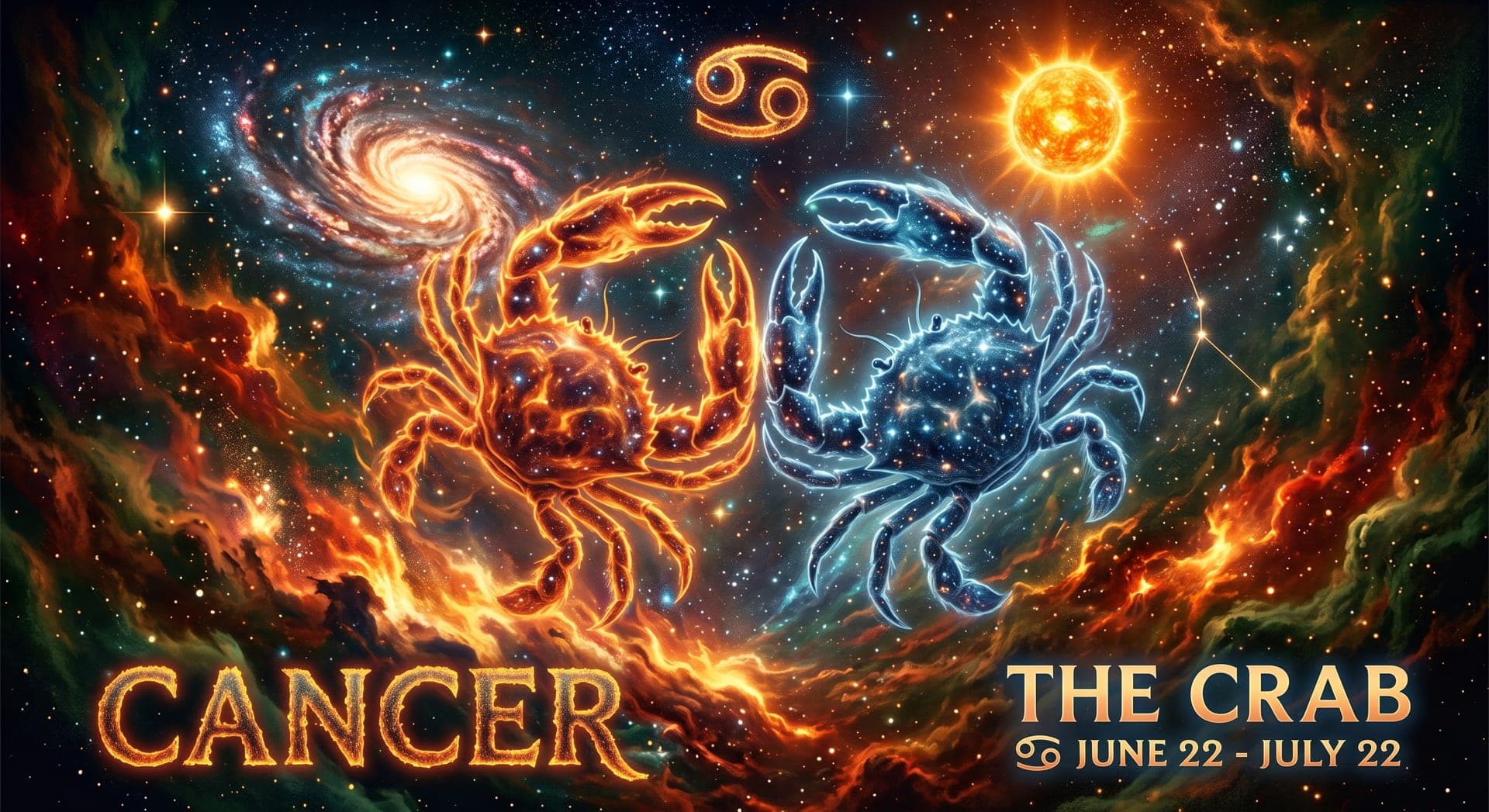
Born on June 21: Cancer ♋
Cancer, the fourth sign of the zodiac, spans June 21 to July 22 and is symbolized by the crab, an animal known for carrying a protective shell while remaining soft and vulnerable underneath. Ruled by the Moon, the celestial body long associated with emotion, intuition, and the subconscious, Cancer is widely regarded as one of the most nurturing and emotionally attuned signs of the zodiac. As a Water sign, Cancer navigates the world through deep feeling, often forming strong emotional bonds and an acute sensitivity to the moods of others. Its Cardinal modality places it at the start of summer, beginning right at the June solstice, reflecting an instinct to initiate and create, especially around home and family. People born under this sign tend to be deeply loyal, protective of loved ones, and drawn to creating a comfortable, secure home environment. Cancer's emotional depth is a genuine strength, but it can also make the sign prone to moodiness or withdrawal when hurt, retreating like a crab into its shell until it feels safe enough to re-emerge.
Personality Traits
Strengths
- Deeply caring and nurturing
- Highly intuitive
- Fiercely loyal and protective
- Strong sense of family and tradition
- Emotionally perceptive
Weaknesses
- Prone to moodiness
- Overly sensitive to criticism
- Can be clingy
- Tends to hold grudges
- Retreats when hurt
Compatible Signs
Fun Facts
- Cancer's crab symbol comes from Greek mythology, where the goddess Hera placed a crab that had fought Hercules among the stars.
- Cancer is ruled by the Moon, the only zodiac sign ruled by a celestial body other than a planet.
- As a Cardinal sign, Cancer initiates summer, beginning at the June solstice, the longest day of the year in the Northern Hemisphere.
- Notable Cancers include Princess Diana, Tom Hanks, Ariana Grande, and Nelson Mandela.
- The crab's hard shell and soft interior are often used as a metaphor for Cancer's protective exterior guarding a deeply sensitive emotional core.
Born on June 21
- 1706
John Dollond
English optician and astronomer who developed and patented the achromatic refracting telescope lens, founding what became the renowned Dollond & Aitchison optical firm.
- 1825
William Stubbs
English historian and Anglican bishop whose pioneering work on medieval constitutional history helped establish history as a rigorous academic discipline at Oxford.
- 1884
Claude Auchinleck
English field marshal who commanded British and Indian forces in North Africa and India during the Second World War, later serving as the last Commander-in-Chief of British India.
- 1905
Jean-Paul Sartre
French existentialist philosopher and author
- 1921
Judy Holliday
American actress and singer
- 1921
Jane Russell
American actress of classic Hollywood cinema
- 1944
Ray Davies
English singer-songwriter and guitarist who founded the Kinks and wrote many of British rock's most enduring songs, including 'Waterloo Sunset' and 'You Really Got Me.'
- 1944
Tony Scott
English film director known for high-energy Hollywood blockbusters such as Top Gun, Crimson Tide and Beverly Hills Cop II, and the younger brother of director Ridley Scott.
- 1948
Ian McEwan
English novelist and Booker Prize winner celebrated for darkly psychological fiction including Amsterdam and Atonement.
- 1955
Michel Platini
French footballer and sports administrator
- 1982
William, Prince of Wales
British royal and heir apparent to the throne, second in line after his father King Charles III, known for his environmental and mental-health advocacy.
- 1983
Edward Snowden
American former intelligence contractor and whistleblower

On This Day in History
- 217 BCE
Carthaginian general Hannibal ambushes and destroys a Roman army at the Battle of Lake Trasimene during the Second Punic War.
Carthaginian general Hannibal ambushed and annihilated a Roman army along the shores of Lake Trasimene during the Second Punic War, exploiting thick morning fog to trap Roman legions between the lake and surrounding hills in one of the most devastating single-day defeats in Roman military history.
- 217 BCE
Hannibal's Carthaginian army destroyed a Roman force under Gaius Flaminius at Lake Trasimene.
During the Second Punic War, Hannibal lured the Roman consul's army into a narrow lakeside pass and ambushed it from the surrounding hills. Roughly 15,000 Roman soldiers were killed in one of the largest ambushes in military history, and Flaminius himself died in the fighting. The catastrophic defeat left Rome temporarily undefended and deepened the crisis that Hannibal's invasion of Italy had created.
- 533
Byzantine general Belisarius set sail from Constantinople to reconquer North Africa from the Vandals.
Commissioned by Emperor Justinian I, Belisarius led a fleet and army intended to overthrow the Vandal Kingdom that had ruled Roman North Africa for a century. The campaign proved swift and successful, restoring the region to Byzantine control within months. It was the opening move in Justinian's broader project to reclaim the western territories of the old Roman Empire.
- 1582
Japanese warlord Oda Nobunaga is betrayed and forced to take his own life by one of his generals in the Honno-ji Incident.
Japanese warlord Oda Nobunaga was betrayed by one of his own generals, Akechi Mitsuhide, and forced to take his own life when his temple headquarters at Honno-ji was surrounded and set ablaze, a sudden downfall that dramatically altered the course of Japan's ongoing unification during the Sengoku period.
- 1582
Japanese warlord Oda Nobunaga was forced to take his own life after a betrayal by his general Akechi Mitsuhide.
Nobunaga, one of the most powerful daimyo in Japan and a key unifier of the country, was staying at Honno-ji temple in Kyoto when Mitsuhide's troops surrounded it in a sudden coup. Rather than be captured, Nobunaga set the temple ablaze and died by seppuku. His death threw the unification process into turmoil, though it was soon carried forward by his successor Toyotomi Hideyoshi.
- 1749
The city of Halifax, Nova Scotia, is founded by British settlers.
British colonial settlers under Edward Cornwallis founded the city of Halifax in present-day Nova Scotia, establishing a strategically positioned military and naval base intended to counterbalance French colonial influence at the nearby fortress of Louisbourg during ongoing imperial rivalry in North America. Halifax's deep, ice-free harbor made it an enduringly valuable British naval asset for the following two centuries.
- 1788
New Hampshire becomes the ninth state to ratify the U.S. Constitution, providing the decisive vote needed for it to take effect.
New Hampshire became the ninth state to ratify the United States Constitution, providing the decisive vote needed to meet the threshold required for the Constitution to formally take effect and establish the new federal government, even though several larger states, including Virginia and New York, had not yet ratified it.
- 1788
New Hampshire became the ninth state to ratify the United States Constitution.
New Hampshire's ratification provided the decisive vote needed to bring the Constitution into effect, since the document required approval from nine of the thirteen states. Although Virginia and New York had not yet ratified, their participation was considered essential, and both followed within weeks. The new federal government began operating under the Constitution the following year.
- 1798
British crown forces crushed the main body of Irish rebels at the Battle of Vinegar Hill.
Fought near Enniscorthy in County Wexford, the battle saw thousands of British troops attack the hilltop camp of United Irishmen rebels who had held the area for weeks. The rebels were routed with heavy losses, effectively breaking the back of the 1798 Irish Rebellion, though sporadic fighting continued elsewhere in Ireland for several more weeks.
- 1813
The Duke of Wellington defeats French forces under Joseph Bonaparte at the Battle of Vitoria during the Peninsular War.
The Duke of Wellington led Anglo-Portuguese-Spanish forces to a decisive victory over French troops commanded by Joseph Bonaparte at the Battle of Vitoria during the Peninsular War, a defeat that effectively shattered French control over Spain and forced a general retreat toward the Pyrenees.
- 1813
The Duke of Wellington won a decisive victory over Joseph Bonaparte's army at the Battle of Vitoria.
Wellington's Anglo-Portuguese-Spanish force routed the French army defending Napoleon's brother Joseph, who had been installed as King of Spain, in northern Spain. The rout effectively ended French control of the country and forced Joseph to abandon his throne. The victory was a turning point in the Peninsular War and inspired Beethoven's orchestral work Wellington's Victory.
- 1898
American forces capture the island of Guam from Spain during the Spanish-American War.
American naval and land forces captured the island of Guam from Spanish colonial control during the Spanish-American War, a relatively swift and low-casualty operation that placed the strategically located Pacific island under United States control, where it has remained an American territory ever since.
- 1898
United States forces captured the Spanish colony of Guam during the Spanish-American War.
A US Navy cruiser arrived off Guam and, finding the small Spanish garrison unaware that war had even broken out, accepted its surrender without a fight. The bloodless capture gave the United States a strategic Pacific coaling station. Guam was formally ceded to the US under the Treaty of Paris later that year, ending nearly two centuries of Spanish rule.
- 1919
The interned German High Seas Fleet was scuttled by its own crews at Scapa Flow.
Believing peace talks had collapsed, Admiral Ludwig von Reuter ordered his officers to sink their own ships rather than let them be seized by the Allies under the terms of the Armistice. Most of the fleet went down in the Orkney anchorage; British guard vessels opened fire on the scuttling sailors, killing nine of them, among the last deaths of the First World War.
- 1921
British forces burned much of the Irish village of Knockcroghery during the War of Independence.
In a reprisal common to the final phase of the Irish War of Independence, Crown forces set fire to the County Roscommon village, destroying most of its houses and its traditional clay-pipe-making workshops. The attack came just weeks before a truce ended the conflict, and Knockcroghery became a lasting symbol of the destruction visited on rural communities during the war.
- 1945
Organized Japanese resistance collapses at the end of the brutal Battle of Okinawa.
Organized Japanese military resistance collapsed at the conclusion of the brutal, prolonged Battle of Okinawa, one of the deadliest engagements of the Pacific War, whose staggering casualties on both sides significantly influenced later American calculations regarding the potential human cost of invading Japan's home islands.
- 1963
Cardinal Giovanni Battista Montini is elected pope, taking the name Paul VI.
Cardinal Giovanni Battista Montini was elected pope following the death of Pope John XXIII, taking the name Paul VI and going on to oversee the conclusion of the transformative Second Vatican Council, guiding significant reforms in Catholic Church practice and liturgy during his subsequent fifteen-year papacy.
- 1989
The U.S. Supreme Court rules that burning the American flag as political protest is protected free speech.
The U.S. Supreme Court ruled in "Texas v. Johnson" that burning the American flag as a form of political protest constitutes protected speech under the First Amendment, a controversial decision that struck down state laws criminalizing flag desecration and prompted subsequent unsuccessful congressional efforts to amend the Constitution.
- 2000
The Scottish Parliament repealed Section 28, the law restricting discussion of homosexuality in schools.
Scotland became the first part of Britain to scrap the controversial clause, which had barred local authorities and schools from 'promoting' homosexuality since 1988. The repeal followed a heated public campaign and was fiercely contested, but passed comfortably in the devolved parliament. England and Wales did not follow suit until 2003, making Scotland's move a significant marker in UK LGBT rights history.
- 2004
SpaceShipOne becomes the first privately funded crewed vehicle to reach the edge of space.
SpaceShipOne, a privately developed and funded suborbital spacecraft, became the first non-government-built crewed vehicle to reach the recognized edge of space, a milestone achievement that helped launch the modern commercial spaceflight industry and later inspired the development of Virgin Galactic's tourism program.