
What’s Observed on June 20
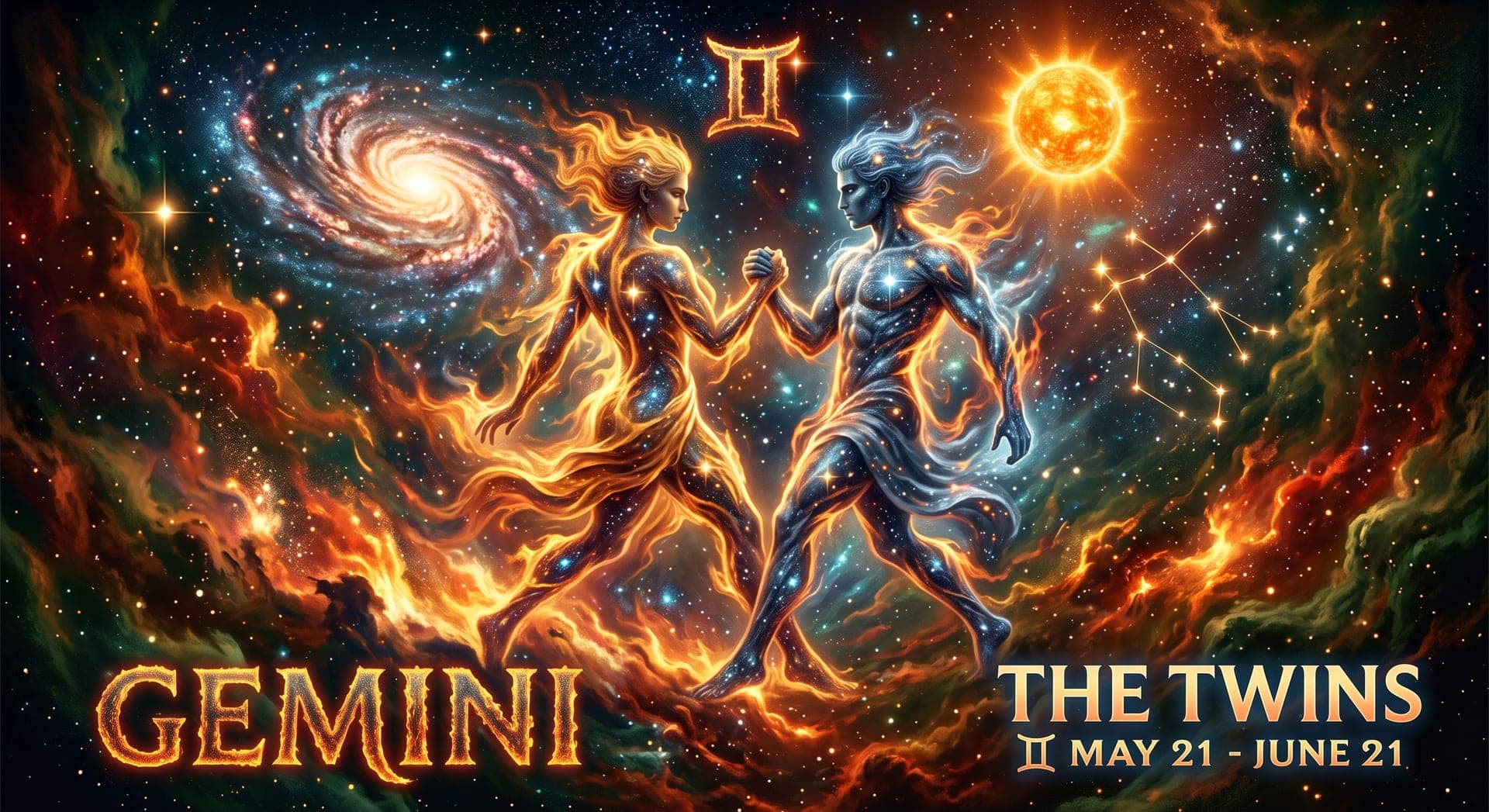
Born on June 20: Gemini ♊
Gemini, the third sign of the zodiac, spans May 21 to June 20 and is symbolized by twins, representing the sign's dual nature and its ability to see multiple sides of any situation at once. Ruled by Mercury, the planet of communication and intellect, Gemini is widely regarded as one of the most talkative, curious, and quick-witted signs of the zodiac, constantly gathering new information and ideas. As an Air sign, Gemini approaches the world primarily through thought and conversation, thriving on mental stimulation and social interaction. Its Mutable modality reflects a restless adaptability, since Gemini tends to resist routine and prefers variety, novelty, and the freedom to change course whenever something more interesting comes along. People born under this sign are often skilled communicators, natural storytellers, and quick learners who can hold their own in nearly any conversation. That same adaptability can also come across as inconsistency, and Gemini's dual nature sometimes earns an unfair reputation for being two-faced, when in reality it simply reflects genuine curiosity about every side of a story.
Personality Traits
Strengths
- Quick-witted and intelligent
- Excellent communicator
- Adaptable to new situations
- Curious and eager to learn
- Charming and sociable
Weaknesses
- Prone to inconsistency
- Can be superficial
- Easily bored
- Indecisive
- Tendency to gossip
Compatible Signs
Fun Facts
- Gemini's twin symbol traces back to the Greek myth of Castor and Pollux, twin brothers placed among the stars as the constellation Gemini.
- Mercury, Gemini's ruling planet, was the swift Roman messenger god, reflecting the sign's associations with communication and quick thinking.
- Gemini is one of only a few zodiac signs represented by human figures rather than animals or objects.
- Notable Geminis include Marilyn Monroe, Kanye West, Angelina Jolie, and John F. Kennedy.
- Gemini season overlaps with the transition from spring to summer in the Northern Hemisphere, reflecting the sign's changeable, in-between nature.
Born on June 20
- 1723
Adam Ferguson
Scottish philosopher and historian, a key figure of the Scottish Enlightenment known for his writings on civil society.
- 1819
Jacques Offenbach
French composer known for operettas
- 1861
Frederick Gowland Hopkins
English biochemist who discovered essential vitamins, awarded the Nobel Prize in Physiology or Medicine in 1929.
- 1875
Reginald Punnett
English geneticist who co-founded the field of genetics in Britain and devised the Punnett square used to predict inheritance patterns.
- 1905
Lillian Hellman
American playwright and screenwriter
- 1906
Catherine Cookson
English novelist whose prolific output of romantic and historical fiction, often set in her native North East England, made her one of Britain's best-selling authors.
- 1909
Errol Flynn
Australian-American actor known for swashbuckling film roles
- 1915
Terence Young
British film director best known for directing the first three James Bond films, "Dr. No," "From Russia with Love," and "Thunderball"
- 1924
Chet Atkins
American guitarist and record producer
- 1925
Audie Murphy
American war hero and actor, Medal of Honor recipient
- 1941
Stephen Frears
English film director known for movies including My Beautiful Laundrette, Dangerous Liaisons, and The Queen.
- 1949
Lionel Richie
American singer-songwriter
- 1951
Paul Muldoon
Northern Irish poet and academic celebrated for his inventive, allusive verse, awarded the Pulitzer Prize for Poetry in 2003.
- 1967
Nicole Kidman
Australian-American actress
- 1978
Frank Lampard
English footballer and manager, one of Chelsea's all-time leading goalscorers during a long career as a midfielder.

On This Day in History
- 451
Roman and allied forces under Flavius Aetius fight Attila the Hun to an inconclusive draw at the Battle of Chalons, prompting Attila's retreat from Gaul.
A coalition of Roman and allied Germanic forces under General Flavius Aetius fought Attila the Hun's invading army to a costly, inconclusive draw at the Battle of Chalons in Gaul, a clash often cited by historians as having helped check Hunnic expansion into Western Europe, prompting Attila's eventual withdrawal.
- 451
A Roman and allied army under Flavius Aetius fights Attila the Hun to an inconclusive but strategically decisive draw at the Battle of Chalons.
One of the last major military efforts of the Western Roman Empire, the battle brought together Romans, Visigoths, and other allies to halt Attila's invasion of Gaul. Although neither side achieved a clear victory, Attila's subsequent withdrawal marked a significant check on Hunnic expansion into Western Europe and is often cited as one of history's most consequential battles.
- 1685
James Scott, 1st Duke of Monmouth, declares himself king at Bridgwater during his rebellion against James II.
The illegitimate son of Charles II, Monmouth had landed in England weeks earlier to challenge his Catholic uncle James II's claim to the throne, rallying support among Protestant dissenters in the West Country. His self-proclamation at Bridgwater marked the height of his rebellion, which collapsed days later at the Battle of Sedgemoor, after which Monmouth was captured and executed.
- 1756
A British garrison is imprisoned overnight in a small cell in Calcutta following the city's capture, an incident that became known as the Black Hole of Calcutta.
After Siraj ud-Daulah, the Nawab of Bengal, seized the British East India Company's Fort William, dozens of British prisoners were reportedly confined overnight in a cramped guardroom, with many dying from suffocation and heat exhaustion. Accounts of the incident's scale have long been disputed by historians, but it was used at the time to help justify Britain's subsequent military campaigns in Bengal.
- 1789
Members of France's Third Estate take the Tennis Court Oath, pledging not to disband until a new constitution is established.
Members of France's Third Estate, locked out of their usual meeting hall, gathered instead at a nearby indoor tennis court and swore the Tennis Court Oath, pledging not to disband until a new French constitution had been established, a defiant act widely regarded as a decisive early moment of the French Revolution.
- 1819
The SS Savannah arrives at Liverpool, completing the first Atlantic crossing by a steam-powered vessel.
Although the ship relied mainly on sails and used its steam engine for only a fraction of the twenty-nine-day voyage from Savannah, Georgia, its arrival in the major British port demonstrated the feasibility of steam propulsion for ocean travel. The crossing is widely regarded as a milestone on the path toward the transatlantic steamship lines that would later transform travel and trade between Europe and America.
- 1837
King William IV of Britain dies, and his niece Victoria ascends to the throne.
King William IV of Britain died without a legitimate surviving heir, and his eighteen-year-old niece Victoria ascended to the throne, beginning a reign of 63 years that would come to define an entire era of British history and global influence known as the Victorian Age.
- 1837
King William IV dies and is succeeded by his niece, who becomes Queen Victoria.
The eighteen-year-old princess was woken before dawn to be told of her uncle's death and her accession to the throne. Her reign, the longest in British history until surpassed by Elizabeth II, spanned sweeping industrial, imperial, and social change, and the era that bears her name came to define much of nineteenth-century Britain and its empire.
- 1840
Samuel Morse receives a patent for the telegraph.
Inventor Samuel Morse received a U.S. patent for his telegraph system and the accompanying Morse code, a technology that revolutionized long-distance communication by allowing messages to be transmitted almost instantly over wires, fundamentally transforming commerce, journalism, and military coordination in the following decades.
- 1863
West Virginia is admitted to the Union as the 35th state, having split from Confederate Virginia.
West Virginia was admitted to the Union as the 35th state, having formally broken away from Confederate Virginia during the Civil War in a rare instance of a state splitting apart amid the conflict, reflecting the region's stronger Unionist sentiment and distinct economic interests from the rest of Virginia.
- 1877
Alexander Graham Bell installs the world's first commercial telephone service in Hamilton, Ontario.
Alexander Graham Bell personally installed the world's first commercial telephone service, connecting a business in Hamilton, Ontario, to enable regular paid telephone communication, an early practical application of his recently patented invention. The service quickly proved its commercial viability, and telephone exchanges expanded rapidly across North America and Europe within just a few years, transforming business and personal communication.
- 1900
A fifty-five-day siege of the foreign legation quarter, including the British legation, begins in Beijing during the Boxer Rebellion.
Boxer rebels and Qing troops surrounded the diplomatic compound housing foreign envoys and their families, including British minister Claude MacDonald, who organized the legations' defense. The besieged foreigners and Chinese Christian refugees held out under sustained attack until relieved by the Eight-Nation Alliance in August, an episode that dramatically heightened Western intervention in China.
- 1921
Textile workers at the British-owned Buckingham and Carnatic Mills in Madras begin a four-month strike.
Thousands of workers walked out over pay and working conditions at the mills, among the largest textile employers in British India, in a dispute that dragged on for months and drew in nationalist labor organizers. The strike became a significant episode in the growth of the Indian labor movement during the colonial period.
- 1944
The Battle of the Philippine Sea concludes in a lopsided American naval victory nicknamed the "Great Marianas Turkey Shoot."
The Battle of the Philippine Sea concluded with an overwhelming American naval and air victory over Japan, a lopsided engagement nicknamed the "Great Marianas Turkey Shoot" for the staggering number of Japanese aircraft destroyed, further crippling Japan's already depleted carrier-based air power in the Pacific War.
- 1960
The Mali Federation gains independence from France, later splitting into the separate nations of Mali and Senegal.
The Mali Federation, a short-lived union combining the former French colonial territories of French Sudan and Senegal, achieved independence from France, though internal political tensions caused the federation to collapse within just months, resulting in the separate independent nations of Mali and Senegal.
- 1975
The film "Jaws" is released in the United States, widely credited with establishing the modern summer blockbuster.
Director Steven Spielberg's film "Jaws" was released in American theaters, becoming an enormous, unprecedented box office success that is widely credited by film historians with creating the modern concept of the wide-release summer blockbuster, permanently reshaping Hollywood's marketing and distribution strategies.
- 1982
Argentine forces at the Corbeta Uruguay base on Southern Thule surrender, formally ending the Falklands War.
Although the main Argentine garrison at Stanley had surrendered days earlier, a small scientific and military outpost on the remote South Sandwich Islands held out until British forces compelled its surrender, bringing the last vestige of Argentine military presence in the South Atlantic to a close and formally concluding the conflict.
- 1990
A magnitude 7.4 earthquake strikes northern Iran, killing tens of thousands of people.
The quake devastated the Manjil and Rudbar regions, flattening towns and villages with little warning and killing an estimated 35,000 to 50,000 people while injuring hundreds of thousands more. It remains one of the deadliest earthquakes of the twentieth century and prompted major reforms to Iran's building codes and disaster preparedness systems.
- 2003
The Wikimedia Foundation is established in Florida to support Wikipedia and related projects.
The Wikimedia Foundation was formally established in St. Petersburg, Florida, to provide organizational and financial support for Wikipedia and its sister collaborative knowledge projects, formalizing the nonprofit structure behind what had already become one of the internet's most visited reference resources.
- 2003
The Wikimedia Foundation, the nonprofit organization behind Wikipedia, is founded in St. Petersburg, Florida.
Established by Jimmy Wales to provide a stable organizational and financial home for Wikipedia and its sister projects, the foundation took over ownership of the online encyclopedia from Wales's earlier for-profit venture. It has since grown into one of the most visited nonprofit websites in the world, supporting Wikipedia's expansion into hundreds of languages.