What’s Observed on May 21
Born on May 21: Gemini ♊
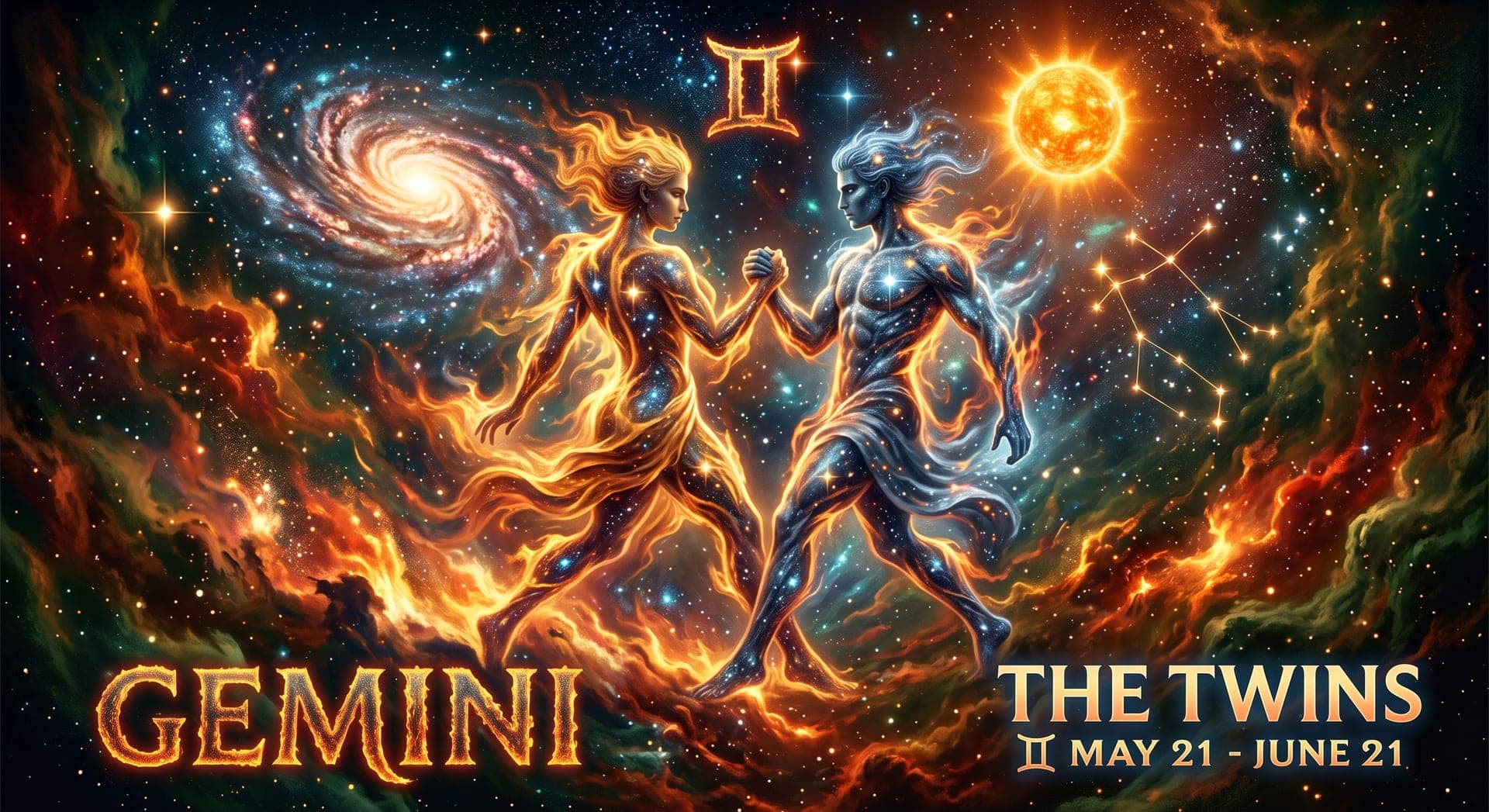
Gemini, the third sign of the zodiac, spans May 21 to June 20 and is symbolized by twins, representing the sign's dual nature and its ability to see multiple sides of any situation at once. Ruled by Mercury, the planet of communication and intellect, Gemini is widely regarded as one of the most talkative, curious, and quick-witted signs of the zodiac, constantly gathering new information and ideas. As an Air sign, Gemini approaches the world primarily through thought and conversation, thriving on mental stimulation and social interaction. Its Mutable modality reflects a restless adaptability, since Gemini tends to resist routine and prefers variety, novelty, and the freedom to change course whenever something more interesting comes along. People born under this sign are often skilled communicators, natural storytellers, and quick learners who can hold their own in nearly any conversation. That same adaptability can also come across as inconsistency, and Gemini's dual nature sometimes earns an unfair reputation for being two-faced, when in reality it simply reflects genuine curiosity about every side of a story.
Personality Traits
Strengths
- Quick-witted and intelligent
- Excellent communicator
- Adaptable to new situations
- Curious and eager to learn
- Charming and sociable
Weaknesses
- Prone to inconsistency
- Can be superficial
- Easily bored
- Indecisive
- Tendency to gossip
Compatible Signs
Fun Facts
- Gemini's twin symbol traces back to the Greek myth of Castor and Pollux, twin brothers placed among the stars as the constellation Gemini.
- Mercury, Gemini's ruling planet, was the swift Roman messenger god, reflecting the sign's associations with communication and quick thinking.
- Gemini is one of only a few zodiac signs represented by human figures rather than animals or objects.
- Notable Geminis include Marilyn Monroe, Kanye West, Angelina Jolie, and John F. Kennedy.
- Gemini season overlaps with the transition from spring to summer in the Northern Hemisphere, reflecting the sign's changeable, in-between nature.
Born on May 21
- 1471
Albrecht Dürer
German Renaissance painter and printmaker
- 1527
Philip II of Spain
King of Spain during its imperial golden age
- 1688
Alexander Pope
English poet and satirist renowned for works such as "The Rape of the Lock" and his translation of Homer's Iliad.
- 1780
Elizabeth Fry
English Quaker philanthropist and prison reformer whose campaigning transformed conditions for women in British prisons.
- 1799
Mary Anning
English fossil collector and paleontologist whose discoveries along the Jurassic Coast reshaped early understanding of prehistoric life.
- 1844
Henri Rousseau
French post-impressionist painter
- 1904
Fats Waller
American jazz pianist and composer
- 1917
Raymond Burr
Canadian-American actor known for "Perry Mason"
- 1941
Martin Carthy
English folk singer and guitarist celebrated for his influential arrangements of traditional English ballads.
- 1949
Andrew Neil
Scottish journalist and broadcaster known for editing The Sunday Times and hosting political programs including This Week.
- 1957
Nadine Dorries
English politician and novelist who served as UK Secretary of State for Digital, Culture, Media and Sport.
- 1973
Noel Fielding
English comedian, musician, and television presenter, co-creator of The Mighty Boosh and host of The Great British Bake Off.

On This Day in History
- 878
The Sicilian city of Syracuse falls to Aghlabid Muslim forces after a nine-month siege.
The Sicilian city of Syracuse, once one of the greatest cities of the ancient Greek world, fell to besieging Aghlabid Muslim forces after a grueling nine-month siege that had reduced its defenders to starvation, a major strategic loss for the Byzantine Empire that further consolidated Muslim Arab control over the island of Sicily.
- 1424
James I is crowned King of Scotland at Scone.
James I was crowned King of Scotland at Scone Abbey following his release from over eighteen years of captivity in England, where he had been held as a diplomatic hostage since childhood, beginning a reign focused on aggressively consolidating royal authority against Scotland's traditionally powerful and unruly nobility.
- 1424
James I is crowned King of Scots at Scone Abbey.
James returned to Scotland only weeks earlier after eighteen years held captive in England, having been seized by pirates as a boy and kept as a hostage by the English crown. His coronation marked the start of a reign focused on strengthening royal authority over Scotland's powerful nobility, reforms that made him one of the most consequential and, ultimately, most resented Stewart monarchs.
- 1554
Queen Mary I grants a royal charter establishing Derby School in England.
The charter formalized the refoundation of an existing grammar school in Derby under royal patronage, part of a broader pattern of Tudor monarchs endowing and regulating England's grammar schools. Such institutions became central to educating the sons of the gentry and professional classes, and many, including Derby School, continued operating for centuries afterward.
- 1703
Writer Daniel Defoe is imprisoned in London on charges of seditious libel.
Defoe was jailed after publishing 'The Shortest Way with the Dissenters,' a satirical pamphlet mocking persecution of religious nonconformists that was taken literally and condemned by the establishment it mocked. He was pilloried before his release, an ordeal that instead won him public sympathy. Defoe went on to become one of England's most prolific writers, later authoring Robinson Crusoe.
- 1792
A collapsing lava dome on Japan's Mount Unzen triggers a catastrophic tsunami, killing an estimated 15,000 people.
The catastrophic collapse of a lava dome on Japan's Mount Unzen during a volcanic eruption triggered a massive tsunami that struck the Shimabara Peninsula and Higo Province, killing an estimated 15,000 people in what remains one of the deadliest volcanic-related disasters in recorded Japanese history.
- 1799
Napoleon Bonaparte abandons his two-month siege of Acre, marking one of his few major defeats.
Napoleon Bonaparte abandoned his two-month siege of the fortress city of Acre in present-day Israel after repeatedly failing to breach its defenses, partly due to British naval support for the Ottoman defenders, a rare and significant setback during his otherwise highly successful early Middle Eastern military campaign.
- 1809
The Battle of Aspern-Essling begins along the Danube River between Austrian and French forces, ending in one of Napoleon's rare defeats.
Austrian forces under Archduke Charles inflicted a costly, unexpected defeat on Napoleon's army at the Battle of Aspern-Essling along the Danube River near Vienna, marking one of the first major battlefield losses of Napoleon's entire military career and a significant morale boost for the anti-French coalition.
- 1881
Clara Barton founds the American Red Cross in Dansville, New York.
Humanitarian Clara Barton, inspired by her earlier battlefield nursing work during the Civil War and her exposure to the International Red Cross movement in Europe, founded the American Red Cross in Dansville, New York, establishing an organization that became a central pillar of American disaster relief, blood donation, and emergency response for well over a century.
- 1894
Queen Victoria formally opens the Manchester Ship Canal, connecting Manchester to the sea.
Stretching 36 miles from the Mersey Estuary to docks in Manchester, the canal allowed oceangoing ships to reach the inland city directly, transforming it into Britain's third-busiest port despite lying far from the coast. The enormous engineering project, one of the largest of the Victorian era, boosted Manchester's industrial economy for decades until changing shipping patterns eroded its importance in the later twentieth century.
- 1904
FIFA, the international governing body for association football, is founded in Paris.
Representatives from seven European football associations, notably excluding England's, founded FIFA in Paris to establish common international rules and organize matches between national teams, laying the institutional foundation for the governing body that now oversees the immensely popular quadrennial World Cup and global football on a massive scale.
- 1917
The Imperial War Graves Commission is established by royal charter to commemorate British and Commonwealth war dead.
Founded largely through the efforts of Fabian Ware, the commission set out the principle that all fallen service members, regardless of rank, would receive equal, permanent memorials near where they fell. It went on to design and maintain war cemeteries across former battlefields worldwide, and continues today as the Commonwealth War Graves Commission, caring for over a million graves.
- 1927
Charles Lindbergh completes the world's first solo nonstop transatlantic flight, landing at Le Bourget Field near Paris.
Charles Lindbergh landed at Le Bourget Field near Paris, completing the world's first solo nonstop transatlantic flight after roughly 33.5 grueling, sleep-deprived hours in the air, and was greeted by a massive, ecstatic crowd of an estimated 150,000 people that instantly transformed him into a global celebrity and aviation hero.
- 1927
Charles Lindbergh lands at Le Bourget Field in Paris, completing the first solo nonstop transatlantic flight.
Lindbergh's arrival, roughly 33.5 hours after departing New York, was met by a jubilant crowd of tens of thousands. The flight proved that long-distance air travel across the Atlantic was possible and made Lindbergh a global celebrity almost overnight, accelerating public and commercial interest in aviation throughout the following decade.
- 1966
The loyalist paramilitary group Ulster Volunteer Force publicly declares war on the IRA.
Revived in Belfast amid rising sectarian tension ahead of the fiftieth anniversary of the Easter Rising, the reconstituted UVF issued the declaration shortly before carrying out its first killings. The group's campaign of violence against Catholics and republicans became one of the defining loyalist forces of the Troubles, the decades of conflict in Northern Ireland that followed.
- 1982
British forces land at San Carlos Water, opening the ground campaign to retake the Falkland Islands.
Operation Sutton put thousands of British troops ashore on East Falkland under cover of darkness, establishing a beachhead despite fierce Argentine air attacks on the supporting fleet in what became known as 'Bomb Alley.' The landings marked the start of the final phase of the Falklands War, leading to Argentina's surrender less than a month later.
- 1988
Prime Minister Margaret Thatcher delivers her 'Sermon on the Mound' address to the Church of Scotland's General Assembly.
Speaking to the Kirk's assembly in Edinburgh, Thatcher set out a theological defense of individualism and free-market economics, arguing that Christianity was compatible with personal wealth creation. The speech, delivered on the Mound where the assembly hall stands, drew sharp criticism from many Scottish clergy and became emblematic of tensions between Thatcher's government and Scottish public opinion.
- 1991
Former Indian Prime Minister Rajiv Gandhi is assassinated by a suicide bomber near Madras.
Former Indian Prime Minister Rajiv Gandhi was assassinated by a suicide bomber affiliated with the Sri Lankan Tamil Tigers militant group while campaigning at a political rally near Madras, a shocking killing that occurred during an already tense general election campaign and echoed his own mother Indira Gandhi's earlier assassination.
- 1991
Former Indian Prime Minister Rajiv Gandhi is assassinated by a suicide bomber in Tamil Nadu.
Gandhi was killed while campaigning at an election rally in Sriperumbudur when a female suicide bomber linked to the Sri Lankan militant group LTTE detonated an explosive device, also killing more than a dozen bystanders. His assassination came seven years after his mother, Indira Gandhi, was also assassinated, and it shocked a nation already scarred by political violence.
- 2006
Montenegro holds a referendum in which a majority votes for independence from its union with Serbia.
Voters in Montenegro narrowly approved independence from their loose federal union with Serbia in a closely watched, high-turnout referendum that cleared the required threshold by a slim margin, removing the final legal barrier to the small Balkan republic's formal declaration of full sovereignty weeks later.