What’s Observed on June 19
Born on June 19: Gemini ♊
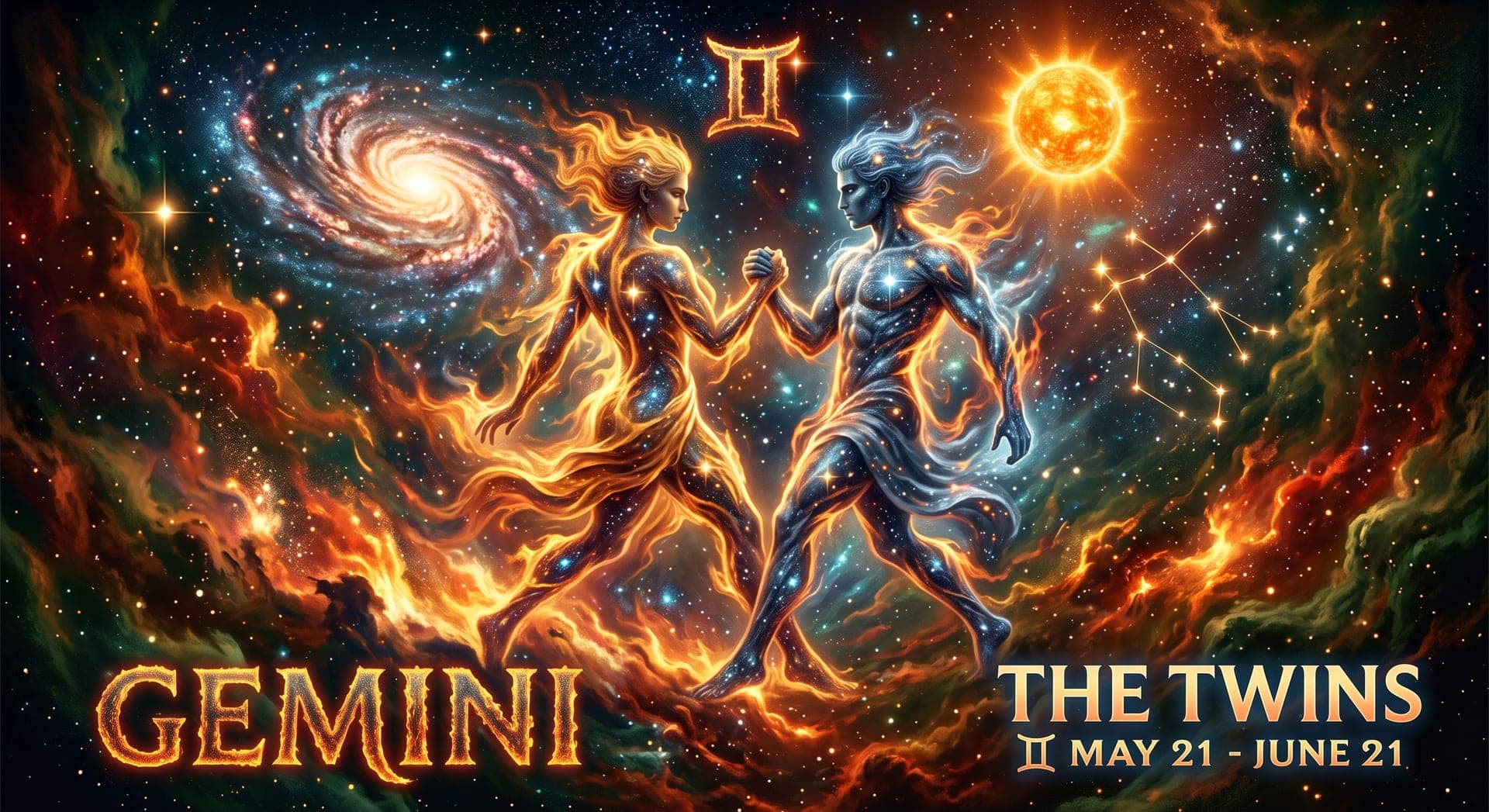
Gemini, the third sign of the zodiac, spans May 21 to June 20 and is symbolized by twins, representing the sign's dual nature and its ability to see multiple sides of any situation at once. Ruled by Mercury, the planet of communication and intellect, Gemini is widely regarded as one of the most talkative, curious, and quick-witted signs of the zodiac, constantly gathering new information and ideas. As an Air sign, Gemini approaches the world primarily through thought and conversation, thriving on mental stimulation and social interaction. Its Mutable modality reflects a restless adaptability, since Gemini tends to resist routine and prefers variety, novelty, and the freedom to change course whenever something more interesting comes along. People born under this sign are often skilled communicators, natural storytellers, and quick learners who can hold their own in nearly any conversation. That same adaptability can also come across as inconsistency, and Gemini's dual nature sometimes earns an unfair reputation for being two-faced, when in reality it simply reflects genuine curiosity about every side of a story.
Personality Traits
Strengths
- Quick-witted and intelligent
- Excellent communicator
- Adaptable to new situations
- Curious and eager to learn
- Charming and sociable
Weaknesses
- Prone to inconsistency
- Can be superficial
- Easily bored
- Indecisive
- Tendency to gossip
Compatible Signs
Fun Facts
- Gemini's twin symbol traces back to the Greek myth of Castor and Pollux, twin brothers placed among the stars as the constellation Gemini.
- Mercury, Gemini's ruling planet, was the swift Roman messenger god, reflecting the sign's associations with communication and quick thinking.
- Gemini is one of only a few zodiac signs represented by human figures rather than animals or objects.
- Notable Geminis include Marilyn Monroe, Kanye West, Angelina Jolie, and John F. Kennedy.
- Gemini season overlaps with the transition from spring to summer in the Northern Hemisphere, reflecting the sign's changeable, in-between nature.
Born on June 19
- 1566
James VI and I
King of Scotland as James VI and later King of England and Ireland as James I, who united the crowns of Scotland and England in 1603.
- 1623
Blaise Pascal
French mathematician and physicist
- 1834
Charles Spurgeon
English Baptist preacher whose sermons drew enormous crowds in London and were widely published, earning him the nickname "the Prince of Preachers."
- 1861
Douglas Haig
Scottish field marshal who commanded British forces on the Western Front for much of World War I, including at the Somme and Passchendaele.
- 1876
Nigel Gresley
Scottish-born engineer who designed some of Britain's most famous steam locomotives, including the Flying Scotsman and the record-breaking Mallard.
- 1896
Wallis Simpson, Duchess of Windsor
American-born socialite whose marriage to King Edward VIII precipitated his abdication from the British throne
- 1897
Cyril Norman Hinshelwood
English chemist awarded the Nobel Prize in Chemistry in 1956 for his work on the kinetics of chemical reactions.
- 1902
Guy Lombardo
Canadian-American bandleader
- 1903
Lou Gehrig
American baseball Hall of Famer
- 1906
Ernst Boris Chain
German-born British biochemist who shared the 1945 Nobel Prize for the discovery and development of penicillin
- 1945
Aung San Suu Kyi
Burmese politician and Nobel Peace Prize laureate
- 1947
Salman Rushdie
Indian-born British novelist best known for the Booker Prize-winning "Midnight's Children" and "The Satanic Verses"
- 1948
Nick Drake
English singer-songwriter and guitarist known for the albums "Five Leaves Left" and "Pink Moon"
- 1963
Rory Underwood
English rugby union player and Royal Air Force pilot, England's all-time leading try scorer for over two decades.
- 1964
Boris Johnson
British politician who served as Prime Minister of the United Kingdom from 2019 to 2022
- 2004
Millie Gibson
English actress known for playing Kelly Neelan in Coronation Street and as a companion in Doctor Who.

On This Day in History
- 325
The First Council of Nicaea adopts the original Nicene Creed, a foundational statement of Christian doctrine.
The First Council of Nicaea, convened by Roman Emperor Constantine and attended by bishops from across the Christian world, adopted the original Nicene Creed, a foundational statement of Christian doctrine addressing the theological nature of Christ that helped resolve the divisive Arian controversy, at least temporarily, within the early church.
- 325
The original Nicene Creed is adopted at the First Council of Nicaea.
Convened by Emperor Constantine to resolve disputes over the nature of Christ, the council of bishops produced a statement of Christian doctrine intended to unify the early church against the Arian teaching that Jesus was a created being distinct from and subordinate to God. The creed, later revised, remains one of the most widely recognized statements of Christian belief.
- 1306
An English army under the Earl of Pembroke defeats Robert the Bruce's Scottish forces at the Battle of Methven.
Only weeks after being crowned King of Scots, Robert the Bruce suffered a crushing surprise defeat near Perth, forcing him into hiding and scattering his supporters. The setback nearly ended his bid for the Scottish crown before it began, but Bruce eventually regrouped to lead Scotland to independence, culminating in victory at Bannockburn in 1314.
- 1586
English colonists abandon the Roanoke Island settlement after failing to establish a permanent foothold in North America.
English colonists abandoned their settlement on Roanoke Island off the coast of present-day North Carolina, having failed to establish a lasting foothold amid supply shortages and tense relations with local Indigenous peoples, an early failed colonization attempt distinct from the later, more mysterious "Lost Colony" expedition to the same site.
- 1586
English colonists abandon Roanoke Island after failing to establish England's first permanent settlement in North America.
Struggling with dwindling supplies and worsening relations with local Native American communities, the settlers accepted a lift home from Sir Francis Drake's passing fleet rather than await a delayed relief ship. A second, better-known Roanoke colony sent the following year vanished entirely, leaving the fate of its settlers one of early colonial history's most enduring mysteries.
- 1791
The first New Church place of worship, the Birmingham New Jerusalem Temple, is dedicated in Birmingham, England.
The congregation followed the theological teachings of Emanuel Swedenborg, whose writings inspired a new Christian denomination in the late eighteenth century. The Birmingham temple's dedication marked the formal establishment of Swedenborgian worship in England, and the New Church subsequently spread to other British cities and, eventually, to North America and beyond.
- 1811
A lavish fête at Carlton House in London celebrates the establishment of the Regency era in Britain.
Held to mark the Prince of Wales's assumption of power as Prince Regent after his father George III was declared unfit to rule, the event drew around 2,000 guests to an extravagantly decorated banquet, including a canal of water running the length of the table stocked with live fish. It epitomized the opulence associated with Regency high society.
- 1816
Fighters aligned with the North West Company clash with Hudson's Bay Company settlers at the Battle of Seven Oaks near present-day Winnipeg.
The confrontation, fought over control of the fur trade and land rights in the Red River Colony, left the colony's governor and about twenty others dead. It stands as one of the most violent episodes in the long rivalry between the two British fur-trading companies, a conflict that only ended with their merger in 1821.
- 1846
The first officially recorded organized baseball game under Alexander Cartwright's rules is played in Hoboken, New Jersey.
The first officially recorded organized baseball game played under a formal, written set of rules developed by Alexander Cartwright's Knickerbocker Base Ball Club took place in Hoboken, New Jersey, a codification widely regarded as a foundational milestone in the development of modern American baseball.
- 1862
President Abraham Lincoln signs legislation prohibiting slavery in all U.S. territories.
President Abraham Lincoln signed legislation prohibiting slavery in all existing and future U.S. territories, a significant step restricting slavery's geographic expansion during the Civil War, taken months before Lincoln's more famous Emancipation Proclamation addressed slavery within the rebelling Confederate states themselves.
- 1865
Union troops arrive in Galveston, Texas, and announce that all enslaved people are free, an event commemorated today as Juneteenth.
Union Major General Gordon Granger arrived in Galveston, Texas, and announced General Order No. 3, informing the state's enslaved population that they were free, more than two years after the Emancipation Proclamation had technically freed them, an event now commemorated nationally as Juneteenth.
- 1867
Emperor Maximilian I of Mexico is executed by firing squad following the collapse of French-backed rule.
Emperor Maximilian I of Mexico, an Austrian archduke installed as ruler by French intervention, was captured and executed by firing squad following the collapse of French military support and the resurgence of Mexican republican forces under Benito Juarez, ending a brief and unpopular foreign-imposed monarchy.
- 1910
The first Father's Day observance in the United States is held in Spokane, Washington.
Sonora Smart Dodd organized the first known Father's Day observance in the United States at the YMCA in Spokane, Washington, inspired by her own father, a Civil War veteran who raised six children alone, a modest local event that eventually grew into a nationally recognized holiday formally established by presidential proclamation decades later.
- 1921
British forces burn much of the village of Knockcroghery, Ireland, during the Irish War of Independence.
Crown forces set fire to homes and businesses in the County Roscommon village in reprisal for an ambush on a police patrol nearby, destroying the village's traditional clay pipe-making industry along with dozens of buildings. The burning was one of many reprisal attacks carried out by British forces against civilian communities during the guerrilla conflict.
- 1953
Julius and Ethel Rosenberg are executed for espionage after being convicted of passing atomic secrets to the Soviet Union.
Julius and Ethel Rosenberg were executed in the electric chair at Sing Sing Correctional Facility after being convicted of conspiracy to commit espionage for allegedly passing American atomic bomb secrets to the Soviet Union, a controversial case that remains debated regarding the extent of Ethel's actual involvement.
- 1953
Julius and Ethel Rosenberg are executed at Sing Sing prison after being convicted of conspiracy to commit espionage for the Soviet Union.
The couple were convicted of passing atomic secrets to the Soviets during and after the Second World War, in a case that became one of the most controversial of the early Cold War. Their execution, carried out despite international appeals for clemency, left their two young sons orphaned and remains debated by historians over the extent of Ethel's actual involvement.
- 1961
Kuwait declares independence from the United Kingdom.
Kuwait formally declared independence from the United Kingdom, ending decades of British protectorate status and establishing itself as a fully sovereign nation, a transition that came amid the broader postwar wave of decolonization sweeping through former British territories in the Middle East and beyond.
- 1961
Kuwait declares independence from the United Kingdom.
Ending a protectorate relationship that had lasted since 1899, Britain relinquished responsibility for Kuwait's defense and foreign affairs, and Sheikh Abdullah Al-Salim Al-Sabah became ruler of the newly sovereign state. Independence was quickly followed by a brief crisis when Iraq claimed the territory, prompting Britain to deploy troops in support of Kuwaiti sovereignty until Arab League forces took over.
- 1964
The U.S. Senate approves the Civil Rights Act of 1964 after overcoming a 60-day filibuster.
The U.S. Senate approved the landmark Civil Rights Act of 1964 after overcoming a 60-day filibuster led by Southern segregationist senators, clearing the way for the bill's final passage and signing into law, a transformative piece of legislation outlawing discrimination based on race, color, religion, sex, or national origin.
- 2012
WikiLeaks founder Julian Assange requests asylum at Ecuador's embassy in London to avoid extradition.
Assange sought refuge inside the embassy building after exhausting his legal appeals against extradition to Sweden over sexual assault allegations, fearing onward extradition to the United States over WikiLeaks' publication of classified American documents. He remained confined within the embassy in central London for nearly seven years before Ecuador withdrew his asylum status and he was arrested by British police in 2019.