What’s Observed on June 18
Born on June 18: Gemini ♊
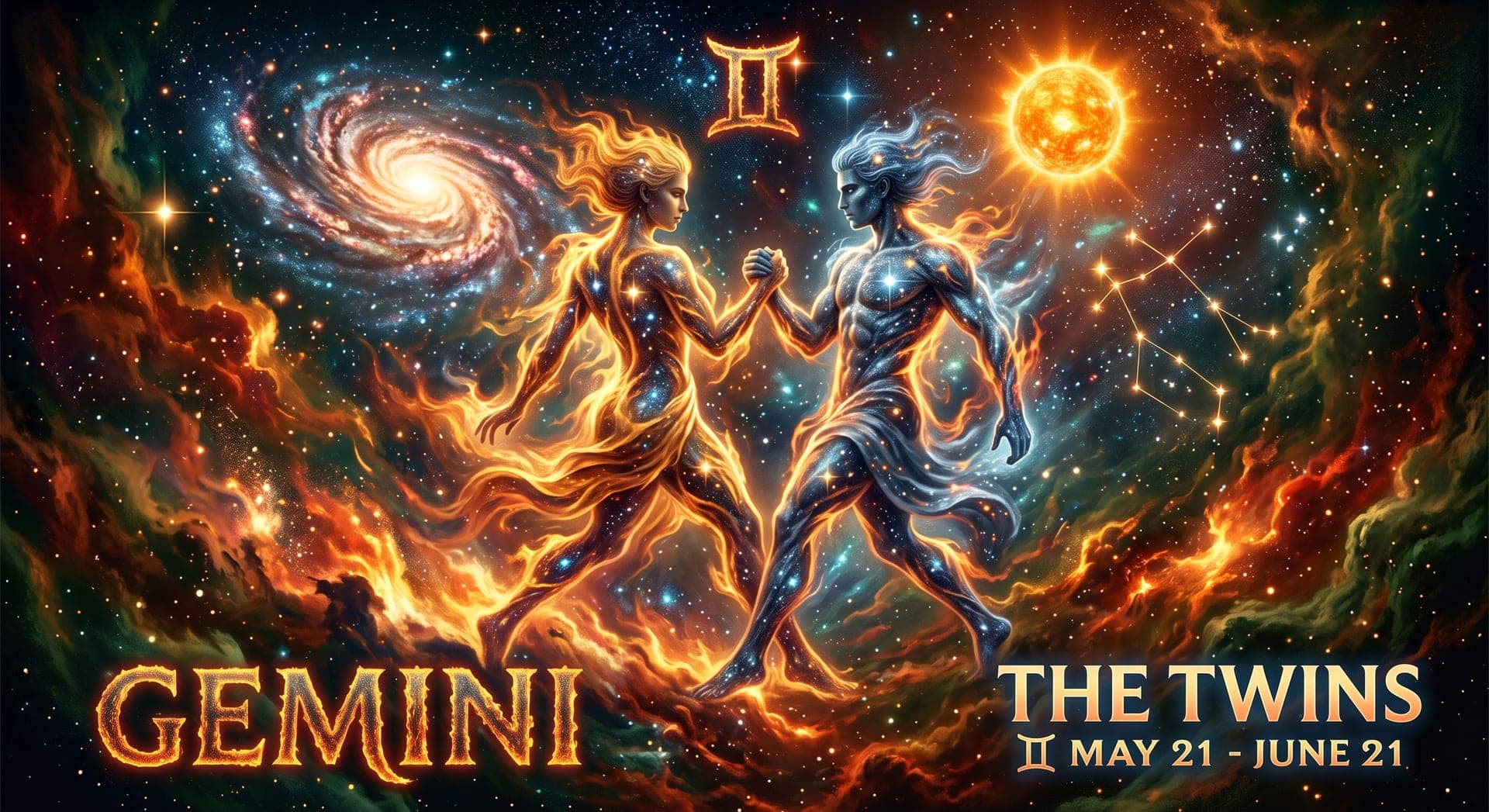
Gemini, the third sign of the zodiac, spans May 21 to June 20 and is symbolized by twins, representing the sign's dual nature and its ability to see multiple sides of any situation at once. Ruled by Mercury, the planet of communication and intellect, Gemini is widely regarded as one of the most talkative, curious, and quick-witted signs of the zodiac, constantly gathering new information and ideas. As an Air sign, Gemini approaches the world primarily through thought and conversation, thriving on mental stimulation and social interaction. Its Mutable modality reflects a restless adaptability, since Gemini tends to resist routine and prefers variety, novelty, and the freedom to change course whenever something more interesting comes along. People born under this sign are often skilled communicators, natural storytellers, and quick learners who can hold their own in nearly any conversation. That same adaptability can also come across as inconsistency, and Gemini's dual nature sometimes earns an unfair reputation for being two-faced, when in reality it simply reflects genuine curiosity about every side of a story.
Personality Traits
Strengths
- Quick-witted and intelligent
- Excellent communicator
- Adaptable to new situations
- Curious and eager to learn
- Charming and sociable
Weaknesses
- Prone to inconsistency
- Can be superficial
- Easily bored
- Indecisive
- Tendency to gossip
Compatible Signs
Fun Facts
- Gemini's twin symbol traces back to the Greek myth of Castor and Pollux, twin brothers placed among the stars as the constellation Gemini.
- Mercury, Gemini's ruling planet, was the swift Roman messenger god, reflecting the sign's associations with communication and quick thinking.
- Gemini is one of only a few zodiac signs represented by human figures rather than animals or objects.
- Notable Geminis include Marilyn Monroe, Kanye West, Angelina Jolie, and John F. Kennedy.
- Gemini season overlaps with the transition from spring to summer in the Northern Hemisphere, reflecting the sign's changeable, in-between nature.
Born on June 18
- 1799
William Lassell
English astronomer and brewer who built his own telescopes and discovered several moons of Neptune, Saturn, and Uranus.
- 1886
George Mallory
English mountaineer who took part in early British expeditions to Mount Everest and disappeared near its summit in 1924.
- 1932
Geoffrey Hill
English poet and academic regarded as one of the major English-language poets of the postwar era.
- 1941
Delia Smith
English cook and author whose television series and cookbooks made her one of Britain's most influential culinary teachers.
- 1942
Paul McCartney
English singer-songwriter and bassist, co-founder of the Beatles and one of the most successful songwriters in popular music history.
- 1952
Isabella Rossellini
Italian actress and filmmaker
- 1961
Alison Moyet
English singer-songwriter known for her work with the duo Yazoo and a long solo career blending soul and pop.
- 1976
Blake Shelton
American country singer
- 1986
Richard Madden
Scottish actor known for roles in Game of Thrones and the television series Bodyguard.
- 1989
Pierre-Emerick Aubameyang
Gabonese professional footballer
- 1994
Takeoff
American rapper and member of Migos
On This Day in History
- 1155
Pope Adrian IV crowns Frederick Barbarossa as Holy Roman Emperor.
Pope Adrian IV, the only Englishman ever to serve as pope, crowned Frederick Barbarossa as Holy Roman Emperor in Rome, a ceremony that briefly papered over deep tensions between the papacy and the ambitious German ruler, tensions that would resurface repeatedly throughout Barbarossa's decades-long, contentious reign.
- 1429
French forces decisively defeat the English at the Battle of Patay during the Hundred Years' War.
French forces decisively defeated an English army at the Battle of Patay during the Hundred Years' War, a rout in which French cavalry caught English longbowmen before they could establish their defensive positions, a significant momentum shift following Joan of Arc's earlier relief of Orleans weeks before.
- 1429
Charles VII's French army, inspired by Joan of Arc, decisively defeats English forces at the Battle of Patay.
In a rare open-field engagement of the Hundred Years' War, French cavalry caught the retreating English army by surprise and routed it, killing or capturing most of its commanders, including the renowned archer John Talbot. The defeat crippled English military strength in France and marked a major turning point in the war following the relief of Orléans.
- 1633
Charles I is crowned King of Scots at St Giles' Cathedral in Edinburgh.
Charles had already been King of England, Scotland, and Ireland for eight years by the time of his belated Scottish coronation, and the elaborate Anglican-style ceremony offended many Scottish Presbyterians. The controversy it stirred foreshadowed the later Bishops' Wars, in which Scottish resistance to Charles's religious policies helped trigger the broader crisis that led to civil war across his kingdoms.
- 1812
The United States declares war on the United Kingdom, beginning the War of 1812.
The United States formally declared war on the United Kingdom, beginning the War of 1812, a conflict rooted in grievances including British interference with American shipping, forced impressment of sailors, and support for Native American resistance to westward American expansion along the frontier.
- 1812
The United States declares war on the United Kingdom, beginning the War of 1812.
President James Madison signed the declaration after Congress approved it over grievances including British interference with American shipping, the impressment of American sailors, and support for Native American resistance on the frontier. The resulting conflict, fought across the Great Lakes, the Atlantic seaboard, and the Gulf Coast, ended in stalemate but reshaped relations between Britain, the United States, and Canada.
- 1815
The Duke of Wellington and Prussian forces under Blucher decisively defeat Napoleon Bonaparte at the Battle of Waterloo.
The Duke of Wellington's British-led coalition forces, joined decisively by Prussian troops under Field Marshal Blucher, defeated Napoleon Bonaparte's French army at the Battle of Waterloo, ending Napoleon's brief return to power during the Hundred Days and resulting in his final exile to the remote island of Saint Helena.
- 1815
The Duke of Wellington's coalition army, alongside Prussian forces, decisively defeats Napoleon Bonaparte at the Battle of Waterloo.
Fought near modern-day Belgium, the battle ended Napoleon's brief return to power during the Hundred Days and brought two decades of nearly continuous European war to a close. Wellington's forces held their ground through repeated French assaults until the timely arrival of Blücher's Prussian army sealed the victory, cementing Wellington's reputation as one of history's great commanders.
- 1858
Charles Darwin receives a paper from Alfred Russel Wallace outlining a theory of evolution strikingly similar to his own.
Darwin had been developing his theory of natural selection privately for two decades when Wallace's essay arrived from the Malay Archipelago. Friends arranged for a joint presentation of both men's ideas to the Linnean Society the following month, prompting Darwin to accelerate publication of his own work, which appeared the next year as On the Origin of Species.
- 1920
A week of sectarian violence breaks out in Derry, marking one of the opening episodes of the Troubles in Ulster.
Clashes between Protestant and Catholic communities in the city left numerous people dead and injured amid rising tensions over Irish independence and the future status of Ulster. The unrest was part of a broader wave of violence that swept Ireland in this period, foreshadowing the partition of the island and decades of communal conflict in Northern Ireland.
- 1928
Amelia Earhart becomes the first woman to cross the Atlantic Ocean by air, though as a passenger rather than pilot.
Amelia Earhart became the first woman to cross the Atlantic Ocean by air, though flying as a passenger and logbook-keeper rather than pilot aboard the aircraft Friendship, an experience that brought her significant fame and helped launch her subsequent career as a celebrated aviation pioneer.
- 1940
Charles de Gaulle delivers his famous radio address from London calling for continued French resistance against Nazi occupation.
French General Charles de Gaulle, having fled to London after France's military collapse, delivered a defiant radio address urging his countrymen to continue resisting Nazi occupation, a broadcast few French citizens actually heard live but which later became foundational to the mythology of the French Resistance movement.
- 1940
Winston Churchill delivers his "Finest Hour" speech to the House of Commons as France prepares to fall to Germany.
With French resistance collapsing, Churchill warned that the Battle of Britain was about to begin and rallied the nation to withstand it, famously declaring that if the British Empire lasted a thousand years, people would still say "this was their finest hour." The speech became one of the most celebrated pieces of wartime oratory in British history.
- 1948
Columbia Records publicly unveils the long-playing vinyl record at a demonstration in New York.
Columbia Records publicly unveiled the long-playing 33⅓ rpm vinyl record at a demonstration in New York, a format offering dramatically longer continuous playback than earlier 78 rpm records, an innovation that transformed the recorded music industry and enabled the modern concept of the studio album.
- 1953
Egypt is declared a republic, ending the Muhammad Ali dynasty's monarchy.
Egypt was formally declared a republic, ending the roughly 150-year-old Muhammad Ali dynasty's constitutional monarchy following a 1952 military coup led by the Free Officers Movement, with Muhammad Naguib becoming the country's first president before Gamal Abdel Nasser later assumed leadership.
- 1972
A British European Airways Trident crashes shortly after takeoff from Heathrow Airport, killing all 118 people on board.
The aircraft stalled and crashed into a field near Staines just minutes after departure, in what was at the time the deadliest air accident on British soil. Investigators found the crew had retracted the plane's wing devices too early, and the disaster led to significant changes in cockpit procedures and crew training across British aviation.
- 1983
Sally Ride becomes the first American woman in space aboard the Space Shuttle Challenger.
Astronaut Sally Ride became the first American woman in space, launching aboard Space Shuttle Challenger as a mission specialist, a milestone that came two decades after Soviet cosmonaut Valentina Tereshkova's pioneering 1963 spaceflight and marked a significant moment for gender representation in the American space program.
- 1984
Around 5,000 police officers clash violently with striking miners at a coking plant in Orgreave, South Yorkshire.
The confrontation, during the year-long UK miners' strike against pit closures, saw mounted police charges and running battles that left dozens injured on both sides. Widely televised, the clash became one of the defining and most controversial images of the strike, and allegations of police misconduct at Orgreave remain a source of dispute and calls for a public inquiry decades later.
- 1994
Ulster Volunteer Force gunmen kill six people watching the World Cup at a pub in Loughinisland, Northern Ireland.
Gunmen burst into the Heights Bar in the County Down village and opened fire on customers watching Ireland play in the football World Cup, in one of the deadliest loyalist paramilitary attacks of the Troubles. The killings, which came amid tentative peace efforts, drew widespread condemnation, and long-running questions about alleged security force collusion in the attack persisted for decades afterward.
- 2023
The Titan submersible implodes in the North Atlantic Ocean while attempting to view the wreck of the Titanic, killing all five aboard.
The Titan submersible, operated by a private company offering paid expeditions to view the wreck of the Titanic, suffered a catastrophic implosion in the North Atlantic Ocean, killing all five people aboard instantly and prompting a major international search effort along with intense scrutiny of the vessel's unconventional engineering and safety practices.