What’s Observed on June 17
Born on June 17: Gemini ♊
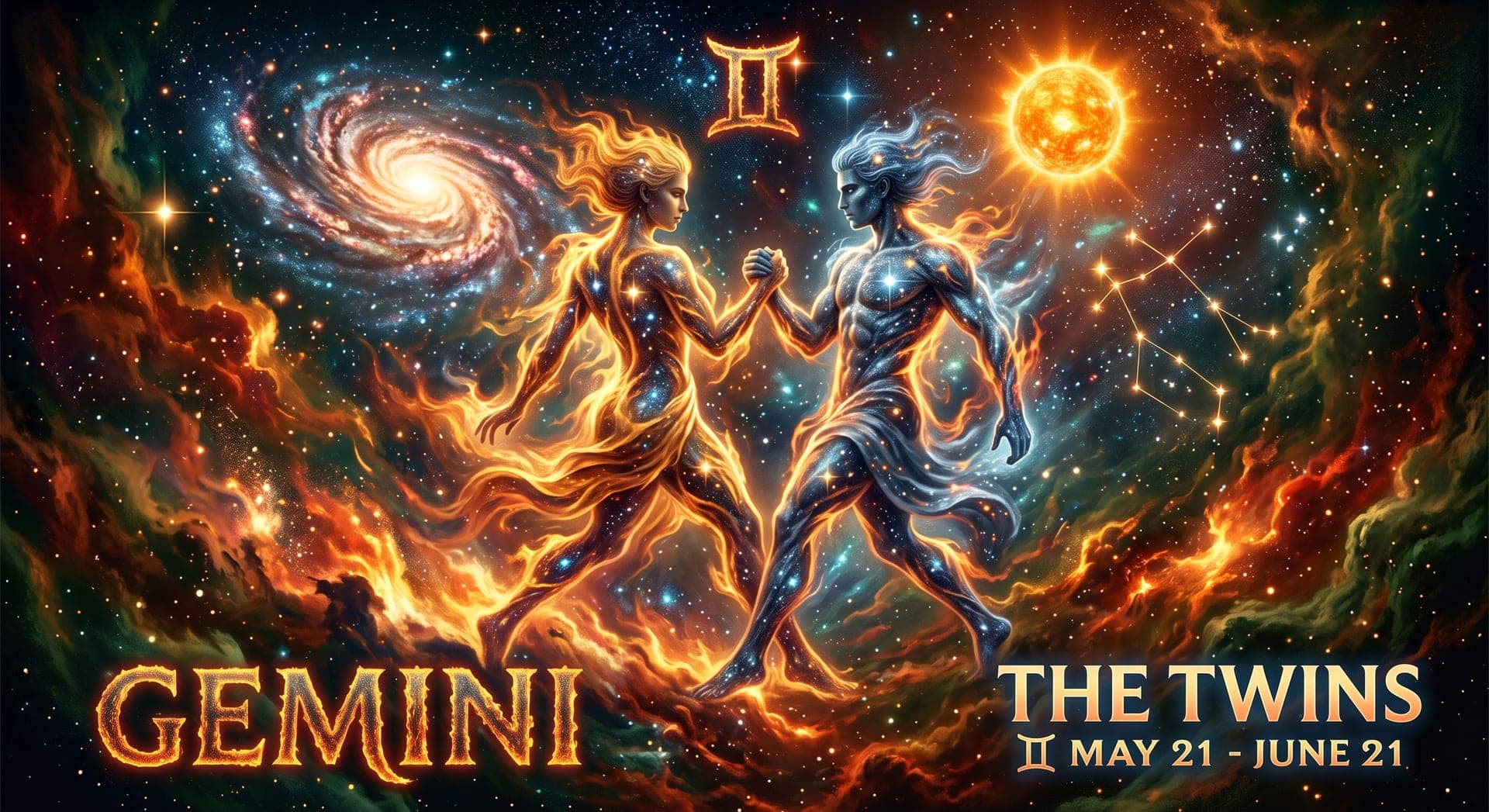
Gemini, the third sign of the zodiac, spans May 21 to June 20 and is symbolized by twins, representing the sign's dual nature and its ability to see multiple sides of any situation at once. Ruled by Mercury, the planet of communication and intellect, Gemini is widely regarded as one of the most talkative, curious, and quick-witted signs of the zodiac, constantly gathering new information and ideas. As an Air sign, Gemini approaches the world primarily through thought and conversation, thriving on mental stimulation and social interaction. Its Mutable modality reflects a restless adaptability, since Gemini tends to resist routine and prefers variety, novelty, and the freedom to change course whenever something more interesting comes along. People born under this sign are often skilled communicators, natural storytellers, and quick learners who can hold their own in nearly any conversation. That same adaptability can also come across as inconsistency, and Gemini's dual nature sometimes earns an unfair reputation for being two-faced, when in reality it simply reflects genuine curiosity about every side of a story.
Personality Traits
Strengths
- Quick-witted and intelligent
- Excellent communicator
- Adaptable to new situations
- Curious and eager to learn
- Charming and sociable
Weaknesses
- Prone to inconsistency
- Can be superficial
- Easily bored
- Indecisive
- Tendency to gossip
Compatible Signs
Fun Facts
- Gemini's twin symbol traces back to the Greek myth of Castor and Pollux, twin brothers placed among the stars as the constellation Gemini.
- Mercury, Gemini's ruling planet, was the swift Roman messenger god, reflecting the sign's associations with communication and quick thinking.
- Gemini is one of only a few zodiac signs represented by human figures rather than animals or objects.
- Notable Geminis include Marilyn Monroe, Kanye West, Angelina Jolie, and John F. Kennedy.
- Gemini season overlaps with the transition from spring to summer in the Northern Hemisphere, reflecting the sign's changeable, in-between nature.
Born on June 17
- 1239
Edward I
King of England from 1272 to 1307, known for his military campaigns in Wales and Scotland and for major legal and administrative reforms.
- 1704
John Kay
English inventor whose flying shuttle mechanized weaving and helped spark the Industrial Revolution in the textile industry.
- 1832
William Crookes
English chemist and physicist who discovered the element thallium and pioneered research into cathode rays.
- 1882
Igor Stravinsky
Russian composer and conductor
- 1898
M. C. Escher
Dutch artist known for mathematical, tessellated artwork
- 1898
Harry Patch
English soldier who became known as "the last Tommy," the final surviving combat veteran of the trenches of World War I.
- 1936
Ken Loach
English film director known for socially critical dramas such as Kes, I, Daniel Blake, and Sorry We Missed You.
- 1943
Barry Manilow
American singer-songwriter
- 1945
Eddy Merckx
Belgian cyclist widely regarded as one of the greatest ever
- 1945
Ken Livingstone
English politician who served as the first elected Mayor of London and earlier led the Greater London Council.
- 1980
Venus Williams
American professional tennis champion
- 1982
Jodie Whittaker
English actress known for starring roles in Broadchurch and as the first woman to play the title role in Doctor Who.
- 1987
Kendrick Lamar
American rapper and hip-hop artist
On This Day in History
- 656
Caliph Uthman is assassinated by rebel forces after a prolonged siege of his residence.
Caliph Uthman, the third successor to the Prophet Muhammad, was assassinated by rebel forces after a prolonged siege of his Medina residence amid growing discontent over his governance and allegations of nepotism, a killing that triggered the First Fitna, a civil war that permanently split the early Muslim community.
- 1128
Empress Matilda, claimant to the English throne, marries Geoffrey Plantagenet, Count of Anjou.
Matilda, daughter and designated heir of King Henry I of England, wed the much younger Geoffrey as part of her father's efforts to secure alliances and eventually place her on the throne. The marriage produced the future King Henry II and founded the Plantagenet dynasty, though Matilda herself had to fight a prolonged civil war, known as the Anarchy, before her line finally took the crown.
- 1397
The Kalmar Union uniting Denmark, Norway, and Sweden under a single monarch is formally established.
Queen Margaret I of Denmark formally established the Kalmar Union, uniting the crowns of Denmark, Norway, and Sweden under a single monarch, a political arrangement intended to consolidate Scandinavian power against German commercial and territorial influence, though internal tensions eventually led to Sweden's withdrawal roughly a century later.
- 1497
Royal forces defeat Cornish rebels at the Battle of Deptford Bridge, ending the Cornish Rebellion of 1497.
Angered by taxes levied to fund a war against Scotland, thousands of Cornishmen marched on London under the leadership of Michael An Gof and Thomas Flamank. King Henry VII's professional army crushed the poorly equipped rebel force at Deptford Bridge, and the rebellion's leaders were subsequently executed, ending the most serious popular uprising of his reign.
- 1579
English explorer Francis Drake claims a portion of the California coast for England, naming it Nova Albion.
English explorer and privateer Francis Drake landed on the coast of present-day California during his circumnavigation of the globe, claiming the territory for England under the name Nova Albion, a claim that, while never resulting in permanent English settlement, added to the era's complex overlapping European territorial assertions in the Americas.
- 1579
English explorer Sir Francis Drake claims land he names Nova Albion, in present-day California, for England.
During his circumnavigation of the globe aboard the Golden Hind, Drake landed on the Pacific coast of North America to repair his ship and claimed the territory for Queen Elizabeth I, naming it Nova Albion after England's ancient name. Though England made no lasting settlement there, the claim later fed into English arguments over territorial rights in the Americas.
- 1596
Dutch explorer Willem Barentsz discovers the Arctic archipelago of Spitsbergen.
Dutch explorer Willem Barentsz discovered the Arctic archipelago of Spitsbergen while searching for a northeastern sea passage to Asia, a find that opened the remote, ice-bound islands to subsequent European whaling and, much later, coal mining and scientific research expeditions.
- 1767
British sea captain Samuel Wallis sights Tahiti, becoming the first European recorded to reach the island.
Commanding HMS Dolphin on a voyage of Pacific exploration, Wallis encountered the island after a difficult crossing and, following brief clashes with local canoes, established friendly relations with the Tahitians. His reports of the island's beauty and hospitality captured European imagination and influenced later, more famous voyages to the Pacific, including those of James Cook.
- 1775
British forces win a costly victory at the Battle of Bunker Hill during the American Revolutionary War, suffering heavy casualties.
British forces achieved a costly tactical victory at the Battle of Bunker Hill near Boston, suffering unexpectedly heavy casualties while dislodging colonial militia from their fortified positions, an engagement early in the American Revolutionary War that demonstrated colonial forces could inflict serious losses on professional British troops.
- 1775
British forces suffer heavy casualties capturing rebel positions overlooking Boston at the Battle of Bunker Hill.
Although British troops ultimately took Breed's Hill and Bunker Hill from colonial militia, they did so at a devastating cost, losing over a thousand men, more than double the American casualties. The battle demonstrated that colonial forces could inflict serious damage on professional British soldiers, boosting rebel morale early in the American Revolutionary War.
- 1789
France's Third Estate declares itself the National Assembly, a pivotal early act of the French Revolution.
Delegates representing France's Third Estate, the commoners' delegation to the Estates-General, declared themselves the National Assembly, asserting that they alone represented the will of the French people, a bold and revolutionary act of defiance against the traditional privileged orders that marked a pivotal early moment of the French Revolution.
- 1885
The Statue of Liberty arrives in New York Harbor as a gift from France.
The Statue of Liberty arrived in New York Harbor aboard a French naval vessel, disassembled into 350 individual pieces packed in over 200 crates, a gift from France commemorating American independence and Franco-American friendship that would be reassembled and formally dedicated on its pedestal months later.
- 1885
The dismantled Statue of Liberty arrives in New York Harbor aboard the French ship Isère.
A gift from the people of France to commemorate the centennial of American independence and the two nations' shared democratic ideals, the statue's 350 individual pieces packed into more than 200 crates had to await completion of its pedestal before being assembled. It was formally dedicated the following year and became one of the most recognized symbols of the United States.
- 1900
Western allied and Japanese forces capture the Taku Forts near Tianjin during the Boxer Rebellion.
The coastal forts guarded the approach to Beijing and were seized in a coordinated naval and land assault by the Eight-Nation Alliance in response to escalating attacks on foreigners in China. Their capture opened the route for allied relief forces to advance inland and ultimately break the siege of the diplomatic legations in Beijing later that summer.
- 1940
The RMS Lancastria is sunk by German aircraft near Saint-Nazaire, France, killing at least 3,000 people in Britain's worst maritime disaster.
Packed with British soldiers and civilians being evacuated during the fall of France, the requisitioned liner was attacked and sank within twenty minutes, claiming more lives than the Titanic and Lusitania combined. The British government suppressed news of the disaster for weeks to protect wartime morale, and the full scale of the loss remained little known for decades.
- 1940
The British Army's 11th Hussars capture Fort Capuzzo in Libya from Italian forces.
In one of the opening actions of the Western Desert campaign, the armored reconnaissance regiment seized the frontier fort shortly after Italy's declaration of war on Britain and France. The raid, though small in scale, demonstrated early British mobility and aggression in North Africa, foreshadowing the larger desert battles that would follow over the next three years.
- 1944
Iceland formally declares independence from Denmark, becoming a republic.
Iceland formally declared its independence from Denmark and established itself as a republic, ending a centuries-long union under the Danish crown, a transition that took advantage of Denmark's ongoing Nazi occupation, which had severed effective Danish administrative control over the island nation during World War II.
- 1972
Five operatives are arrested burglarizing the Democratic National Committee headquarters at the Watergate complex, setting off the Watergate scandal.
Five men working for President Richard Nixon's reelection campaign were arrested while burglarizing and wiretapping the Democratic National Committee headquarters at the Watergate office complex in Washington, an initially minor-seeming break-in that unraveled into the sprawling Watergate scandal, ultimately forcing Nixon's resignation two years later.
- 1972
Five men working for the Nixon reelection campaign are arrested for burglarizing the Democratic National Committee offices at the Watergate complex.
The break-in, aimed at wiretapping party offices and photographing documents, initially appeared a minor local crime story. Subsequent investigation revealed connections to the White House, triggering the Watergate scandal that consumed the remainder of Richard Nixon's presidency and led to his resignation two years later, the only resignation by a sitting U.S. president.
- 2021
President Joe Biden signs legislation establishing Juneteenth as a federal holiday.
President Joe Biden signed legislation establishing Juneteenth as a federal holiday, making it the first new federal holiday created since Martin Luther King Jr. Day in 1983, a legislative milestone that followed renewed national attention on the history of slavery and racial justice movements in recent years.