
What’s Observed on June 22
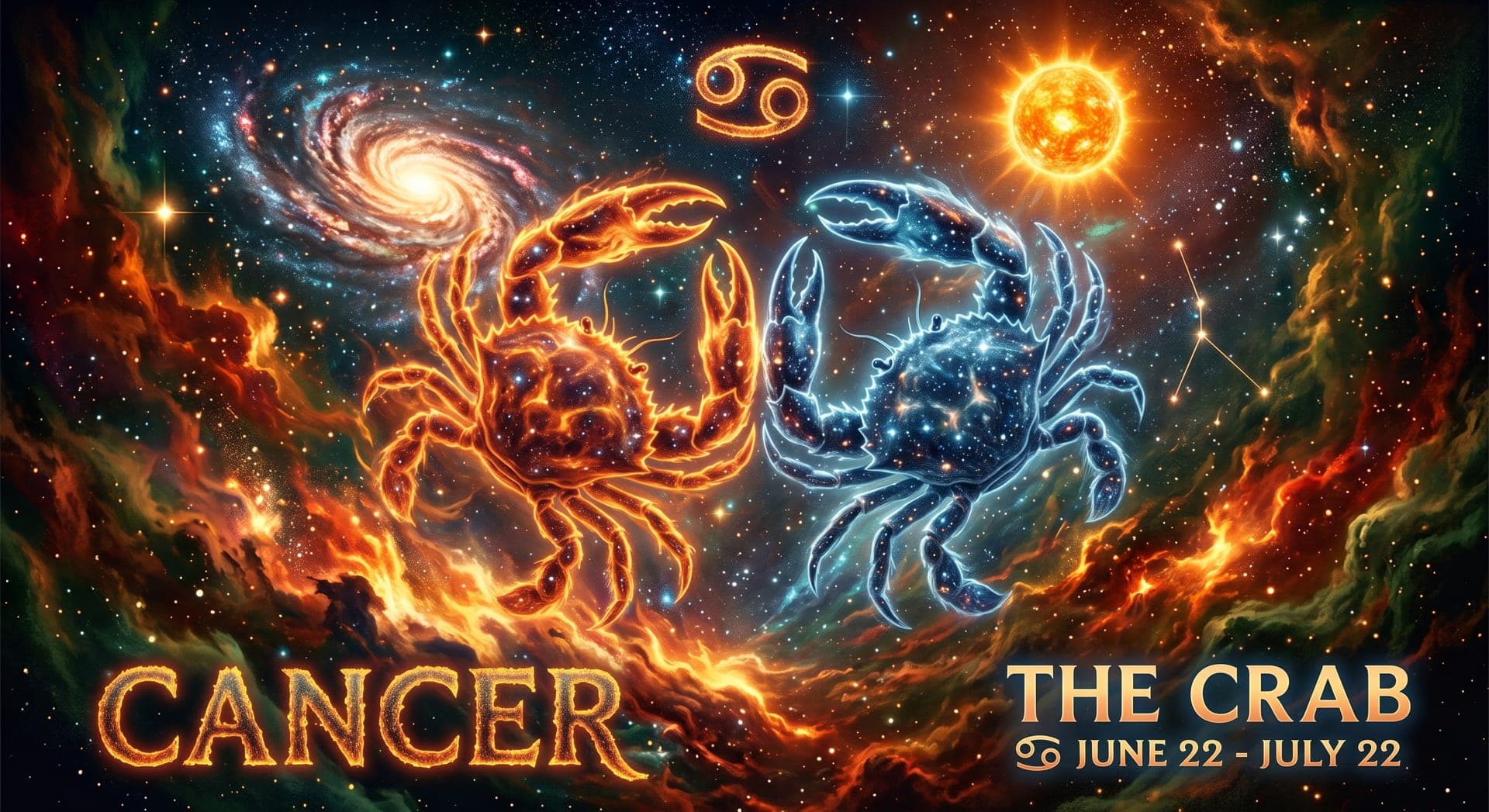
Born on June 22: Cancer ♋
Cancer, the fourth sign of the zodiac, spans June 21 to July 22 and is symbolized by the crab, an animal known for carrying a protective shell while remaining soft and vulnerable underneath. Ruled by the Moon, the celestial body long associated with emotion, intuition, and the subconscious, Cancer is widely regarded as one of the most nurturing and emotionally attuned signs of the zodiac. As a Water sign, Cancer navigates the world through deep feeling, often forming strong emotional bonds and an acute sensitivity to the moods of others. Its Cardinal modality places it at the start of summer, beginning right at the June solstice, reflecting an instinct to initiate and create, especially around home and family. People born under this sign tend to be deeply loyal, protective of loved ones, and drawn to creating a comfortable, secure home environment. Cancer's emotional depth is a genuine strength, but it can also make the sign prone to moodiness or withdrawal when hurt, retreating like a crab into its shell until it feels safe enough to re-emerge.
Personality Traits
Strengths
- Deeply caring and nurturing
- Highly intuitive
- Fiercely loyal and protective
- Strong sense of family and tradition
- Emotionally perceptive
Weaknesses
- Prone to moodiness
- Overly sensitive to criticism
- Can be clingy
- Tends to hold grudges
- Retreats when hurt
Compatible Signs
Fun Facts
- Cancer's crab symbol comes from Greek mythology, where the goddess Hera placed a crab that had fought Hercules among the stars.
- Cancer is ruled by the Moon, the only zodiac sign ruled by a celestial body other than a planet.
- As a Cardinal sign, Cancer initiates summer, beginning at the June solstice, the longest day of the year in the Northern Hemisphere.
- Notable Cancers include Princess Diana, Tom Hanks, Ariana Grande, and Nelson Mandela.
- The crab's hard shell and soft interior are often used as a metaphor for Cancer's protective exterior guarding a deeply sensitive emotional core.
Born on June 22
- 1757
George Vancouver
English naval officer and explorer who charted much of the Pacific coastline of North America, giving his name to the Canadian city and island of Vancouver.
- 1837
Paul Morphy
American chess player regarded as one of history's greatest
- 1856
H. Rider Haggard
English novelist best known for pioneering adventure fiction such as King Solomon's Mines and She, which helped define the 'lost world' genre.
- 1887
Julian Huxley
English evolutionary biologist and writer who became the first Director-General of UNESCO and helped found the World Wildlife Fund.
- 1906
Billy Wilder
Austrian-American film director
- 1910
Konrad Zuse
German computer scientist who built one of the first programmable computers
- 1918
Cicely Saunders
English nurse, physician and social worker who founded the modern hospice movement, establishing St Christopher's Hospice in London to pioneer palliative care.
- 1932
Prunella Scales
English actress best known for playing Sybil Fawlty in the sitcom Fawlty Towers.
- 1940
Esther Rantzen
English broadcaster and journalist who created the consumer affairs programme That's Life! and founded the children's helpline ChildLine.
- 1949
Meryl Streep
American actress
- 1949
Elizabeth Warren
American politician and U.S. Senator
- 1953
Cyndi Lauper
American singer-songwriter
- 1974
Jo Cox
English Labour Party politician and humanitarian campaigner who served as MP for Batley and Spen before being murdered in 2016.
On This Day in History
- 217 BCE
Egyptian Ptolemaic forces defeat the Seleucid army at the Battle of Raphia, one of the largest battles of the Hellenistic era.
Ptolemaic Egyptian forces defeated the Seleucid army at the Battle of Raphia, one of the largest battles of the Hellenistic era involving war elephants on both sides, a significant victory that secured Ptolemaic control over the disputed region of Coele-Syria for several more decades.
- 168 BCE
Roman legions decisively defeat Macedonia at the Battle of Pydna, effectively ending Macedonian independence.
Roman legions under consul Lucius Aemilius Paullus decisively defeated the Kingdom of Macedonia at the Battle of Pydna, capturing King Perseus and effectively ending Macedonian independence after generations of intermittent conflict with Rome. The victory, which concluded the Third Macedonian War, dramatically extended direct Roman political and military dominance over the Greek world for centuries to come.
- 1633
Galileo Galilei is forced by the Roman Inquisition to formally recant his support for a heliocentric universe.
Galileo Galilei, facing threats of torture from the Roman Inquisition, was forced to formally recant his support for the heliocentric model of the solar system, a humiliating public renunciation that nonetheless failed to suppress the scientific ideas he had championed, which prevailed within a matter of decades.
- 1774
The British Parliament passed the Quebec Act, establishing a framework of government for its newly acquired Canadian colony.
The act restored French civil law, guaranteed religious freedom for Quebec's Catholic majority, and expanded the province's borders into the Ohio Valley. Intended to secure the loyalty of French-Canadians after Britain's conquest of New France, the act angered the Thirteen Colonies, who saw it as an example of royal overreach, and it became one of the grievances cited in the American Revolution.
- 1807
The British warship HMS Leopard opened fire on and boarded the American frigate USS Chesapeake in search of deserters.
After the Chesapeake refused to be searched, Leopard fired several broadsides, killing three American sailors and wounding eighteen before a boarding party removed four men it claimed were Royal Navy deserters. The incident, known as the Chesapeake-Leopard Affair, inflamed American public opinion against Britain and became one of the underlying causes of the War of 1812.
- 1812
Napoleon's Grande Armee crosses into Russian territory, beginning his disastrous invasion of Russia.
Napoleon Bonaparte's massive Grande Armee crossed the Neman River into Russian territory without a formal declaration of war, launching his ambitious and ultimately catastrophic invasion of Russia, a campaign that would decimate his army through combat, disease, and the brutal Russian winter.
- 1813
Canadian settler Laura Secord walked roughly 30 kilometres to warn British forces of an impending American attack.
Having overheard American officers billeted in her home discussing plans for a surprise assault, Secord made a long and difficult trek through enemy-held territory in Upper Canada to alert British lieutenant James FitzGibbon. The warning helped the British and their Indigenous allies prepare an ambush at the Battle of Beaver Dams days later, and Secord became a celebrated figure in Canadian history.
- 1893
The Royal Navy battleship HMS Camperdown accidentally rammed and sank HMS Victoria during a fleet manoeuvre, killing 358 men.
While practising a turning exercise off the coast of Tripoli, Lebanon, Vice-Admiral Sir George Tryon ordered a manoeuvre that brought his flagship Victoria directly into the path of Camperdown. The collision tore open Victoria's hull, and the ship sank within minutes, drowning Tryon along with 357 of his crew. The disaster remains one of the Royal Navy's worst peacetime losses.
- 1907
The Charing Cross, Euston and Hampstead Railway opened, adding a new line to the London Underground.
The deep-level tube line connected central London with the northern suburbs of Hampstead and Golders Green, easing pressure on the capital's surface transport. Built using the latest electric traction and lift technology, it later became part of the Northern line. Its opening reflected the rapid expansion of London's underground network in the early twentieth century.
- 1911
King George V and Queen Mary were crowned at Westminster Abbey.
The coronation followed the traditional Anglican rite used for British monarchs for centuries, and drew huge crowds along the ceremonial route through London. George V had acceded to the throne the previous year following the death of his father, Edward VII. His reign would go on to encompass the First World War and significant changes to the structure of the British Empire.
- 1922
Field Marshal Sir Henry Wilson was assassinated by IRA gunmen outside his London home.
Two members of the Irish Republican Army shot Wilson, a prominent unionist and former military adviser to the Northern Ireland government, on his own doorstep in broad daylight. The killing shocked Britain and heightened pressure on the fledgling Irish Free State to act against anti-Treaty forces, contributing directly to the outbreak of the Irish Civil War days later.
- 1940
France signs an armistice with Nazi Germany, ending organized French resistance in the Battle of France.
France signed an armistice with Nazi Germany in the same railway carriage used for Germany's own humiliating World War I surrender, formally ending organized French military resistance and dividing the country into a German-occupied zone and the nominally independent but collaborationist Vichy regime.
- 1941
Nazi Germany launches Operation Barbarossa, a massive surprise invasion of the Soviet Union.
Nazi Germany launched Operation Barbarossa, a massive surprise invasion of the Soviet Union involving millions of troops along a vast front, breaking the earlier non-aggression pact between the two powers and opening what became the largest and deadliest theater of World War II.
- 1941
Nazi Germany launched Operation Barbarossa, its massive invasion of the Soviet Union.
More than three million German and Axis troops crossed the Soviet border along a vast front, opening the largest military campaign in history and the deadliest theatre of the Second World War. Hitler's aim was to destroy the Soviet Union quickly, but the invasion ultimately stalled, drawing Germany into a catastrophic war of attrition on the Eastern Front that would prove decisive to the war's outcome.
- 1948
The HMT Empire Windrush arrives in Britain carrying Caribbean migrants, symbolically marking the beginning of significant postwar West Indian immigration.
The ship HMT Empire Windrush arrived in Britain carrying several hundred Caribbean migrants invited to help address postwar labor shortages, an arrival that symbolically marked the beginning of significant Caribbean immigration to Britain and profoundly shaped the country's modern multicultural identity.
- 1948
The Empire Windrush docked at Tilbury, carrying hundreds of Caribbean migrants to Britain.
Among the ship's passengers were several hundred people from Jamaica and other Caribbean territories arriving to work and settle in postwar Britain, many responding to labour shortages and the offer of British citizenship. The Windrush's arrival became a landmark symbol of the beginning of large-scale Caribbean immigration to the UK and gave its name to the generation that followed.
- 1948
King George VI formally relinquished the title 'Emperor of India' following Indian independence the previous year.
Although India and Pakistan had become independent in August 1947, George VI had continued to hold the imperial title until a royal proclamation removed it. The change reflected Britain's shrinking empire and the transition of India toward becoming a republic within the Commonwealth, which was formalised a few years later.
- 1969
Ohio's Cuyahoga River catches fire due to industrial pollution, an incident that helped spur the modern American environmental movement.
Ohio's heavily polluted Cuyahoga River caught fire due to accumulated industrial waste and oil slicks on its surface, an incident, though not the river's first such fire, that captured national media attention and became a galvanizing symbol helping spur passage of major American environmental protection legislation.
- 1986
Diego Maradona scores his controversial "Hand of God" goal against England in the FIFA World Cup quarterfinals.
Argentine footballer Diego Maradona scored his infamous "Hand of God" goal against England in a World Cup quarterfinal match, punching the ball into the net undetected by the referee, a controversial moment Maradona later openly acknowledged as deliberate, followed minutes later by one of the greatest solo goals in World Cup history.
- 1990
Checkpoint Charlie, the famous Cold War crossing point in Berlin, is dismantled as Germany moves toward reunification.
Checkpoint Charlie, the famous Cold War-era crossing point between East and West Berlin, was formally dismantled in a ceremony attended by international dignitaries, a symbolic milestone in Germany's ongoing reunification process following the fall of the Berlin Wall the previous year.