What’s Observed on June 23
Born on June 23: Cancer ♋
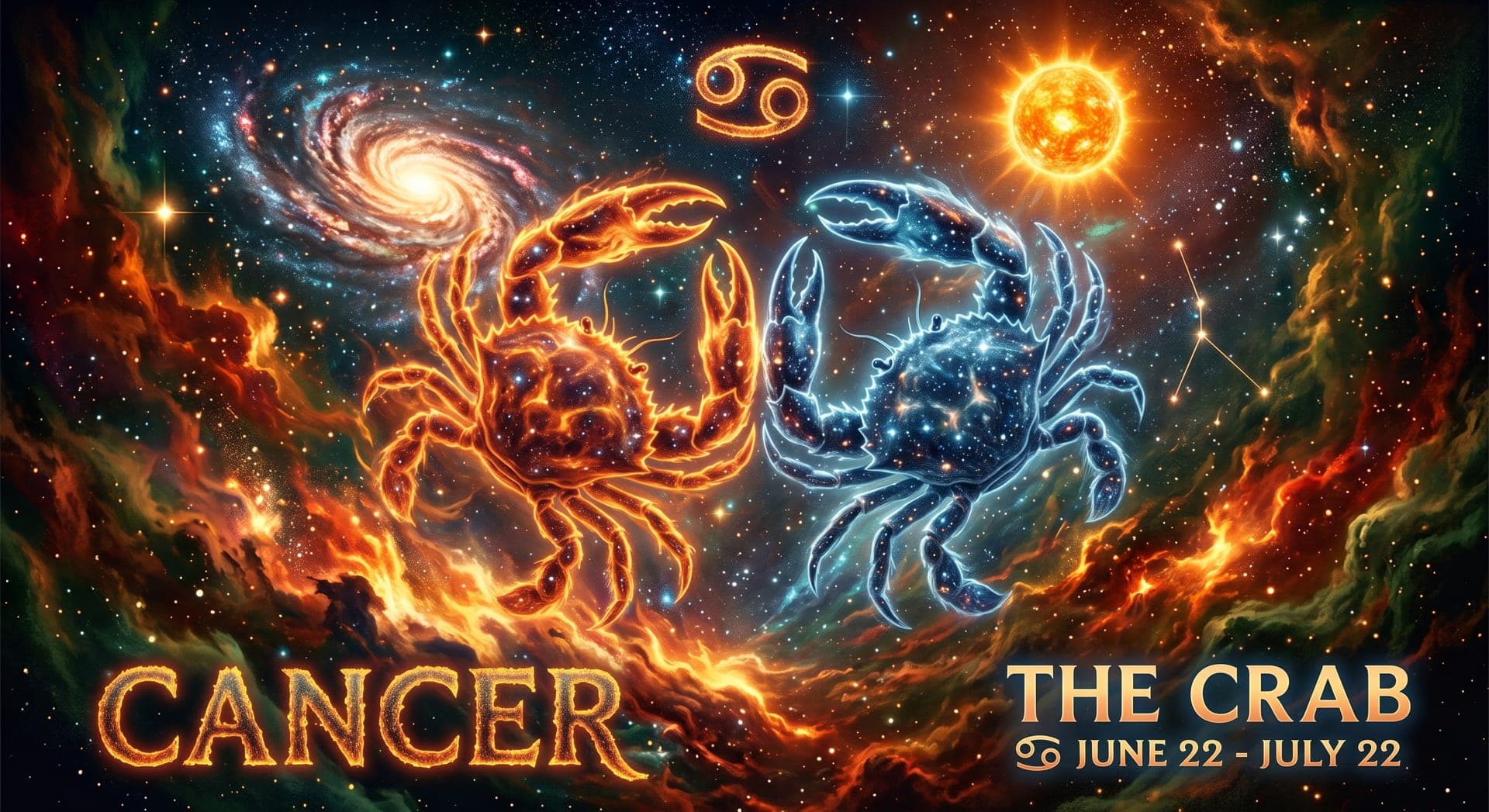
Cancer, the fourth sign of the zodiac, spans June 21 to July 22 and is symbolized by the crab, an animal known for carrying a protective shell while remaining soft and vulnerable underneath. Ruled by the Moon, the celestial body long associated with emotion, intuition, and the subconscious, Cancer is widely regarded as one of the most nurturing and emotionally attuned signs of the zodiac. As a Water sign, Cancer navigates the world through deep feeling, often forming strong emotional bonds and an acute sensitivity to the moods of others. Its Cardinal modality places it at the start of summer, beginning right at the June solstice, reflecting an instinct to initiate and create, especially around home and family. People born under this sign tend to be deeply loyal, protective of loved ones, and drawn to creating a comfortable, secure home environment. Cancer's emotional depth is a genuine strength, but it can also make the sign prone to moodiness or withdrawal when hurt, retreating like a crab into its shell until it feels safe enough to re-emerge.
Personality Traits
Strengths
- Deeply caring and nurturing
- Highly intuitive
- Fiercely loyal and protective
- Strong sense of family and tradition
- Emotionally perceptive
Weaknesses
- Prone to moodiness
- Overly sensitive to criticism
- Can be clingy
- Tends to hold grudges
- Retreats when hurt
Compatible Signs
Fun Facts
- Cancer's crab symbol comes from Greek mythology, where the goddess Hera placed a crab that had fought Hercules among the stars.
- Cancer is ruled by the Moon, the only zodiac sign ruled by a celestial body other than a planet.
- As a Cardinal sign, Cancer initiates summer, beginning at the June solstice, the longest day of the year in the Northern Hemisphere.
- Notable Cancers include Princess Diana, Tom Hanks, Ariana Grande, and Nelson Mandela.
- The crab's hard shell and soft interior are often used as a metaphor for Cancer's protective exterior guarding a deeply sensitive emotional core.
Born on June 23
- 1763
Josephine de Beauharnais
Empress consort of France as wife of Napoleon I
- 1894
Edward VIII
King of the United Kingdom who abdicated the throne in 1936 after less than a year's reign in order to marry the American divorcee Wallis Simpson.
- 1912
Alan Turing
English mathematician and computer scientist whose codebreaking work at Bletchley Park helped defeat Nazi Germany, and whose theoretical work laid foundations for modern computing.
- 1916
Len Hutton
English cricketer regarded as one of the finest batsmen of his era, who held the world Test record score for two decades and became the first professional to captain England.
- 1927
Bob Fosse
American dancer, choreographer, and director
- 1940
Stuart Sutcliffe
Scottish painter and musician who played bass in the early Beatles before leaving the band to pursue art in Hamburg, where he died young.
- 1948
Clarence Thomas
Associate Justice of the U.S. Supreme Court
- 1963
Colin Montgomerie
Scottish golfer who won the European Tour's Order of Merit a record eight times and became one of Europe's most successful Ryder Cup players.
- 1972
Zinedine Zidane
French footballer and manager
- 1975
KT Tunstall
Scottish singer-songwriter known for the breakthrough hit 'Black Horse and the Cherry Tree' and her Ivor Novello Award-winning songwriting.
- 1977
Jason Mraz
American singer-songwriter
- 1984
Duffy
Welsh singer-songwriter whose 2008 album Rockferry, led by the hit single 'Mercy,' made her one of Britain's biggest-selling artists of the year.
On This Day in History
- 1266
Venetian forces defeat a larger Genoese fleet at the Battle of Trapani during the War of Saint Sabas.
A Venetian fleet decisively defeated a larger Genoese naval force at the Battle of Trapani off the coast of Sicily during the War of Saint Sabas, a conflict fought largely over lucrative trading rights and commercial dominance in the eastern Mediterranean between the two rival maritime republics.
- 1314
Scottish forces under Robert the Bruce begin the decisive Battle of Bannockburn against England, a pivotal moment in Scotland's fight for independence.
Scottish forces under Robert the Bruce began the decisive Battle of Bannockburn against a larger invading English army, a pivotal multi-day engagement that ended in a stunning Scottish victory, securing de facto Scottish independence and cementing Bruce's legitimacy as king.
- 1314
Robert the Bruce's Scottish army began the Battle of Bannockburn against English forces near Stirling.
Bruce positioned his troops to block the English relief of Stirling Castle, and the first day of fighting saw the English vanguard repulsed with the death of knight Henry de Bohun in single combat with Bruce himself. The clash set the stage for a full-scale battle the following day that would prove one of the most significant Scottish victories over England.
- 1520
King Henry VIII of England and King Francis I of France sign a treaty pledging mutual military support against the Holy Roman Emperor.
King Henry VIII of England and King Francis I of France signed a treaty at the extravagant diplomatic summit known as the Field of the Cloth of Gold, pledging mutual military support against the Holy Roman Emperor Charles V, though the alliance ultimately proved fragile and short-lived.
- 1532
Henry VIII of England and Francis I of France signed a treaty of mutual defence.
The agreement bound the two kings to support one another against outside aggression, reflecting the shifting alliances of the period as Henry's break from Rome over his divorce from Catherine of Aragon isolated England diplomatically. Anglo-French relations of the era remained volatile, and such treaties were often short-lived amid the broader rivalry between France, England and the Holy Roman Empire.
- 1594
English ships intercepted and sank the Portuguese treasure carrack Cinco Chagas near the Azores.
The heavily laden vessel, returning from the East Indies with a valuable cargo, caught fire during the engagement with English raiders and sank with enormous loss of life, including many enslaved people held aboard. The attack was part of the broader pattern of English privateering against Iberian shipping during the long conflict with Spain and Portugal in the late sixteenth century.
- 1713
French residents of Acadia were given one year to swear allegiance to Britain or leave Nova Scotia.
Following Britain's acquisition of Acadia under the Treaty of Utrecht, colonial authorities issued the ultimatum to the region's French-speaking settlers. Many Acadians resisted taking the oath and remained in a state of uneasy neutrality for decades, a standoff that eventually culminated in their forced mass expulsion by British forces in the 1750s.
- 1757
British forces under Robert Clive win a decisive victory over a much larger Indian army at the Battle of Plassey, cementing British control over Bengal.
British forces under Robert Clive won a decisive and lopsided victory over a vastly larger army commanded by the Nawab of Bengal at the Battle of Plassey, a triumph achieved partly through bribery and betrayal within the Nawab's own ranks that established British East India Company control over Bengal.
- 1757
Robert Clive led British East India Company forces to a decisive victory over a much larger Bengali army at the Battle of Plassey.
Clive's outnumbered troops defeated the Nawab of Bengal's army with the help of a bribed defecting commander, Mir Jafar, who withheld his forces from the fighting. The victory gave the East India Company effective control of Bengal, one of the richest provinces in India, and is widely regarded as the foundation of British colonial rule on the subcontinent.
- 1758
British, Hanoverian and Prussian forces defeated the French army at the Battle of Krefeld during the Seven Years' War.
Commanded by Ferdinand of Brunswick, the allied army routed French forces near the Rhine city of Krefeld, temporarily securing western Germany for Britain's coalition. The victory was one of several Anglo-German successes that helped Britain maintain the upper hand in the European theatre of the Seven Years' War while it also fought France overseas in North America and India.
- 1812
Britain revoked the Orders in Council that had restricted American trade, removing a key cause of the War of 1812.
The Orders in Council had authorised the Royal Navy to blockade French ports and seize neutral ships trading with Napoleon's Europe, provoking fierce American resentment. Britain's repeal came too late to prevent war, however, since the news did not reach Washington until after Congress had already declared war on Britain days earlier.
- 1868
Christopher Latham Sholes receives a patent for the modern typewriter.
American inventor Christopher Latham Sholes received a patent for a practical typewriter design, a machine that, after further refinement and commercial development by the Remington company, transformed office work and significantly expanded employment opportunities for women as professional typists and clerks.
- 1887
Banff National Park, Canada's first national park, is established by law.
The Canadian Parliament passed legislation establishing Banff National Park, the country's first national park, protecting a stunning mountainous region around natural hot springs in Alberta that had been discovered by railway workers years earlier. The park's creation set an early precedent for wilderness conservation in Canada and influenced subsequent national park systems developed worldwide.
- 1894
The International Olympic Committee is founded at a congress in Paris.
Delegates gathered at a congress at the Sorbonne in Paris founded the International Olympic Committee, largely through the efforts of French educator Pierre de Coubertin, an organization that went on to revive the ancient Olympic Games as a modern international athletic competition beginning two years later.
- 1925
British and French troops opened fire on Chinese demonstrators at Shameen Island in Guangzhou, killing dozens.
The shooting occurred during a wave of anti-imperialist protests sweeping China following an earlier killing of Chinese workers by British police in Shanghai. At least 52 protesters were killed at Shameen, an incident that further inflamed Chinese nationalist and anti-foreign sentiment and fuelled support for revolutionary movements opposing Western and Japanese influence in China.
- 1942
A German Focke-Wulf Fw 190 fighter mistakenly landed intact at RAF Pembrey in Wales.
Disoriented after a dogfight over the English Channel, the German pilot believed he was landing at a French airfield and touched down at the RAF base instead, delivering one of the Luftwaffe's most advanced fighters into British hands undamaged. The captured aircraft allowed British engineers to study the Fw 190 in detail and develop effective countermeasures.
- 1960
The FDA approves the first combined oral contraceptive pill in the United States.
The U.S. Food and Drug Administration approved the first combined oral contraceptive pill for sale, a landmark moment in reproductive medicine that gave women unprecedented control over family planning and is widely credited with contributing to major social and economic changes in women's education and workforce participation.
- 1972
Title IX is signed into law, prohibiting sex discrimination in federally funded educational programs and dramatically expanding women's athletics.
President Richard Nixon signed Title IX into law as part of a broader education act, prohibiting sex discrimination in any federally funded educational program or activity. The provision dramatically expanded opportunities for women's athletics in American schools and universities over the following decades, transforming the landscape of collegiate and scholastic sports and educational access more broadly.
- 2016
The United Kingdom votes in a referendum to leave the European Union, a decision known as Brexit.
British voters narrowly chose in a national referendum to leave the European Union, a decision commonly known as Brexit that triggered years of complex political negotiations over trade, borders, and citizenship rights. The United Kingdom formally exited the bloc in 2020, ending nearly five decades of membership and reshaping the country's economic and political relationship with Europe.
- 2016
The United Kingdom voted to leave the European Union in a nationwide referendum.
Voters backed leaving the EU by 52 percent to 48 percent, in a result that split the country geographically and generationally and triggered years of political upheaval. Prime Minister David Cameron resigned the following day, and the vote set in motion a prolonged negotiation process that led to Britain's formal departure from the EU in January 2020.