What’s Observed on June 24
Born on June 24: Cancer ♋
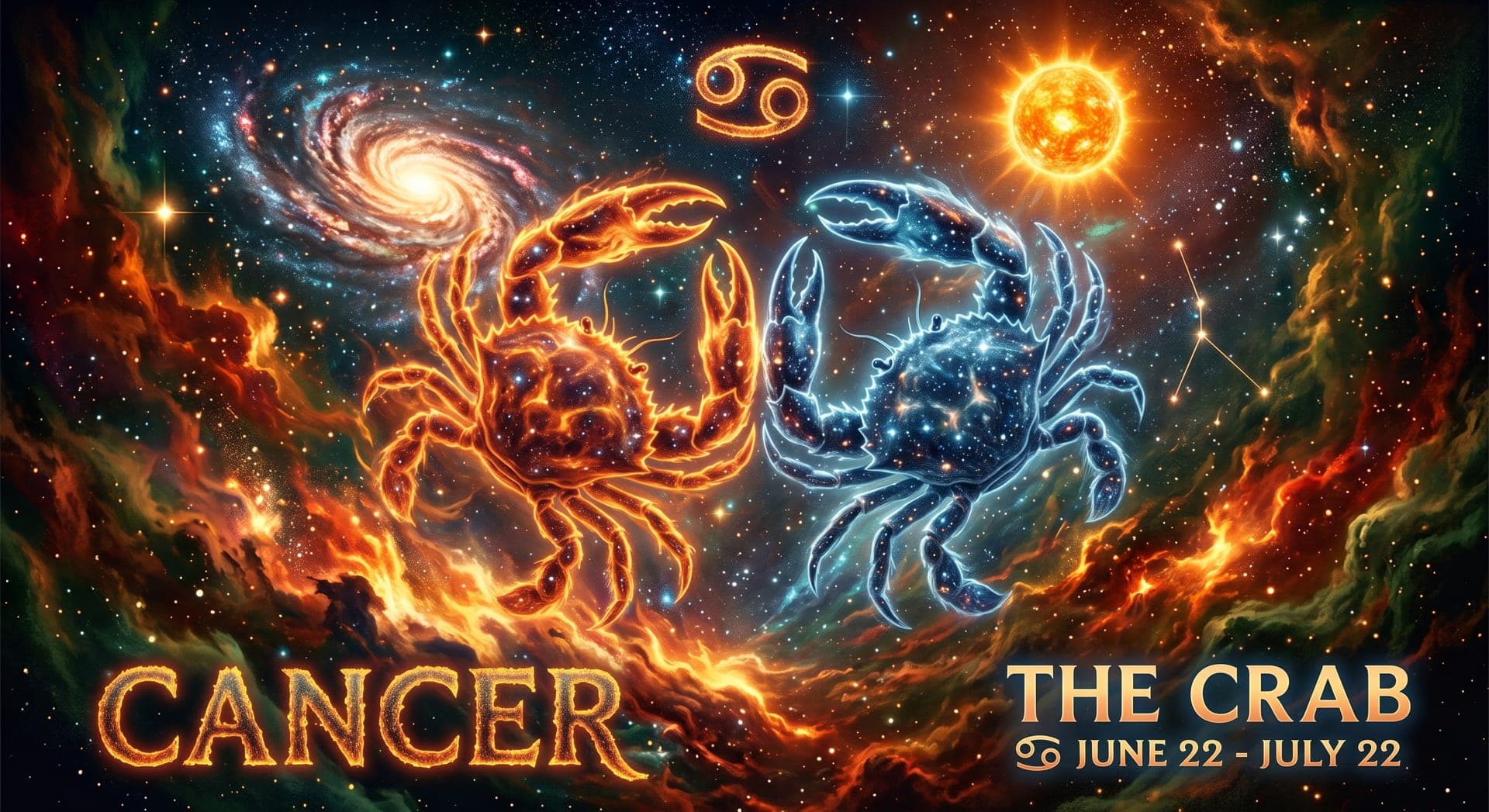
Cancer, the fourth sign of the zodiac, spans June 21 to July 22 and is symbolized by the crab, an animal known for carrying a protective shell while remaining soft and vulnerable underneath. Ruled by the Moon, the celestial body long associated with emotion, intuition, and the subconscious, Cancer is widely regarded as one of the most nurturing and emotionally attuned signs of the zodiac. As a Water sign, Cancer navigates the world through deep feeling, often forming strong emotional bonds and an acute sensitivity to the moods of others. Its Cardinal modality places it at the start of summer, beginning right at the June solstice, reflecting an instinct to initiate and create, especially around home and family. People born under this sign tend to be deeply loyal, protective of loved ones, and drawn to creating a comfortable, secure home environment. Cancer's emotional depth is a genuine strength, but it can also make the sign prone to moodiness or withdrawal when hurt, retreating like a crab into its shell until it feels safe enough to re-emerge.
Personality Traits
Strengths
- Deeply caring and nurturing
- Highly intuitive
- Fiercely loyal and protective
- Strong sense of family and tradition
- Emotionally perceptive
Weaknesses
- Prone to moodiness
- Overly sensitive to criticism
- Can be clingy
- Tends to hold grudges
- Retreats when hurt
Compatible Signs
Fun Facts
- Cancer's crab symbol comes from Greek mythology, where the goddess Hera placed a crab that had fought Hercules among the stars.
- Cancer is ruled by the Moon, the only zodiac sign ruled by a celestial body other than a planet.
- As a Cardinal sign, Cancer initiates summer, beginning at the June solstice, the longest day of the year in the Northern Hemisphere.
- Notable Cancers include Princess Diana, Tom Hanks, Ariana Grande, and Nelson Mandela.
- The crab's hard shell and soft interior are often used as a metaphor for Cancer's protective exterior guarding a deeply sensitive emotional core.
Born on June 24
- 1777
John Ross
Scottish Royal Navy officer and Arctic explorer who led early expeditions in search of the Northwest Passage and helped map the Canadian Arctic coastline.
- 1850
Herbert Kitchener
British Army field marshal and colonial administrator best known for his victory at Omdurman and for organizing Britain's WWI volunteer army as Secretary of State for War
- 1895
Jack Dempsey
American heavyweight boxing champion
- 1909
William Penney
English mathematician and physicist who led the development of Britain's first atomic bomb and later served as chairman of the UK Atomic Energy Authority.
- 1911
Juan Manuel Fangio
Argentine Formula One racing champion
- 1915
Fred Hoyle
English astronomer who coined the term 'Big Bang' and made major contributions to the theory of stellar nucleosynthesis, though he long favoured a rival steady-state model of the universe.
- 1917
Joan Clarke
English cryptanalyst who worked alongside Alan Turing at Bletchley Park breaking German Enigma codes during the Second World War.
- 1930
Claude Chabrol
French film director
- 1944
Jeff Beck
English guitarist regarded as one of rock's most influential instrumentalists, who rose to fame with the Yardbirds before leading the Jeff Beck Group.
- 1947
Mick Fleetwood
English drummer and co-founder of Fleetwood Mac, whose surname provided half of the band's name.
- 1961
Iain Glen
Scottish actor known for stage work and screen roles including Ser Jorah Mormont in Game of Thrones and appearances in the Jurassic World and Tomb Raider films.
- 1962
Gautam Adani
Indian industrialist and billionaire
On This Day in History
- 1314
Scottish forces led by Robert the Bruce secure a decisive victory over England at the Battle of Bannockburn.
Scottish forces led by Robert the Bruce secured a decisive victory over a much larger invading English army at the Battle of Bannockburn, a triumph that effectively secured Scottish independence and remains one of the most celebrated military victories in Scottish history.
- 1314
Robert the Bruce's Scottish army decisively defeated the English at the Battle of Bannockburn.
On the second day of fighting near Stirling, Bruce's schiltrons of spearmen broke the English cavalry and infantry in a rout that sent King Edward II fleeing the field. The victory secured effective Scottish independence for a generation and remains the most celebrated battlefield triumph in Scottish history, later commemorated in the national anthem 'Flower of Scotland.'
- 1340
English forces under King Edward III destroy the French fleet at the Battle of Sluys during the Hundred Years' War.
English forces under King Edward III destroyed a French fleet at the Battle of Sluys off the coast of Flanders, an early and decisive naval victory of the Hundred Years' War that gave England temporary control of the English Channel and secured safe passage for English troops and supplies to the continent.
- 1340
English King Edward III destroyed the French fleet at the Battle of Sluys, seizing control of the English Channel.
In one of the opening major engagements of the Hundred Years' War, Edward personally commanded his fleet against the French and their Genoese allies off the Flemish coast, sinking or capturing most of the French ships. The victory gave England naval supremacy in the Channel for years and prevented any French invasion of English territory for the remainder of the century.
- 1509
Henry VIII and Catherine of Aragon are crowned King and Queen of England.
Henry VIII and Catherine of Aragon were formally crowned King and Queen of England in a joint coronation ceremony at Westminster Abbey, beginning a marriage that lasted over two decades before Henry's desire for a male heir led to the annulment that triggered England's break with Rome.
- 1509
Henry VIII and Catherine of Aragon were crowned King and Queen of England at Westminster Abbey.
The joint coronation followed Henry's accession weeks earlier upon the death of his father Henry VII, and his marriage to Catherine, his brother's widow, secured a diplomatic alliance with Spain. The early years of Henry's reign were marked by popularity and optimism, in stark contrast to the religious and marital upheavals that would define his later decades on the throne.
- 1520
The lavish diplomatic summit known as the Field of the Cloth of Gold, between Henry VIII and Francis I, came to an end.
Held near Calais over more than two weeks, the meeting featured extravagant tournaments, feasting and pageantry intended to demonstrate the wealth and friendship of the English and French crowns. Despite the spectacle, the summit produced little lasting diplomatic benefit, and Henry allied with the Holy Roman Emperor against France within a year.
- 1571
Spanish forces under Miguel Lopez de Legazpi conquer Manila, establishing colonial rule over the Philippines.
Spanish conquistador forces under Miguel Lopez de Legazpi conquered the settlement that became Manila, establishing the foundation of Spanish colonial rule over the Philippine archipelago, a colonial administration that persisted for over three centuries until the islands were ceded to the United States in 1898.
- 1717
The Premier Grand Lodge of England is established in London, marking the formal beginning of organized Freemasonry.
Four existing London Masonic lodges united to form the Premier Grand Lodge of England, marking the formal, organized beginning of modern Freemasonry, a fraternal movement that subsequently spread internationally and became one of the world's largest and most influential secret societies.
- 1717
The Premier Grand Lodge of England was founded in London, becoming the world's first Masonic Grand Lodge.
Four existing London lodges united at the Goose and Gridiron tavern to form the new governing body, formalising and organising Freemasonry as an institution for the first time. The Grand Lodge's model was subsequently copied across Britain and exported around the world, making London the historical birthplace of organised Freemasonry.
- 1762
British-allied forces defeated the French at the Battle of Wilhelmsthal during the Seven Years' War.
An Anglo-Hanoverian army under Ferdinand of Brunswick outmanoeuvred and routed French forces in Hesse, inflicting heavy casualties and capturing thousands of prisoners. The victory helped secure western Germany for Britain's coalition in the closing stages of the war, contributing to the favourable terms Britain secured in the subsequent Treaty of Paris.
- 1779
Spanish and French forces began the Great Siege of Gibraltar, attempting to seize the British-held territory.
The siege, launched during the American Revolutionary War as Spain sought to reclaim Gibraltar from Britain, would last more than three years, becoming one of the longest sieges in British military history. The garrison held out despite blockade and bombardment, and Gibraltar's successful defence remains a source of British pride and a foundation of the territory's continued status as an overseas territory.
- 1813
British and Indigenous forces defeated an American army at the Battle of Beaver Dams in Upper Canada.
Acting on the warning delivered by Laura Secord days earlier, British lieutenant James FitzGibbon and his Indigenous allies ambushed and forced the surrender of an American detachment near present-day Thorold, Ontario. The victory helped secure the Niagara frontier for Britain during the War of 1812 and became a celebrated episode in Canadian military history.
- 1880
"O Canada" is performed publicly for the first time, later becoming Canada's national anthem.
The patriotic song "O Canada," composed with French lyrics by Adolphe-Basile Routhier set to music by Calixa Lavallee, was performed publicly for the first time at a French-Canadian national gathering in Quebec City. The composition gained increasing popularity across English and French Canada over the following century before being officially adopted as the country's national anthem in 1980.
- 1940
British commandos carried out Operation Collar, the first Commando raid on occupied France.
A small party from No. 11 Independent Company landed near Boulogne to reconnoitre German defences and gather intelligence, in an operation ordered directly by Winston Churchill weeks after the fall of France. Though limited in scale, it marked the beginning of British Commando raiding operations that would grow into a significant feature of the war in occupied Europe.
- 1948
The Soviet Union cuts off overland access to West Berlin, beginning the Berlin Blockade.
The Soviet Union severed all overland rail, road, and canal access between West Germany and the Western-controlled sectors of Berlin, beginning the Berlin Blockade, a major early Cold War crisis that the Western Allies overcame through a massive sustained airlift of food and fuel supplies.
- 1981
The Humber Bridge opens in England, holding the record for the world's longest single-span suspension bridge for the next seventeen years.
The Humber Bridge opened in eastern England, connecting the banks of the Humber Estuary and holding the world record for the longest single-span suspension bridge for the following seventeen years, a major feat of civil engineering that dramatically improved regional transportation links.
- 1981
The Humber Bridge opened, connecting Yorkshire and Lincolnshire across the Humber Estuary.
At the time of its opening, the bridge held the record for the longest single-span suspension bridge in the world, a title it retained for seventeen years. Built to link communities long divided by the wide tidal estuary, the crossing remains one of Britain's most significant pieces of civil engineering and a lasting symbol of regional connection in East Yorkshire and North Lincolnshire.
- 2010
John Isner defeats Nicolas Mahut in the longest professional tennis match in history at Wimbledon, lasting over eleven hours across three days.
American tennis player John Isner defeated France's Nicolas Mahut in the longest professional tennis match ever played at Wimbledon, a contest that stretched across three separate days and more than eleven hours of total playing time, with the deciding final set alone lasting over eight hours.
- 2022
The U.S. Supreme Court overturns "Roe v. Wade," eliminating the federal constitutional right to abortion and returning regulatory authority to individual states.
The U.S. Supreme Court overturned "Roe v. Wade" in its ruling on "Dobbs v. Jackson Women's Health Organization," eliminating the federal constitutional right to abortion established nearly five decades earlier and returning regulatory authority over abortion access to individual state governments.