What’s Observed on September 10
Born on September 10: Virgo ♍
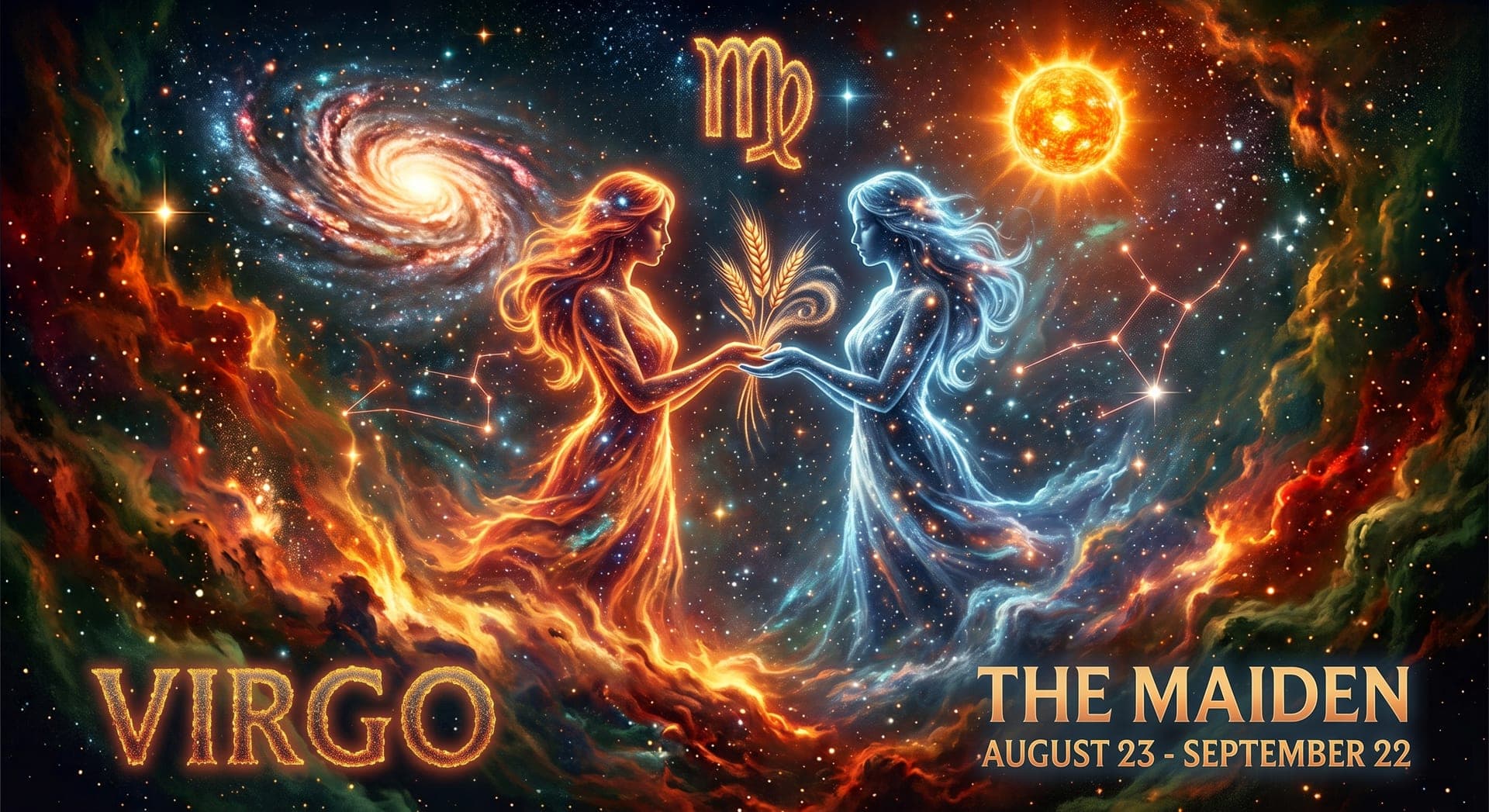
Virgo, the sixth sign of the zodiac, spans August 23 to September 22 and is symbolized by the maiden, often depicted holding a sheaf of wheat, representing purity, meticulous care, and the harvest. Ruled by Mercury, the planet of communication and intellect, Virgo channels its mental energy toward precision, analysis, and practical problem-solving rather than idle chatter. As an Earth sign, Virgo is grounded and detail-oriented, finding genuine satisfaction in organizing, refining, and perfecting the world around it. Its Mutable modality gives Virgo an adaptable, service-oriented nature, often finding purpose in quietly helping others and improving systems rather than seeking the spotlight. People born under this sign are frequently drawn to work requiring precision, research, or care for others, from science and medicine to editing and organization. Virgo's high standards make it an excellent problem-solver and a reliable presence others can count on, though that same perfectionism can turn inward as self-criticism or outward as an exacting, sometimes overly critical, eye toward the people and world around it.
Personality Traits
Strengths
- Highly organized and detail-oriented
- Reliable and hardworking
- Analytical problem-solver
- Genuinely helpful to others
- Modest and unpretentious
Weaknesses
- Prone to overcritical perfectionism
- Tends to worry excessively
- Can be overly critical of others
- Reserved to the point of aloofness
- Struggles to relax
Compatible Signs
Fun Facts
- Virgo's maiden symbol is often associated with Astraea, the Greek goddess of justice and purity, said to have been the last immortal to live among humans.
- Virgo is the only zodiac sign represented by a female human figure.
- Virgo and Gemini share Mercury as their ruling planet, though Virgo channels the planet's communicative energy toward analysis and precision rather than pure talkativeness.
- Notable Virgos include Beyoncé, Michael Jackson, Mother Teresa, and Stephen King.
- Virgo season falls at the tail end of summer, a period traditionally associated with harvest, meticulous preparation, and gathering resources for the colder months ahead.
Born on September 10
- 1659
Henry Purcell
English Baroque composer
- 1753
John Soane
English architect renowned for his Neoclassical designs, including the Bank of England and his own house-museum in London
- 1839
Charles Sanders Peirce
American philosopher and logician
- 1871
Charles Collett
English mechanical engineer who served as Chief Mechanical Engineer of the Great Western Railway, designing celebrated steam locomotives
- 1890
Elsa Schiaparelli
Italian-French fashion designer
- 1890
Mortimer Wheeler
Scottish-born British archaeologist known for excavations at sites including Maiden Castle and for popularising archaeology on television
- 1926
Beryl Cook
English painter celebrated for her cheerful, curvaceous depictions of everyday British life
- 1929
Arnold Palmer
American professional golfer
- 1933
Karl Lagerfeld
German fashion designer for Chanel and Fendi
- 1936
Peter Lovesey
English crime writer best known for his Sergeant Cribb and Peter Diamond detective novels
- 1941
Stephen Jay Gould
American paleontologist and evolutionary biologist
- 1941
Christopher Hogwood
English conductor and harpsichordist who founded the Academy of Ancient Music and championed historically informed performance
- 1960
Colin Firth
English actor known for roles in Pride and Prejudice and his Academy Award-winning performance in The King's Speech
- 1964
Jack Ma
Chinese businessman who co-founded Alibaba
- 1968
Guy Ritchie
English film director and screenwriter known for stylised crime films such as Lock, Stock and Two Smoking Barrels and Snatch
On This Day in History
- 1419
John the Fearless, Duke of Burgundy, is assassinated by supporters of the future French king, deepening France's civil conflict.
John the Fearless was ambushed and killed during a supposed peace meeting with the Dauphin, the future Charles VII, an assassination carried out in revenge for John's own earlier murder of a royal rival. The killing deepened the bitter civil conflict between rival French factions and pushed Burgundy into a formal alliance with England during the ongoing Hundred Years' War.
- 1509
A major earthquake strikes Constantinople, causing such widespread destruction it becomes known as "The Lesser Judgment Day."
A severe earthquake struck the Ottoman capital, causing catastrophic damage to buildings including mosques and the city walls, and reportedly triggering a destructive tsunami as well. Contemporary chroniclers gave the disaster its ominous nickname due to the sheer scale of destruction and loss of life across the densely populated imperial city.
- 1515
Thomas Wolsey, chief minister to King Henry VIII, is invested as a Cardinal of the Roman Catholic Church.
The appointment cemented Wolsey's dominance over English government and church affairs through the 1510s and 1520s. He went on to become Lord Chancellor and Papal Legate, wielding near-total control over state policy, until his failure to secure Henry VIII's annulment from Catherine of Aragon triggered his dramatic fall from power in 1529.
- 1547
English forces defeat the Scots at the Battle of Pinkie, the last full-scale military engagement between England and Scotland.
English forces decisively defeated an invading Scottish army near the village of Pinkie, inflicting heavy casualties in what became known as "Black Saturday" in Scotland. The battle proved to be the final large-scale pitched battle fought between the two kingdoms, though border skirmishes continued intermittently for decades afterward.
- 1547
English forces led by the Duke of Somerset decisively defeat the Scots at the Battle of Pinkie near Musselburgh, Scotland.
Fought during the "Rough Wooing," Edward VI's campaign to force a marriage between the young Mary, Queen of Scots, and the English king, it was the last pitched battle fought between England and Scotland as sovereign nations. English artillery and cavalry inflicted heavy casualties, killing several thousand Scots in one of the bloodiest days in Scottish military history.
- 1776
Nathan Hale volunteers to serve as a spy for the Continental Army.
The young schoolteacher-turned-soldier volunteered for a dangerous intelligence-gathering mission behind British lines in New York, reportedly declaring that he regretted having only one life to lose for his country. He was captured and executed by the British shortly afterward, becoming one of the American Revolution's most celebrated martyrs.
- 1798
British settlers and their allies repel a Spanish invasion fleet at the Battle of St. George's Caye off the coast of British Honduras.
The victory ended Spain's repeated attempts to expel British loggers and settlers from the Belize coast, securing British control over the settlement that eventually became the colony of British Honduras and later the independent nation of Belize. The anniversary of the battle remains a national holiday in Belize today.
- 1813
American naval forces defeat the British fleet at the Battle of Lake Erie during the War of 1812.
American naval forces under Commodore Oliver Hazard Perry defeated a British squadron on Lake Erie, securing American control of the crucial lake and enabling the recapture of Detroit shortly afterward. Perry's after-battle report, "We have met the enemy and they are ours," became one of the most famous phrases of the war.
- 1813
American naval forces under Oliver Hazard Perry defeat a British squadron at the Battle of Lake Erie during the War of 1812.
The victory gave the United States control of Lake Erie, severing British supply lines and forcing the abandonment of Detroit. Perry's famous dispatch, "We have met the enemy and they are ours," made the battle a celebrated American naval triumph and a significant setback to British strategy in the war's western theatre.
- 1846
Elias Howe receives a patent for his design of the sewing machine.
Inventor Elias Howe secured a patent for his design of a lockstitch sewing machine, featuring an eye-pointed needle and a mechanism for producing durable, even stitches far faster than hand sewing. Though Howe initially struggled to find buyers, his invention eventually became foundational to the industrialization of clothing manufacturing worldwide.
- 1898
Empress Elisabeth of Austria is assassinated by an Italian anarchist in Geneva.
While walking near Lake Geneva, the Austrian empress consort, known for her beauty and eccentric personal habits, was fatally stabbed by an Italian anarchist seeking to assassinate any member of royalty as a political statement. Her death shocked European royal circles and deeply affected her husband, Emperor Franz Joseph I, who outlived nearly his entire immediate family.
- 1932
New York City's municipally owned IND subway system opens to the public.
New York City's third subway system, built and operated directly by the municipal government rather than private companies, opened its first line, part of a broader effort to expand affordable public transit and reduce the city's reliance on privately operated transit monopolies.
- 1936
The first official Speedway World Championship final is staged at Wembley Stadium in London.
Motorcycle speedway had grown rapidly in popularity across Britain during the 1920s and 1930s, and Wembley became the sport's spiritual home for the newly formalised world title. Australian rider Lionel Van Praag won the inaugural championship in front of a huge crowd, launching an annual event that continued for decades afterward.
- 1939
The Royal Navy submarine HMS Oxley is mistakenly sunk by fellow submarine HMS Triton off Norway, the first British submarine loss of the Second World War.
The tragedy resulted from a navigational misunderstanding and a failure to correctly identify Oxley before Triton fired torpedoes at what its crew believed was an enemy vessel, killing all but two of Oxley's crew. Occurring just days after Britain's declaration of war, it underscored the dangerous confusion of early wartime naval operations.
- 1942
British forces launch an amphibious landing on Vichy French-held Madagascar as part of Operation Ironclad.
The campaign aimed to deny the strategically vital island's ports to Japanese naval forces following Japan's rapid advance through the Indian Ocean. After months of scattered fighting, Vichy French forces surrendered the island in November 1942, securing British control of the vital sea lanes to India and the Middle East.
- 1967
The people of Gibraltar vote overwhelmingly in a referendum to remain under British sovereignty rather than come under Spanish control.
The result, with over 99 percent voting to stay British, came amid a long-running dispute with Spain over the territory's status. It reinforced Gibraltar's status as a British Overseas Territory and became a touchstone the territory has repeatedly cited in later sovereignty disputes with Spain, including in the years following Brexit.
- 2000
British special forces launch Operation Barras, successfully rescuing British soldiers held hostage by the rebel militia West Side Boys in Sierra Leone.
The hostages, members of the Royal Irish Regiment, had been captured a month earlier while on a liaison patrol. Troops from the SAS and Parachute Regiment freed them in a fierce firefight, and the operation is widely credited with breaking the West Side Boys and helping bring an end to Sierra Leone's brutal civil war.
- 2001
British contestant Charles Ingram is later found to have won a game show's top prize through fraud, in a case that captivated public attention.
British contestant Charles Ingram won the top prize on the game show "Who Wants to Be a Millionaire?" but was later found to have used a coded coughing system with accomplices in the audience to identify correct answers, a scandal that became a widely publicized case study in game show fraud.
- 2001
British Army major Charles Ingram wins the top prize on the UK game show Who Wants to Be a Millionaire? using a coughing code from an accomplice in the audience.
Producers grew suspicious of coughing sounds on the recording that appeared to signal correct answers to Ingram and withheld the £1 million prize. Ingram, his wife, and an accomplice were later convicted of deception in a widely publicised trial, and the "coughing major" scandal became a landmark case in British television history.
- 2008
The Large Hadron Collider is activated for the first time at CERN in Switzerland.
Physicists at the CERN research facility near Geneva successfully powered up the Large Hadron Collider, the world's largest and most powerful particle accelerator, designed to probe fundamental questions in physics including the search for the theorized Higgs boson particle, which was confirmed discovered several years later.