What’s Observed on September 12
Born on September 12: Virgo ♍
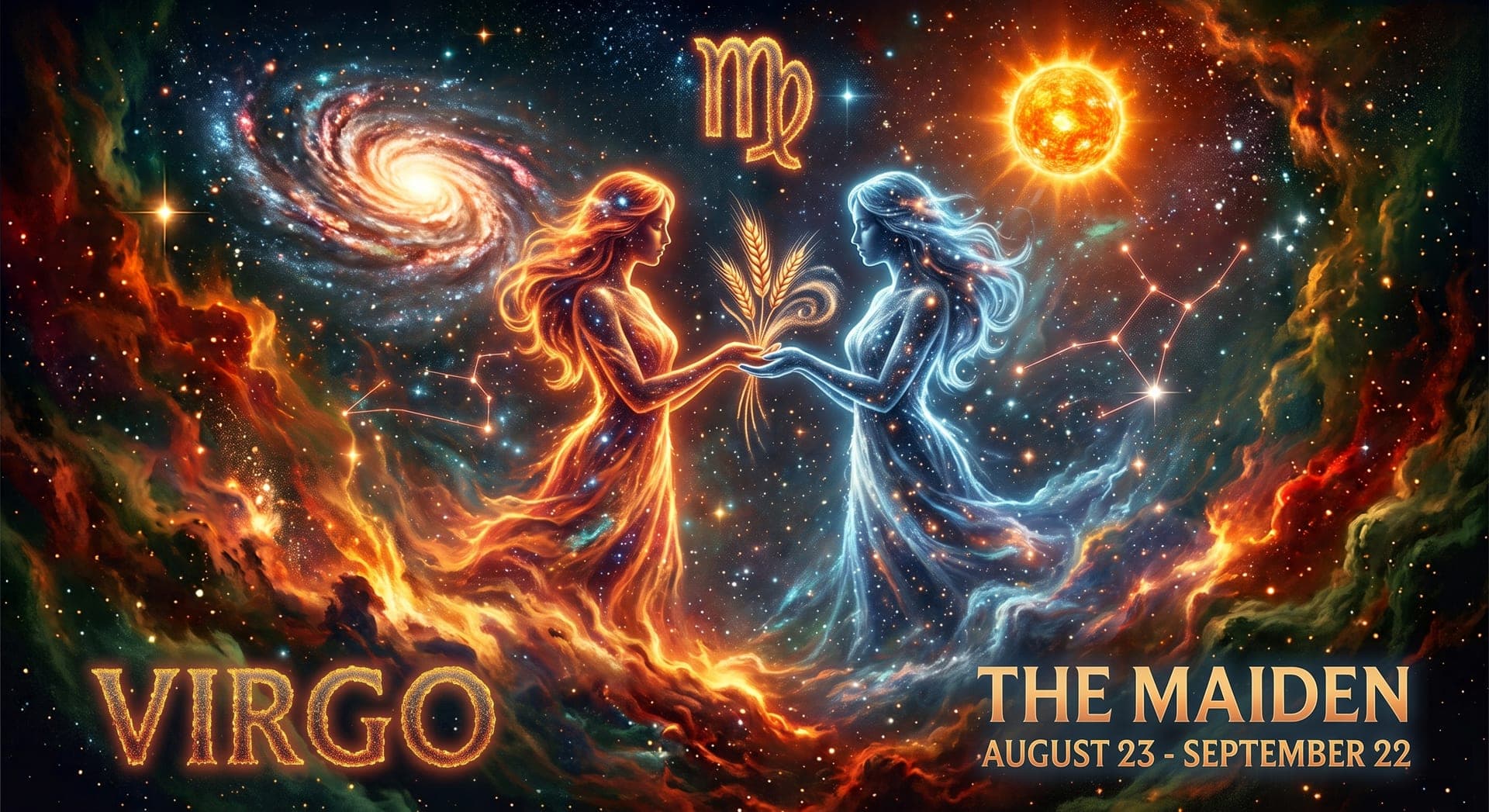
Virgo, the sixth sign of the zodiac, spans August 23 to September 22 and is symbolized by the maiden, often depicted holding a sheaf of wheat, representing purity, meticulous care, and the harvest. Ruled by Mercury, the planet of communication and intellect, Virgo channels its mental energy toward precision, analysis, and practical problem-solving rather than idle chatter. As an Earth sign, Virgo is grounded and detail-oriented, finding genuine satisfaction in organizing, refining, and perfecting the world around it. Its Mutable modality gives Virgo an adaptable, service-oriented nature, often finding purpose in quietly helping others and improving systems rather than seeking the spotlight. People born under this sign are frequently drawn to work requiring precision, research, or care for others, from science and medicine to editing and organization. Virgo's high standards make it an excellent problem-solver and a reliable presence others can count on, though that same perfectionism can turn inward as self-criticism or outward as an exacting, sometimes overly critical, eye toward the people and world around it.
Personality Traits
Strengths
- Highly organized and detail-oriented
- Reliable and hardworking
- Analytical problem-solver
- Genuinely helpful to others
- Modest and unpretentious
Weaknesses
- Prone to overcritical perfectionism
- Tends to worry excessively
- Can be overly critical of others
- Reserved to the point of aloofness
- Struggles to relax
Compatible Signs
Fun Facts
- Virgo's maiden symbol is often associated with Astraea, the Greek goddess of justice and purity, said to have been the last immortal to live among humans.
- Virgo is the only zodiac sign represented by a female human figure.
- Virgo and Gemini share Mercury as their ruling planet, though Virgo channels the planet's communicative energy toward analysis and precision rather than pure talkativeness.
- Notable Virgos include Beyoncé, Michael Jackson, Mother Teresa, and Stephen King.
- Virgo season falls at the tail end of summer, a period traditionally associated with harvest, meticulous preparation, and gathering resources for the colder months ahead.
Born on September 12
- 1494
Francis I of France
King of France and Renaissance patron of the arts
- 1852
H. H. Asquith
English statesman who served as Prime Minister of the United Kingdom from 1908 to 1916, leading Britain into the First World War
- 1888
Maurice Chevalier
French actor and singer
- 1913
Jesse Owens
American track and field athlete and four-time Olympic gold medalist
- 1914
Desmond Llewelyn
Welsh-English actor best known for playing Q, the gadget master, in the James Bond film series for over three decades
- 1931
George Jones
American country music singer
- 1931
Ian Holm
English actor celebrated for roles including Bilbo Baggins in The Lord of the Rings and The Hobbit trilogies
- 1944
Barry White
American soul singer known for his deep baritone voice
- 1951
Ray Gravell
Welsh rugby union player and actor who won 23 caps for Wales and later became a broadcaster
- 1957
Hans Zimmer
German film composer
- 1957
Rachel Ward
English-Australian actress known for her role in the television miniseries The Thorn Birds
- 1980
Yao Ming
Chinese professional basketball player
- 1986
Alfie Allen
English actor known for playing Theon Greyjoy in the television series Game of Thrones
- 1986
Joanne Jackson
English swimmer who won an Olympic bronze medal in the 400-metre freestyle at the 2008 Beijing Olympics
On This Day in History
- 490 BCE
Athenian forces and their Plataean allies defeat the first Persian invasion of Greece at the Battle of Marathon.
A vastly outnumbered Athenian army, aided by allies from the small city of Plataea, decisively defeated the first Persian invasion force on the plain of Marathon, employing an innovative tactical formation that enveloped the Persian flanks. The victory is often cited as a pivotal moment preserving early Greek civilization and democratic experimentation from Persian conquest.
- 490 BCE
Athenian forces decisively defeat an invading Persian army at the Battle of Marathon, halting the first Persian invasion of Greece.
The heavily outnumbered Athenians, aided by allies from Plataea, routed the Persian force on the plain of Marathon northeast of Athens. The victory became a foundational moment of Athenian identity and, according to legend, inspired the modern marathon race after a runner carried news of the win back to the city.
- 1609
Henry Hudson begins exploring the river later named after him while commanding the Halve Maen.
Sailing for the Dutch East India Company while searching for a northwest passage to Asia, English navigator Henry Hudson instead explored the river later named in his honor, extensively charting the waterway and establishing early Dutch claims to the region that became New Netherland.
- 1814
American forces halt the British advance toward Baltimore at the Battle of North Point during the War of 1812.
American militia and regular troops repelled a British advance toward Baltimore at North Point, inflicting casualties including the death of the British commanding general, a defensive stand that helped set the stage for the successful defense of nearby Fort McHenry the following day.
- 1814
American militia clash with a British invasion force at the Battle of North Point outside Baltimore during the War of 1812.
The delaying action slowed the British advance toward Baltimore and led to the death of British commander Major General Robert Ross, shot by American sharpshooters. Combined with the failed naval bombardment of nearby Fort McHenry over the following days, it forced the British to abandon their campaign against the city and withdraw.
- 1847
The Battle of Chapultepec begins during the Mexican-American War.
American forces under General Winfield Scott launched an assault on the fortified hilltop castle of Chapultepec, then serving as Mexico's military academy, in one of the final major battles before the fall of Mexico City during the Mexican-American War. The castle's defenders included young military cadets who fought fiercely, and the battle's outcome opened the road directly into the Mexican capital.
- 1857
The steamship SS Central America sinks off North Carolina, carrying a significant shipment of California gold.
Overloaded with passengers and a substantial cargo of gold from the California mines, the steamship SS Central America sank during a hurricane off the Carolina coast, killing over 400 people in one of the deadliest peacetime maritime disasters in American history to that point.
- 1885
Arbroath defeats Bon Accord 36–0 in the Scottish Cup, still the record score in British senior football history.
The lopsided result came against a weak amateur side fielding a mismatched team, with Arbroath's John Petrie alone scoring 13 goals in the rout. The scoreline has never been surpassed in over a century of British football since and remains a frequently cited piece of footballing trivia in Scotland and beyond.
- 1897
Twenty-one soldiers of the British Indian Army's 36th Sikhs make a last stand against thousands of Afghan tribesmen at the outpost of Saragarhi.
The garrison, defending a communications post on British India's North-West Frontier, fought to the last man rather than surrender, inflicting heavy casualties on the attackers before being overwhelmed. The defence became legendary within the British Indian Army and is still commemorated today as a symbol of extraordinary courage and discipline.
- 1906
The Newport Transporter Bridge opens in Wales.
Designed to allow crossing traffic while permitting tall ships to pass beneath, the transporter bridge suspended a moving gondola from an overhead framework above the River Usk in Newport, Wales, an unusual engineering solution that remains a distinctive local landmark.
- 1906
The Newport Transporter Bridge, carrying passengers and vehicles across the River Usk in Wales via a suspended gondola, officially opens.
The unusual engineering solution allowed river traffic to pass unimpeded beneath the high-level structure while still moving people and goods across the water below. One of only a handful of such bridges ever built worldwide, it remains a working landmark and a symbol of Newport's industrial heritage in south Wales.
- 1923
The United Kingdom formally annexes Southern Rhodesia, ending rule by the British South Africa Company and making it a self-governing British colony.
The change followed a 1922 referendum in which the territory's white settlers voted against joining the Union of South Africa. Southern Rhodesia remained a British colony, later self-governing, until its white minority government unilaterally declared independence in 1965, eventually becoming the independent nation of Zimbabwe in 1980.
- 1953
Future president John F. Kennedy marries Jacqueline Lee Bouvier in Newport, Rhode Island.
The future president married Jacqueline Bouvier in a highly publicized society wedding at St. Mary's Church in Newport, Rhode Island, an event that drew significant media attention and helped establish the glamorous public image that would later characterize the Kennedy White House.
- 1958
Engineer Jack Kilby demonstrates the first working integrated circuit at Texas Instruments.
The device, a simple oscillator built on a single sliver of germanium, proved that multiple electronic components could be fabricated together on one chip rather than wired together separately by hand. The breakthrough underpinned the modern microelectronics revolution and earned Kilby a share of the Nobel Prize in Physics in 2000.
- 1962
President Kennedy delivers his "We choose to go to the Moon" speech at Rice University.
Addressing a large crowd at Rice University, President Kennedy articulated his ambitious vision for landing Americans on the Moon within the decade, famously declaring the nation chose to pursue the goal "not because it is easy, but because it is hard," galvanizing public and congressional support for the Apollo program.
- 1962
US President John F. Kennedy delivers his "We choose to go to the Moon" speech at Rice University, committing America to a crewed lunar landing.
The speech framed the Apollo program as a test of national resolve during the Cold War space race with the Soviet Union, setting the goal of landing a man on the Moon and returning him safely before the end of the decade. That goal was achieved with the Apollo 11 mission in July 1969.
- 1990
A treaty authorizing German reunification is signed in Moscow.
Representatives of East and West Germany along with the four World War II Allied powers signed the Treaty on the Final Settlement, formally clearing the way for German reunification just weeks later, officially ending the postwar division that had defined Cold War Europe for over four decades.
- 1990
The Treaty on the Final Settlement with Respect to Germany is signed by the two German states and the four Allied powers, paving the way for German reunification.
The agreement, signed by the United Kingdom, United States, France and the Soviet Union alongside East and West Germany, formally ended the Allied powers' post-war occupation rights over Germany. It cleared the last legal obstacle to reunification, which took effect weeks later on 3 October 1990, ending Germany's 45-year division.
- 2013
NASA confirms that its Voyager 1 probe had become the first human-made object to enter interstellar space.
NASA scientists analyzing data from the Voyager 1 spacecraft confirmed that the probe had crossed the heliopause roughly a year earlier, becoming the first human-made object to leave the protective bubble of charged particles surrounding the solar system and enter true interstellar space.
- 2013
NASA confirms that the Voyager 1 space probe has become the first human-made object to enter interstellar space.
The probe, launched in 1977, had crossed the heliopause, the boundary where the Sun's solar wind gives way to the interstellar medium, after a 36-year journey outward through the solar system. Still transmitting data from billions of miles away, Voyager 1 remains humanity's most distant active spacecraft.