What’s Observed on April 24
Born on April 24: Taurus ♉
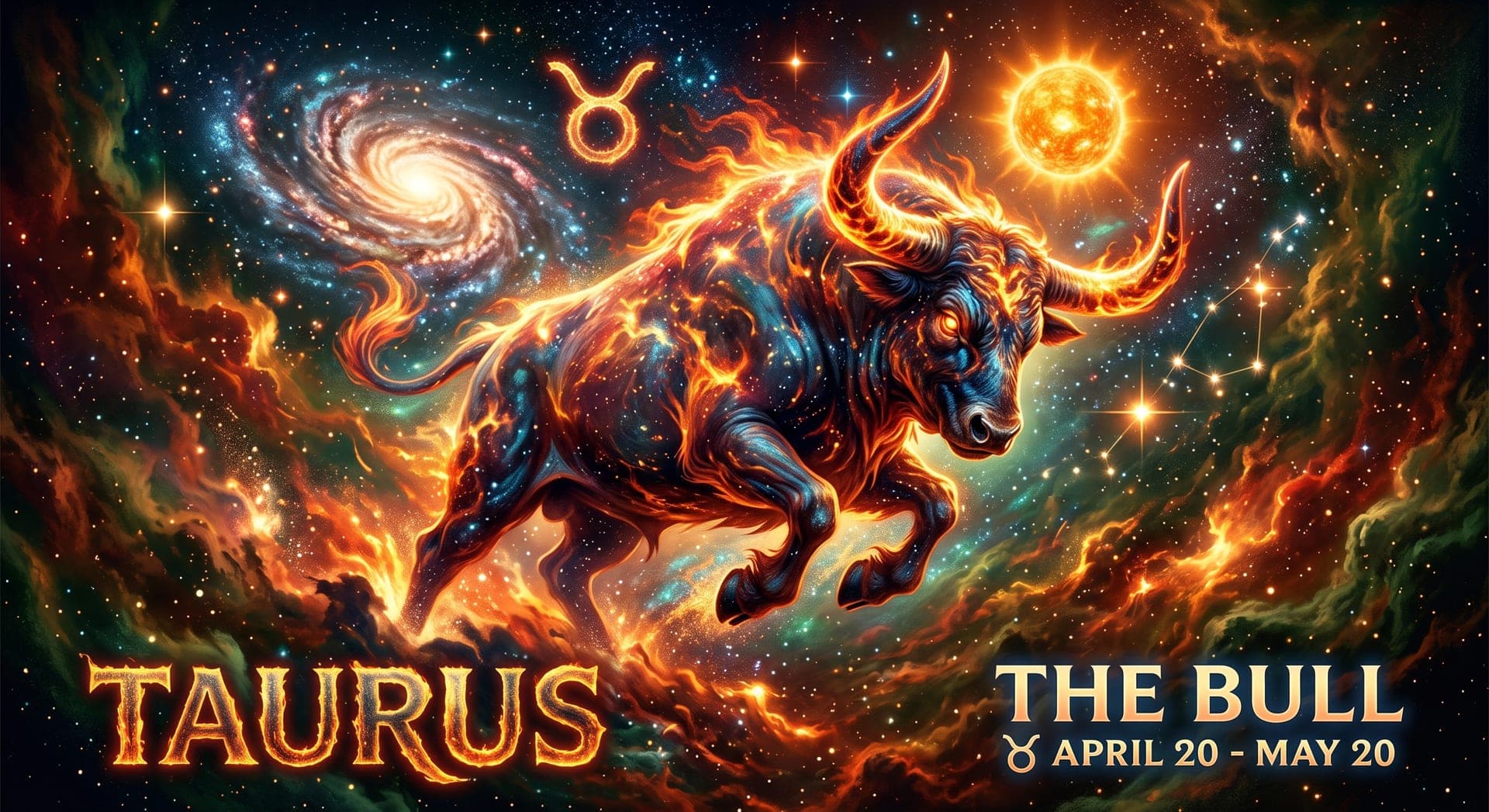
Taurus, the second sign of the zodiac, spans April 20 to May 20 and is symbolized by the bull, an animal prized for its strength, steadiness, and quiet determination. Ruled by Venus, the planet of love, beauty, and material comfort, Taurus is often described as one of the most sensual and pleasure-loving signs, drawn to good food, fine art, and physical comfort. As an Earth sign, Taurus is grounded, practical, and deeply connected to the physical world, valuing stability and tangible security over abstract ideas or sudden change. Its Fixed modality gives Taurus a well-earned reputation for stubbornness, since once a Taurus has settled on a plan or opinion, shifting it can be remarkably difficult. People born under this sign tend to be dependable, loyal, and patient, often the steady presence others rely on during difficult times. While their resistance to change can occasionally frustrate those around them, Taurus's persistence and work ethic make them exceptionally good at seeing long-term goals through to completion.
Personality Traits
Strengths
- Dependable and steady
- Patient and persistent
- Devoted to loved ones
- Appreciates beauty and comfort
- Financially sensible
Weaknesses
- Extremely stubborn
- Resistant to change
- Can be possessive
- Overindulgent
- Slow to forgive
Compatible Signs
Fun Facts
- Taurus's bull symbol connects to the Greek myth of Zeus transforming into a white bull to abduct Europa.
- Venus, Taurus' ruling planet, is the Roman goddess of love and beauty, reflecting the sign's love of comfort, art, and sensory pleasure.
- Taurus is considered by many astrologers to be the most stubborn sign of the zodiac, a trait often attributed to its Fixed modality and bull symbolism.
- Notable Taureans include Queen Elizabeth II, William Shakespeare, Adele, and David Beckham.
- The star cluster known as the Pleiades sits within the constellation Taurus and has been referenced in mythology and literature across many cultures.
Born on April 24
- 1533
William I of Orange
Founding father of the Netherlands who led the Dutch revolt against Spain
- 1620
John Graunt
English statistician born in London, a founding figure of demography whose analysis of London's mortality records pioneered vital statistics.
- 1743
Edmund Cartwright
English inventor of the power loom
- 1815
Anthony Trollope
English novelist born in London, prolific Victorian author best known for the Barsetshire and Palliser series of novels.
- 1880
Gideon Sundback
Swedish-American engineer who developed the modern zipper
- 1882
Hugh Dowding
Air Chief Marshal born in Moffat, Scotland, who commanded RAF Fighter Command during the Battle of Britain.
- 1889
Stafford Cripps
English politician born in London, who served as Chancellor of the Exchequer in the post-war Labour government.
- 1904
Willem de Kooning
Dutch-American abstract expressionist painter
- 1931
Bridget Riley
English painter born in Norwood, London, a leading figure of the Op Art movement known for her optically dazzling abstract works.
- 1942
Barbra Streisand
American singer, actress, and filmmaker
- 1962
Stuart Pearce
English footballer and manager born in Hammersmith, London, a hard-tackling left-back who captained England through the 1990s.
- 1973
Lee Westwood
English golfer born in Worksop, Nottinghamshire, a former world number one who won more than 40 professional titles.
- 1992
Laura Kenny
English track cyclist born in Cheshire, the most decorated female British Olympian with five gold medals.
On This Day in History
- 1558
Mary, Queen of Scots marries the French Dauphin, later King Francis II, at Notre-Dame de Paris.
The teenage Mary, Queen of Scots, married the French Dauphin, who would briefly become King Francis II the following year, in an elaborate ceremony at Notre-Dame de Paris intended to strengthen the alliance between Scotland and France. The marriage was part of a broader political strategy amid ongoing tensions between Scotland, France, and England.
- 1704
The Boston News-Letter begins publication, generally regarded as the first regularly published newspaper in British colonial America.
The Boston News-Letter began publication under printer John Campbell, generally regarded by historians as the first successfully sustained newspaper in Britain's American colonies, providing readers with a mix of local announcements and reprinted news from Europe. Its establishment marked an early step in the development of colonial American journalism.
- 1704
The Boston News-Letter, the first regularly published newspaper in British Colonial America, begins publication.
Founded by postmaster John Campbell in Boston, then a colony of the British Empire, the paper printed official notices, shipping news, and items reprinted from London papers under royal authority. Though modest in circulation, it established a template for colonial journalism and ran continuously for 72 years, until 1776.
- 1800
President John Adams approves funding to establish the Library of Congress.
President John Adams signed legislation appropriating $5,000 to purchase books needed by Congress as it prepared to relocate to the new capital city of Washington, establishing what became the Library of Congress. The institution has since grown into one of the largest libraries in the world, serving both Congress and the American public.
- 1877
Russia declares war on the Ottoman Empire, beginning the Russo-Turkish War.
The Russian Empire declared war on the Ottoman Empire, launching the Russo-Turkish War, fought partly in support of Balkan Christian populations seeking independence from Ottoman rule. The war's outcome led to significant territorial changes in the Balkans, including greater autonomy or independence for several nations, though it also drew concerned intervention from other European powers.
- 1913
The Woolworth Building opens in New York City, briefly becoming the tallest building in the world.
The Woolworth Building, an ornate Gothic-style skyscraper financed by five-and-dime retail magnate Frank Woolworth, opened in Lower Manhattan, briefly becoming the tallest building in the world at 792 feet. Dubbed the "Cathedral of Commerce," it remained an iconic feature of the New York skyline for decades.
- 1916
Irish republicans launch the Easter Rising in Dublin, proclaiming an independent Irish Republic.
Irish republican rebels seized key locations across Dublin and proclaimed an independent Irish Republic in the Easter Rising, an armed insurrection against British rule that was militarily crushed within a week but whose leaders' subsequent execution by British authorities significantly galvanized Irish public support for full independence.
- 1916
Irish republicans launch the Easter Rising, an armed insurrection against British rule in Dublin.
Roughly 1,200 rebels, led by figures including Patrick Pearse and James Connolly, seized key buildings across Dublin and proclaimed an independent Irish Republic from the steps of the General Post Office. British forces crushed the six-day uprising, and the subsequent execution of its leaders inflamed nationalist sentiment, becoming a pivotal moment on the path to Irish independence.
- 1918
The first tank-versus-tank combat in history occurs at the Battle of Villers-Bretonneux during World War I.
British and German tanks engaged each other directly for the first time in military history at the Battle of Villers-Bretonneux in France, a small but historically significant clash that marked the emergence of tank-versus-tank combat as a feature of modern warfare, foreshadowing armored warfare's central role in future conflicts.
- 1918
The first tank-to-tank combat in history occurs during the Second Battle of Villers-Bretonneux.
British Mark IV tanks clashed with German A7V tanks near the French village on the Western Front, as both sides used the new weapon to break the trench-warfare stalemate. The engagement ended inconclusively but marked a milestone in mechanized warfare, a field in which Britain had pioneered the tank's combat debut two years earlier.
- 1922
The first segment of the Imperial Wireless Chain, a network linking Britain to its empire by radio, comes into operation.
Conceived to give Britain a system of long-range wireless stations independent of undersea cables, which were vulnerable in wartime, the chain aimed to connect London with imperial outposts across Africa, Asia, and the Pacific. Though delayed and revised for years, it reflected Britain's effort to modernize communications across its far-flung empire in the interwar period.
- 1932
Rambler Benny Rothman leads a mass trespass onto the Kinder Scout moorland in the Peak District.
Several hundred working-class ramblers deliberately walked onto private grouse-shooting land to protest the exclusion of the public from vast tracts of the English countryside. Several trespassers, including Rothman, were arrested and jailed, but the protest galvanized the access-to-countryside movement and is widely credited with paving the way for Britain's national parks and rights-of-way laws.
- 1953
Winston Churchill is knighted by Queen Elizabeth II.
Former British Prime Minister Winston Churchill was formally knighted by Queen Elizabeth II in recognition of his wartime leadership and decades of public service, becoming Sir Winston Churchill. Already one of the most celebrated statesmen of the 20th century, the honor further cemented his legacy as Britain's iconic wartime leader.
- 1953
Winston Churchill is knighted by Queen Elizabeth II.
The former and future wartime prime minister was made a Knight of the Order of the Garter, Britain's oldest and most prestigious order of chivalry, in recognition of his leadership during the Second World War and his long career in public life. He had returned to office as prime minister the previous year and would receive the Nobel Prize in Literature later that same year.
- 1957
The Suez Canal reopens to shipping following the deployment of United Nations peacekeepers.
The canal had been blocked by scuttled ships since the Suez Crisis the previous autumn, when Britain and France, alongside Israel, invaded Egypt after President Nasser nationalized the canal. International pressure, including from the United States, forced a humiliating withdrawal of British and French forces, and the reopening under UN oversight marked the definitive end of Britain's dominant role in the region.
- 1963
Princess Alexandra of Kent marries the Honourable Angus Ogilvy at Westminster Abbey.
A first cousin of Queen Elizabeth II, Alexandra was among the most popular members of the royal family at the time, and her wedding drew large crowds and television coverage. The couple went on to have two children and remained married until Ogilvy's death in 2004.
- 1967
Soviet cosmonaut Vladimir Komarov is killed when his Soyuz 1 spacecraft crashes on reentry, becoming the first human to die during a spaceflight.
Soviet cosmonaut Vladimir Komarov was killed when his Soyuz 1 spacecraft's parachute system failed during reentry after a mission plagued by technical problems, making him the first human to die during an actual spaceflight. His death, following mounting known issues with the spacecraft that were reportedly overridden for political reasons, prompted a significant overhaul of Soviet spaceflight safety procedures.
- 1990
The Hubble Space Telescope is launched into orbit aboard Space Shuttle Discovery.
The Hubble Space Telescope was launched into low Earth orbit aboard Space Shuttle Discovery, beginning a mission that, despite early problems with a flawed mirror later corrected by astronauts, went on to produce some of the most significant astronomical images and discoveries in the history of space science.
- 1990
Gruinard Island off the coast of Scotland is declared free of anthrax contamination after 48 years.
The uninhabited island had been used by the British military in 1942 to test anthrax as a biological weapon, leaving the soil contaminated for decades and earning it the nickname 'Anthrax Island.' A lengthy decontamination effort using formaldehyde and seawater finally rendered the island safe, and it was returned to the descendants of its original owners.
- 1993
An IRA bomb devastates the Bishopsgate area in the City of London.
The truck bomb, detonated in London's financial district, killed one person, injured over 40, and caused roughly a billion pounds in damage to historic buildings and offices. It was one of the most economically damaging attacks of the Troubles and prompted a major overhaul of security around the City of London, including the 'ring of steel' surveillance and checkpoint system.