What’s Observed on April 20
Born on April 20: Taurus ♉
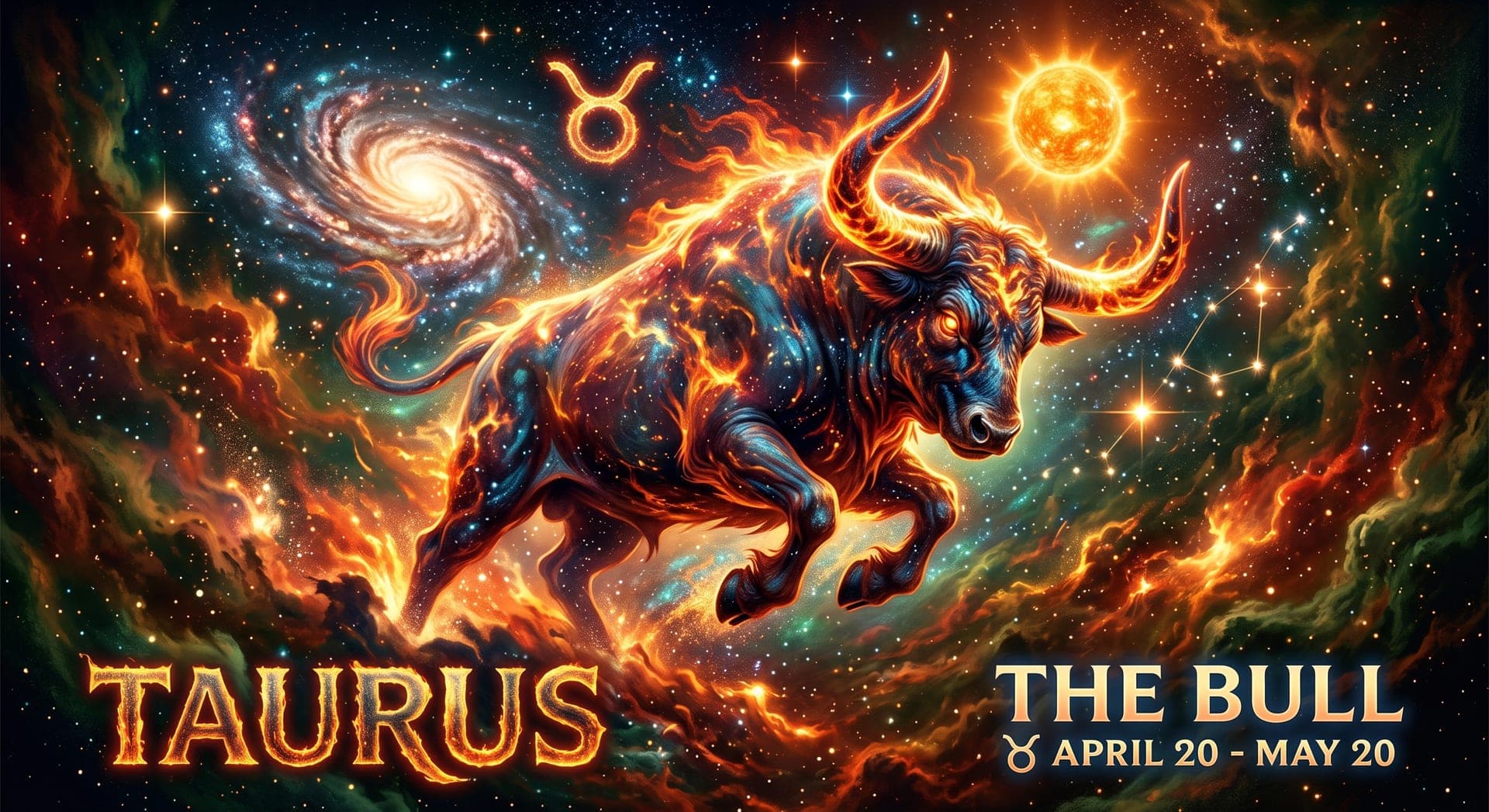
Taurus, the second sign of the zodiac, spans April 20 to May 20 and is symbolized by the bull, an animal prized for its strength, steadiness, and quiet determination. Ruled by Venus, the planet of love, beauty, and material comfort, Taurus is often described as one of the most sensual and pleasure-loving signs, drawn to good food, fine art, and physical comfort. As an Earth sign, Taurus is grounded, practical, and deeply connected to the physical world, valuing stability and tangible security over abstract ideas or sudden change. Its Fixed modality gives Taurus a well-earned reputation for stubbornness, since once a Taurus has settled on a plan or opinion, shifting it can be remarkably difficult. People born under this sign tend to be dependable, loyal, and patient, often the steady presence others rely on during difficult times. While their resistance to change can occasionally frustrate those around them, Taurus's persistence and work ethic make them exceptionally good at seeing long-term goals through to completion.
Personality Traits
Strengths
- Dependable and steady
- Patient and persistent
- Devoted to loved ones
- Appreciates beauty and comfort
- Financially sensible
Weaknesses
- Extremely stubborn
- Resistant to change
- Can be possessive
- Overindulgent
- Slow to forgive
Compatible Signs
Fun Facts
- Taurus's bull symbol connects to the Greek myth of Zeus transforming into a white bull to abduct Europa.
- Venus, Taurus' ruling planet, is the Roman goddess of love and beauty, reflecting the sign's love of comfort, art, and sensory pleasure.
- Taurus is considered by many astrologers to be the most stubborn sign of the zodiac, a trait often attributed to its Fixed modality and bull symbolism.
- Notable Taureans include Queen Elizabeth II, William Shakespeare, Adele, and David Beckham.
- The star cluster known as the Pleiades sits within the constellation Taurus and has been referenced in mythology and literature across many cultures.
Born on April 20
- 1808
Napoleon III
First President of France and later Emperor of the French
- 1826
Dinah Craik
English novelist and poet best known for the bestselling Victorian novel John Halifax, Gentleman.
- 1893
Joan Miró
Spanish surrealist painter and sculptor
- 1893
Harold Lloyd
American silent film actor and comedian
- 1924
Leslie Phillips
English actor known for his distinctive voice and comic roles in the Carry On films and decades of British stage, film, and television work.
- 1930
Antony Jay
English writer and broadcaster who co-created the satirical television series Yes Minister and Yes, Prime Minister.
- 1937
George Takei
American actor known for "Star Trek"
- 1943
John Eliot Gardiner
English conductor renowned for historically informed performances of Baroque and Classical repertoire, particularly the works of Bach.
- 1949
Jessica Lange
American actress known for film and television
- 1949
Veronica Cartwright
English-born actress known for her role in the science-fiction film Alien and a long career in American film and television.
- 1953
Sebastian Faulks
English novelist and journalist best known for Birdsong, a novel set during the First World War.
- 1963
Rachel Whiteread
English sculptor known for casting the negative spaces of everyday objects and buildings, and the first woman to win the Turner Prize.
- 1964
Andy Serkis
English actor and director who pioneered motion-capture performance, most notably as Gollum in The Lord of the Rings trilogy.
- 1983
Miranda Kerr
Australian model
- 1997
Alexander Zverev
German professional tennis player

On This Day in History
- 1152
Baldwin III of Jerusalem gains sole control of his kingdom after years of conflict with his mother, Melisende.
Baldwin III of Jerusalem, having briefly shared power uneasily with his mother, Queen Melisende, in a joint and often contentious regency, achieved sole control of the Crusader Kingdom of Jerusalem after years of internal political conflict, stabilizing the kingdom's leadership at a critical period in its ongoing struggle against neighboring Muslim states.
- 1303
Mamluk forces defeat the Ilkhanate at the Battle of Marj al-Saffar, ending Mongol incursions into Syria.
Mamluk forces decisively defeated the Mongol Ilkhanate at the Battle of Marj al-Saffar near Damascus, ending recurring Mongol invasions into Syria and securing Mamluk control over the region for generations. The victory marked a significant turning point in the broader struggle for dominance in the medieval Middle East.
- 1653
Oliver Cromwell forcibly dissolves England's Rump Parliament, consolidating his control during the Commonwealth period.
Lord Protector Oliver Cromwell marched troops into Parliament and forcibly dissolved the Rump Parliament, the remnant assembly that had governed England since the execution of King Charles I, accusing its members of corruption and self-interest. The dissolution consolidated Cromwell's personal authority during England's brief republican Commonwealth period.
- 1653
Oliver Cromwell forcibly dissolves England's Rump Parliament, ending its authority after years of political deadlock.
Frustrated by the Rump's refusal to dissolve itself and hold fresh elections, Cromwell marched a body of musketeers into the chamber, denounced the assembled members, and had the mace, symbol of parliamentary authority, removed. The dissolution marked a decisive step in Cromwell's consolidation of power during the English Interregnum and preceded his installation as Lord Protector later that year.
- 1657
English admiral Robert Blake destroys a Spanish treasure fleet at the Battle of Santa Cruz de Tenerife.
Sailing his squadron into a heavily fortified harbour defended by shore batteries and castle guns, Blake attacked and burned the Spanish ships at anchor without losing a single vessel of his own. The victory, achieved despite the enemy's strong defensive position, was hailed in England as a triumph of naval daring and cemented Blake's reputation as one of the greatest admirals in English history.
- 1792
France declares war on Austria, marking the beginning of the French Revolutionary Wars.
Revolutionary France declared war on Austria, an act driven by a mix of ideological fervor and political calculation, launching the French Revolutionary Wars that would eventually expand into a broader continental conflict engulfing much of Europe for over two decades and paving the way for Napoleon's later rise to power.
- 1861
Robert E. Lee resigns his commission in the U.S. Army to command Confederate forces in his native Virginia.
Robert E. Lee resigned his commission in the United States Army rather than lead an invasion of his native Virginia, subsequently accepting command of Virginia's state military forces and later the Confederate Army of Northern Virginia. His decision, made despite personal reservations about secession, shaped the course of the Civil War's Eastern Theater.
- 1898
President William McKinley signs a joint resolution demanding Spain withdraw from Cuba, precipitating the Spanish-American War.
President William McKinley signed a joint congressional resolution recognizing Cuban independence and demanding Spain withdraw its forces from the island, a move Spain considered tantamount to a declaration of war, precipitating the brief Spanish-American War that ended with the United States acquiring Puerto Rico, Guam, and the Philippines.
- 1898
The United States declares war on Spain after President William McKinley signs a congressional resolution, beginning the Spanish-American War.
Tensions had built for months over Spain's brutal suppression of a Cuban independence uprising and the mysterious sinking of the USS Maine in Havana harbor. The brief but consequential war ended within months with a decisive American victory, resulting in Spain's loss of Cuba, Puerto Rico, Guam, and the Philippines and marking the emergence of the United States as an imperial power on the world stage.
- 1946
The League of Nations formally dissolves, transferring most of its responsibilities to the newly created United Nations.
Founded after the First World War to prevent future conflicts through collective security and diplomacy, the League had failed to stop the aggression that led to the Second World War, exposing its lack of enforcement power. Its assets, mandates, and many of its agencies were handed over to the United Nations, which had already been established the previous year in San Francisco.
- 1949
Chinese Communist forces open fire on the British frigate HMS Amethyst as it sails up the Yangtze River toward Nanjing.
The ship came under sustained artillery bombardment from People's Liberation Army positions during the Chinese Civil War, killing crew members and running it aground. Amethyst remained trapped on the river for over three months before making a daring nighttime escape downriver to the open sea. The episode became a celebrated feat of seamanship and a notable flashpoint in early Cold War relations between Britain and Communist China.
- 1961
The Bay of Pigs Invasion collapses as Cuban government forces defeat the CIA-backed exile brigade.
The CIA-backed Bay of Pigs invasion force, having landed in Cuba days earlier, was decisively defeated by Cuban government forces under Fidel Castro, with most of the invading exiles killed or captured. The failed operation deeply embarrassed the Kennedy administration and pushed Cuba further toward formal alliance with the Soviet Union.
- 1968
British Conservative politician Enoch Powell delivers his controversial "Rivers of Blood" speech opposing mass immigration to Britain.
Speaking to a Conservative association meeting in Birmingham, Powell warned in inflammatory terms against continued Commonwealth immigration, quoting a constituent's fear of racial conflict. The speech caused immediate uproar, led to his dismissal from the shadow cabinet the next day, and provoked lasting debate about race, immigration, and free speech that continues to shape British political discourse.
- 1972
Apollo 16's lunar module lands on the Moon, with astronauts John Young and Charles Duke conducting a series of surface experiments.
Apollo 16 astronauts John Young and Charles Duke landed their lunar module in the Descartes Highlands region of the Moon, beginning a mission that included extensive geological sampling and the use of a lunar rover to explore terrain more rugged than that visited by earlier Apollo missions.
- 1972
The Apollo 16 Lunar Module Orion, carrying astronauts John Young and Charles Duke, lands on the Moon.
The pair touched down in the Descartes Highlands, a mountainous lunar region chosen to test theories about volcanic activity on the Moon, while Ken Mattingly orbited above in the command module. Young and Duke spent nearly three days on the surface, conducting three moonwalks and driving a lunar rover across rugged terrain to collect geological samples.
- 1999
Two students kill 12 classmates and a teacher before taking their own lives at Columbine High School in Colorado.
Two students armed with guns and homemade explosives killed 12 fellow students and a teacher before taking their own lives at Columbine High School in Colorado, a massacre that became a defining and horrifying template referenced in numerous subsequent American school shootings and sparked intense national debate over gun control and school safety.
- 1999
Two students kill twelve classmates and a teacher before taking their own lives in the Columbine High School massacre.
Eric Harris and Dylan Klebold carried out a meticulously planned attack with firearms and homemade explosives at their high school in Columbine, Colorado, wounding more than twenty others before turning their guns on themselves. The massacre, among the deadliest school shootings in American history at the time, prompted intense national debate over gun control, school security, and the causes of youth violence.
- 2010
The Deepwater Horizon drilling rig explodes in the Gulf of Mexico, killing eleven workers and triggering a massive oil spill.
The blowout of BP's Macondo well, following the rig explosion, released roughly 4.9 million barrels of oil into the Gulf over the following three months before the well was finally capped. It became the largest marine oil spill in history, devastating marine ecosystems and coastal economies across the region and leading to sweeping changes in offshore drilling regulation.
- 2021
A jury finds former police officer Derek Chauvin guilty on all charges in the murder of George Floyd.
Chauvin, who had knelt on Floyd's neck for more than nine minutes during a 2020 arrest in Minneapolis, was convicted of second-degree murder, third-degree murder, and manslaughter. The verdict, reached after video of the killing sparked global protests against police brutality and racial injustice, was widely seen as a rare instance of accountability for a police killing of a Black American.
- 2023
SpaceX's Starship, the largest rocket ever built, launches on its first uncrewed test flight but breaks apart minutes after liftoff.
SpaceX's Starship, the largest and most powerful rocket ever built, launched on its first integrated uncrewed test flight from Texas but broke apart approximately four minutes after liftoff following the failure of several engines and a loss of vehicle control. Despite the explosive end, SpaceX characterized the flight as a valuable data-gathering step in the vehicle's development.