What’s Observed on April 19
Born on April 19: Aries ♈
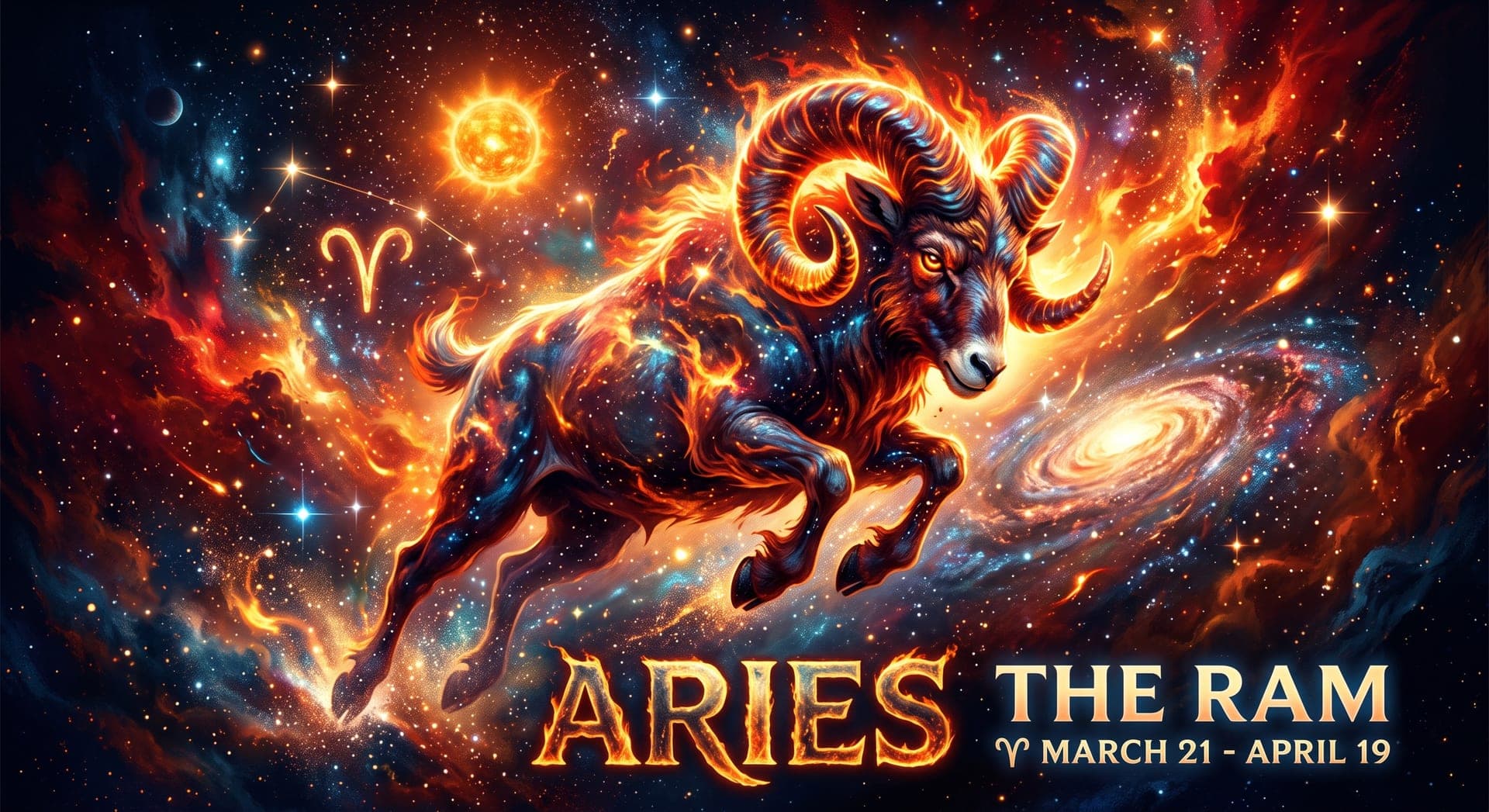
Aries, the first sign of the zodiac, spans March 21 to April 19 and is represented by the ram, an animal known for its boldness, stubborn determination, and willingness to charge forward. Ruled by Mars, the planet of action, drive, and war, Aries is often characterized as one of the most energetic and assertive signs in the zodiac, comfortable taking initiative and leading the way into new territory. As a Fire sign, Aries burns with passion and enthusiasm, approaching life with an instinctive, competitive edge and a low tolerance for hesitation. Its Cardinal modality reflects its role as an initiator, the sign that kicks off the astrological year at the spring equinox and each new season's start. People born under this sign are frequently drawn to leadership roles, sports, entrepreneurship, or any pursuit that rewards courage and quick decision-making. Direct and refreshingly honest, Aries individuals tend to say exactly what they think and rarely shy away from a challenge worth having.
Personality Traits
Strengths
- Courageous and determined
- Natural-born leader
- Honest and direct
- Enthusiastic and optimistic
- Quick to act on opportunities
Weaknesses
- Impatient and quick-tempered
- Impulsive, acts before thinking
- Can be overly competitive
- Struggles with follow-through
- Prone to selfishness
Compatible Signs
Fun Facts
- Aries is the first sign of the zodiac, marking the start of the astrological year at the spring equinox.
- The ram symbol is tied to the Greek myth of the golden-fleeced ram that rescued Phrixus, whose fleece later became the prize sought by Jason and the Argonauts.
- Mars, Aries' ruling planet, was the Roman god of war, reflecting the sign's associations with boldness, drive, and aggression.
- As a Cardinal sign, Aries is one of four signs, along with Cancer, Libra, and Capricorn, that initiate a new season.
- Notable Aries include Lady Gaga, Robert Downey Jr., Mariah Carey, and Leonardo da Vinci.
Born on April 19
- 1721
Roger Sherman
American statesman who helped draft the U.S. Constitution
- 1757
Edward Pellew, 1st Viscount Exmouth
English Royal Navy admiral celebrated for his ship-handling skill and later famed for leading the 1816 bombardment of Algiers to curb Barbary piracy and free European slaves.
- 1873
Sydney Barnes
English cricketer widely regarded as one of the greatest bowlers in the sport's history, renowned for his mastery of spin and seam.
- 1877
Ole Evinrude
Norwegian-American engineer who invented the outboard motor
- 1900
Richard Hughes
English novelist and playwright best known for the novel A High Wind in Jamaica.
- 1903
Eliot Ness
American law enforcement agent known for combating organized crime
- 1912
Glenn T. Seaborg
American chemist and Nobel Prize laureate
- 1928
Alexis Korner
British blues musician and broadcaster regarded as a founding father of British blues, influential in the formation of the Rolling Stones
- 1933
Dickie Bird
English cricketer and later one of the sport's most respected and recognisable umpires, officiating in a record number of Test matches at the time of his retirement.
- 1935
Dudley Moore
English actor, comedian, and jazz pianist known for his comedy partnership with Peter Cook and for films including Arthur.
- 1946
Tim Curry
English actor and singer best known for playing Dr. Frank-N-Furter in The Rocky Horror Picture Show.
- 1968
Ashley Judd
American actress
- 1970
Kelly Holmes
English middle-distance runner who won double Olympic gold in the 800 and 1500 metres at the 2004 Athens Games.
- 2001
PinkPantheress
English singer-songwriter and record producer known for blending 2000s pop and UK garage and drum and bass influences into viral internet-era hits.
On This Day in History
- 1506
The Lisbon Massacre begins, in which thousands of forcibly converted Jews are killed by a mob over several days.
A mob in Lisbon, incited by rumors and religious fervor, began a massacre of thousands of Jewish residents who had been forcibly converted to Christianity under earlier Portuguese decrees, killing victims over several days of violence before royal authorities finally intervened to restore order. The massacre remains one of the darkest episodes in Portuguese history.
- 1529
A group of reform-minded rulers formally protest the reinstatement of the Edict of Worms at the Second Diet of Speyer, an act that gave rise to the term "Protestant."
A group of reform-minded German princes and free cities formally protested the Diet of Speyer's decision to reinstate restrictions on the Edict of Worms, which had earlier suppressed Martin Luther's teachings, an act of defiance that gave rise to the term "Protestant" used to describe followers of the emerging Reformation movement.
- 1572
England and France sign the Treaty of Blois, forming a defensive alliance against Spain.
Negotiated under Elizabeth I, the treaty marked a significant shift in English foreign policy, aligning Protestant England with Catholic France against the shared threat of Spanish power in Europe. It also included a marriage proposal between Elizabeth and the Duke of Alençon, which never came to fruition. The alliance helped ease tensions between the two historic rivals during a period of religious and political upheaval across Europe.
- 1608
Sir Cahir O'Doherty launches a rebellion against English rule in Ireland by burning the town of Derry.
O'Doherty, an Irish chieftain previously loyal to the Crown, rose up after a dispute with the English governor of Derry, attacking and destroying the settlement. The rebellion was crushed within months and O'Doherty was killed in battle, but the unrest helped justify the large-scale Plantation of Ulster that followed, in which English and Scottish settlers were granted confiscated Irish land.
- 1770
Captain James Cook sights the eastern coast of Australia for the first time.
British explorer Captain James Cook and the crew of HMS Endeavour sighted the eastern coastline of Australia for the first time, beginning a survey voyage that would lead to Cook's later landing and claiming of the territory for Britain. The sighting marked a significant step in European awareness and eventual colonization of the Australian continent.
- 1770
British explorer Captain James Cook becomes the first recorded European to sight the eastern coast of Australia.
Sailing aboard HMS Endeavour on a scientific and exploratory voyage across the Pacific, Cook charted the previously uncharted coastline and would go on to land at Botany Bay weeks later, claiming the territory for Britain. His survey laid the groundwork for British colonisation of Australia, which began with the arrival of the First Fleet at Sydney Cove eighteen years afterward.
- 1775
The American Revolutionary War begins with the Battles of Lexington and Concord, the first military engagements of the conflict.
British regulars marching to seize colonial weapons stockpiles clashed with Massachusetts militiamen at Lexington and Concord in the first military engagements of the American Revolutionary War, an exchange later commemorated as "the shot heard round the world." The fighting, which saw British forces suffer heavy casualties during their retreat to Boston, marked the point of no return toward full-scale rebellion.
- 1775
The American Revolutionary War begins as colonial minutemen clash with British troops at the Battles of Lexington and Concord.
British regulars marching from Boston to seize colonial military supplies at Concord encountered armed resistance, first at Lexington Green and then at Concord's North Bridge, where colonial militia forced the British column to retreat under fire back to Boston. The fighting, which produced the first combat deaths of the war, transformed a simmering political crisis into open armed rebellion against British rule.
- 1775
American militia forces surround British-held Boston, beginning the Siege of Boston.
Following the fighting at Lexington and Concord, thousands of colonial militiamen converged on Boston and cut off land access to the British garrison inside the city. The siege, which would last nearly a year, gave the newly formed Continental Army under George Washington its first extended campaign and ended when British forces evacuated the city by sea in March 1776.
- 1943
Jewish resistance fighters launch the Warsaw Ghetto Uprising as German troops attempt to round up the ghetto's remaining residents for deportation.
Jewish resistance fighters in the Warsaw Ghetto, armed with smuggled and improvised weapons, launched an uprising against German troops attempting a final roundup of the ghetto's remaining residents for deportation to death camps. Though the underequipped fighters were ultimately crushed after nearly a month of fighting, the uprising stands as one of the most significant acts of Jewish resistance during the Holocaust.
- 1943
The Warsaw Ghetto Uprising begins as Jewish resistance fighters battle German troops attempting to deport the ghetto's remaining residents.
Armed with smuggled weapons and improvised explosives, fighters of the Jewish Combat Organization and other resistance groups held off German forces for nearly a month, far longer than commanders had anticipated. The uprising, the largest single act of Jewish resistance during the Holocaust, ended with the ghetto razed and most of its remaining population killed or deported, but it became a lasting symbol of defiance.
- 1956
Actress Grace Kelly marries Prince Rainier III of Monaco in a lavish ceremony.
Hollywood film star Grace Kelly married Prince Rainier III of Monaco in an elaborate ceremony watched by an estimated global television audience of 30 million people, transforming the American actress into Princess Grace and effectively ending her acting career. The glamorous wedding significantly raised the tiny principality's international profile.
- 1971
The Soviet Union launches Salyut 1, the world's first space station, into orbit.
Salyut 1 was designed to test the feasibility of long-duration human spaceflight in Earth orbit, part of the Soviet Union's response to losing the race to land a crewed mission on the Moon. Its first crew failed to dock successfully, and a second crew later died during re-entry after a fatal cabin depressurization, but the mission established key techniques for the space stations that followed.
- 1993
The 51-day standoff at Waco, Texas, ends when a fire breaks out at the Branch Davidian compound, killing 76 people.
A fire of disputed origin engulfed the Branch Davidian compound near Waco, Texas, at the end of a 51-day standoff between the religious sect and federal law enforcement agents, killing 76 people including the group's leader, David Koresh, and many children. The controversial siege and its violent conclusion later influenced extremist movements and fueled deep distrust of federal law enforcement among some Americans.
- 1995
A truck bomb destroys the Alfred P. Murrah Federal Building in Oklahoma City, killing 168 people in the deadliest act of domestic terrorism in U.S. history.
A truck bomb assembled by Timothy McVeigh detonated outside the Alfred P. Murrah Federal Building in Oklahoma City, killing 168 people, including 19 children in an on-site daycare, in the deadliest act of domestic terrorism in American history. McVeigh, motivated by anti-government extremism, was later convicted and executed for the attack.
- 1995
A truck bomb detonates outside the Alfred P. Murrah Federal Building in Oklahoma City, killing 168 people.
Timothy McVeigh, an anti-government extremist, parked a rented truck packed with explosives outside the federal building before detonating it during business hours, destroying much of the structure and damaging buildings blocks away. Nineteen children in the building's daycare center were among the dead. It remains the deadliest act of domestic terrorism in United States history and prompted a major overhaul of federal building security.
- 2005
Cardinal Joseph Ratzinger is elected pope, taking the name Benedict XVI.
The College of Cardinals elected German Cardinal Joseph Ratzinger as pope, and he took the name Benedict XVI, becoming the first German pontiff in nearly a thousand years. Known for his theological conservatism, Benedict served until his surprise resignation in 2013, becoming the first pope to voluntarily step down in nearly 600 years.
- 2005
Cardinal Joseph Ratzinger is elected pope, taking the name Benedict XVI.
Ratzinger, a German theologian who had led the Vatican's doctrinal office for over two decades, was elected on the second day of the conclave following the death of Pope John Paul II. His papacy emphasised doctrinal continuity and traditional liturgy, though it was later marked by the Church's ongoing sexual abuse crisis. He resigned in 2013, becoming the first pope to do so in nearly 600 years.
- 2021
NASA's Ingenuity helicopter achieves the first powered, controlled flight of an aircraft on another planet, Mars.
NASA's small robotic helicopter Ingenuity achieved the first powered, controlled flight of an aircraft on another planet, lifting briefly off the surface of Mars as part of the Perseverance rover mission. The successful test, inspired in part by the Wright brothers' first flight, opened new possibilities for aerial exploration of other worlds.
- 2021
NASA's Ingenuity helicopter completes the first powered, controlled flight by an aircraft on another planet.
The small solar-powered helicopter, carried to Mars aboard the Perseverance rover, rose about three metres above the Martian surface and hovered briefly before landing safely, in a feat likened to the Wright brothers' first flight. Ingenuity went on to fly dozens more missions over the following years, demonstrating that aerial exploration could complement rovers in studying the Martian surface.