What’s Observed on March 26
Born on March 26: Aries ♈
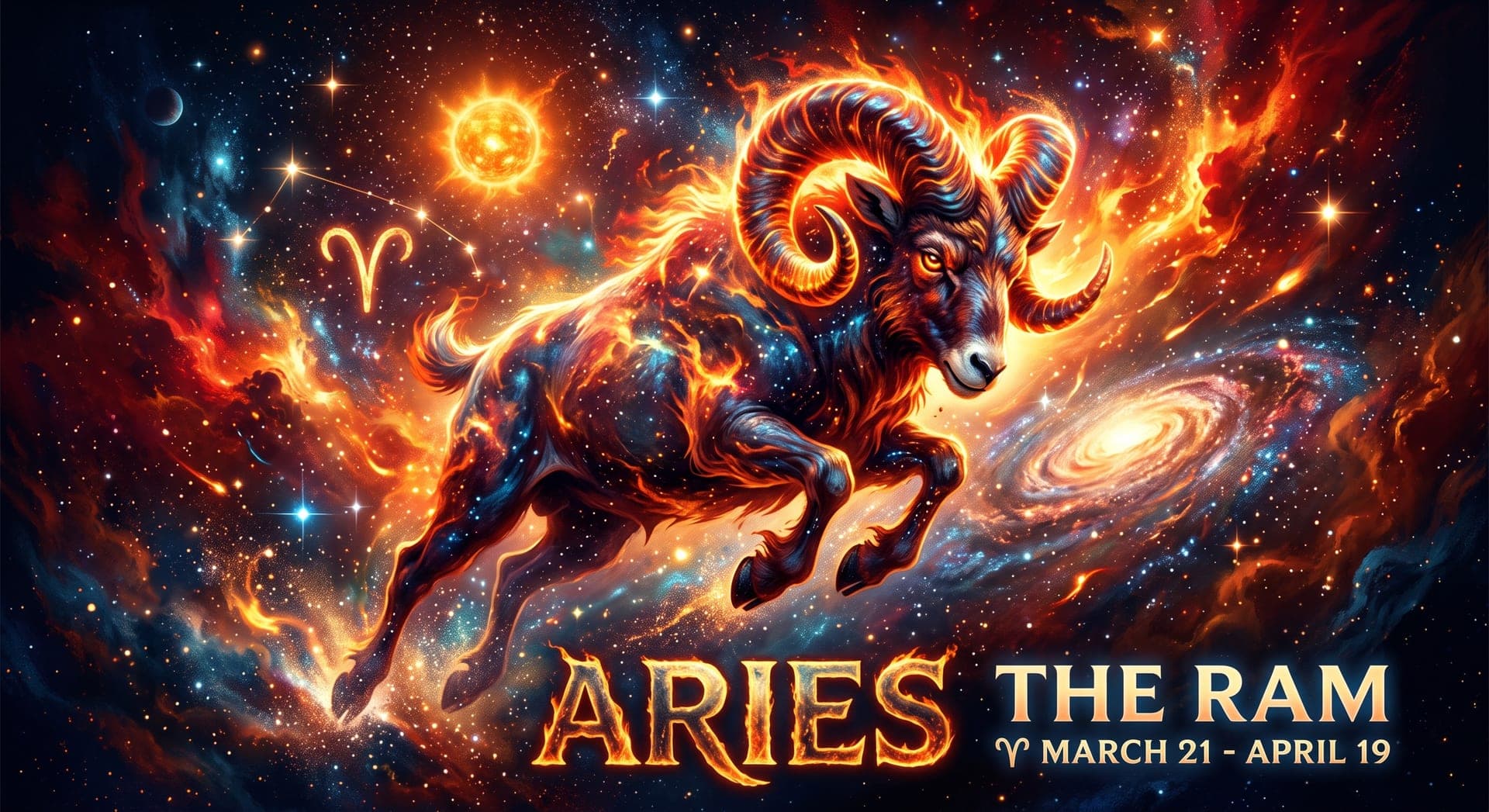
Aries, the first sign of the zodiac, spans March 21 to April 19 and is represented by the ram, an animal known for its boldness, stubborn determination, and willingness to charge forward. Ruled by Mars, the planet of action, drive, and war, Aries is often characterized as one of the most energetic and assertive signs in the zodiac, comfortable taking initiative and leading the way into new territory. As a Fire sign, Aries burns with passion and enthusiasm, approaching life with an instinctive, competitive edge and a low tolerance for hesitation. Its Cardinal modality reflects its role as an initiator, the sign that kicks off the astrological year at the spring equinox and each new season's start. People born under this sign are frequently drawn to leadership roles, sports, entrepreneurship, or any pursuit that rewards courage and quick decision-making. Direct and refreshingly honest, Aries individuals tend to say exactly what they think and rarely shy away from a challenge worth having.
Personality Traits
Strengths
- Courageous and determined
- Natural-born leader
- Honest and direct
- Enthusiastic and optimistic
- Quick to act on opportunities
Weaknesses
- Impatient and quick-tempered
- Impulsive, acts before thinking
- Can be overly competitive
- Struggles with follow-through
- Prone to selfishness
Compatible Signs
Fun Facts
- Aries is the first sign of the zodiac, marking the start of the astrological year at the spring equinox.
- The ram symbol is tied to the Greek myth of the golden-fleeced ram that rescued Phrixus, whose fleece later became the prize sought by Jason and the Argonauts.
- Mars, Aries' ruling planet, was the Roman god of war, reflecting the sign's associations with boldness, drive, and aggression.
- As a Cardinal sign, Aries is one of four signs, along with Cancer, Libra, and Capricorn, that initiate a new season.
- Notable Aries include Lady Gaga, Robert Downey Jr., Mariah Carey, and Leonardo da Vinci.
Born on March 26
- 1633
Mary Beale
English portrait painter, among the first professional female artists in Britain, who ran a successful studio in London painting clergy, scholars, and society figures.
- 1859
A. E. Housman
English poet and classical scholar best known for the poetry collection A Shropshire Lad, and for his rigorous editorial work on Latin texts.
- 1866
Fred Karno
English theatrical impresario who pioneered slapstick comedy sketches and mentored performers including Charlie Chaplin and Stan Laurel through his touring companies.
- 1874
Robert Frost
American poet, four-time Pulitzer Prize winner
- 1875
Syngman Rhee
First President of South Korea
- 1911
Tennessee Williams
American playwright known for "A Streetcar Named Desire"
- 1911
J. L. Austin
English philosopher whose work on speech act theory, especially in How to Do Things with Words, became foundational to modern philosophy of language.
- 1913
Paul Erdős
Hungarian mathematician known for prolific collaborative research
- 1916
Bill Edrich
English cricketer who played for Middlesex and England, forming a celebrated batting partnership with Denis Compton in the years after the Second World War.
- 1931
Leonard Nimoy
American actor known for portraying Spock in "Star Trek"
- 1940
Nancy Pelosi
American politician, Speaker of the U.S. House of Representatives
- 1941
Richard Dawkins
British evolutionary biologist and author, born in Nairobi, known for "The Selfish Gene" and "The God Delusion" and for his prominence as a leading atheist thinker
- 1961
William Hague
English politician who led the Conservative Party from 1997 to 2001 and later served as Foreign Secretary and First Secretary of State.
- 1985
Keira Knightley
English actress who rose to international fame in Pirates of the Caribbean and earned acclaim for period dramas such as Pride & Prejudice and The Imitation Game.

On This Day in History
- 1351
Thirty Breton knights defeat an equal number of English knights in the Combat of the Thirty.
Fought near Ploërmel during the Breton War of Succession, the staged combat pitted thirty champions loyal to Charles of Blois against thirty backing the English-supported claimant. The Breton side won after a brutal day of hand-to-hand fighting, and the episode became celebrated in French chivalric literature as an example of formalized medieval combat.
- 1484
William Caxton prints his English translation of Aesop's Fables.
Caxton, who had introduced the printing press to England less than a decade earlier, translated the fables from French and Latin sources for a wider English readership. The edition helped popularize the stories in English and demonstrated the young printing trade's power to spread classical and moral literature far beyond the reach of hand-copied manuscripts.
- 1700
English explorer William Dampier becomes the first European to circumnavigate New Britain.
Sailing aboard HMS Roebuck on a Royal Navy voyage of exploration in the western Pacific, Dampier charted the coastline of the island later named New Britain and proved it was separated from New Guinea by a strait that now bears his name. A former buccaneer turned naturalist, he was among the era's most observant maritime explorers.
- 1812
A massive earthquake devastates the city of Caracas, Venezuela, killing thousands amid the region's war for independence.
A powerful earthquake struck Caracas and other Venezuelan cities amid the country's ongoing war of independence from Spain, killing thousands of people and severely undermining the fledgling revolutionary government led by Simon Bolivar. Royalist priests and propagandists seized on the disaster, claiming it was divine punishment for rebellion against the Spanish crown, temporarily weakening support for independence.
- 1830
The Book of Mormon is first published in Palmyra, New York, by Joseph Smith.
Joseph Smith published "The Book of Mormon" in Palmyra, New York, a religious text he said was translated from golden plates revealed to him by an angel. The book became the foundational scripture of the Latter Day Saint movement, which grew into a major American religious tradition.
- 1830
The Book of Mormon is published in Palmyra, New York.
Joseph Smith presented the text as a translation of ancient golden plates he said he had unearthed, and its publication became the founding scripture of the Latter Day Saint movement. Within days of its release, Smith organized the Church of Christ, later renamed the Church of Jesus Christ of Latter-day Saints, launching a new American religious tradition.
- 1839
The first Henley Royal Regatta is held on the River Thames.
Founded as a local rowing contest in the Oxfordshire town of Henley-on-Thames, the regatta quickly grew into one of the most prestigious events in the international rowing calendar. It later gained royal patronage from Prince Albert in 1851, and its summer meeting remains a fixture of the English social and sporting season.
- 1885
The Congo Free State is established under the personal rule of Belgium's King Leopold II, beginning a brutal colonial regime.
King Leopold II of Belgium established the Congo Free State as his personal colonial possession rather than a Belgian state colony, ruling it privately for over two decades through a brutal regime of forced labor and violence that killed millions of Congolese people before international pressure forced reform.
- 1902
Cecil Rhodes, the British colonialist and mining magnate, dies in South Africa.
Cecil Rhodes, the British imperialist, businessman, and founder of the diamond company De Beers, died in South Africa. His vast fortune funded the Rhodes Scholarship, while his colonial legacy, including the territories once named Rhodesia after him, remains deeply controversial.
- 1917
The Seattle Metropolitans defeat the Montreal Canadiens to become the first American team to win the Stanley Cup.
The Seattle Metropolitans of the Pacific Coast Hockey Association clinched the Stanley Cup by defeating the Montreal Canadiens of the National Hockey Association, becoming the first team based in the United States to win the trophy. The series stood out as a rare cross-league championship contest from an era when professional hockey was split between multiple competing leagues, years before the NHL rose to become the sport's dominant organization.
- 1917
British troops are halted by Ottoman forces at the First Battle of Gaza.
Advancing from Egypt into Ottoman-held Palestine, British and Empire forces attempted to seize Gaza but were repelled by Turkish defenders after early gains were reversed through miscommunication and lost momentum. The setback delayed the British campaign in Palestine by months and prompted a change in command before a successful assault later that year.
- 1934
The United Kingdom introduces its first driving test.
Prompted by a sharp rise in road deaths after the spread of motor vehicles, the government created a formal test to assess drivers' competence before granting a licence. Initially voluntary, it became compulsory for all new drivers the following year, establishing a model of road safety regulation still used, with substantial changes, in Britain today.
- 1971
East Pakistan declares independence as Bangladesh, triggering a brutal war for liberation.
Following a brutal nine-month war and a genocidal campaign by Pakistani forces that killed hundreds of thousands, East Pakistan declared independence as Bangladesh under the leadership of Sheikh Mujibur Rahman, gaining full sovereignty later that year with Indian military assistance.
- 1971
East Pakistan declares independence, precipitating the Bangladesh Liberation War.
Following a brutal military crackdown by the Pakistani army against Bengali nationalists, leaders in East Pakistan proclaimed the independent state of Bangladesh. The declaration triggered a nine-month war that drew in India and ended with Pakistani surrender in December 1971, resulting in the creation of Bangladesh as a sovereign nation.
- 1979
Egypt and Israel sign a peace treaty at the White House, the first between Israel and an Arab nation.
Egyptian President Anwar Sadat and Israeli Prime Minister Menachem Begin signed a peace treaty at the White House, brokered by President Jimmy Carter following the Camp David Accords, making Egypt the first Arab nation to formally recognize and make peace with Israel.
- 1979
Egypt and Israel sign a peace treaty at the White House.
Brokered by U.S. President Jimmy Carter after negotiations at Camp David, the treaty saw Egyptian President Anwar Sadat and Israeli Prime Minister Menachem Begin formally end three decades of hostility between their nations. It made Egypt the first Arab state to recognize Israel, reshaping the diplomatic landscape of the Middle East.
- 1981
The Social Democratic Party is founded in the United Kingdom.
Formed by four senior Labour Party figures known as the 'Gang of Four' who broke away over the party's leftward shift, the SDP sought to establish a centrist alternative in British politics. It later allied with the Liberal Party and eventually merged with it in 1988 to form the Liberal Democrats.
- 1991
South American nations Argentina, Brazil, Paraguay, and Uruguay sign the Treaty of Asuncion, founding the Mercosur trade bloc.
Argentina, Brazil, Paraguay, and Uruguay signed the Treaty of Asuncion, establishing the Southern Common Market, known as Mercosur, a regional trade bloc aimed at promoting the free movement of goods, services, and people among member South American economies. The bloc later expanded its membership and influence, becoming one of the world's largest regional trading agreements by combined economic output.
- 1997
Thirty-nine members of the Heaven's Gate cult are found dead in a mass suicide in California.
Authorities discovered the bodies of 39 members of the Heaven's Gate religious cult in a rented mansion near San Diego, who had died in a coordinated mass suicide believing their souls would ascend to a spacecraft trailing the Hale-Bopp comet.
- 1999
The "Melissa" computer virus begins spreading rapidly via email, one of the first major macro viruses to disrupt the internet.
The "Melissa" macro virus, spread through infected Microsoft Word email attachments, began propagating rapidly across corporate and government networks, forcing many organizations to shut down email systems temporarily and marking an early wake-up call about the vulnerability of networked computing.