What’s Observed on September 7
Born on September 7: Virgo ♍
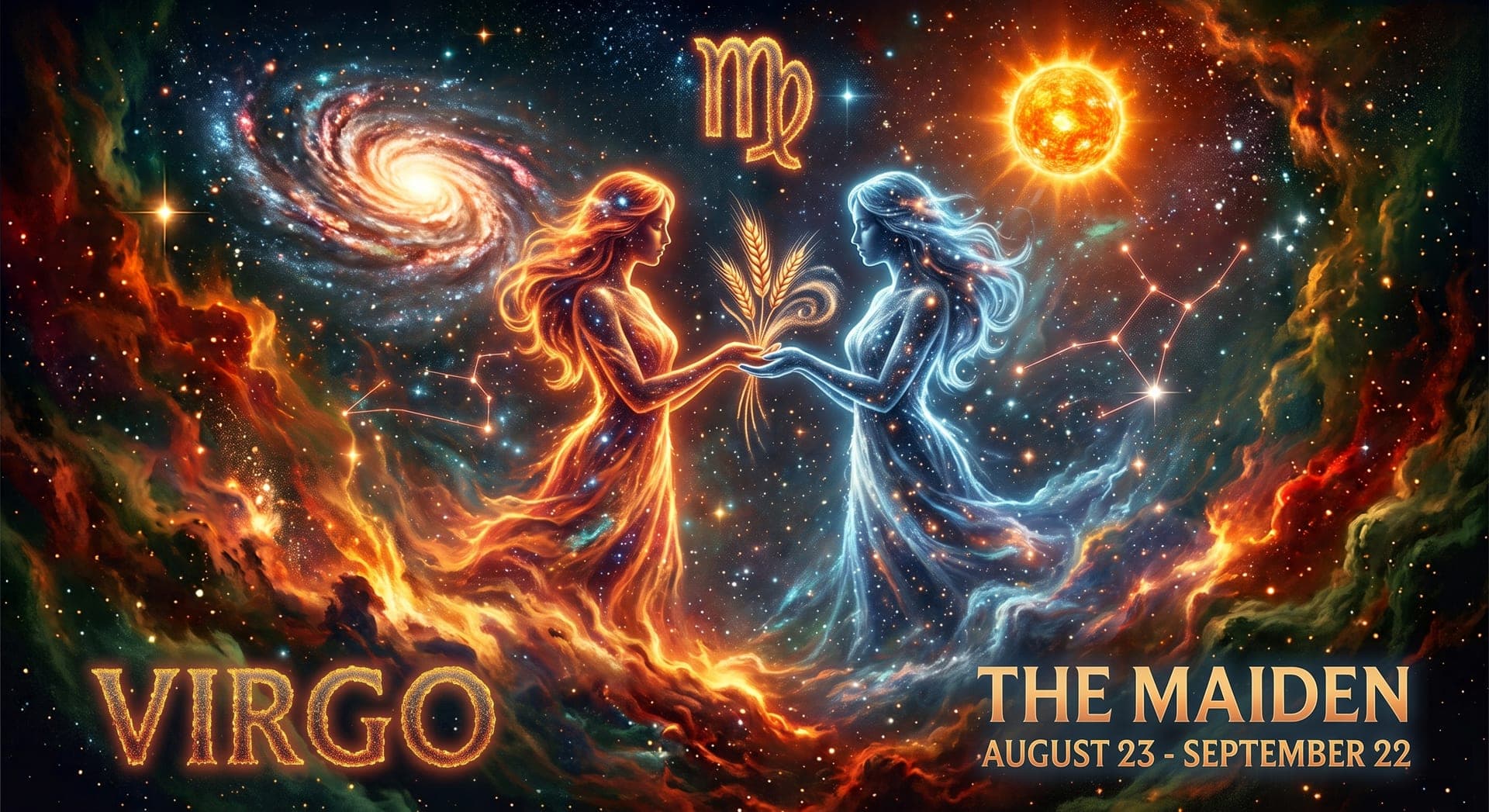
Virgo, the sixth sign of the zodiac, spans August 23 to September 22 and is symbolized by the maiden, often depicted holding a sheaf of wheat, representing purity, meticulous care, and the harvest. Ruled by Mercury, the planet of communication and intellect, Virgo channels its mental energy toward precision, analysis, and practical problem-solving rather than idle chatter. As an Earth sign, Virgo is grounded and detail-oriented, finding genuine satisfaction in organizing, refining, and perfecting the world around it. Its Mutable modality gives Virgo an adaptable, service-oriented nature, often finding purpose in quietly helping others and improving systems rather than seeking the spotlight. People born under this sign are frequently drawn to work requiring precision, research, or care for others, from science and medicine to editing and organization. Virgo's high standards make it an excellent problem-solver and a reliable presence others can count on, though that same perfectionism can turn inward as self-criticism or outward as an exacting, sometimes overly critical, eye toward the people and world around it.
Personality Traits
Strengths
- Highly organized and detail-oriented
- Reliable and hardworking
- Analytical problem-solver
- Genuinely helpful to others
- Modest and unpretentious
Weaknesses
- Prone to overcritical perfectionism
- Tends to worry excessively
- Can be overly critical of others
- Reserved to the point of aloofness
- Struggles to relax
Compatible Signs
Fun Facts
- Virgo's maiden symbol is often associated with Astraea, the Greek goddess of justice and purity, said to have been the last immortal to live among humans.
- Virgo is the only zodiac sign represented by a female human figure.
- Virgo and Gemini share Mercury as their ruling planet, though Virgo channels the planet's communicative energy toward analysis and precision rather than pure talkativeness.
- Notable Virgos include Beyoncé, Michael Jackson, Mother Teresa, and Stephen King.
- Virgo season falls at the tail end of summer, a period traditionally associated with harvest, meticulous preparation, and gathering resources for the colder months ahead.
Born on September 7
- 1533
Elizabeth I
English queen who reigned for 45 years, presiding over the defeat of the Spanish Armada and a flourishing of English drama and exploration
- 1707
Georges-Louis Leclerc, Comte de Buffon
French naturalist and mathematician
- 1795
John William Polidori
English physician and writer whose story The Vampyre helped establish the vampire genre in literature
- 1807
Henry Sewell
First Prime Minister of New Zealand
- 1836
Henry Campbell-Bannerman
Scottish-born Liberal politician who served as Prime Minister of the United Kingdom from 1905 to 1908
- 1855
William Friese-Greene
English photographer and inventor who was an early pioneer of motion picture cinematography
- 1860
Grandma Moses
American folk artist
- 1887
Edith Sitwell
English poet and critic known for her flamboyant style and works such as Façade
- 1908
Paul Brown
American football coach who helped shape modern coaching strategy
- 1909
Elia Kazan
Greek-American film and theater director
- 1913
Anthony Quayle
English actor and theatre director celebrated for his stage work and film roles including Lawrence of Arabia
- 1927
Eric Hill
English author and illustrator best known for creating the beloved children's book character Spot the dog
- 1936
Buddy Holly
American rock and roll pioneer
- 1943
Gloria Gaynor
American singer known for "I Will Survive"
- 1966
Toby Jones
English actor known for character roles in films such as Capote and the Harry Potter series
On This Day in History
- 1191
Richard I of England defeats Saladin's forces at the Battle of Arsuf during the Third Crusade.
Richard the Lionheart's disciplined army repelled a determined attack by Saladin's forces along the coastal route near Arsuf, inflicting significant casualties while maintaining a tight defensive formation during the march. The victory bolstered Crusader morale and opened the way toward Jaffa, though it did not ultimately lead to the recapture of Jerusalem itself.
- 1191
During the Third Crusade, King Richard I of England defeats Saladin's forces at the Battle of Arsuf on the coast of the Holy Land.
The battle came as Richard marched his army south along the coast from Acre toward Jaffa in tight defensive formation to resist harassment from Saladin's cavalry. When Crusader knights broke ranks to charge, Richard turned it into a decisive counterattack. The victory was one of Richard's most celebrated feats, cementing his reputation as Richard the Lionheart and reviving Crusader momentum in the Holy Land.
- 1228
Holy Roman Emperor Frederick II launches the Sixth Crusade, which achieves the peaceful restoration of Jerusalem to Christian control.
Frederick II, despite having been excommunicated by the pope for delaying his crusading vow, negotiated directly with the Ayyubid sultan al-Kamil to secure Jerusalem's peaceful transfer back to Christian control, a highly unusual diplomatic rather than military resolution to a Crusade. The arrangement proved short-lived, as Jerusalem fell again to Muslim forces roughly fifteen years later.
- 1571
Thomas Howard, 4th Duke of Norfolk, is arrested in England for his role in the Ridolfi plot to overthrow Queen Elizabeth I.
The plot, masterminded by the Florentine banker Roberto Ridolfi, aimed to marry Norfolk to the imprisoned Mary, Queen of Scots, depose Elizabeth, and restore Catholicism in England with Spanish backing. Intercepted correspondence exposed the scheme to Elizabeth's spymaster, Sir Francis Walsingham. Norfolk was tried for treason and executed the following year, marking one of the most serious plots against Elizabeth's early reign.
- 1625
England and the Dutch Republic sign the Treaty of Southampton, forming a military alliance against Habsburg Spain.
Negotiated early in the reign of Charles I, the treaty committed England and the United Provinces to joint naval action against Spanish shipping and territory as the Thirty Years' War widened across Europe. It reflected England's broader effort to support continental Protestant powers against Catholic Habsburg strength, though the alliance produced only limited military success in the years that followed.
- 1695
English pirate Henry Every captures the Grand Mughal treasure ship Ganj-i-Sawai in the Arabian Sea, one of the most profitable raids in pirate history.
The haul, reputedly worth hundreds of thousands of pounds, sparked one of history's first large-scale international manhunts, with English, Dutch and Mughal authorities all pursuing the culprits. The raid badly damaged the East India Company's relations with the Mughal Empire. Every himself vanished afterward and was never captured, becoming a folk legend as the era's most successful pirate.
- 1776
American sergeant Ezra Lee pilots the hand-powered submarine Turtle in an unsuccessful attack on the British warship HMS Eagle in New York Harbor.
The Turtle, designed by inventor David Bushnell, was meant to attach an explosive charge to the hull of Eagle, flagship of the British fleet blockading New York, but Lee could not bore through the ship's copper sheathing. Though the attack failed, it stands as history's first submarine attack on a warship, foreshadowing the underwater warfare that would follow more than a century later.
- 1778
French forces invade and capture the British-held Caribbean island of Dominica during the American Revolutionary War.
Dominica had passed to Britain under the 1763 Treaty of Paris after decades of Anglo-French rivalry in the Caribbean. France's entry into the American war widened the fighting into a global colonial contest, with the lucrative sugar islands prized targets on both sides. Dominica changed hands during the conflict before being restored to Britain under the 1783 Treaty of Paris.
- 1812
The Battle of Borodino, the bloodiest single day of the Napoleonic Wars, is fought near Moscow.
Napoleon's Grande Armee clashed with Russian forces near the village of Borodino outside Moscow in a brutal, largely inconclusive battle that produced an estimated 70,000 combined casualties in a single day. Though Napoleon technically won the field, the Russian army's ability to withdraw in relatively good order set the stage for the disastrous French retreat from Moscow that followed weeks later.
- 1822
Dom Pedro I declares Brazil's independence from Portugal at Ipiranga Brook near Sao Paulo.
Prince Pedro, son of Portugal's King John VI, declared Brazil's independence from Portuguese rule upon receiving news that the Portuguese government intended to strip Brazil of its autonomous status. Pedro subsequently became Brazil's first emperor, and the largely peaceful transition to independence stood in notable contrast to the often more violent independence struggles elsewhere in Latin America.
- 1860
Giuseppe Garibaldi enters Naples during the campaign to unify Italy.
Leading his famous "Expedition of the Thousand" volunteer force, Italian nationalist Giuseppe Garibaldi entered Naples to enthusiastic popular support after the city's Bourbon rulers fled, a major milestone in the campaign to unify the various Italian states under a single kingdom. His conquests in southern Italy were soon formally incorporated into the new Kingdom of Italy.
- 1864
Atlanta is evacuated on the orders of Union General William Tecumseh Sherman.
Recognizing that continued defense of Atlanta was untenable following weeks of siege, Confederate forces evacuated the city on Sherman's approach, allowing Union troops to occupy this crucial Southern rail and manufacturing hub. Sherman's subsequent "March to the Sea" from Atlanta became one of the most devastating and strategically significant campaigns of the Civil War.
- 1901
The Boxer Protocol is signed in Beijing, formally ending the Boxer Rebellion and imposing heavy penalties on China.
Britain was among the eight allied powers, alongside Japan, Russia, Germany and others, that had sent troops to suppress the anti-foreign, anti-Christian uprising. The protocol forced China to pay a massive indemnity and allowed foreign powers to station troops in Beijing to protect their legations, cementing Western and Japanese influence over Chinese affairs for decades to come.
- 1906
Alberto Santos-Dumont achieves the first officially witnessed powered flight in Europe aboard his 14-bis aircraft.
Brazilian aviation pioneer Alberto Santos-Dumont flew his box-kite-like 14-bis aircraft a short distance in front of witnesses near Paris, an achievement widely recognized in Europe as the continent's first officially verified powered flight, though the Wright brothers had already flown in the United States three years earlier under less publicly documented circumstances.
- 1907
The Cunard liner RMS Lusitania departs Liverpool on her maiden transatlantic voyage to New York.
Built to help Britain reclaim the Blue Riband in the fierce Anglo-German rivalry over the fastest Atlantic crossing, Lusitania briefly held the speed record for ocean liners. The ship became infamous eight years later when a German U-boat torpedoed and sank her off the Irish coast in 1915, killing nearly 1,200 people and inflaming public opinion against Germany.
- 1940
Germany's Luftwaffe begins the Blitz, bombing London and other British cities for over fifty consecutive nights.
German bombers began a sustained campaign of nighttime raids against London and other major British cities, a strategic shift from targeting military airfields that inadvertently gave the depleted Royal Air Force crucial time to recover. Though the Blitz caused enormous civilian casualties and destruction, it ultimately failed to break British morale or force capitulation.
- 1940
Nazi Germany's Luftwaffe launches the Blitz, beginning a sustained bombing campaign against London and other British cities.
The shift from targeting RAF airfields to bombing civilian centers followed heavy Luftwaffe losses in the Battle of Britain. London was struck on 57 consecutive nights, and by the campaign's end in May 1941 tens of thousands of British civilians had been killed nationwide. The bombing failed to break British morale or force the country's surrender.
- 1945
Japanese forces on Wake Island surrender to U.S. Marines after holding the atoll since December 1941.
After enduring sustained Japanese assault and holding out for weeks following the attack on Pearl Harbor, the small American garrison on Wake Island finally surrendered, becoming prisoners of war for the remainder of the conflict. The atoll's defense had briefly captured American public attention as a symbol of resistance during the war's darkest early days.
- 1978
Bulgarian dissident writer Georgi Markov is fatally poisoned on Waterloo Bridge in London, jabbed with an umbrella tip containing a ricin pellet.
Markov, a defector who broadcast for the BBC World Service criticising Bulgaria's communist regime, fell ill and died days later. Investigators concluded that Bulgaria's secret police, likely assisted by the KGB, had orchestrated the assassination using a specially engineered weapon. The case became one of the Cold War's most notorious acts of state-sponsored killing carried out on British soil.
- 2021
El Salvador becomes the first country to adopt Bitcoin as legal tender.
El Salvador became the first nation in the world to grant Bitcoin the status of legal tender alongside the U.S. dollar, a controversial policy championed by President Nayib Bukele intended to boost financial inclusion and attract cryptocurrency investment. The rollout faced significant technical problems and public skepticism, and the cryptocurrency's volatile value drew criticism from international financial institutions.