What’s Observed on September 6
Born on September 6: Virgo ♍
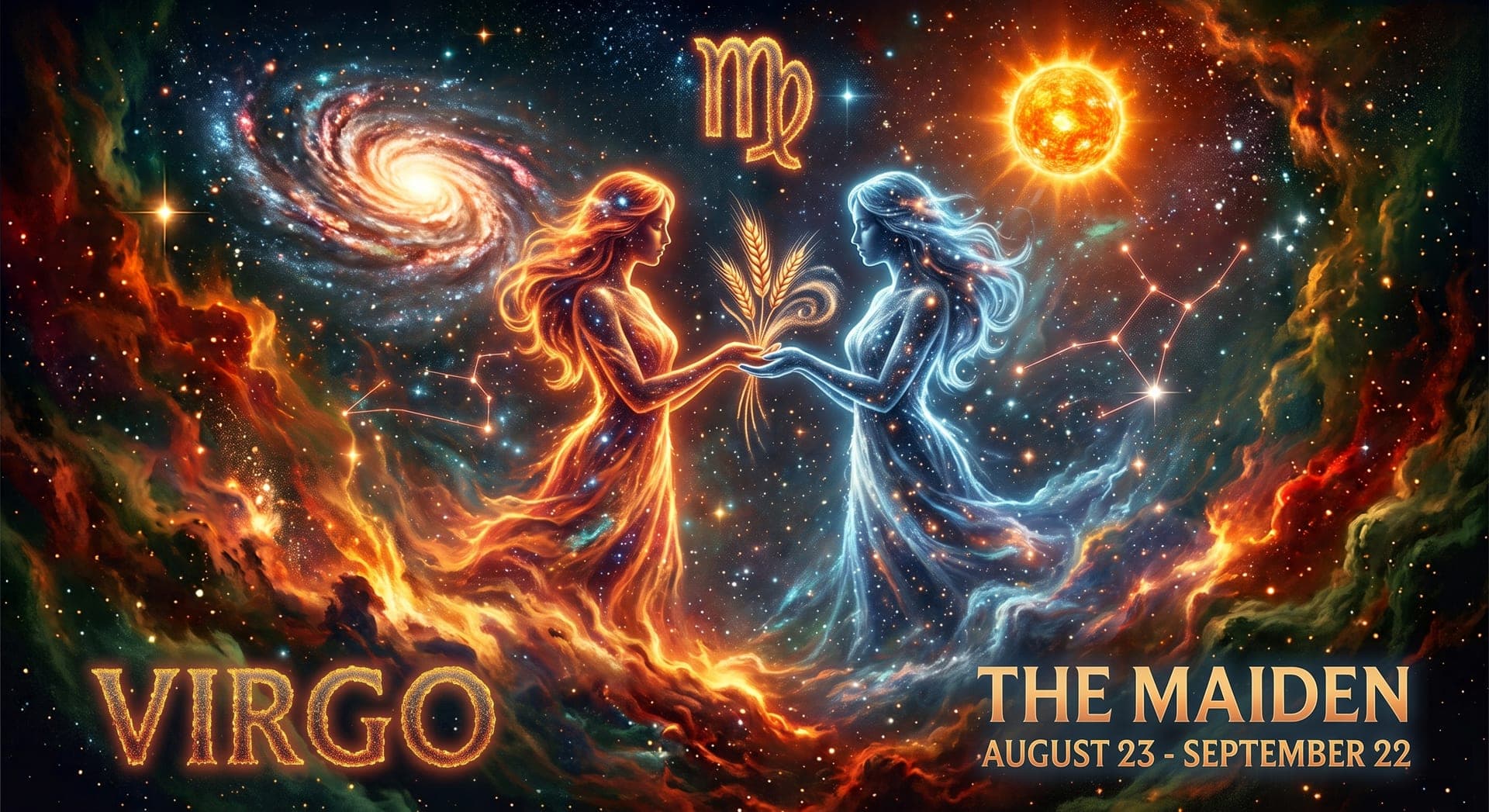
Virgo, the sixth sign of the zodiac, spans August 23 to September 22 and is symbolized by the maiden, often depicted holding a sheaf of wheat, representing purity, meticulous care, and the harvest. Ruled by Mercury, the planet of communication and intellect, Virgo channels its mental energy toward precision, analysis, and practical problem-solving rather than idle chatter. As an Earth sign, Virgo is grounded and detail-oriented, finding genuine satisfaction in organizing, refining, and perfecting the world around it. Its Mutable modality gives Virgo an adaptable, service-oriented nature, often finding purpose in quietly helping others and improving systems rather than seeking the spotlight. People born under this sign are frequently drawn to work requiring precision, research, or care for others, from science and medicine to editing and organization. Virgo's high standards make it an excellent problem-solver and a reliable presence others can count on, though that same perfectionism can turn inward as self-criticism or outward as an exacting, sometimes overly critical, eye toward the people and world around it.
Personality Traits
Strengths
- Highly organized and detail-oriented
- Reliable and hardworking
- Analytical problem-solver
- Genuinely helpful to others
- Modest and unpretentious
Weaknesses
- Prone to overcritical perfectionism
- Tends to worry excessively
- Can be overly critical of others
- Reserved to the point of aloofness
- Struggles to relax
Compatible Signs
Fun Facts
- Virgo's maiden symbol is often associated with Astraea, the Greek goddess of justice and purity, said to have been the last immortal to live among humans.
- Virgo is the only zodiac sign represented by a female human figure.
- Virgo and Gemini share Mercury as their ruling planet, though Virgo channels the planet's communicative energy toward analysis and precision rather than pure talkativeness.
- Notable Virgos include Beyoncé, Michael Jackson, Mother Teresa, and Stephen King.
- Virgo season falls at the tail end of summer, a period traditionally associated with harvest, meticulous preparation, and gathering resources for the colder months ahead.
Born on September 6
- 1766
John Dalton
English chemist and physicist who developed modern atomic theory and pioneered the study of color blindness
- 1860
Jane Addams
American social reformer and Nobel Peace Prize laureate
- 1888
Joseph P. Kennedy Sr.
American businessman and diplomat
- 1892
Edward Victor Appleton
English physicist awarded the Nobel Prize for discovering the ionospheric layer that enables long-distance radio transmission
- 1943
Roger Waters
English singer-songwriter and bassist who co-founded the progressive rock band Pink Floyd
- 1943
Richard J. Roberts
English biochemist awarded the Nobel Prize for discovering split genes and RNA splicing
- 1965
Christopher Nolan
English film director and screenwriter known for acclaimed films including Inception and The Dark Knight trilogy
- 1972
Idris Elba
English actor known for roles in The Wire, Luther, and numerous major film productions
- 1973
Greg Rusedski
Canadian-British tennis player
- 1974
Tim Henman
English tennis player who reached four Wimbledon semi-finals and became one of Britain's most popular sportsmen
- 1976
Naomie Harris
English actress known for her roles in the James Bond films and Moonlight
- 1990
John Wall
American professional basketball player
On This Day in History
- 394
Roman Emperor Theodosius I defeats and kills the usurper Eugenius at the Battle of the Frigidus.
Roman Emperor Theodosius I led his forces to a decisive victory over the usurper Eugenius, who had seized power in the western half of the empire with the backing of pagan Roman senators seeking to restore traditional religious practices. The victory secured Theodosius's position as sole ruler and reinforced Christianity's status as the empire's dominant faith.
- 1492
Christopher Columbus departs the Canary Islands, beginning the Atlantic crossing of his first voyage.
Having assembled his three ships and crew at the Canary Islands for final provisioning and repairs, Columbus departed westward into open ocean, beginning the roughly five-week Atlantic crossing that would culminate in his historic landfall in the Caribbean. This departure point became a customary stopover for subsequent Spanish transatlantic voyages for generations afterward.
- 1522
The Victoria arrives back in Spain, completing the first known circumnavigation of the globe.
Commanded during its final leg by Basque navigator Juan Sebastian Elcano after Ferdinand Magellan's death in the Philippines, the Victoria limped back into the Spanish port of Sanlucar de Barrameda with just 18 surviving crew members out of the original expedition's roughly 270. The ship's arrival confirmed the completion of history's first circumnavigation of the globe.
- 1522
The Spanish ship Victoria returns to port having completed the first circumnavigation of the globe, three years after setting out with Ferdinand Magellan.
Magellan himself had been killed in the Philippines partway through the voyage, and only Victoria and a handful of exhausted survivors of the original fleet of five ships and roughly 270 men made it back to Spain. Captain Juan Sebastián Elcano guided the battered vessel home laden with valuable spices. The voyage proved conclusively that the Earth could be circled by sea and vastly expanded European geographic knowledge.
- 1620
The Mayflower departs Plymouth, England, carrying Pilgrims bound for North America.
Carrying 102 passengers, many of them religious separatists seeking freedom to practice their faith away from the Church of England, the Mayflower set sail after an earlier failed attempt alongside a companion ship that proved unseaworthy. The roughly two-month Atlantic crossing brought the Pilgrims to present-day Massachusetts, where they established the Plymouth Colony.
- 1620
The Mayflower departs Plymouth, England, carrying the Pilgrims across the Atlantic to establish a colony in North America.
The ship's roughly 100 passengers, many fleeing religious persecution, endured a grueling ten-week voyage before sighting land far north of their intended destination in Virginia. They eventually settled at what became Plymouth Colony in present-day Massachusetts, and before disembarking drew up the Mayflower Compact, an early framework for self-governance. Their journey became a foundational story in American national mythology.
- 1803
Chemist John Dalton begins using symbols to represent atoms of different elements, an early step toward modern atomic theory.
Building on the ancient Greek concept of indivisible atoms, Dalton proposed that each chemical element consisted of uniquely weighted atoms and developed a system of circular symbols to represent them in chemical diagrams, an early visual language for expressing chemical composition. His broader atomic theory, developed around the same period, laid crucial groundwork for the modern science of chemistry.
- 1803
English chemist John Dalton begins using a system of symbols to represent atoms of different elements in his notebooks.
Dalton was developing the atomic theory that would become his most lasting scientific legacy, proposing that each element consisted of identical, indivisible atoms with a characteristic weight. His pictorial symbols, circles marked with dots, lines, or letters, were an early attempt to represent chemical compounds visually. Though later replaced by the letter-based notation still used today, his underlying atomic theory transformed chemistry.
- 1901
President William McKinley is shot by anarchist Leon Czolgosz at the Pan-American Exposition in Buffalo, New York.
While greeting the public at the Pan-American Exposition in Buffalo, President McKinley was shot twice at close range by self-proclaimed anarchist Leon Czolgosz. McKinley initially appeared to be recovering but died eight days later from infection related to his wounds, elevating Vice President Theodore Roosevelt to the presidency and prompting increased Secret Service protection for future presidents.
- 1914
The First Battle of the Marne halts the German army's advance into France, a turning point in the war's opening weeks.
After German forces had advanced to within striking distance of Paris, a determined Allied counterattack along the Marne River forced the German army into a strategic retreat, ending hopes of a swift victory envisioned under the German war plan. The battle's outcome effectively locked both sides into the prolonged trench warfare that would define most of the remaining conflict.
- 1915
The British engineering firm William Foster & Co. completes the first prototype tank, nicknamed 'Little Willie', in Lincoln, England.
Developed in secrecy to break the deadlock of trench warfare on the Western Front, the tracked vehicle struggled with obstacles and was quickly superseded by an improved design better suited to crossing trenches. Its successors saw combat for the first time the following year at the Battle of the Somme. The invention marked the birth of armored warfare, which would transform battlefields for the rest of the century.
- 1939
The Royal Air Force suffers its first fighter pilot casualty of the Second World War in a friendly-fire incident over the Thames Estuary.
Radar operators mistakenly reported an incoming raid, prompting RAF Hurricanes to scramble and, in the ensuing confusion, mistakenly attack a squadron of British Spitfires. Pilot Officer Montague Hulton-Harrop was killed in the episode, later dubbed the 'Battle of Barking Creek.' The incident exposed serious flaws in Britain's fledgling early-warning radar and fighter-control systems just days into the war, prompting urgent reforms.
- 1952
A de Havilland DH.110 prototype breaks apart during a display at the Farnborough Airshow in England, killing the two crew and 29 spectators.
The aircraft disintegrated in mid-air after exceeding its structural limits during a demonstration, scattering wreckage and engine debris into the crowd below. It remains one of the deadliest air show disasters in history. Remarkably, the show continued the same day, but the crash prompted lasting changes to display flying rules and closer scrutiny of experimental aircraft testing near spectators in Britain.
- 1962
Workers excavating the Thames foreshore in London discover the wreck of a Roman-era cargo ship.
Known as Blackfriars Ship I, the vessel dated from the second century AD and had been used to transport building stone along the river, offering rare physical evidence of Roman London's river trade. Its timbers, remarkably well preserved in the Thames mud, were carefully recorded and conserved. The find remains one of the most significant Roman archaeological discoveries made in the City of London.
- 1968
Swaziland gains full independence from Britain, becoming a sovereign kingdom under King Sobhuza II.
The small southern African territory had been a British protectorate since the late nineteenth century, administered separately from neighboring South Africa. Independence came amid a wave of decolonization across the British Empire in the 1960s, as Britain relinquished direct control over most of its African territories. The country was later renamed Eswatini in 2018 to mark fifty years of independence.
- 1972
Palestinian militants take Israeli athletes hostage at the Munich Olympics, resulting in the deaths of nine athletes in what becomes known as the Munich massacre.
During the Munich Summer Olympics, members of the Palestinian militant group Black September infiltrated the Olympic Village, killing two Israeli team members immediately and taking nine others hostage. A botched rescue attempt at a nearby airport resulted in the deaths of all nine remaining hostages, along with a German police officer and five of the eight attackers.
- 1991
The Soviet Union formally recognizes the independence of the three Baltic states.
As the Soviet Union's central authority rapidly disintegrated following the failed August coup against Mikhail Gorbachev, the State Council of the USSR formally acknowledged the restored independence of Estonia, Latvia, and Lithuania, nations that had been forcibly annexed by the Soviet Union in 1940. Their independence was quickly recognized internationally as well.
- 1997
The funeral of Diana, Princess of Wales, is held at Westminster Abbey in London, watched by an estimated global television audience of over two billion.
Diana had died in a car crash in Paris six days earlier, unleashing an extraordinary outpouring of public grief across Britain that put unprecedented pressure on the royal family to respond publicly. Her brother Earl Spencer delivered a pointed eulogy criticizing the media, while crowds lined the funeral route in London. The event remains one of the most-watched broadcasts in television history.
- 2022
Liz Truss becomes Prime Minister of the United Kingdom, succeeding Boris Johnson.
Following Boris Johnson's resignation amid mounting political scandals, Liz Truss traveled to Balmoral Castle to be formally appointed prime minister by Queen Elizabeth II, in what would prove to be one of the monarch's final official acts before her death just two days later. Truss's own tenure in office lasted only 49 days, the shortest of any British prime minister in history.
- 2022
Boris Johnson formally resigns as Prime Minister, travelling to Balmoral to tender his resignation to Queen Elizabeth II as Liz Truss takes office.
Johnson had announced his intention to step down two months earlier after a wave of ministerial resignations over his handling of scandals, including lockdown-breaking parties in Downing Street during the pandemic. The Conservative Party's membership had since elected Liz Truss as his successor. It was one of the Queen's final official duties, appointing her fifteenth prime minister just two days before her death.