What’s Observed on September 5
Born on September 5: Virgo ♍
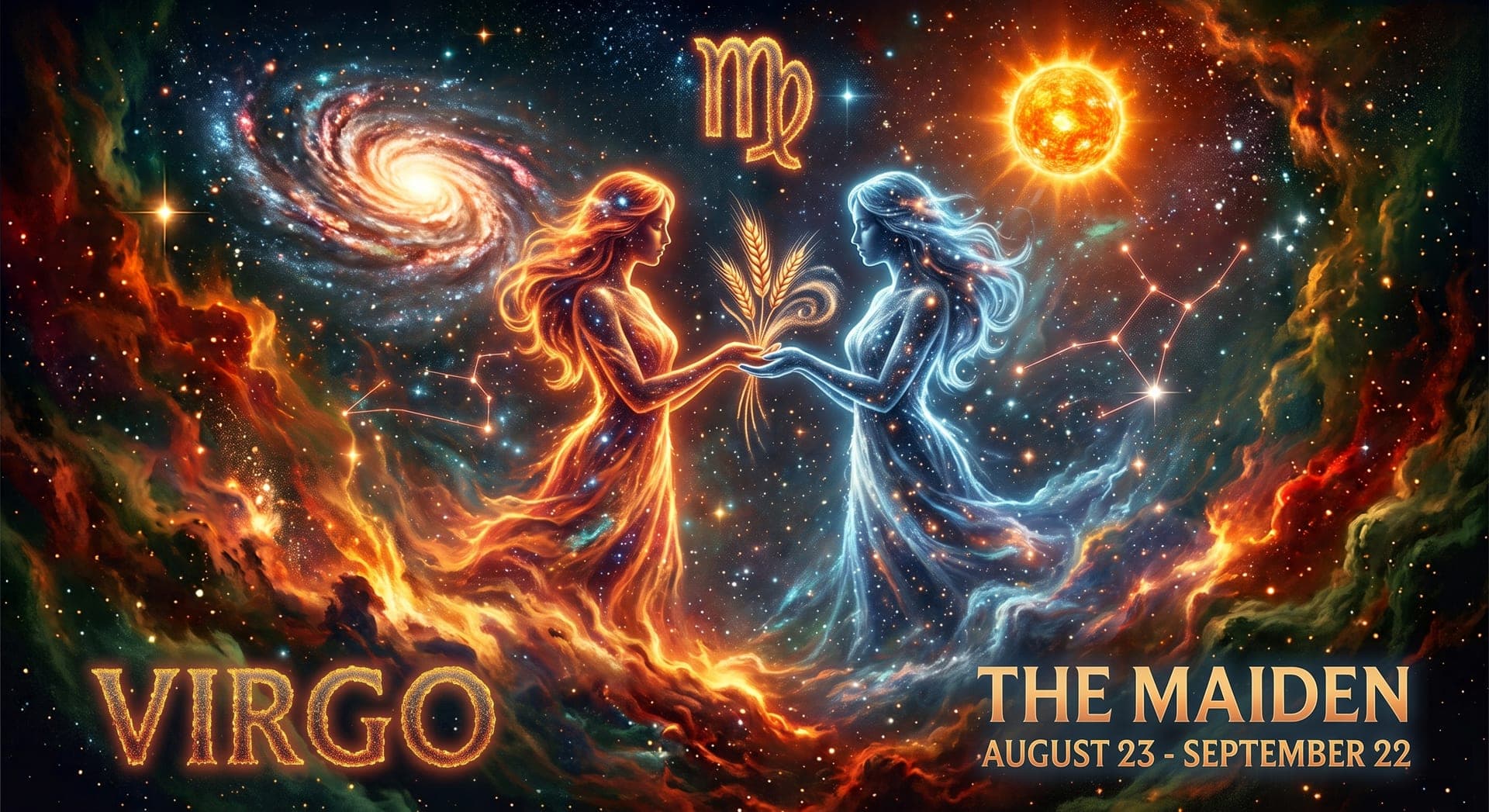
Virgo, the sixth sign of the zodiac, spans August 23 to September 22 and is symbolized by the maiden, often depicted holding a sheaf of wheat, representing purity, meticulous care, and the harvest. Ruled by Mercury, the planet of communication and intellect, Virgo channels its mental energy toward precision, analysis, and practical problem-solving rather than idle chatter. As an Earth sign, Virgo is grounded and detail-oriented, finding genuine satisfaction in organizing, refining, and perfecting the world around it. Its Mutable modality gives Virgo an adaptable, service-oriented nature, often finding purpose in quietly helping others and improving systems rather than seeking the spotlight. People born under this sign are frequently drawn to work requiring precision, research, or care for others, from science and medicine to editing and organization. Virgo's high standards make it an excellent problem-solver and a reliable presence others can count on, though that same perfectionism can turn inward as self-criticism or outward as an exacting, sometimes overly critical, eye toward the people and world around it.
Personality Traits
Strengths
- Highly organized and detail-oriented
- Reliable and hardworking
- Analytical problem-solver
- Genuinely helpful to others
- Modest and unpretentious
Weaknesses
- Prone to overcritical perfectionism
- Tends to worry excessively
- Can be overly critical of others
- Reserved to the point of aloofness
- Struggles to relax
Compatible Signs
Fun Facts
- Virgo's maiden symbol is often associated with Astraea, the Greek goddess of justice and purity, said to have been the last immortal to live among humans.
- Virgo is the only zodiac sign represented by a female human figure.
- Virgo and Gemini share Mercury as their ruling planet, though Virgo channels the planet's communicative energy toward analysis and precision rather than pure talkativeness.
- Notable Virgos include Beyoncé, Michael Jackson, Mother Teresa, and Stephen King.
- Virgo season falls at the tail end of summer, a period traditionally associated with harvest, meticulous preparation, and gathering resources for the colder months ahead.
Born on September 5
- 1638
Louis XIV
King of France known as the Sun King
- 1791
Giacomo Meyerbeer
German composer of grand opera
- 1826
John Wisden
English cricketer and founder of the Wisden Cricketers' Almanack, the sport's most famous annual reference book
- 1847
Jesse James
American outlaw of the Old West
- 1881
Henry Maitland Wilson
British Army field marshal who commanded Allied forces in the Middle East and Mediterranean during the Second World War
- 1912
John Cage
American experimental composer
- 1922
Denys Wilkinson
English physicist who pioneered nuclear structure research and helped shape postwar British science policy
- 1929
Bob Newhart
American comedian and actor
- 1938
Doreen Massey
English geographer whose influential work reshaped how scholars think about space, place, and globalization
- 1940
Raquel Welch
American actress
- 1946
Freddie Mercury
British singer and frontman of Queen
- 1951
Michael Keaton
American actor known for "Batman" and "Beetlejuice"
- 1969
Mark Ramprakash
English cricketer who scored over a hundred first-class centuries and later became a national team coach
- 1970
Johnny Vegas
English comedian and actor known for his distinctive stand-up persona and television roles
- 1973
Paddy Considine
English actor, writer, and director acclaimed for films including Dead Man's Shoes and The Outrun
- 1991
Skandar Keynes
English actor known for playing Edmund Pevensie in The Chronicles of Narnia film series
On This Day in History
- 917
Liu Yan declares himself emperor, establishing the Southern Han state in southern China.
Taking advantage of instability following the fall of the Tang dynasty, regional military governor Liu Yan declared himself emperor of a new independent state in what is now Guangdong province, one of several rival kingdoms that emerged during China's turbulent Five Dynasties and Ten Kingdoms period. The Southern Han state endured for several decades before eventually being absorbed by the reunifying Song dynasty.
- 1661
French finance minister Nicolas Fouquet is arrested in Nantes on orders of King Louis XIV.
Once one of France's most powerful and wealthy officials, Fouquet was arrested on orders of the young King Louis XIV, reportedly out of jealousy over Fouquet's extravagant wealth and an elaborate party that overshadowed the king himself. Fouquet was subsequently tried on corruption charges and spent the remainder of his life imprisoned, a cautionary tale of royal favor lost.
- 1697
A French warship defeats an English squadron at the Battle of Hudson's Bay, the largest naval engagement ever fought in Arctic waters.
French captain Pierre Le Moyne d'Iberville, commanding a single powerful ship, took on three English vessels of the Hudson's Bay Company and sank or captured two of them despite being outnumbered. The victory allowed French forces to capture the company's main fur-trading post at York Factory, dealing a serious blow to English commercial interests in the contested region.
- 1774
The First Continental Congress convenes in Philadelphia.
Delegates from twelve of the thirteen American colonies gathered in Philadelphia to coordinate a unified response to Britain's increasingly restrictive colonial policies, including the so-called Intolerable Acts. Though the Congress initially sought reconciliation with Britain rather than independence, its formation represented a crucial early step toward eventual coordinated colonial resistance and, ultimately, revolution.
- 1781
The Battle of the Chesapeake weakens British naval power during the American Revolutionary War.
A French fleet under Admiral de Grasse fought the Royal Navy to a strategic standstill off the coast of Virginia, preventing British ships from reinforcing or evacuating General Cornwallis's army at Yorktown. The battle's outcome proved decisive, as it allowed American and French land forces to besiege and ultimately force Cornwallis's surrender weeks later, effectively securing American independence.
- 1793
The French National Convention formally begins the Reign of Terror.
Facing internal counter-revolutionary uprisings and the threat of foreign invasion, France's radical National Convention formally authorized the use of terror as government policy, empowering revolutionary tribunals to swiftly try and execute perceived enemies of the revolution. Over the following months, the Reign of Terror claimed tens of thousands of lives before its architects, including Robespierre, were themselves overthrown and executed.
- 1793
The French National Convention formally institutes the Reign of Terror, authorizing mass arrests and executions of perceived enemies of the Revolution.
Driven by war fever, food shortages, and fear of counter-revolutionary plots, the Convention empowered the Committee of Public Safety under Maximilien Robespierre to suppress dissent by any means necessary. Over the following year, tens of thousands of people were guillotined or otherwise killed across France. The Terror ended only with Robespierre's own execution in July 1794, leaving a lasting mark on revolutionary politics.
- 1839
Britain declares war on Qing China, opening the First Opium War after tensions over the opium trade and the Kowloon skirmish.
The conflict stemmed from China's efforts to halt British merchants' lucrative and illegal opium trade, culminating in the confiscation and destruction of British opium stocks at Canton. Britain's superior naval technology delivered a series of crushing victories over the following three years. The resulting Treaty of Nanking ceded Hong Kong to Britain and forced China to open several ports to foreign trade.
- 1877
Lakota leader Crazy Horse is killed at Fort Robinson, Nebraska.
The famed Lakota war leader, who had played a pivotal role in the defeat of Custer's forces at the Battle of the Little Bighorn, was fatally bayoneted by a soldier while resisting confinement at Fort Robinson following his surrender. His death remains a significant and mourned moment in Lakota history, symbolizing the broader tragedy of Native American displacement during westward expansion.
- 1887
A fire sweeps through the Theatre Royal in Exeter, England, killing 186 people in one of Britain's deadliest building fires.
The blaze broke out during a performance and spread with terrifying speed through the crowded auditorium, whose limited exits and highly flammable scenery trapped hundreds of patrons. The disaster shocked Victorian Britain and led directly to sweeping new safety regulations for theatres nationwide, including requirements for iron safety curtains, additional exits, and fireproofing standards that shaped theatre design for generations.
- 1905
Russia and Japan sign the Treaty of Portsmouth in New Hampshire, ending the Russo-Japanese War.
Negotiated with the mediation of US President Theodore Roosevelt, who won the Nobel Peace Prize for his efforts, the treaty confirmed Japan's emergence as a major world power after its stunning victories over a European empire. Russia ceded territory and influence in Manchuria and Korea to Japan. The humiliating defeat also fueled unrest that contributed to the Russian Revolution of 1905.
- 1914
The First Battle of the Marne begins northeast of Paris, as French forces attack advancing German troops.
As German forces advanced rapidly toward Paris in the opening weeks of World War I, French and British troops launched a determined counteroffensive along the Marne River, aided by reinforcements famously rushed to the front in Parisian taxicabs. The resulting battle halted the German advance and forced a retreat, dashing German hopes for a quick victory and setting the stage for years of grinding trench warfare.
- 1914
Allied forces, including the British Expeditionary Force, halt the German advance on Paris at the First Battle of the Marne.
French and British troops launched a fierce counterattack that exploited a gap opening between two German armies, forcing a general German retreat after weeks of relentless advance since the war began in August. The battle shattered German hopes of a quick victory in the west and forced both sides to dig in, beginning the years of static trench warfare that came to define the First World War.
- 1945
Soviet defector Igor Gouzenko exposes Soviet espionage in North America, an early signal of Cold War tensions.
A cipher clerk at the Soviet embassy in Ottawa, Igor Gouzenko defected with documents revealing an extensive Soviet espionage network operating in Canada and the United States, including efforts to steal atomic secrets. His revelations, made public shortly after World War II's end, are often cited by historians as an early flashpoint signaling the onset of the Cold War.
- 1972
Palestinian militants from Black September take Israeli athletes hostage at the Munich Olympics, ultimately killing eleven athletes and coaches.
The attackers stormed the Olympic Village and demanded the release of Palestinian prisoners; after a tense standoff, a botched rescue attempt by West German police at a nearby airfield resulted in the deaths of all remaining hostages along with several attackers and a police officer. The massacre led to major reforms in Olympic security and prompted Israel to launch a covert campaign to hunt down those responsible.
- 1977
NASA launches the Voyager 1 spacecraft on its historic journey through the outer solar system and beyond.
Launched shortly after its twin probe Voyager 2, Voyager 1 was designed to study the outer planets of the solar system before continuing outward, eventually becoming the most distant human-made object from Earth. The spacecraft's cameras captured iconic images throughout its journey, including the famous "Pale Blue Dot" photograph of Earth taken from the edge of the solar system.
- 1977
NASA launches the Voyager 1 space probe on a mission to study the outer planets and beyond.
Voyager 1 went on to capture historic close-up images of Jupiter and Saturn and their moons before continuing outward, eventually becoming the first human-made object to cross into interstellar space in 2012. It carries the Golden Record, a collection of sounds and images of Earth intended as a message should the probe ever be found by another civilization. It remains operational, communicating from billions of miles away.
- 1981
The first women arrive to establish a peace camp outside RAF Greenham Common in Berkshire, England, protesting the planned siting of US nuclear cruise missiles.
What began as a small march grew into a sprawling, women-only protest camp that endured for nearly two decades and became one of the most famous demonstrations of the anti-nuclear movement. Thousands of women periodically joined mass actions there, including human chains encircling the base's perimeter fence. The missiles were eventually withdrawn in 1991 under the INF Treaty, and the camp finally closed in 2000.
- 2022
Liz Truss is declared winner of the UK Conservative Party leadership election, becoming the incoming prime minister.
Truss emerged victorious in the Conservative Party's internal leadership contest, triggered by Boris Johnson's resignation amid a series of scandals, defeating rival candidate Rishi Sunak in a vote of party members. Her tenure as prime minister proved remarkably brief, however, lasting only weeks before economic turmoil forced her resignation.
- 2022
Liz Truss wins the UK Conservative Party leadership contest, positioning her to become Britain's next prime minister.
Truss defeated former chancellor Rishi Sunak in a vote of party members following Boris Johnson's resignation amid scandal. She was appointed prime minister by Queen Elizabeth II just two days before the monarch's death. Truss's tenure proved extraordinarily short-lived, lasting only 49 days after a disastrous mini-budget triggered market turmoil, making her the shortest-serving prime minister in British history.