What’s Observed on September 4
Born on September 4: Virgo ♍
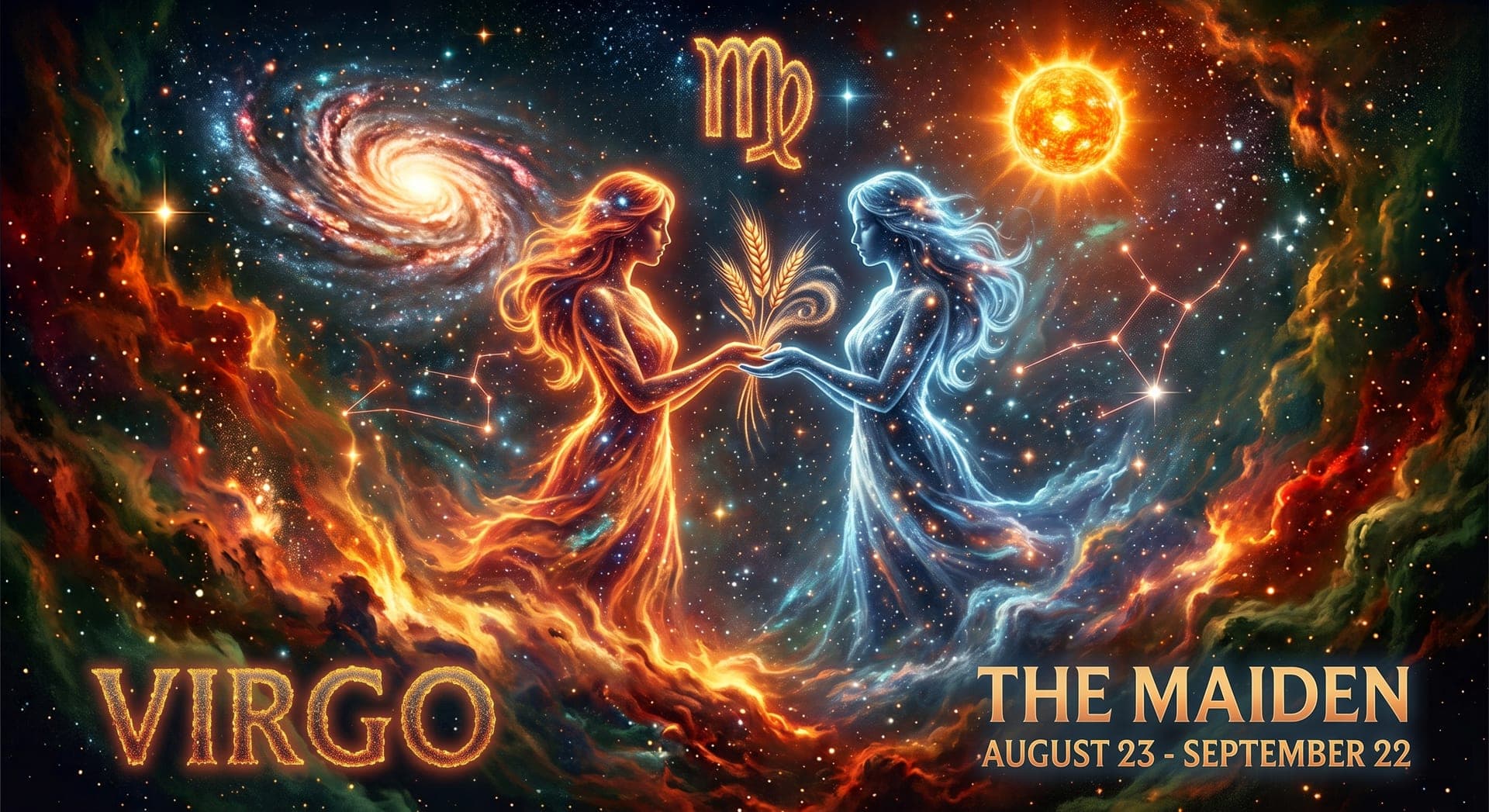
Virgo, the sixth sign of the zodiac, spans August 23 to September 22 and is symbolized by the maiden, often depicted holding a sheaf of wheat, representing purity, meticulous care, and the harvest. Ruled by Mercury, the planet of communication and intellect, Virgo channels its mental energy toward precision, analysis, and practical problem-solving rather than idle chatter. As an Earth sign, Virgo is grounded and detail-oriented, finding genuine satisfaction in organizing, refining, and perfecting the world around it. Its Mutable modality gives Virgo an adaptable, service-oriented nature, often finding purpose in quietly helping others and improving systems rather than seeking the spotlight. People born under this sign are frequently drawn to work requiring precision, research, or care for others, from science and medicine to editing and organization. Virgo's high standards make it an excellent problem-solver and a reliable presence others can count on, though that same perfectionism can turn inward as self-criticism or outward as an exacting, sometimes overly critical, eye toward the people and world around it.
Personality Traits
Strengths
- Highly organized and detail-oriented
- Reliable and hardworking
- Analytical problem-solver
- Genuinely helpful to others
- Modest and unpretentious
Weaknesses
- Prone to overcritical perfectionism
- Tends to worry excessively
- Can be overly critical of others
- Reserved to the point of aloofness
- Struggles to relax
Compatible Signs
Fun Facts
- Virgo's maiden symbol is often associated with Astraea, the Greek goddess of justice and purity, said to have been the last immortal to live among humans.
- Virgo is the only zodiac sign represented by a female human figure.
- Virgo and Gemini share Mercury as their ruling planet, though Virgo channels the planet's communicative energy toward analysis and precision rather than pure talkativeness.
- Notable Virgos include Beyoncé, Michael Jackson, Mother Teresa, and Stephen King.
- Virgo season falls at the tail end of summer, a period traditionally associated with harvest, meticulous preparation, and gathering resources for the colder months ahead.
Born on September 4
- 1824
Anton Bruckner
Austrian composer and organist
- 1846
Daniel Burnham
American architect who designed the World's Columbian Exposition
- 1901
William Lyons
English businessman who co-founded Jaguar Cars and shaped its iconic vehicle designs
- 1902
Tommy Mitchell
English cricketer who played Test cricket for England as a leg-spin bowler for Derbyshire
- 1905
Mary Renault
English novelist celebrated for her historical fiction set in ancient Greece, including The King Must Die
- 1908
Richard Wright
American novelist known for "Native Son"
- 1917
Henry Ford II
American businessman who led the Ford Motor Company
- 1927
John McCarthy
American computer scientist who coined the term artificial intelligence
- 1937
Les Allen
English footballer who won the league and FA Cup double with Tottenham Hotspur in 1961
- 1944
Tony Atkinson
English economist regarded as a founding figure of the modern study of income inequality
- 1962
Shinya Yamanaka
Japanese physician and Nobel laureate for stem cell research
- 1974
Mark Ronson
English DJ, songwriter, and record producer known for hits including "Uptown Funk"
- 1981
Beyonce
American singer-songwriter
- 1982
Mark Lewis-Francis
English sprinter who won Olympic gold as part of Britain's 4x100 metres relay team
- 1990
James Bay
English singer-songwriter known for his folk-rock hit "Hold Back the River"
On This Day in History
- 476
Germanic general Odoacer deposes Romulus Augustulus and proclaims himself King of Italy, traditionally marking the end of the Western Roman Empire.
The Germanic military leader Odoacer, commanding a mixed force of Roman auxiliary troops, deposed the teenage emperor Romulus Augustulus and sent him into comfortable retirement rather than executing him. Odoacer then styled himself King of Italy rather than claiming the imperial title, an event historians traditionally use to mark the symbolic end of the Western Roman Empire, though Byzantine rule continued in the east.
- 476
The Germanic chieftain Odoacer deposes the last Western Roman emperor, Romulus Augustulus, an event traditionally marking the fall of the Western Roman Empire.
Romulus Augustulus was a teenage figurehead who had reigned less than a year when Odoacer's forces overthrew him and sent him into obscure retirement rather than killing him. Odoacer proclaimed himself King of Italy and sent the imperial regalia to Constantinople, formally ending the line of Western emperors that stretched back to Augustus. Historians still debate the event's true significance, since Roman institutions persisted in Italy for decades afterward.
- 626
Li Shimin, later Emperor Taizong, secures control of the Tang dynasty following a violent succession struggle.
Li Shimin eliminated his brothers in a violent succession struggle known as the Xuanwu Gate Incident before forcing his father to abdicate in his favor, becoming Emperor Taizong of the newly established Tang dynasty. Despite the bloody circumstances of his rise, Taizong's subsequent reign is regarded as one of the most successful and culturally flourishing periods in Chinese imperial history.
- 1260
Sienese Ghibelline forces defeat Florentine Guelphs at the Battle of Montaperti.
Ghibelline forces from Siena, aided by exiled Florentine Ghibellines and German mercenary cavalry, inflicted a devastating defeat on the rival Guelph army from Florence near the Arbia River. The battle, one of the bloodiest in medieval Italian history, temporarily shifted political power in Tuscany, though the Guelphs regained dominance in Florence within less than a decade.
- 1479
The Treaty of Alcacovas is signed between the Catholic Monarchs of Castile and Aragon and Portugal, settling territorial disputes.
Negotiated to resolve a war of succession over the Castilian throne, the treaty settled competing territorial claims between Portugal and the combined Spanish kingdoms, notably granting Portugal exclusive rights to territories south of the Canary Islands, including along the West African coast. The agreement significantly shaped the subsequent competition between the two Iberian powers during the early age of European exploration.
- 1607
Irish earls flee to mainland Europe in the Flight of the Earls, ending Gaelic aristocratic resistance to English rule.
Facing mounting pressure from English colonial authority following the collapse of a major Gaelic rebellion, the last independent Gaelic Irish earls sailed into exile on the European continent, effectively ending centuries of Gaelic aristocratic power in Ulster. Their departure opened the way for the large-scale English and Scottish colonization of Ulster that followed in subsequent years.
- 1607
The Gaelic earls of Tyrone and Tyrconnell sail from Ireland into permanent exile, an event known as the Flight of the Earls.
Hugh O'Neill and Rory O'Donnell had led the failed Nine Years' War against English rule and, facing mounting pressure and possible arrest, departed with dozens of followers for Spain and eventually Rome. Their departure removed the last major obstacle to English control of Ulster and paved the way for the Plantation of Ulster, in which their confiscated lands were settled by English and Scottish colonists.
- 1666
The Great Fire of London reaches its most destructive point, with flames sweeping through the heart of the medieval city.
By the fire's third day, the blaze had consumed most of the area within the old Roman walls, including old St Paul's Cathedral, dozens of livery company halls, and thousands of homes and shops. Firefighters and soldiers finally began to gain control by pulling down buildings to create firebreaks. The catastrophe, though it killed few people directly, left tens of thousands of Londoners homeless.
- 1781
Spanish settlers found the settlement that becomes Los Angeles, naming it El Pueblo de Nuestra Senora la Reina de los Angeles.
A group of Spanish colonial settlers, including families of mixed Spanish, Indigenous, and African descent, founded a small farming pueblo near the Los Angeles River under orders from the Spanish governor of California. The settlement grew slowly over the following decades before eventually becoming one of the largest and most influential cities in the United States.
- 1839
British warships exchange fire with Chinese vessels off Kowloon in the opening skirmish of the First Opium War.
The clash arose after British traders were expelled from Canton following the Qing government's crackdown on the illegal opium trade, and British ships attempted to secure food supplies near Hong Kong. Though a minor engagement, it prefigured the larger war that followed within months. Britain's eventual victory forced China to cede Hong Kong and open treaty ports to foreign trade.
- 1870
Emperor Napoleon III of France is deposed and the Third French Republic is declared.
Following Napoleon III's humiliating capture at the Battle of Sedan during the Franco-Prussian War, crowds in Paris rose up and proclaimed the end of the Second French Empire, establishing the Third Republic in its place. The new republican government continued the war against Prussia, though Paris itself would soon face a lengthy and difficult siege.
- 1870
Following the disastrous French defeat at Sedan, Napoleon III is deposed and the Third French Republic is proclaimed in Paris.
News of the emperor's capture two days earlier triggered a bloodless revolution in Paris, where crowds stormed the legislature and republican deputies declared France's new government from the Hôtel de Ville. The change of regime did nothing to halt the German advance, and Paris itself would soon fall under a grueling four-month siege before France was forced to accept a harsh peace.
- 1882
Pearl Street Station in New York City becomes the first power plant to supply electricity to paying customers.
Thomas Edison's Pearl Street Station in lower Manhattan began supplying direct current electricity to a small number of paying customers in the surrounding financial district, marking a foundational moment in the commercialization of electric power. The station's success helped launch the broader electrification of American cities in the following decades.
- 1886
Apache leader Geronimo surrenders to General Nelson Miles, ending nearly three decades of armed resistance.
After leading Apache resistance fighters through decades of conflict with American and Mexican forces across the Southwest, Geronimo formally surrendered to General Nelson Miles in Arizona, marking the end of major armed Native American resistance in the region. Geronimo spent the remainder of his life as a prisoner of war, eventually becoming something of a celebrity figure before his death in 1909.
- 1939
The Royal Air Force carries out its first bombing raid of the Second World War, striking German warships at Wilhelmshaven.
Bristol Blenheim and Wellington bombers attacked the German fleet in the Jade estuary just a day after Britain's declaration of war, aiming to blunt the naval threat to British shipping. The raid caused only modest damage and cost several aircraft, an early indication of the heavy losses daylight bombing missions would suffer before the RAF adapted its tactics later in the war.
- 1944
Britain's 11th Armoured Division liberates the Belgian port city of Antwerp from German occupation.
The rapid advance captured the city's vast docks largely intact, a potential windfall for Allied supply lines that had been stretched thin since the breakout from Normandy. However, German forces retained control of the Scheldt estuary approaches for weeks afterward, meaning the port could not actually be used until a costly separate campaign cleared the waterway that November.
- 1964
Queen Elizabeth II opens the Forth Road Bridge, spanning the Firth of Forth near Edinburgh, Scotland.
At the time of its completion, the suspension bridge was the longest of its kind outside the United States and replaced a centuries-old ferry crossing between Edinburgh and Fife. It stood alongside the older Forth Bridge, the iconic Victorian rail crossing built in the 1890s. Decades of increasing traffic eventually led to the construction of the neighboring Queensferry Crossing, which opened in 2017.
- 1985
British chemist Harry Kroto and American colleagues Robert Curl and Richard Smalley discover buckminsterfullerene, a new form of carbon, at Rice University.
While vaporizing graphite with a laser to simulate conditions around dying stars, the team detected a remarkably stable molecule of sixty carbon atoms arranged in a cage resembling a soccer ball, which they named after architect Buckminster Fuller's geodesic domes. The discovery revealed an entirely new class of carbon molecules, fullerenes, and earned the three scientists the 1996 Nobel Prize in Chemistry.
- 1998
Google is founded by Stanford PhD students Larry Page and Sergey Brin.
Working from a garage in Menlo Park, California, Larry Page and Sergey Brin formally incorporated their search engine company, which had grown out of a research project exploring how to rank web pages by analyzing the links between them. Google went on to become one of the most valuable and influential technology companies in the world, fundamentally reshaping how people access information online.
- 1998
Larry Page and Sergey Brin incorporate Google as a company, having developed its search engine as Stanford graduate students.
The pair's PageRank algorithm ranked web pages by analyzing the links between them, producing dramatically more relevant search results than existing engines. Working initially out of a friend's garage in Menlo Park, California, the company grew within a decade into one of the world's most valuable, expanding far beyond search into email, maps, mobile software, and advertising.