What’s Observed on September 3
Born on September 3: Virgo ♍
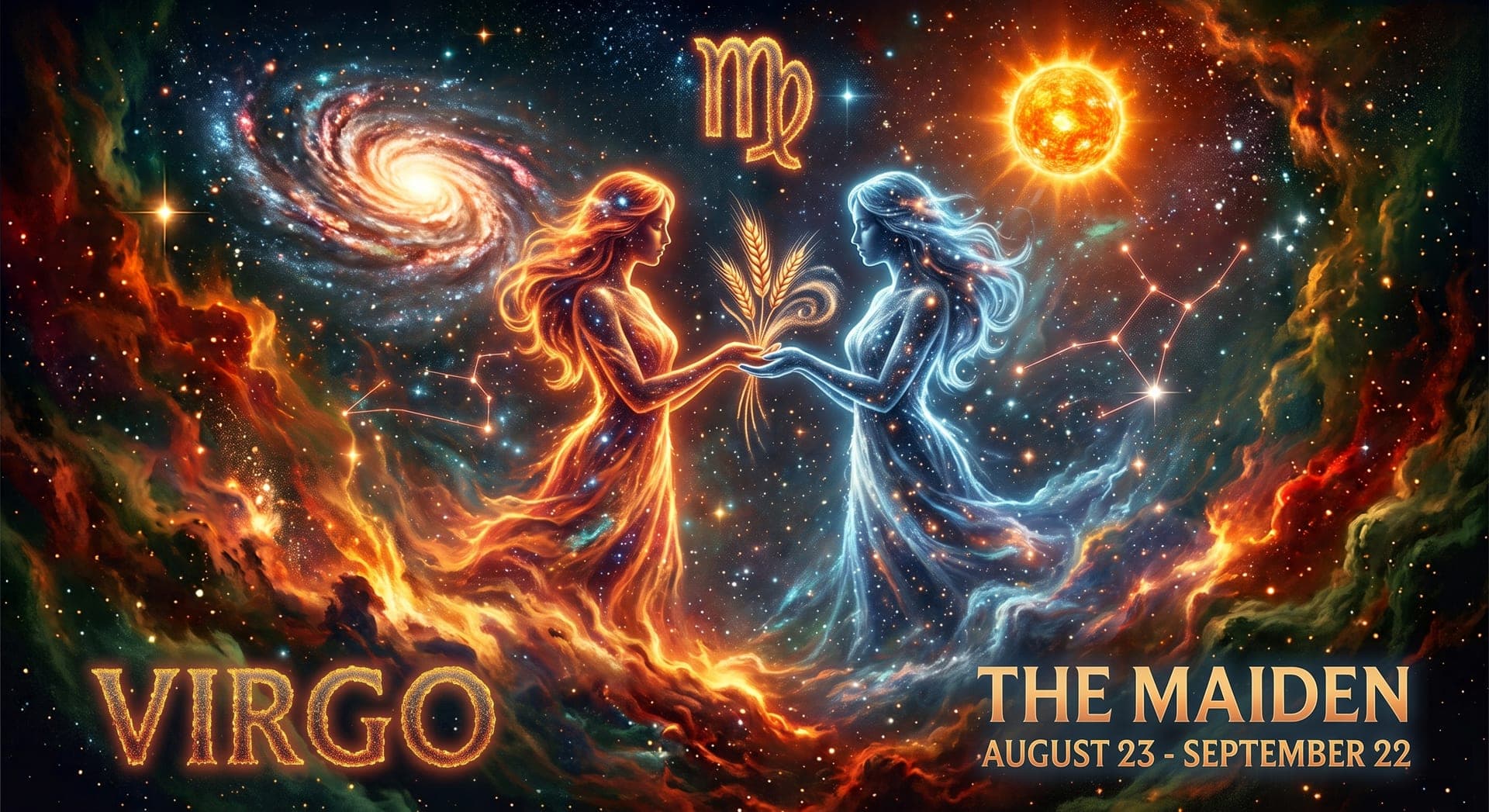
Virgo, the sixth sign of the zodiac, spans August 23 to September 22 and is symbolized by the maiden, often depicted holding a sheaf of wheat, representing purity, meticulous care, and the harvest. Ruled by Mercury, the planet of communication and intellect, Virgo channels its mental energy toward precision, analysis, and practical problem-solving rather than idle chatter. As an Earth sign, Virgo is grounded and detail-oriented, finding genuine satisfaction in organizing, refining, and perfecting the world around it. Its Mutable modality gives Virgo an adaptable, service-oriented nature, often finding purpose in quietly helping others and improving systems rather than seeking the spotlight. People born under this sign are frequently drawn to work requiring precision, research, or care for others, from science and medicine to editing and organization. Virgo's high standards make it an excellent problem-solver and a reliable presence others can count on, though that same perfectionism can turn inward as self-criticism or outward as an exacting, sometimes overly critical, eye toward the people and world around it.
Personality Traits
Strengths
- Highly organized and detail-oriented
- Reliable and hardworking
- Analytical problem-solver
- Genuinely helpful to others
- Modest and unpretentious
Weaknesses
- Prone to overcritical perfectionism
- Tends to worry excessively
- Can be overly critical of others
- Reserved to the point of aloofness
- Struggles to relax
Compatible Signs
Fun Facts
- Virgo's maiden symbol is often associated with Astraea, the Greek goddess of justice and purity, said to have been the last immortal to live among humans.
- Virgo is the only zodiac sign represented by a female human figure.
- Virgo and Gemini share Mercury as their ruling planet, though Virgo channels the planet's communicative energy toward analysis and precision rather than pure talkativeness.
- Notable Virgos include Beyoncé, Michael Jackson, Mother Teresa, and Stephen King.
- Virgo season falls at the tail end of summer, a period traditionally associated with harvest, meticulous preparation, and gathering resources for the colder months ahead.
Born on September 3
- 1814
James Joseph Sylvester
English mathematician who made major contributions to matrix theory and invariant theory and coined much of the field's terminology
- 1875
Ferdinand Porsche
Austrian engineer who founded the Porsche automobile company
- 1878
Dorothea Douglass Lambert Chambers
English tennis player who won the Wimbledon singles title seven times, a record that stood for decades
- 1900
Percy Chapman
English cricketer who captained England to victory in the famous 1926 Ashes series
- 1913
Alan Ladd
American actor known for "Shane"
- 1938
Caryl Churchill
English playwright celebrated for boundary-pushing works such as Top Girls and Cloud Nine
- 1940
Pauline Collins
English actress who won acclaim on stage and screen, including an Oscar-nominated role in Shirley Valentine
- 1955
Steve Jones
English guitarist and founding member of the punk band the Sex Pistols
- 1965
Charlie Sheen
American actor known for "Platoon" and "Two and a Half Men"
- 1965
Rachel Johnson
English journalist, author, and broadcaster known for her political commentary
- 1981
Fearne Cotton
English television and radio presenter known for hosting shows on the BBC and founding the wellbeing brand Happy Place
- 1986
Shaun White
American snowboarder and Olympic gold medalist
- 1993
Dominic Thiem
Austrian professional tennis player
- 1999
Rich Brian
Indonesian rapper and singer
- 2003
Jack Dylan Grazer
American actor known for "It" and "Shazam!"
On This Day in History
- 36 BCE
Octavian's admiral Agrippa defeats Sextus Pompey at the Battle of Naulochus, ending organized opposition to the Second Triumvirate.
Agrippa's naval forces decisively defeated the fleet of Sextus Pompey, son of the famous Roman general Pompey the Great, off the coast of Sicily. The victory eliminated the last significant military threat to the Second Triumvirate's authority and cleared the way for the eventual showdown between Octavian and Mark Antony that would determine the future ruler of Rome.
- 301
San Marino is traditionally founded by Saint Marinus, becoming what is now the world's oldest surviving republic.
According to tradition, a Christian stonemason named Marinus fled religious persecution and founded a small community atop Mount Titano in present-day Italy, which gradually developed into the independent republic that survives today. San Marino's continuous existence as a sovereign state, surrounded entirely by Italian territory, makes it one of the oldest and smallest republics still functioning in the modern world.
- 1189
Richard the Lionheart is crowned King of England at Westminster Abbey.
Following the death of his father Henry II, Richard was formally crowned King of England in a lavish ceremony at Westminster Abbey, though he would spend only a small fraction of his decade-long reign actually residing in England, focusing instead on Crusading campaigns abroad. His coronation is also notoriously remembered for anti-Jewish violence that erupted in London during the celebrations.
- 1189
Richard I is crowned King of England in a lavish ceremony at Westminster Abbey.
The coronation followed the death of his father, Henry II, whom Richard had fought against in his final years. Known as Richard the Lionheart, the new king would spend only a handful of months of his ten-year reign actually in England, focusing his energies instead on the Third Crusade and defending his continental territories in France. His coronation feast was marred by a violent riot against London's Jewish community.
- 1260
Mamluk forces achieve their first decisive victory over the Mongols at the Battle of Ain Jalut in Palestine.
Mamluk forces from Egypt inflicted a crucial defeat on the previously unstoppable Mongol army in Palestine, marking the first major military setback the Mongols had suffered in their westward expansion. The victory halted further Mongol advances into Egypt and the broader Islamic heartland, preserving Mamluk power in the region for centuries to come.
- 1650
Oliver Cromwell leads an outnumbered English army to a stunning victory over Scottish Covenanter forces at the Battle of Dunbar.
Trapped against the sea by a much larger Scottish army loyal to the exiled Charles II, Cromwell launched a surprise dawn attack that routed his opponents, killing or capturing thousands. The victory opened the road to Edinburgh and marked a turning point in Cromwell's Scottish campaign during the Wars of the Three Kingdoms, though full conquest of Scotland took another year.
- 1651
The Battle of Worcester, the last major engagement of the Wars of the Three Kingdoms, ends in Parliamentarian victory.
Oliver Cromwell's Parliamentarian New Model Army decisively defeated the Royalist forces of Charles II at Worcester, effectively ending the prolonged series of conflicts collectively known as the Wars of the Three Kingdoms. Charles II narrowly escaped capture, famously hiding in an oak tree before eventually fleeing into exile in Europe, not returning to claim the throne until the Restoration nine years later.
- 1651
Cromwell's New Model Army crushes the Royalist forces of Charles II at the Battle of Worcester, ending the Wars of the Three Kingdoms.
Charles II had marched south from Scotland with a mostly Scottish army in a bid to reclaim his throne, but Cromwell's larger force overwhelmed the Royalists in a day of fierce street fighting. Charles famously escaped capture by hiding in an oak tree before fleeing to exile in France. The defeat left Cromwell in undisputed control of England, Scotland, and Ireland for the next several years.
- 1658
Lord Protector Oliver Cromwell dies in London, and his son Richard Cromwell succeeds him.
Cromwell had ruled England, Scotland, and Ireland since abolishing the monarchy, but his death exposed how much the fragile republic had depended on his personal authority. Richard Cromwell, lacking his father's military standing and political skill, was unable to hold together the army and Parliament, and resigned within a year. The resulting instability led directly to the restoration of Charles II in 1660.
- 1666
London's Royal Exchange, the city's great center of commerce, is destroyed as the Great Fire of London reaches its third day.
Founded a century earlier by the merchant Thomas Gresham as a hub for trade and finance, the Exchange had become a symbol of London's commercial power. Contemporary accounts describe the building's stone facade collapsing as its statues of English monarchs shattered one by one in the heat. It was rebuilt within a few years, only to burn down again in a separate fire in 1838.
- 1783
The American Revolutionary War formally concludes with the signing of the Treaty of Paris.
Negotiated in Paris between American and British representatives, the treaty formally recognized the independence of the United States and established the young nation's boundaries, bringing an official end to the Revolutionary War. The agreement also addressed issues including fishing rights, debts, and the treatment of Loyalists, shaping the diplomatic relationship between the two nations going forward.
- 1783
Britain and the United States sign the Treaty of Paris, formally ending the American Revolutionary War and recognizing American independence.
Negotiated in France by American commissioners including Benjamin Franklin and John Adams, the treaty saw Britain relinquish its thirteen American colonies and set generous boundaries stretching to the Mississippi River. It also addressed fishing rights, debts, and the treatment of Loyalists. Signed alongside separate agreements with France, Spain, and the Netherlands, the treaty brought the wider global conflict to a close.
- 1838
Frederick Douglass escapes from slavery, later becoming a leading abolitionist and orator.
Disguised in a sailor's uniform and carrying borrowed identification papers, Douglass boarded a train in Baltimore and made his way north to freedom in New York City, a daring escape from slavery he later described in his influential autobiographies. He went on to become one of the most prominent abolitionist speakers and writers of the nineteenth century, advocating tirelessly for emancipation and civil rights.
- 1878
The pleasure steamer Princess Alice collides with the collier Bywell Castle on the River Thames, killing over 640 people.
The crowded excursion boat was returning to London from a day trip to the Kent coast when it was struck near Woolwich and sank within minutes, its passengers trapped by the ship's design and dragged down by raw sewage discharged into the river. It remains the deadliest inland waterway disaster in British history and led to major reforms in shipping safety and river sanitation.
- 1879
Afghan troops storm the British Residency in Kabul, killing envoy Sir Louis Cavagnari and his entire escort.
Cavagnari had been installed as British envoy only weeks earlier under a treaty ending the first phase of the Second Anglo-Afghan War, but mutinous Afghan soldiers overran the lightly defended compound after a fierce day-long fight. The massacre triggered a renewed British invasion of Afghanistan under General Frederick Roberts, who occupied Kabul in retaliation before the war concluded the following year.
- 1916
British pilot William Leefe Robinson shoots down the German airship SL 11 over Hertfordshire, the first Zeppelin-type raider destroyed over Britain.
Flying a BE2c biplane armed with newly developed incendiary ammunition, Robinson set the giant hydrogen-filled airship ablaze in front of crowds who watched it fall from the night sky near London. The feat made him an instant national hero and earned him the Victoria Cross. It also marked a turning point in Britain's air defenses against the German airship raids of the First World War.
- 1939
Britain, France, Australia, and New Zealand declare war on Germany following the invasion of Poland.
Honoring their treaty commitments to Poland after Germany's invasion two days earlier, Britain, France, and several Commonwealth nations including Australia and New Zealand formally declared war on Germany. The declarations marked the definitive start of a global conflict that would eventually draw in dozens of nations and become the deadliest war in human history.
- 1939
Britain, France, Australia, and New Zealand declare war on Germany after Hitler ignores an ultimatum to withdraw from Poland.
Prime Minister Neville Chamberlain announced the declaration in a somber radio broadcast to the British public, two days after German forces had invaded Poland. The declaration brought the British Empire into the Second World War, a conflict that would last nearly six years and reshape Britain's role in the world. Chamberlain resigned the following spring, giving way to Winston Churchill's wartime government.
- 1945
A three-day victory celebration begins across China marking the end of the war against Japan.
Following Japan's formal surrender the previous day, celebrations erupted across Chinese cities marking the end of nearly eight years of brutal war against Japanese occupation, a conflict that had caused millions of Chinese casualties. The victory also set the stage for the resumption of China's civil war between Nationalist and Communist forces, who had maintained an uneasy alliance against Japan.
- 1967
Sweden switches overnight from driving on the left side of the road to the right, an event known as Dagen H.
In a remarkably well-organized single-night transition, Sweden switched its entire road traffic system from driving on the left side of the road to the right, aligning with its Scandinavian neighbors. The change, known as Dagen H, or H Day, required replacing road signs, adjusting bus doors, and extensive public information campaigns, and it occurred with far fewer traffic accidents than many had feared.