What’s Observed on September 2
Born on September 2: Virgo ♍
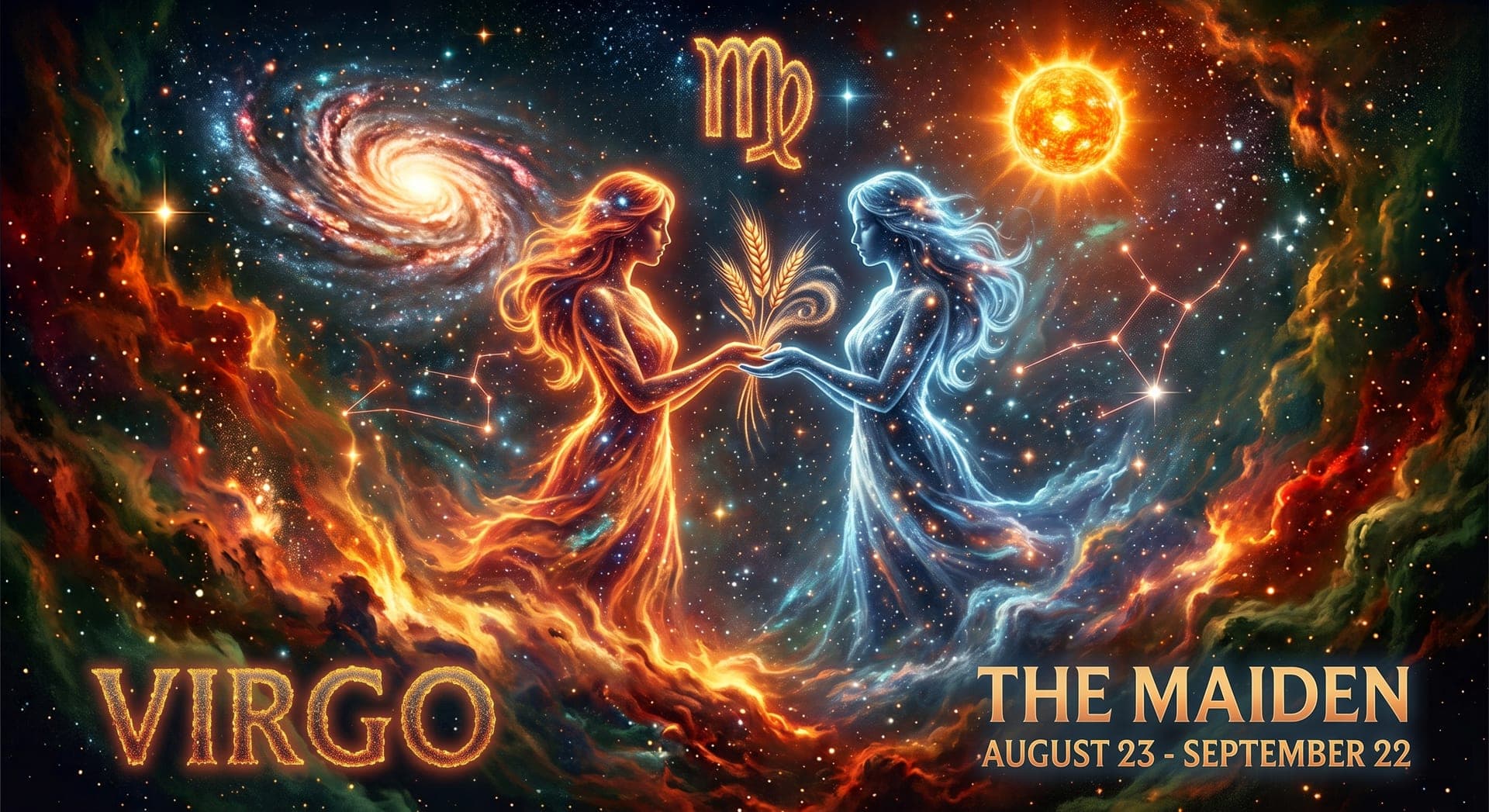
Virgo, the sixth sign of the zodiac, spans August 23 to September 22 and is symbolized by the maiden, often depicted holding a sheaf of wheat, representing purity, meticulous care, and the harvest. Ruled by Mercury, the planet of communication and intellect, Virgo channels its mental energy toward precision, analysis, and practical problem-solving rather than idle chatter. As an Earth sign, Virgo is grounded and detail-oriented, finding genuine satisfaction in organizing, refining, and perfecting the world around it. Its Mutable modality gives Virgo an adaptable, service-oriented nature, often finding purpose in quietly helping others and improving systems rather than seeking the spotlight. People born under this sign are frequently drawn to work requiring precision, research, or care for others, from science and medicine to editing and organization. Virgo's high standards make it an excellent problem-solver and a reliable presence others can count on, though that same perfectionism can turn inward as self-criticism or outward as an exacting, sometimes overly critical, eye toward the people and world around it.
Personality Traits
Strengths
- Highly organized and detail-oriented
- Reliable and hardworking
- Analytical problem-solver
- Genuinely helpful to others
- Modest and unpretentious
Weaknesses
- Prone to overcritical perfectionism
- Tends to worry excessively
- Can be overly critical of others
- Reserved to the point of aloofness
- Struggles to relax
Compatible Signs
Fun Facts
- Virgo's maiden symbol is often associated with Astraea, the Greek goddess of justice and purity, said to have been the last immortal to live among humans.
- Virgo is the only zodiac sign represented by a female human figure.
- Virgo and Gemini share Mercury as their ruling planet, though Virgo channels the planet's communicative energy toward analysis and precision rather than pure talkativeness.
- Notable Virgos include Beyoncé, Michael Jackson, Mother Teresa, and Stephen King.
- Virgo season falls at the tail end of summer, a period traditionally associated with harvest, meticulous preparation, and gathering resources for the colder months ahead.
Born on September 2
- 1675
William Somervile
English poet best known for The Chase, a georgic poem celebrating fox hunting
- 1877
Frederick Soddy
English chemist awarded the Nobel Prize for his work explaining radioactive decay and isotopes
- 1910
Donald Watson
English activist who coined the word "vegan" and founded the Vegan Society
- 1913
Bill Shankly
Scottish footballer and manager who transformed Liverpool FC into one of England's dominant clubs
- 1922
Arthur Ashkin
American physicist and Nobel laureate for optical tweezers research
- 1924
Daniel arap Moi
Second President of Kenya
- 1929
Victor Spinetti
Welsh actor known for his comic roles in three Beatles films
- 1949
Moira Stuart
British broadcaster who became one of the first Black newsreaders on UK television
- 1962
Keir Starmer
English lawyer and Labour politician who became Prime Minister of the United Kingdom
- 1964
Keanu Reeves
Canadian actor known for "The Matrix" and "John Wick"
- 1965
Lennox Lewis
English-born boxer who became a two-time undisputed world heavyweight champion
- 1966
Salma Hayek
Mexican-American actress and producer
- 1989
Zedd
Russian-German DJ and record producer
On This Day in History
- 44 BCE
Cleopatra VII declares her son Ptolemy XV Caesarion co-ruler of Egypt.
Following the assassination of her lover Julius Caesar, Cleopatra moved to secure her son's political future by formally naming the young Ptolemy XV Caesarion, whose name directly invoked his purported father, as her co-ruler in Egypt. The move was intended to strengthen the Ptolemaic dynasty's legitimacy and its ties to Rome during an increasingly unstable period following Caesar's death.
- 31 BCE
Octavian's forces defeat Mark Antony and Cleopatra at the Battle of Actium, a decisive naval engagement off the Greek coast.
Octavian's fleet, commanded by his skilled admiral Marcus Agrippa, decisively defeated the combined naval forces of Mark Antony and Cleopatra off the western coast of Greece. The victory effectively ended the civil war that had followed Julius Caesar's assassination, leaving Octavian as the unchallenged master of the Roman world and setting the stage for his transformation into the emperor Augustus.
- 31 BCE
Octavian's fleet decisively defeats the combined forces of Mark Antony and Cleopatra at the Battle of Actium off the coast of Greece.
The naval battle effectively ended the long civil war that followed Julius Caesar's assassination, leaving Octavian the unchallenged master of Rome. Antony and Cleopatra fled to Egypt, where both took their own lives within the year rather than face capture. Octavian's victory paved the way for his transformation into Augustus, Rome's first emperor, ushering in centuries of imperial rule.
- 1192
Richard I and Saladin sign the Treaty of Jaffa, concluding the Third Crusade.
After months of fighting during the Third Crusade, Richard the Lionheart and Saladin negotiated a truce that granted Christian pilgrims safe access to Jerusalem while leaving the city itself under Muslim control. Though Richard failed to recapture Jerusalem outright, the treaty represented a pragmatic compromise that concluded the costly military campaign on relatively favorable terms for both sides.
- 1192
Richard I of England and Saladin conclude the Treaty of Jaffa, bringing the Third Crusade to an end.
After months of hard fighting that failed to recapture Jerusalem, Richard the Lionheart negotiated a three-year truce that left the city under Muslim control while guaranteeing Christian pilgrims safe access to its holy sites. Exhausted and eager to return home to deal with troubles in England, Richard departed the Holy Land soon after, his crusading reputation nonetheless secured by the agreement.
- 1601
A Spanish fleet carrying troops to aid Irish rebels lands at Kinsale, opening the campaign that decided the Nine Years' War in Ireland.
The expedition was sent to support Hugh O'Neill's rebellion against English rule, but the landing far from the rebel heartland forced Irish forces to march the length of the country to link up with the Spanish. The resulting Battle of Kinsale that winter ended in a crushing defeat for O'Neill and his allies, breaking Gaelic resistance and clearing the way for the English conquest of Ireland.
- 1666
The Great Fire of London breaks out, ultimately destroying roughly 13,200 houses including Old St Paul's Cathedral.
Starting in a bakery on Pudding Lane, the fire spread rapidly through London's densely packed, largely wooden medieval buildings, raging for four days and destroying the vast majority of the walled city, including thousands of homes and dozens of churches. The catastrophe ultimately led to significant reforms in building codes and urban planning, encouraging wider streets and construction using brick and stone rather than timber.
- 1666
The Great Fire of London breaks out in a Pudding Lane bakery and rapidly spreads, ultimately destroying roughly 10,000 buildings across the City of London.
Fed by a summer drought and cramped, timber-framed housing, the blaze raged for four days before firebreaks created by demolition finally brought it under control. It gutted old St Paul's Cathedral and dozens of parish churches along with most of the medieval city, though remarkably few deaths were recorded. The disaster prompted Christopher Wren's rebuilding of London and new fire-prevention regulations.
- 1752
Great Britain and its colonies formally adopt the Gregorian calendar.
To align with the more astronomically accurate calendar already adopted by most of Catholic Europe over a century earlier, Britain and its colonies skipped eleven days, with the day after September 2nd becoming September 14th. The abrupt calendar shift caused considerable public confusion and, according to popular but likely exaggerated legend, sparked riots among those who believed they had been cheated out of eleven days of their lives.
- 1752
Great Britain and its colonies switch from the Julian to the Gregorian calendar, skipping eleven days to realign with the rest of Europe.
The Calendar Act had ordained that the day after September 2 would be September 14, correcting centuries of accumulated drift from the old Julian system that most Catholic countries had abandoned back in 1582. The change also moved the start of the legal year from March 25 to January 1. Popular legend holds that some Britons protested the lost days, though solid evidence for riots is thin.
- 1789
The United States Department of the Treasury is established.
Established by an act of the First Congress under the newly ratified Constitution, the Treasury Department was tasked with managing the young nation's finances, including collecting revenue, paying debts, and printing currency. Alexander Hamilton became its first secretary, using the position to implement ambitious financial policies that stabilized the fledgling American economy and established national credit.
- 1792
Mobs in Paris begin the September Massacres, killing more than a thousand prisoners amid fears of counter-revolutionary conspiracy.
With foreign armies advancing on Paris and rumors swirling that jailed priests and royalists would rise up to aid the invaders, revolutionary crowds stormed the city's prisons and summarily executed inmates over several days. The killings shocked observers across Europe, including in Britain, and hardened opinion against the French Revolution among its former sympathizers. They marked a decisive radicalization of the Revolution.
- 1807
The British Royal Navy bombards Copenhagen to prevent Denmark's fleet from falling into Napoleon's hands.
Fearing that a defeated Denmark's substantial naval fleet might fall under French control and be turned against British interests, the Royal Navy launched a preemptive bombardment of Copenhagen, a controversial attack on a technically neutral nation. The assault forced Denmark to surrender its fleet to Britain, though it also pushed Denmark into an alliance with Napoleon out of resentment over the attack.
- 1807
The Royal Navy bombards Copenhagen to force Denmark to surrender its fleet, preventing it from falling into Napoleon's hands.
Fearing that a defeated Denmark would be compelled to hand its formidable navy to France, Britain launched a pre-emptive assault that set much of the Danish capital ablaze and killed hundreds of civilians. Denmark capitulated and surrendered its warships, but the unprovoked attack pushed the previously neutral Danes into an alliance with Napoleon, drawing them into the wider Napoleonic Wars.
- 1864
Union forces under General William Tecumseh Sherman capture Atlanta during the Civil War.
Union forces under General William Tecumseh Sherman captured the vital Confederate rail and manufacturing hub of Atlanta after a prolonged siege and campaign, a major strategic and psychological victory for the Union just months before the 1864 presidential election. The capture significantly boosted Northern morale and contributed to Abraham Lincoln's re-election that November.
- 1898
An Anglo-Egyptian army under General Herbert Kitchener crushes the forces of the Mahdist Sudanese state at the Battle of Omdurman.
Armed with modern rifles, artillery, and machine guns, Kitchener's force inflicted overwhelming casualties on the Mahdist army while suffering only light losses of its own. The victory avenged the death of General Gordon at Khartoum thirteen years earlier and secured British and Egyptian control over Sudan. A young cavalry officer named Winston Churchill took part in the battle's famous charge.
- 1945
Japan signs the official Instrument of Surrender aboard the USS Missouri, formally ending World War II.
Aboard the battleship USS Missouri anchored in Tokyo Bay, Japanese officials formally signed the Instrument of Surrender before General Douglas MacArthur and representatives of the Allied powers, bringing World War II to its official conclusion. The ceremony marked the end of nearly six years of the deadliest conflict in human history and the beginning of the Allied occupation of Japan.
- 1945
Japanese officials sign the Instrument of Surrender aboard the USS Missouri in Tokyo Bay, formally ending the Second World War.
General Douglas MacArthur presided over the brief ceremony, which followed Japan's announcement of surrender two weeks earlier after the atomic bombings of Hiroshima and Nagasaki and the Soviet declaration of war. British representatives signed alongside delegates from the United States, China, the Soviet Union, and other Allied powers. The date is officially commemorated as Victory over Japan Day.
- 2008
Google publicly launches its Chrome web browser.
Google introduced its Chrome browser with an emphasis on speed, simplicity, and security, features that helped it rapidly gain market share against established competitors like Internet Explorer and Firefox. Chrome eventually became the world's dominant web browser, and its underlying open-source Chromium project also came to power numerous other browsers developed by competing technology companies.
- 2008
Google publicly releases its Chrome web browser, which would go on to become the world's most widely used browser.
Launched initially for Windows with a stripped-down interface and a then-novel multi-process architecture designed for speed and stability, Chrome was released alongside an open-source comic book explaining its engineering choices. Within a few years it overtook rivals such as Internet Explorer and Firefox to dominate global browser usage, cementing Google's influence over how most people access the web.