What’s Observed on September 1
Born on September 1: Virgo ♍
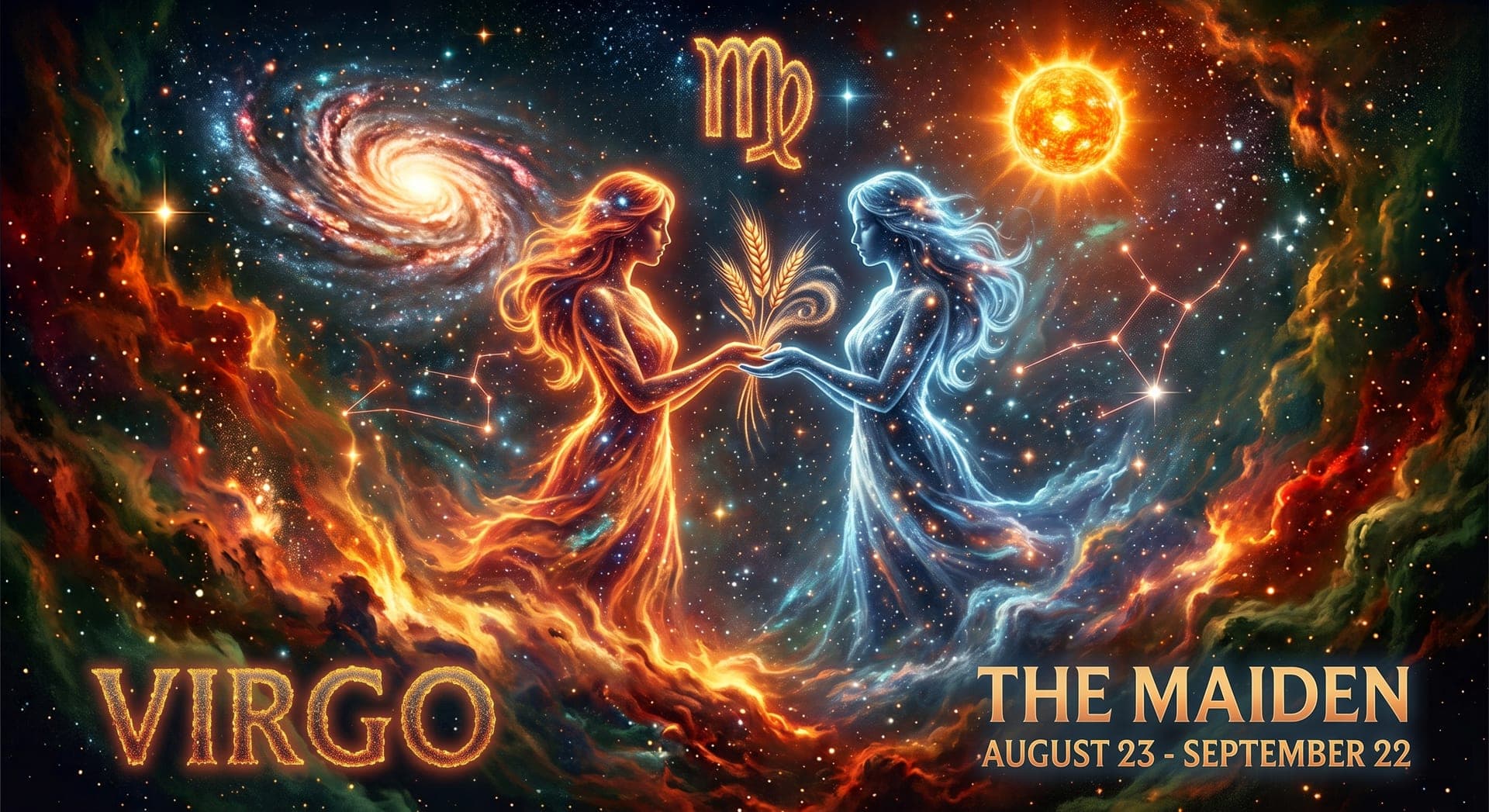
Virgo, the sixth sign of the zodiac, spans August 23 to September 22 and is symbolized by the maiden, often depicted holding a sheaf of wheat, representing purity, meticulous care, and the harvest. Ruled by Mercury, the planet of communication and intellect, Virgo channels its mental energy toward precision, analysis, and practical problem-solving rather than idle chatter. As an Earth sign, Virgo is grounded and detail-oriented, finding genuine satisfaction in organizing, refining, and perfecting the world around it. Its Mutable modality gives Virgo an adaptable, service-oriented nature, often finding purpose in quietly helping others and improving systems rather than seeking the spotlight. People born under this sign are frequently drawn to work requiring precision, research, or care for others, from science and medicine to editing and organization. Virgo's high standards make it an excellent problem-solver and a reliable presence others can count on, though that same perfectionism can turn inward as self-criticism or outward as an exacting, sometimes overly critical, eye toward the people and world around it.
Personality Traits
Strengths
- Highly organized and detail-oriented
- Reliable and hardworking
- Analytical problem-solver
- Genuinely helpful to others
- Modest and unpretentious
Weaknesses
- Prone to overcritical perfectionism
- Tends to worry excessively
- Can be overly critical of others
- Reserved to the point of aloofness
- Struggles to relax
Compatible Signs
Fun Facts
- Virgo's maiden symbol is often associated with Astraea, the Greek goddess of justice and purity, said to have been the last immortal to live among humans.
- Virgo is the only zodiac sign represented by a female human figure.
- Virgo and Gemini share Mercury as their ruling planet, though Virgo channels the planet's communicative energy toward analysis and precision rather than pure talkativeness.
- Notable Virgos include Beyoncé, Michael Jackson, Mother Teresa, and Stephen King.
- Virgo season falls at the tail end of summer, a period traditionally associated with harvest, meticulous preparation, and gathering resources for the colder months ahead.
Born on September 1
- 1566
Edward Alleyn
English actor and founder of Dulwich College who was one of the leading tragedians of the Elizabethan stage
- 1875
Edgar Rice Burroughs
American novelist who created Tarzan
- 1877
Francis William Aston
English chemist awarded the Nobel Prize for inventing the mass spectrograph and discovering numerous isotopes
- 1896
A.C. Bhaktivedanta Swami Prabhupada
Indian spiritual teacher who founded the International Society for Krishna Consciousness
- 1898
Violet Carson
English actress and singer best remembered as Ena Sharples in the soap opera Coronation Street
- 1906
Eleanor Alice Burford (Jean Plaidy)
English author of prolific historical novels published under pen names including Jean Plaidy and Victoria Holt
- 1922
Yvonne De Carlo
Canadian-American actress known for "The Munsters"
- 1923
Rocky Marciano
American boxer and undefeated heavyweight champion
- 1931
Cecil Parkinson
English Conservative politician who served as a senior cabinet minister under Margaret Thatcher
- 1957
Gloria Estefan
Cuban-American singer-songwriter
- 1961
Jeremy Farrar
British physician and academic who directed the Wellcome Trust and became a leading voice during the COVID-19 pandemic
- 1967
Steve Pemberton
English actor and screenwriter known as a co-creator of the dark comedy series The League of Gentlemen
- 1976
Clare Connor
English cricketer and administrator who captained the national team before becoming the first female president of the MCC
- 1996
Zendaya
American actress and singer
- 1997
Jungkook
South Korean singer and member of BTS
On This Day in History
- 396 BCE
The Temple of Juno Regina on Rome's Aventine Hill is dedicated by Marcus Furius Camillus.
Roman general Marcus Furius Camillus vowed to build the temple during a military campaign against the neighboring Falisci, honoring Juno in her aspect as protector of women and the state. The temple stood on the Aventine Hill, one of Rome's seven hills traditionally associated with the common people, and remained an important religious site for centuries, later restored and rebuilt by subsequent emperors after suffering fire damage.
- 1532
Anne Boleyn is created Marquess of Pembroke by King Henry VIII in advance of their marriage.
Henry VIII bestowed the title on Anne Boleyn in her own right, an unusual honor for a woman at the time, granting her substantial income and lands independent of any husband. The elevation was widely understood as preparation for their eventual marriage, which followed within months once Henry's annulment from Catherine of Aragon was underway, setting in motion the English Reformation.
- 1532
Henry VIII creates Anne Boleyn Marquess of Pembroke in her own right at Windsor Castle.
The title was a highly unusual honor for a woman, granted independently rather than through marriage, and signaled Henry's determination to elevate Anne ahead of their eventual union. The ceremony, conducted with full heraldic pomp, was widely understood as preparation for making her queen. Within months Henry and Anne married secretly, setting in motion the break with Rome that created the Church of England.
- 1604
The Adi Granth, later known as the Guru Granth Sahib, is first installed as Sikhism's central holy scripture at Harmandir Sahib.
The scripture, a compilation of hymns and teachings from Sikh gurus and other saints, was compiled by the fifth Sikh guru, Guru Arjan, at Harmandir Sahib, now known as the Golden Temple, in Amritsar. Decades later, the tenth guru declared it the eternal and final guru of Sikhism, elevating the text itself to the role of spiritual leader for the faith, a status it retains today.
- 1644
The Marquess of Montrose leads Royalist forces to a decisive victory over the Covenanters at the Battle of Tippermuir near Perth, Scotland.
It was the opening battle of Montrose's remarkable campaign on behalf of Charles I during the Wars of the Three Kingdoms. Vastly outnumbered, his small Royalist army routed the Covenanter militia and captured Perth the following day. The victory launched a string of successes that made Montrose the most feared Royalist commander in Scotland before his eventual defeat and execution.
- 1645
A Scottish Covenanter army lifts its siege of the English city of Hereford after five weeks, retreating north.
The Covenanters had been besieging the Royalist-held city in support of Parliament during the English Civil War, but news of Montrose's victories in Scotland forced their withdrawal to defend home territory. Hereford's relief was a rare Royalist success that year, even as the wider war was turning decisively against the King following his defeat at Naseby that June.
- 1715
Louis XV becomes King of France at age five, succeeding his great-grandfather Louis XIV.
Louis XIV's death left the throne to his five-year-old great-grandson, since the king had outlived his own son and grandson during his remarkably long 72-year reign. A regency government led by Philippe II, Duke of Orleans, governed France during Louis XV's minority, a period marked by financial experimentation and political intrigue before the young king assumed full personal rule.
- 1859
The Carrington Event, the most intense geomagnetic storm in recorded history, begins.
Solar flares triggered auroras visible as far south as the Caribbean and caused telegraph systems across Europe and North America to spark, fail, or in some cases continue transmitting messages even after being disconnected from their power sources. Scientists study the Carrington Event today as a benchmark for the potential catastrophic impact a similarly powerful storm could have on modern satellite and electrical infrastructure.
- 1859
English astronomer Richard Carrington observes an intense solar flare that triggers the most powerful geomagnetic storm in recorded history.
Carrington was studying sunspots from his private observatory in Redhill, Surrey, when he witnessed a brilliant flash of light on the Sun's surface. The resulting storm lit up the night sky with auroras as far south as the Caribbean and set telegraph systems on fire across Europe and North America. It remains the benchmark event scientists use to gauge the risk of a modern solar superstorm.
- 1870
Prussian forces achieve a decisive victory over France at the Battle of Sedan.
Prussian forces under Field Marshal Helmuth von Moltke encircled and decisively defeated the French army near Sedan, capturing Emperor Napoleon III himself along with roughly 100,000 troops. The stunning defeat effectively ended the Second French Empire and led directly to the fall of Napoleon III's government, paving the way for the Third Republic and Germany's subsequent unification under Prussian leadership.
- 1870
Prussian and German forces crush the French army at the Battle of Sedan, capturing Emperor Napoleon III.
The catastrophic defeat effectively decided the Franco-Prussian War, triggering the collapse of the Second French Empire and the proclamation of a French republic days later. It also cleared the way for German unification under Prussian leadership, reshaping the balance of power in Europe and setting a pattern of Franco-German rivalry that would shape the continent for decades.
- 1878
Emma Nutt becomes the world's first female telephone operator, hired by Alexander Graham Bell's company.
Nutt was hired by the Boston Telephone Dispatch Company after earlier male operators proved impatient and occasionally rude with callers, whereas Nutt's calm, courteous demeanor proved far better suited to the job. Her successful hiring launched a broader shift toward employing women as telephone operators, a role that became closely associated with women in the workforce for much of the twentieth century.
- 1880
British and Indian forces under General Frederick Roberts decisively defeat Ayub Khan's army at the Battle of Kandahar, effectively ending the Second Anglo-Afghan War.
The victory came after Roberts led a punishing forced march of his relief column some 300 miles from Kabul to Kandahar in just twenty days. It avenged the earlier British defeat at Maiwand and secured British political objectives in Afghanistan without full annexation. Roberts's exploit made him one of the most celebrated generals of the Victorian era.
- 1923
The Great Kanto earthquake devastates Tokyo and Yokohama, killing roughly 105,000 people.
The magnitude 7.9 earthquake struck the Kanto region of Japan during the lunch hour, when many households had open cooking fires, triggering devastating fires that consumed large portions of both cities and significantly worsened the death toll. The disaster prompted major reforms in Japanese building codes and urban planning aimed at improving resilience against future major earthquakes.
- 1923
A magnitude 7.9 earthquake devastates the Tokyo-Yokohama region of Japan, killing an estimated 105,000 people.
The quake struck at lunchtime, toppling buildings and igniting fires that swept through densely packed wooden neighborhoods, causing the majority of the casualties. It remains one of the deadliest earthquakes in recorded history and prompted a substantial rebuilding of Tokyo's infrastructure. In the chaos that followed, rumors sparked violent attacks on ethnic Korean residents, killing thousands more.
- 1939
Germany invades Poland, marking the beginning of the European phase of World War II.
German forces launched a coordinated invasion of Poland from multiple directions, employing a rapid, mechanized style of warfare that came to be known as blitzkrieg. Britain and France declared war on Germany two days later in response, honoring their treaty commitments to Poland, formally beginning the European phase of a conflict that would eventually engulf much of the globe.
- 1939
Germany invades Poland, prompting Britain and France to prepare for war and marking the start of the Second World War in Europe.
The invasion followed months of German pressure over the Free City of Danzig and the Polish Corridor, backed by a secret Nazi-Soviet pact dividing Eastern Europe. Britain had guaranteed Polish independence that spring, and when Germany ignored an ultimatum to withdraw, Prime Minister Neville Chamberlain declared war two days later. The conflict would eventually draw in most of the world's nations.
- 1983
A Soviet fighter jet shoots down Korean Air Lines Flight 007 after it strays into Soviet airspace, killing all 269 people aboard.
The Boeing 747 had drifted far off its planned route from New York to Seoul, crossing sensitive Soviet military installations on Sakhalin Island. Soviet interceptors tracked the airliner for over two hours before firing, apparently believing it to be a spy plane. The killing of dozens of passengers, including a sitting US congressman, caused international outrage and further chilled Cold War relations.
- 1985
Robert Ballard and Jean-Louis Michel lead the expedition that discovers the wreck of the Titanic.
Using a combination of sonar imaging and a remotely operated submersible vehicle, the joint American-French expedition located the wreck of the RMS Titanic roughly 12,500 feet below the surface of the North Atlantic, more than 70 years after the ship sank. The discovery reignited enormous public fascination with the disaster and led to extensive subsequent archaeological study of the wreck site.
- 1985
A joint American-French expedition led by Robert Ballard locates the wreck of RMS Titanic on the floor of the North Atlantic.
The British-registered liner, built in Belfast for the White Star Line, had sunk in 1912 after striking an iceberg, killing more than 1,500 people. Ballard's team found the wreck roughly 370 miles off Newfoundland, split in two and resting nearly 4,000 metres down, using a submersible partly developed for a classified US Navy mission. The discovery revived global fascination with the disaster.