
What’s Observed on August 31
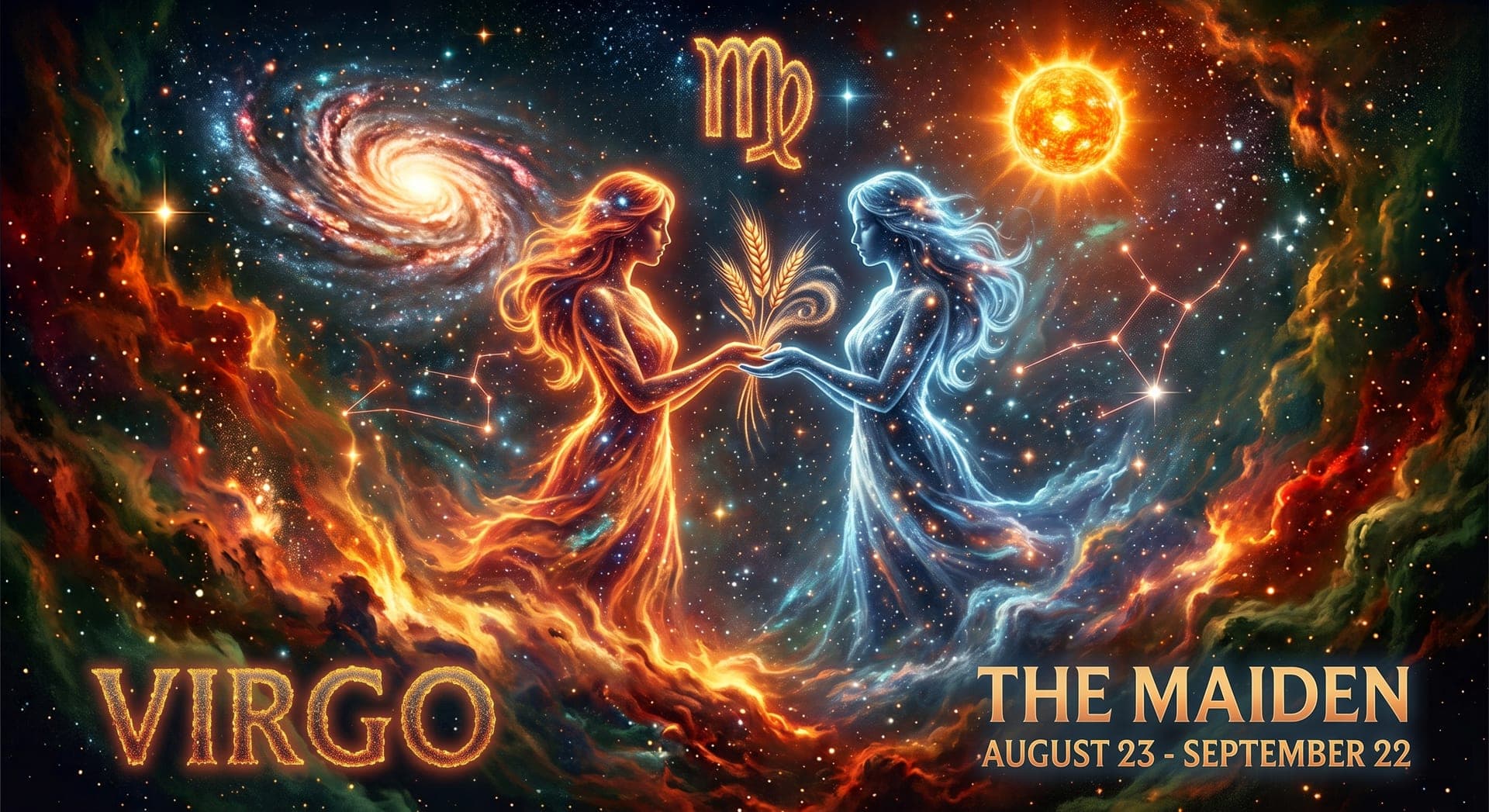
Born on August 31: Virgo ♍
Virgo, the sixth sign of the zodiac, spans August 23 to September 22 and is symbolized by the maiden, often depicted holding a sheaf of wheat, representing purity, meticulous care, and the harvest. Ruled by Mercury, the planet of communication and intellect, Virgo channels its mental energy toward precision, analysis, and practical problem-solving rather than idle chatter. As an Earth sign, Virgo is grounded and detail-oriented, finding genuine satisfaction in organizing, refining, and perfecting the world around it. Its Mutable modality gives Virgo an adaptable, service-oriented nature, often finding purpose in quietly helping others and improving systems rather than seeking the spotlight. People born under this sign are frequently drawn to work requiring precision, research, or care for others, from science and medicine to editing and organization. Virgo's high standards make it an excellent problem-solver and a reliable presence others can count on, though that same perfectionism can turn inward as self-criticism or outward as an exacting, sometimes overly critical, eye toward the people and world around it.
Personality Traits
Strengths
- Highly organized and detail-oriented
- Reliable and hardworking
- Analytical problem-solver
- Genuinely helpful to others
- Modest and unpretentious
Weaknesses
- Prone to overcritical perfectionism
- Tends to worry excessively
- Can be overly critical of others
- Reserved to the point of aloofness
- Struggles to relax
Compatible Signs
Fun Facts
- Virgo's maiden symbol is often associated with Astraea, the Greek goddess of justice and purity, said to have been the last immortal to live among humans.
- Virgo is the only zodiac sign represented by a female human figure.
- Virgo and Gemini share Mercury as their ruling planet, though Virgo channels the planet's communicative energy toward analysis and precision rather than pure talkativeness.
- Notable Virgos include Beyoncé, Michael Jackson, Mother Teresa, and Stephen King.
- Virgo season falls at the tail end of summer, a period traditionally associated with harvest, meticulous preparation, and gathering resources for the colder months ahead.
Born on August 31
- 12
Caligula
Roman emperor
- 161
Commodus
Roman emperor
- 1870
Maria Montessori
Italian physician and educator who developed the Montessori method
- 1880
Wilhelmina of the Netherlands
Queen of the Netherlands
- 1897
Fredric March
American stage and film actor
- 1907
Ramon Magsaysay
7th President of the Philippines
- 1913
Bernard Lovell
English physicist and radio astronomer who founded the Jodrell Bank Observatory.
- 1921
Raymond Williams
Welsh cultural critic, novelist, and academic whose writing on culture and society shaped modern cultural studies.
- 1932
Roy Castle
English entertainer, tap dancer, and trumpeter best known for hosting the television show Record Breakers.
- 1945
Van Morrison
Northern Irish singer-songwriter known for hits such as 'Brown Eyed Girl' and the album Moondance.
- 1949
Richard Gere
American actor
- 1957
Glenn Tilbrook
English singer-songwriter and guitarist, co-founder of the pop band Squeeze.
- 1971
Kirstie Allsopp
English television presenter best known for co-hosting the property show Location, Location, Location.
- 1979
Simon Neil
Scottish singer-songwriter and guitarist, frontman of the rock band Biffy Clyro.
On This Day in History
- 1056
Byzantine Empress Theodora dies, ending the Macedonian dynasty's rule.
Empress Theodora, who had ruled the Byzantine Empire alongside and after several male relatives, died without an heir, bringing an end to the Macedonian dynasty that had governed Byzantium for close to two centuries of relative stability and cultural flourishing.
- 1218
Al-Kamil becomes sultan of the Ayyubid dynasty following his father's death.
Following the death of his father, al-Malik al-Kamil ascended as sultan of the Ayyubid dynasty founded by the famed Saladin, later negotiating a notable diplomatic peace treaty with Holy Roman Emperor Frederick II that temporarily restored Jerusalem to Christian control without warfare.
- 1422
King Henry V of England dies, and his nine-month-old son becomes King Henry VI.
King Henry V, the celebrated victor of Agincourt whose military campaigns had brought France to the brink of complete conquest, died unexpectedly of dysentery while still in his thirties, leaving his infant son to inherit thrones and conflicts far beyond the child's capacity to manage.
- 1422
King Henry V of England died of dysentery in France, leaving his nine-month-old son to inherit the throne as Henry VI.
Henry V had spent much of his reign campaigning in France, famously winning the Battle of Agincourt in 1415, and was on the verge of securing the French crown for his heirs under the Treaty of Troyes when illness struck him down at Vincennes. His infant son's accession as king of both England and, nominally, France ushered in a long royal minority that ultimately unravelled England's gains in the Hundred Years' War.
- 1795
British forces captured the port of Trincomalee in Ceylon from Dutch control during the War of the First Coalition.
With the Netherlands under French-allied revolutionary control, Britain moved to seize valuable Dutch colonial possessions before France could claim them. The capture of Trincomalee's strategic harbour on the island's east coast marked the beginning of British control over Ceylon, which would remain a British colony for the next 153 years.
- 1798
French and Irish rebel forces proclaimed the short-lived Republic of Connacht in western Ireland.
Established in Castlebar days after French general Jean Humbert's small expeditionary force routed British defenders there, the republic was modelled on revolutionary France and headed by Irish radical John Moore. It survived barely a fortnight before British reinforcements crushed the rebellion at the Battle of Ballinamuck in early September, ending one of the more dramatic episodes of the Irish Rebellion of 1798.
- 1813
Spanish forces repel a French attack at the Battle of San Marcial during the Peninsular War.
During the Peninsular War, Spanish forces successfully repelled a French assault near the town of San Marcial in northern Spain, a defensive victory that helped secure the Pyrenees frontier as Wellington's Allied forces pushed French troops back toward their own border.
- 1864
The Battle of Jonesborough begins near Atlanta, part of the campaign that leads to the city's fall.
As part of Union General William Tecumseh Sherman's broader campaign to encircle and capture the vital Confederate rail hub of Atlanta, Union forces engaged Confederate troops near Jonesborough, a battle that succeeded in cutting the last remaining railroad supply line into the city and directly precipitating its fall to Union forces just days later.
- 1888
The body of Mary Ann Nichols is discovered in London's Whitechapel district, the first canonical victim attributed to Jack the Ripper.
The body of 43-year-old Mary Ann Nichols was discovered in London's impoverished Whitechapel district with severe throat and abdominal wounds, marking the first of what became five widely accepted "canonical" murders attributed to an unidentified serial killer who taunted police and the press under the infamous pseudonym Jack the Ripper.
- 1888
Mary Ann Nichols was murdered in London's Whitechapel district, becoming the first confirmed victim of the killer known as Jack the Ripper.
Nichols's body was discovered in Buck's Row in the early hours of the morning, her throat cut and abdomen mutilated, marking the start of a series of unsolved murders that terrorised the East End over the following months. The case, never solved despite an intense police investigation, remains one of the most notorious unsolved crimes in British history.
- 1895
Ferdinand von Zeppelin patents his design for a navigable rigid airship.
German inventor and count Ferdinand von Zeppelin secured a patent for his design of a large, rigid-framed airship capable of controlled powered flight, a design that later led to the development of the famous Zeppelin passenger airships of the early twentieth century.
- 1907
Britain and Russia signed the Anglo-Russian Convention, dividing Persia into spheres of influence and easing decades of imperial rivalry.
The agreement also settled disputes over Afghanistan and Tibet, effectively ending the long strategic rivalry between the two empires in Central Asia known as the Great Game. By resolving these colonial disputes, the convention paved the way for the Triple Entente between Britain, Russia, and France, a grouping that would face Germany and its allies in the First World War.
- 1918
The Australian Corps, fighting within the British Fourth Army, captured the strategic heights of Mont Saint-Quentin during the Hundred Days Offensive.
Despite being heavily outnumbered, Australian troops under General John Monash stormed the fortified high ground overlooking the Somme near Péronne, in an assault later described by military historians as one of the finest feats of arms of the entire war. The victory helped force a broader German withdrawal and formed part of the sustained Allied advance that led to the armistice ten weeks later.
- 1939
Nazi Germany stages a false-flag attack on a German radio station at Gleiwitz, used as pretext for invading Poland the next day.
German forces staged a fabricated attack on a German radio station near the Polish border, dressing concentration camp prisoners in Polish uniforms and leaving their bodies as false evidence, using the incident as a pretext to justify Germany's invasion of Poland the following day.
- 1957
The Federation of Malaya gained independence from British colonial rule.
The transfer of sovereignty, proclaimed by Tunku Abdul Rahman, ended British control that had shaped the Malay Peninsula for over a century and followed years of negotiation as well as the long counter-insurgency campaign known as the Malayan Emergency. The federation later expanded in 1963 to form modern Malaysia, incorporating Singapore, Sabah, and Sarawak.
- 1962
Trinidad and Tobago gained independence from the United Kingdom.
The twin-island Caribbean nation, a British colony since the Napoleonic era, became a self-governing member of the Commonwealth after years of gradual constitutional reform led by Chief Minister Eric Williams. Trinidad and Tobago later became a republic in 1976 while retaining its Commonwealth membership.
- 1963
The British Crown Colony of North Borneo achieved self-government ahead of its planned incorporation into Malaysia.
North Borneo, on the island of Borneo, had been administered by Britain since the late nineteenth century, first through a chartered company and later as a crown colony. Its transition to self-rule paved the way for it to join the newly formed Federation of Malaysia weeks later, in September 1963, becoming the state of Sabah.
- 1997
Diana, Princess of Wales, dies in a car crash in Paris.
Diana, Princess of Wales, was fatally injured in a high-speed car crash in a Paris tunnel while being pursued by paparazzi photographers, an event that triggered an extraordinary global outpouring of public grief and renewed scrutiny of press intrusion into royal privacy.
- 1997
Diana, Princess of Wales, died in a car crash in Paris along with her companion Dodi Fayed and driver Henri Paul.
The car crashed in the Pont de l'Alma tunnel while being pursued by paparazzi photographers, in a tragedy that provoked an extraordinary outpouring of public grief across Britain and the world. Diana's death, and the royal family's initially muted public response to it, prompted a period of intense national reflection on the monarchy's relationship with the public.
- 2016
Brazil's President Dilma Rousseff is formally removed from office following an impeachment trial.
Following a lengthy impeachment process centered on allegations of fiscal mismanagement, Brazil's Senate voted to permanently remove President Dilma Rousseff from office, elevating her vice president to complete the remainder of the presidential term amid a deeply polarized political climate.