
What’s Observed on August 30
Born on August 30: Virgo ♍
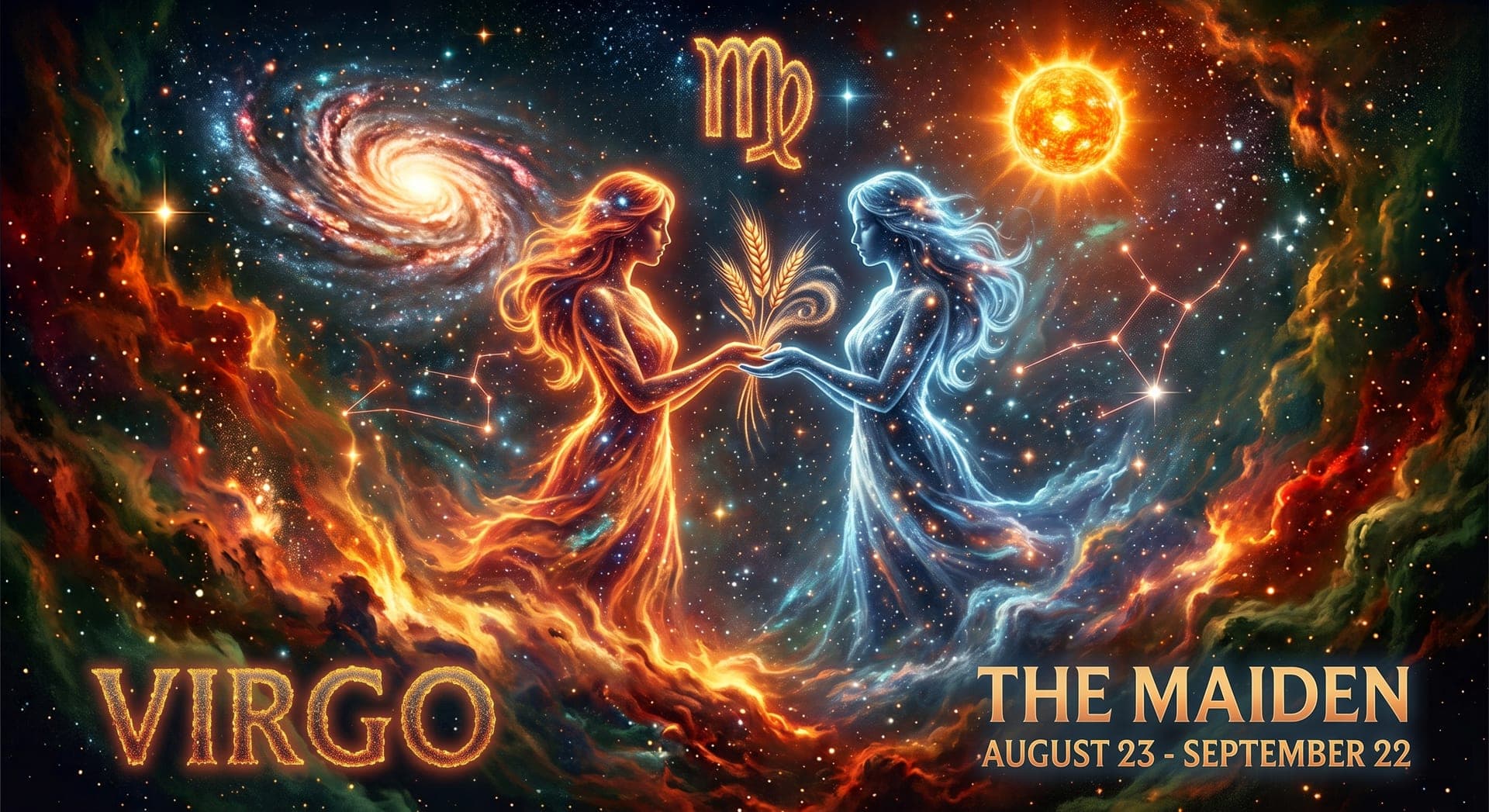
Virgo, the sixth sign of the zodiac, spans August 23 to September 22 and is symbolized by the maiden, often depicted holding a sheaf of wheat, representing purity, meticulous care, and the harvest. Ruled by Mercury, the planet of communication and intellect, Virgo channels its mental energy toward precision, analysis, and practical problem-solving rather than idle chatter. As an Earth sign, Virgo is grounded and detail-oriented, finding genuine satisfaction in organizing, refining, and perfecting the world around it. Its Mutable modality gives Virgo an adaptable, service-oriented nature, often finding purpose in quietly helping others and improving systems rather than seeking the spotlight. People born under this sign are frequently drawn to work requiring precision, research, or care for others, from science and medicine to editing and organization. Virgo's high standards make it an excellent problem-solver and a reliable presence others can count on, though that same perfectionism can turn inward as self-criticism or outward as an exacting, sometimes overly critical, eye toward the people and world around it.
Personality Traits
Strengths
- Highly organized and detail-oriented
- Reliable and hardworking
- Analytical problem-solver
- Genuinely helpful to others
- Modest and unpretentious
Weaknesses
- Prone to overcritical perfectionism
- Tends to worry excessively
- Can be overly critical of others
- Reserved to the point of aloofness
- Struggles to relax
Compatible Signs
Fun Facts
- Virgo's maiden symbol is often associated with Astraea, the Greek goddess of justice and purity, said to have been the last immortal to live among humans.
- Virgo is the only zodiac sign represented by a female human figure.
- Virgo and Gemini share Mercury as their ruling planet, though Virgo channels the planet's communicative energy toward analysis and precision rather than pure talkativeness.
- Notable Virgos include Beyoncé, Michael Jackson, Mother Teresa, and Stephen King.
- Virgo season falls at the tail end of summer, a period traditionally associated with harvest, meticulous preparation, and gathering resources for the colder months ahead.
Born on August 30
- 1716
Capability Brown
English landscape architect whose naturalistic garden designs transformed the grounds of countless British stately homes.
- 1797
Mary Shelley
English novelist best known for writing Frankenstein, a foundational work of science fiction.
- 1871
Ernest Rutherford
New Zealand-born British physicist known as the "father of nuclear physics" for discovering the atomic nucleus
- 1893
Huey Long
American politician who served as Governor of Louisiana
- 1910
Roger Bushell
South African-born Royal Air Force officer who masterminded the "Great Escape" from Stalag Luft III in 1944
- 1913
Richard Stone
English economist and Nobel laureate who pioneered the modern system of national income accounting.
- 1917
Denis Healey
English Labour politician who served as Chancellor of the Exchequer and Secretary of State for Defence.
- 1918
Ted Williams
American Major League Baseball player
- 1930
Warren Buffett
American investor and philanthropist
- 1939
John Peel
English radio broadcaster celebrated for championing new and alternative music during his decades on BBC Radio 1.
- 1942
Jonathan Aitken
British Conservative politician and former Cabinet minister who later became an Anglican priest, following a 1999 perjury conviction
- 1943
Jean-Claude Killy
French alpine skier
- 1950
Antony Gormley
English sculptor best known for the large-scale public work Angel of the North.
- 1958
Muriel Gray
Scottish broadcaster, journalist, and author known for her work in Scottish media and arts commentary.
- 1972
Cameron Diaz
American actress
- 1982
Andy Roddick
American tennis player
- 1992
Jessica Henwick
English actress known for roles in Game of Thrones and the Star Wars sequel trilogy.
On This Day in History
- 70
Roman general Titus ends the siege of Jerusalem after the destruction of the Second Temple.
Following a prolonged and brutal siege during the First Jewish-Roman War, Roman forces under the future emperor Titus finally breached Jerusalem's defenses and destroyed the Second Temple, an event of profound and lasting religious significance still solemnly commemorated in Jewish tradition on the fast day of Tisha B'Av.
- 1282
Peter III of Aragon lands at Trapani to join the War of the Sicilian Vespers.
During the ongoing War of the Sicilian Vespers, Peter III of Aragon landed with his forces at the Sicilian port of Trapani, intervening in the rebellion against French Angevin rule that had erupted following a popular uprising against oppressive Angevin governance.
- 1535
Pope Paul III issued a bull excommunicating King Henry VIII of England for enacting the Acts of Supremacy.
The bull, titled Eius qui immobilis, condemned Henry's break from Rome and his establishment of the Church of England with himself as its supreme head, following his divorce from Catherine of Aragon. Although historians believe the document was never actually published or formally promulgated, it symbolised the deepening rupture between England and the Catholic Church that defined the English Reformation.
- 1594
King James VI of Scotland staged an elaborate masque at Stirling Castle to celebrate the baptism of his infant son, Prince Henry.
The lavish entertainment, featuring an artificial ship and allegorical pageantry, was designed to project the wealth and sophistication of the Scottish court to visiting foreign dignitaries. Prince Henry Frederick, the infant being baptised, was heir to the Scottish throne and, after his father inherited the English crown in 1603, to the English throne as well, though he died young in 1612, before he could ever become king.
- 1721
The Treaty of Nystad ends the Great Northern War between Sweden and Russia.
Sweden and Russia formally concluded their prolonged Great Northern War through the Treaty of Nystad, with Sweden ceding significant Baltic territories to Russia, a settlement that confirmed Russia's emergence as the dominant power in the Baltic region and a major European empire.
- 1727
Anne, the eldest daughter of King George II of Great Britain, was created Princess Royal.
The title, an honorific traditionally bestowed on the eldest daughter of the reigning monarch, marked Anne's status within the royal family shortly after her father's accession to the throne. She later married William IV, Prince of Orange, becoming a key figure in Anglo-Dutch royal relations, and was one of the earliest women to hold the historic title still used by British princesses today.
- 1791
The Royal Navy frigate HMS Pandora sank after running aground on the Great Barrier Reef while hunting the Bounty mutineers.
Pandora had captured fourteen mutineers from HMS Bounty and was returning them to England for trial when it struck the reef and began taking on water. Several of the shackled prisoners drowned in the ship's hold along with a number of crew before survivors made a perilous open-boat journey to Timor, echoing the earlier voyage of Bounty's own castaway captain, William Bligh.
- 1799
British forces under Sir Ralph Abercromby and Admiral Sir Charles Mitchell captured an entire Dutch fleet without a fight during the Anglo-Russian invasion of Holland.
In what became known as the Vlieter Incident, the Batavian Republic's fleet, anchored at the Vlieter roadstead, surrendered to the approaching British squadron after its crews refused to fight for the pro-French government. The bloodless capture handed Britain a dozen warships and dealt a significant blow to Dutch and French naval power during the War of the Second Coalition.
- 1835
The city of Melbourne is founded in what becomes the Australian state of Victoria.
British colonial surveyor Robert Hoddle laid out the settlement that became Melbourne along the banks of the Yarra River, following earlier unauthorized settlement by pastoralists from Tasmania seeking new grazing land. The city rapidly grew to become one of Australia's largest and most economically significant urban centers, particularly after the discovery of gold in the surrounding region.
- 1914
German forces defeat the Russian army at the Battle of Tannenberg during World War I.
German forces under generals Hindenburg and Ludendorff decisively defeated a numerically superior Russian army at Tannenberg in East Prussia, a stunning early victory on the Eastern Front that effectively crippled Russian offensive capability for the remainder of the war's opening phase.
- 1916
Ernest Shackleton completed the rescue of the 22 men he had left stranded on Elephant Island in Antarctica.
After his ship Endurance was crushed by pack ice, Shackleton had sailed an open boat over 800 miles to South Georgia for help, then made repeated attempts to return through the ice. Reaching the island aboard the Chilean tug Yelcho, he found all 22 of his men alive after more than four months of survival on the barren island, completing one of the most celebrated rescues in the history of polar exploration.
- 1936
The British ocean liner RMS Queen Mary captured the Blue Riband for the fastest transatlantic crossing.
On its return voyage from New York, the Cunard liner averaged over 30 knots to claim the unofficial prize, wresting the record from the French liner Normandie. The Queen Mary's achievement was a source of national pride during a period of fierce prestige competition among the great ocean liners, and it held the eastbound record for several years.
- 1942
The Battle of Alam el Halfa began as British Eighth Army forces halted a major Axis offensive in the Egyptian desert.
German and Italian forces under Field Marshal Erwin Rommel attempted to outflank British defensive lines, but General Bernard Montgomery's Eighth Army, forewarned by intelligence and well dug in, blunted the attack within days. The battle was Rommel's last major offensive in North Africa and a key confidence-building victory for Montgomery ahead of the decisive Second Battle of El Alamein two months later.
- 1945
General Douglas MacArthur arrives in Japan at Atsugi Air Base following the country's surrender.
General Douglas MacArthur landed at Atsugi Air Base near Tokyo to formally begin the Allied occupation of Japan following its surrender, overseeing the country's demilitarization, constitutional reform, and democratic reconstruction over the following several years as supreme commander of the Allied powers.
- 1945
The Japanese occupation of Hong Kong ended after nearly four years, as British authority was restored to the colony.
Japanese forces had seized Hong Kong from British defenders in December 1941 after a fierce eighteen-day battle, subjecting the colony to a harsh occupation. Following Japan's surrender, a British fleet under Rear Admiral Cecil Harcourt arrived to accept the Japanese surrender in the territory and re-establish British colonial administration, which continued for another half-century.
- 1945
Britain joined the United States, the Soviet Union, and France in establishing the Allied Control Council to jointly govern occupied Germany.
The council gave each of the four occupying powers, including Britain's zone covering north-western Germany, supreme authority over their respective areas while coordinating policy for the defeated country as a whole. Deepening Cold War divisions soon paralysed the body's joint decision-making, and it effectively collapsed in 1948, foreshadowing Germany's division into separate Western and Soviet-aligned states.
- 1967
Thurgood Marshall is confirmed as the first African American justice of the U.S. Supreme Court.
Thurgood Marshall, who had previously argued the landmark Brown v. Board of Education case before the Supreme Court as a civil rights attorney, was confirmed by the Senate as the first African American to serve as a Supreme Court justice.
- 1983
Space Shuttle Challenger conducts the program's first night launch, carrying Guion Bluford, the first Black American astronaut in space.
Space Shuttle Challenger launched on the STS-8 mission, notable both as the first shuttle flight to launch and land at night and for carrying mission specialist Guion Bluford, who became the first African American to travel into space, a significant milestone in the diversification of NASA's astronaut corps.
- 1991
Azerbaijan declares independence from the disintegrating Soviet Union.
As the Soviet Union rapidly disintegrated amid the political fallout from the failed August coup against Mikhail Gorbachev, Azerbaijan's Supreme Soviet formally declared independence, restoring the sovereignty the nation had briefly enjoyed decades earlier as a short-lived democratic republic before its forcible Soviet annexation in 1920.
- 2021
The final U.S. military personnel withdraw from Afghanistan, ending nearly two decades of American military involvement.
The final American military aircraft departed Kabul's airport just before a midnight deadline set by the withdrawal agreement, formally concluding nearly twenty years of continuous U.S. military presence in Afghanistan following the September 11 attacks and marking the definitive, chaotic end of America's longest sustained war.