What’s Observed on August 29
Born on August 29: Virgo ♍
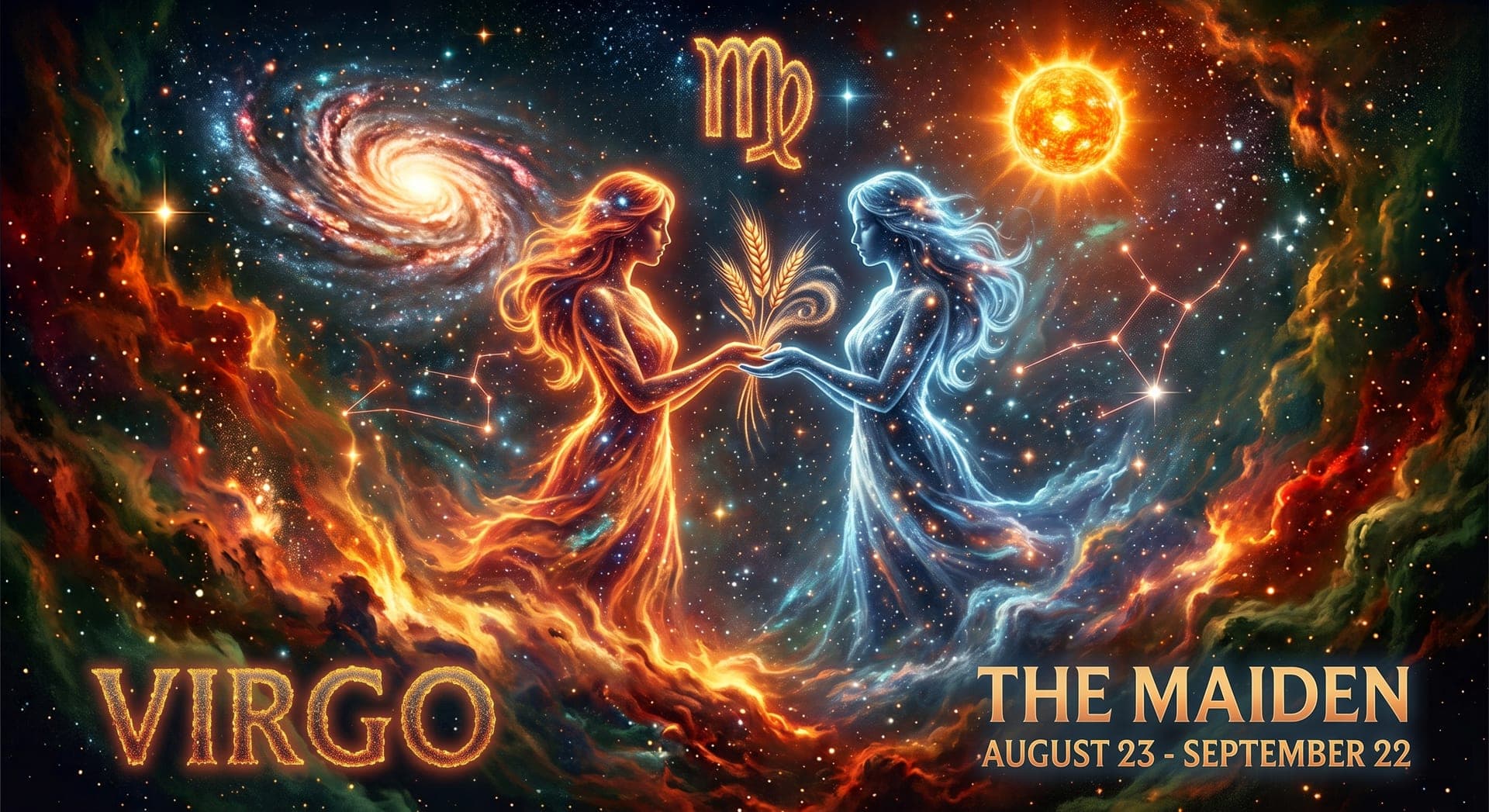
Virgo, the sixth sign of the zodiac, spans August 23 to September 22 and is symbolized by the maiden, often depicted holding a sheaf of wheat, representing purity, meticulous care, and the harvest. Ruled by Mercury, the planet of communication and intellect, Virgo channels its mental energy toward precision, analysis, and practical problem-solving rather than idle chatter. As an Earth sign, Virgo is grounded and detail-oriented, finding genuine satisfaction in organizing, refining, and perfecting the world around it. Its Mutable modality gives Virgo an adaptable, service-oriented nature, often finding purpose in quietly helping others and improving systems rather than seeking the spotlight. People born under this sign are frequently drawn to work requiring precision, research, or care for others, from science and medicine to editing and organization. Virgo's high standards make it an excellent problem-solver and a reliable presence others can count on, though that same perfectionism can turn inward as self-criticism or outward as an exacting, sometimes overly critical, eye toward the people and world around it.
Personality Traits
Strengths
- Highly organized and detail-oriented
- Reliable and hardworking
- Analytical problem-solver
- Genuinely helpful to others
- Modest and unpretentious
Weaknesses
- Prone to overcritical perfectionism
- Tends to worry excessively
- Can be overly critical of others
- Reserved to the point of aloofness
- Struggles to relax
Compatible Signs
Fun Facts
- Virgo's maiden symbol is often associated with Astraea, the Greek goddess of justice and purity, said to have been the last immortal to live among humans.
- Virgo is the only zodiac sign represented by a female human figure.
- Virgo and Gemini share Mercury as their ruling planet, though Virgo channels the planet's communicative energy toward analysis and precision rather than pure talkativeness.
- Notable Virgos include Beyoncé, Michael Jackson, Mother Teresa, and Stephen King.
- Virgo season falls at the tail end of summer, a period traditionally associated with harvest, meticulous preparation, and gathering resources for the colder months ahead.
Born on August 29
- 1632
John Locke
English philosopher and physician whose ideas on natural rights and government profoundly shaped liberal political thought.
- 1780
Jean-Auguste-Dominique Ingres
French Neoclassical painter
- 1915
Ingrid Bergman
Swedish actress known for "Casablanca"
- 1920
Charlie Parker
American jazz saxophonist who pioneered bebop
- 1923
Richard Attenborough
English actor and film director who won two Academy Awards for directing Gandhi and later starred as John Hammond in Jurassic Park.
- 1947
James Hunt
English Formula One driver who won the 1976 World Championship and later became a popular BBC racing commentator.
- 1958
Michael Jackson
American singer known as the King of Pop
- 1958
Lenny Henry
English comedian, actor, and broadcaster known for his stand-up work and co-founding the charity Comic Relief.
- 1959
Stephen Wolfram
English physicist and computer scientist who created the Mathematica software system and the Wolfram Alpha computational engine.
- 1959
Eddi Reader
Scottish singer best known as the voice of Fairground Attraction's hit 'Perfect' and for a successful solo career.
- 1963
Elizabeth Fraser
Scottish singer known for her distinctive vocals as lead singer of the dream pop band Cocteau Twins.
- 1967
Neil Gorsuch
U.S. Supreme Court Associate Justice
- 1986
Lea Michele
American actress and singer
- 1993
Liam Payne
English singer who rose to fame as a member of the boy band One Direction.

On This Day in History
- 1261
Jacques Pantaleon is elected pope, taking the name Urban IV.
Following the death of Pope Alexander IV, cardinals elected Jacques Pantaleon, a former patriarch of Jerusalem with extensive diplomatic experience, who took the papal name Urban IV and went on to establish the Feast of Corpus Christi as a major liturgical celebration.
- 1315
The Republic of Pisa achieves a decisive victory despite being outnumbered at the Battle of Montecatini.
Despite being significantly outnumbered by a coalition of Florentine, Neapolitan, and papal forces, troops from the Republic of Pisa achieved a surprising and decisive victory at Montecatini, temporarily reversing Pisa's declining fortunes in its ongoing struggles against rival Tuscan city-states.
- 1350
King Edward III personally led an English fleet to victory over a Castilian fleet in the Battle of Winchelsea, off the south coast of England.
Also known as 'Les Espagnols sur Mer,' the battle saw Edward III's ships engage and capture or sink a squadron of Castilian vessels that had been raiding English shipping in the Channel. The king and his sons, including the future Black Prince, fought aboard the English ships, and the victory affirmed English naval strength during the Hundred Years' War.
- 1475
The Hundred Years' War effectively concludes with the Treaty of Picquigny between France and England.
After decades of intermittent warfare, France and England formally concluded the Hundred Years' War-era conflict through the Treaty of Picquigny, with French King Louis XI agreeing to substantial annual payments to English King Edward IV in exchange for English withdrawal from French territorial claims.
- 1475
England and France signed the Treaty of Picquigny, effectively ending the Hundred Years' War.
Under the treaty, King Edward IV of England agreed to withdraw his invading army from France in exchange for a large cash payment and an annual pension from King Louis XI. Although not a formal peace treaty and never ratified by either country's full council, the agreement brought an end to large-scale Anglo-French warfare that had persisted intermittently for well over a century.
- 1521
Ottoman forces capture Belgrade, extending Ottoman control deeper into the Balkans.
Ottoman forces under Suleiman the Magnificent captured the strategically vital Balkan fortress city of Nandorfehervar, known today as Belgrade, extending Ottoman control deeper into Central Europe and removing a key defensive barrier that had long protected the Kingdom of Hungary from further Ottoman expansion northward.
- 1588
Japanese ruler Toyotomi Hideyoshi enacts a sword-hunting edict disarming the peasantry to consolidate his power.
Japanese warlord and unifier Toyotomi Hideyoshi issued an edict prohibiting peasants and non-samurai classes from owning swords and other weapons, a measure intended to prevent local uprisings and firmly establish the rigid social distinction between the ruling samurai warrior class and the agricultural peasantry, a policy that shaped Japanese social structure for centuries.
- 1807
British forces under Sir Arthur Wellesley defeated Danish militia at the Battle of Køge near Copenhagen.
The engagement came during the Second Battle of Copenhagen, in which Britain moved to seize the Danish fleet before it could fall into Napoleon's hands. Wellesley's troops, greatly outnumbering and outclassing the hastily assembled Danish militia, secured the area around the capital and helped enable the successful British bombardment and capture of the Danish navy days later.
- 1831
Michael Faraday discovers electromagnetic induction, a foundational breakthrough in electrical engineering.
While conducting experiments with electromagnetic coils and a rotating magnet, English scientist Michael Faraday discovered that a changing magnetic field could induce an electric current in a nearby conductor, a foundational principle of electromagnetism that later enabled the development of electric generators, transformers, and motors essential to modern industrial civilization.
- 1831
English scientist Michael Faraday discovered electromagnetic induction, a foundational principle of electrical engineering.
Experimenting at the Royal Institution in London, Faraday found that a changing magnetic field could induce an electric current in a nearby conductor. The discovery underpinned the later invention of electric generators, transformers, and motors, and stands as one of the most significant contributions of British science to the modern world.
- 1842
The Treaty of Nanking ends the First Opium War between Britain and China.
Following Britain's decisive military victory in the First Opium War, China's Qing government was forced to accept humiliating terms including the cession of Hong Kong, the opening of several ports to British trade, and substantial financial indemnities, marking the beginning of a period of Western imperial encroachment.
- 1842
Britain and China signed the Treaty of Nanking, ending the First Opium War and ceding Hong Kong Island to Britain.
The treaty forced China to open five 'treaty ports' to British trade, pay a large indemnity, and cede Hong Kong in perpetuity, marking the start of what China would later call its 'century of humiliation.' It was the first of a series of unequal treaties that reshaped China's relations with Western powers and established Hong Kong as a British colony for the next century and a half.
- 1885
Gottlieb Daimler patents the world's first motorcycle powered by an internal combustion engine.
German engineer Gottlieb Daimler patented a wooden-framed vehicle powered by a compact, high-speed internal combustion engine of his own design, a machine now widely recognized by historians as the first true motorcycle. The innovation laid important technical groundwork for the subsequent rapid development of motorized personal transportation in the following decades.
- 1911
Canada's naval service was formally renamed the Royal Canadian Navy under a charter granted by King George V.
Established just a year earlier as the Naval Service of Canada, the fledgling fleet received its royal title as part of Canada's development as a self-governing dominion within the British Empire. The new Royal Canadian Navy went on to grow rapidly during the First and Second World Wars, becoming one of the largest Allied navies by the end of the latter conflict.
- 1918
The New Zealand Division, fighting as part of the British Empire's forces on the Western Front, captured the French town of Bapaume during the Hundred Days Offensive.
Advancing alongside British and Commonwealth units in the final Allied push of the First World War, New Zealand troops took the town that had changed hands repeatedly since 1914, including its earlier fall to British forces in 1917. The capture formed part of the broader collapse of German defences that led to the armistice just over two months later.
- 1930
The last 36 residents of St Kilda, a remote Scottish archipelago, were voluntarily evacuated at their own request.
Centuries of isolated life on the islands, roughly 40 miles off the Outer Hebrides, had become unsustainable after wartime disruption, emigration, and a series of poor harvests and deaths. The islanders were resettled on the Scottish mainland, and St Kilda, now a UNESCO World Heritage Site, remains one of the most poignant symbols of depopulation in Scottish history.
- 1950
British Commonwealth ground forces arrived in Korea to reinforce United Nations troops during the Korean War.
The arrival of the 27th British Commonwealth Brigade, drawing on British and other Commonwealth troops, bolstered hard-pressed American and South Korean forces defending the Pusan Perimeter against the North Korean invasion. British and Commonwealth units went on to serve throughout the war, suffering significant casualties in battles such as the Imjin River the following year.
- 1966
The Beatles perform their final scheduled concert before paying fans at Candlestick Park in San Francisco.
The Beatles performed what turned out to be their final concert before a paying general audience at Candlestick Park in San Francisco, after which the increasingly reclusive band focused exclusively on studio recording rather than the exhausting demands of touring.
- 2005
Hurricane Katrina devastates the U.S. Gulf Coast, killing well over a thousand people.
Hurricane Katrina made landfall along the U.S. Gulf Coast, causing catastrophic flooding in New Orleans after levee failures inundated most of the city, resulting in well over a thousand deaths and exposing significant failures in disaster preparedness and government response.
- 2012
The 2012 Summer Paralympic Games opened in London, the first city to host the Paralympics twice.
Following the widely praised Olympics weeks earlier, London's Paralympics drew record ticket sales and television audiences, helping transform British and global public attitudes toward disability sport. The Games featured over 4,200 athletes from more than 160 countries and were credited with leaving a significant legacy for disability rights and accessibility in the United Kingdom.