What’s Observed on September 8
Born on September 8: Virgo ♍
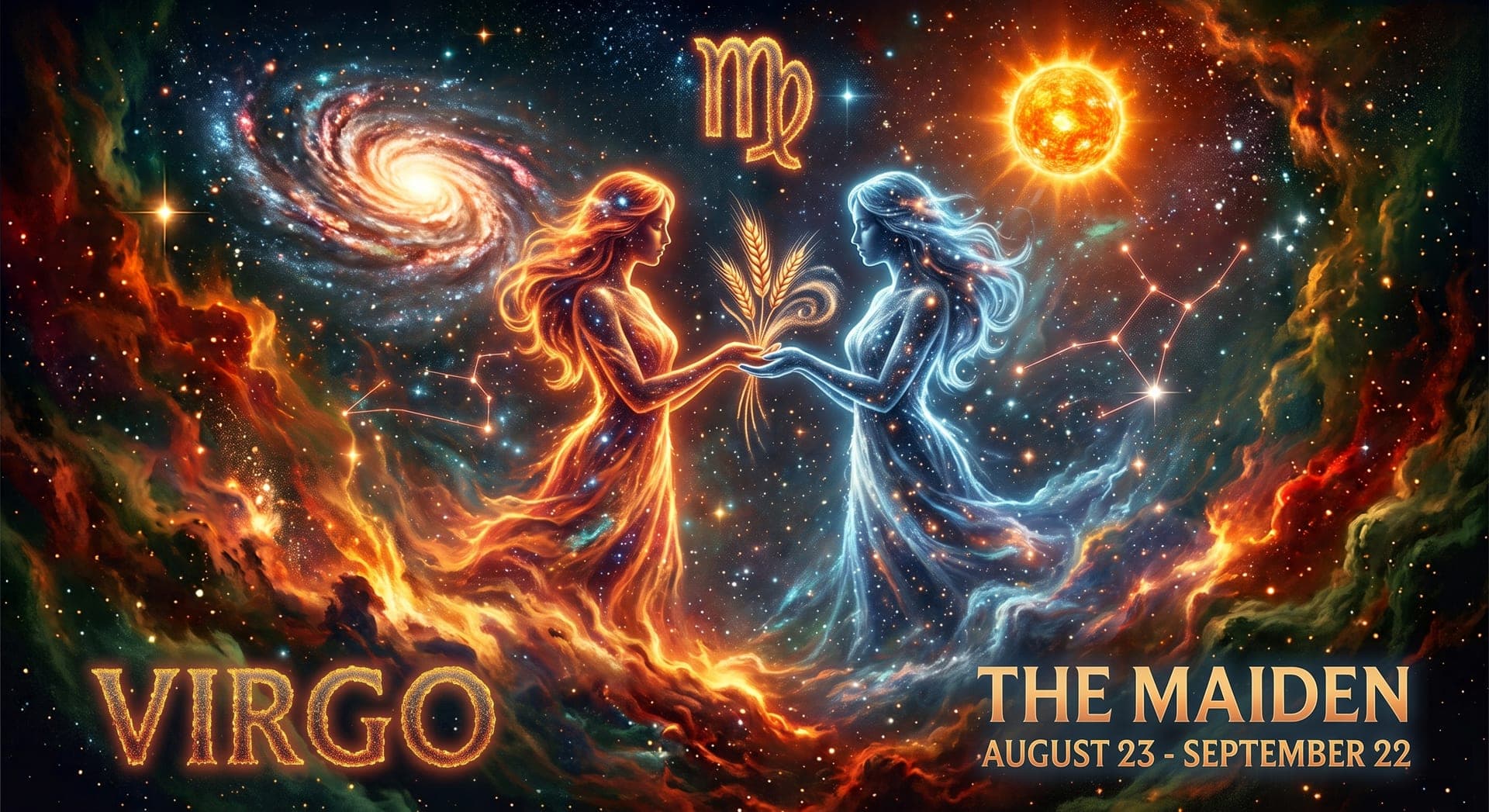
Virgo, the sixth sign of the zodiac, spans August 23 to September 22 and is symbolized by the maiden, often depicted holding a sheaf of wheat, representing purity, meticulous care, and the harvest. Ruled by Mercury, the planet of communication and intellect, Virgo channels its mental energy toward precision, analysis, and practical problem-solving rather than idle chatter. As an Earth sign, Virgo is grounded and detail-oriented, finding genuine satisfaction in organizing, refining, and perfecting the world around it. Its Mutable modality gives Virgo an adaptable, service-oriented nature, often finding purpose in quietly helping others and improving systems rather than seeking the spotlight. People born under this sign are frequently drawn to work requiring precision, research, or care for others, from science and medicine to editing and organization. Virgo's high standards make it an excellent problem-solver and a reliable presence others can count on, though that same perfectionism can turn inward as self-criticism or outward as an exacting, sometimes overly critical, eye toward the people and world around it.
Personality Traits
Strengths
- Highly organized and detail-oriented
- Reliable and hardworking
- Analytical problem-solver
- Genuinely helpful to others
- Modest and unpretentious
Weaknesses
- Prone to overcritical perfectionism
- Tends to worry excessively
- Can be overly critical of others
- Reserved to the point of aloofness
- Struggles to relax
Compatible Signs
Fun Facts
- Virgo's maiden symbol is often associated with Astraea, the Greek goddess of justice and purity, said to have been the last immortal to live among humans.
- Virgo is the only zodiac sign represented by a female human figure.
- Virgo and Gemini share Mercury as their ruling planet, though Virgo channels the planet's communicative energy toward analysis and precision rather than pure talkativeness.
- Notable Virgos include Beyoncé, Michael Jackson, Mother Teresa, and Stephen King.
- Virgo season falls at the tail end of summer, a period traditionally associated with harvest, meticulous preparation, and gathering resources for the colder months ahead.
Born on September 8
- 1157
Richard I of England
English king known as Richard the Lionheart, celebrated as a military leader of the Third Crusade
- 1462
Henry Medwall
English playwright regarded as the earliest known author of secular drama in the English language
- 1474
Ludovico Ariosto
Italian Renaissance poet
- 1742
Ozias Humphry
English painter noted for his portrait miniatures and pastel works in Georgian society
- 1830
Frederic Mistral
French poet and Nobel laureate in Literature
- 1841
Antonin Dvorak
Czech composer
- 1863
W. W. Jacobs
English author and short story writer best remembered for the horror classic The Monkey's Paw
- 1886
Siegfried Sassoon
English poet and army officer whose war poetry captured the horror and disillusionment of the First World War
- 1921
Harry Secombe
Welsh entertainer, singer and comedian known for The Goon Show and his later singing career
- 1925
Peter Sellers
English actor and comedian celebrated for his roles in The Pink Panther films and Dr. Strangelove
- 1932
Patsy Cline
American country music singer
- 1941
Bernie Sanders
American senator and presidential candidate
- 1971
Martin Freeman
English actor known for roles in The Office, The Hobbit trilogy, and Sherlock

On This Day in History
- 70
Roman forces under Titus secure and plunder Jerusalem following a prolonged siege.
After a grueling months-long siege during the First Jewish-Roman War, Roman legions under the command of the future emperor Titus breached Jerusalem's defenses, looting the city and destroying the Second Temple. The event remains one of the most significant in Jewish history, commemorated annually as a day of mourning on the fast of Tisha B'Av.
- 1504
Michelangelo's sculpture David is unveiled in Florence's Piazza della Signoria.
Standing over 17 feet tall and carved from a single block of marble, Michelangelo's depiction of the biblical hero David was unveiled to enormous public acclaim in Florence's main public square. The sculpture quickly became, and remains, one of the most celebrated masterpieces of Renaissance art and a powerful symbol of Florentine civic pride and republican ideals.
- 1565
Spanish admiral Pedro Menendez de Aviles founds St. Augustine, Florida.
Spanish admiral Pedro Menendez de Aviles established a settlement on Florida's Atlantic coast that developed into the city of St. Augustine, which remains the oldest continuously occupied European-established settlement in the continental United States, predating the English colony at Jamestown by more than four decades.
- 1727
A fire breaks out in a barn in Burwell, Cambridgeshire, England, during a puppet show, killing 78 people, many of them children.
The blaze started when a candle ignited straw piled near the barn's only exit, trapping much of the audience inside as the fire spread rapidly. It remains one of the deadliest fire disasters in English history and later prompted greater scrutiny of safety conditions at temporary public entertainment venues held in barns and other makeshift buildings across rural England.
- 1760
French forces surrender Montreal to the British during the French and Indian War.
Facing an overwhelming British and colonial force during the French and Indian War, French commander Pierre de Rigaud, Marquis de Vaudreuil, surrendered Montreal and effectively all of French Canada to the British, concluding major military operations in North America ahead of the broader Seven Years' War's formal end.
- 1760
French forces surrender Montreal to British troops, completing Britain's conquest of New France during the Seven Years' War.
The fall of Montreal followed the earlier capture of Quebec City and effectively ended French colonial rule in Canada. The territory was formally ceded to Britain under the 1763 Treaty of Paris, reshaping the map of North America and laying the foundation for the British colony that eventually became the Dominion of Canada.
- 1761
King George III of the United Kingdom marries Princess Charlotte of Mecklenburg-Strelitz at St James's Palace in London.
The couple met for the first time only hours before the ceremony, an arranged match typical of royal marriages of the era. Their union lasted 57 years and produced 15 children, making Charlotte one of the most prolific consorts in British royal history. She became a notable patron of the arts and sciences, including early botanical work at Kew Gardens.
- 1855
French forces capture Sevastopol during the Crimean War after storming the Malakoff fortification.
After a lengthy and costly siege, French forces successfully stormed the heavily fortified Malakoff redoubt, a decisive assault that led to the fall of Sevastopol, Russia's key Black Sea naval base, effectively ending major combat operations of the Crimean War. The war's brutal conditions, documented by journalists and nurses like Florence Nightingale, spurred significant military and medical reforms.
- 1883
The Northern Pacific Railway is completed with a ceremonial golden spike driven at Gold Creek, Montana.
Railroad officials drove a ceremonial golden spike to mark the completion of the Northern Pacific Railway's transcontinental line connecting the Great Lakes region to the Pacific Northwest, an engineering achievement that dramatically accelerated settlement and economic development across the northern United States.
- 1888
The world's first professional football league, the Football League, kicks off with its opening six matches in England.
Founded by Aston Villa director William McGregor, the twelve-club league introduced fixed fixtures and a standings table to a sport previously organised through informal challenge matches. It became the template copied by professional football leagues worldwide and remains the structural foundation of England's modern football pyramid to this day.
- 1888
The body of Annie Chapman, the second victim attributed to the unidentified killer known as Jack the Ripper, is discovered in London's Whitechapel district.
Her mutilated body was found in the backyard of a lodging house, deepening the public panic already stirred by the murder of Mary Ann Nichols just over a week earlier. The unsolved Whitechapel murders became one of history's most infamous crime sprees, reshaping Victorian-era policing methods and setting off a wave of sensationalist press coverage.
- 1892
The Pledge of Allegiance is publicly recited for the first time in the United States.
Written by Francis Bellamy for a children's magazine as part of a national public school celebration honoring Columbus, the pledge was first recited by schoolchildren across the country, though the specific wording has since been revised several times, including the addition of the phrase "under God" during the Cold War era.
- 1898
A Turkish mob kills around 700 Greek civilians along with 17 British guards and the British consul on the island of Crete.
Violence erupted amid unrest between Muslim and Christian communities as Crete moved toward autonomy from Ottoman rule. The killing of British troops, who were stationed on the island as part of an international peacekeeping force, provoked outrage in Britain and hastened international pressure that pushed Crete further along the path to self-government.
- 1900
A powerful hurricane devastates Galveston, Texas, killing an estimated 8,000 people in the deadliest natural disaster in U.S. history.
A massive hurricane made landfall at Galveston, Texas, then a major port city, with a storm surge that overwhelmed the low-lying barrier island and killed an estimated 8,000 people, making it the deadliest natural disaster in United States history. The catastrophe prompted the construction of a massive protective seawall and a significant raising of the city's elevation in subsequent years.
- 1914
Private Thomas Highgate becomes the first British soldier executed for desertion during the First World War.
An eighteen-year-old veteran of the retreat from Mons, Highgate was found hiding in a barn wearing civilian clothes and was court-martialled within days without any defence representation. His death was among more than 300 British and Commonwealth executions for military offences during the war, many of which are now widely regarded as gross miscarriages of justice.
- 1944
London is struck by a German V-2 rocket for the first time, the first ballistic missile ever used in warfare against a city.
The rocket exploded in Chiswick without warning, since it travelled faster than sound and arrived before any siren could sound. Over the following months more than a thousand V-2s struck Britain, killing thousands, as part of Hitler's campaign of "vengeance weapons" launched against London from occupied Europe in the war's final year.
- 1962
The Pines Express makes its final run over the Somerset and Dorset Railway, hauled by British Railways' last steam locomotive, Evening Star.
The line linking the Midlands to England's south coast was closed as part of sweeping cuts to Britain's rail network in the 1960s. The symbolism of the newly built Evening Star pulling the last train over the route was widely noted at the time, marking a practical milestone toward the end of mainline steam traction on British Railways.
- 1966
Star Trek premieres on American television with its first-aired episode, "The Man Trap."
Gene Roddenberry's science fiction series debuted on NBC, introducing audiences to the crew of the starship Enterprise and a hopeful, exploratory vision of humanity's future among the stars. Though initially modest in ratings and canceled after three seasons, Star Trek grew into a massive and enduring media franchise spanning films, spin-off series, and a devoted global fan culture.
- 2022
Queen Elizabeth II dies at Balmoral Castle after 70 years on the British throne; her son becomes King Charles III.
Britain's longest-reigning monarch died peacefully at her beloved Scottish estate at the age of 96, concluding a reign of exactly 70 years that had spanned fifteen prime ministers and enormous social change. Her eldest son immediately ascended the throne as King Charles III, and her death prompted an extraordinary outpouring of public mourning across the Commonwealth.
- 2022
Queen Elizabeth II of the United Kingdom dies at Balmoral Castle in Scotland after reigning for 70 years, the longest of any British monarch.
Her death at age 96 ended the second Elizabethan age, a reign that had spanned 15 prime ministers and vast social change since her accession in 1952. Her eldest son, Charles, Prince of Wales, immediately succeeded her as King Charles III, and the United Kingdom observed ten days of national mourning before her state funeral.