What’s Observed on September 17
Born on September 17: Virgo ♍
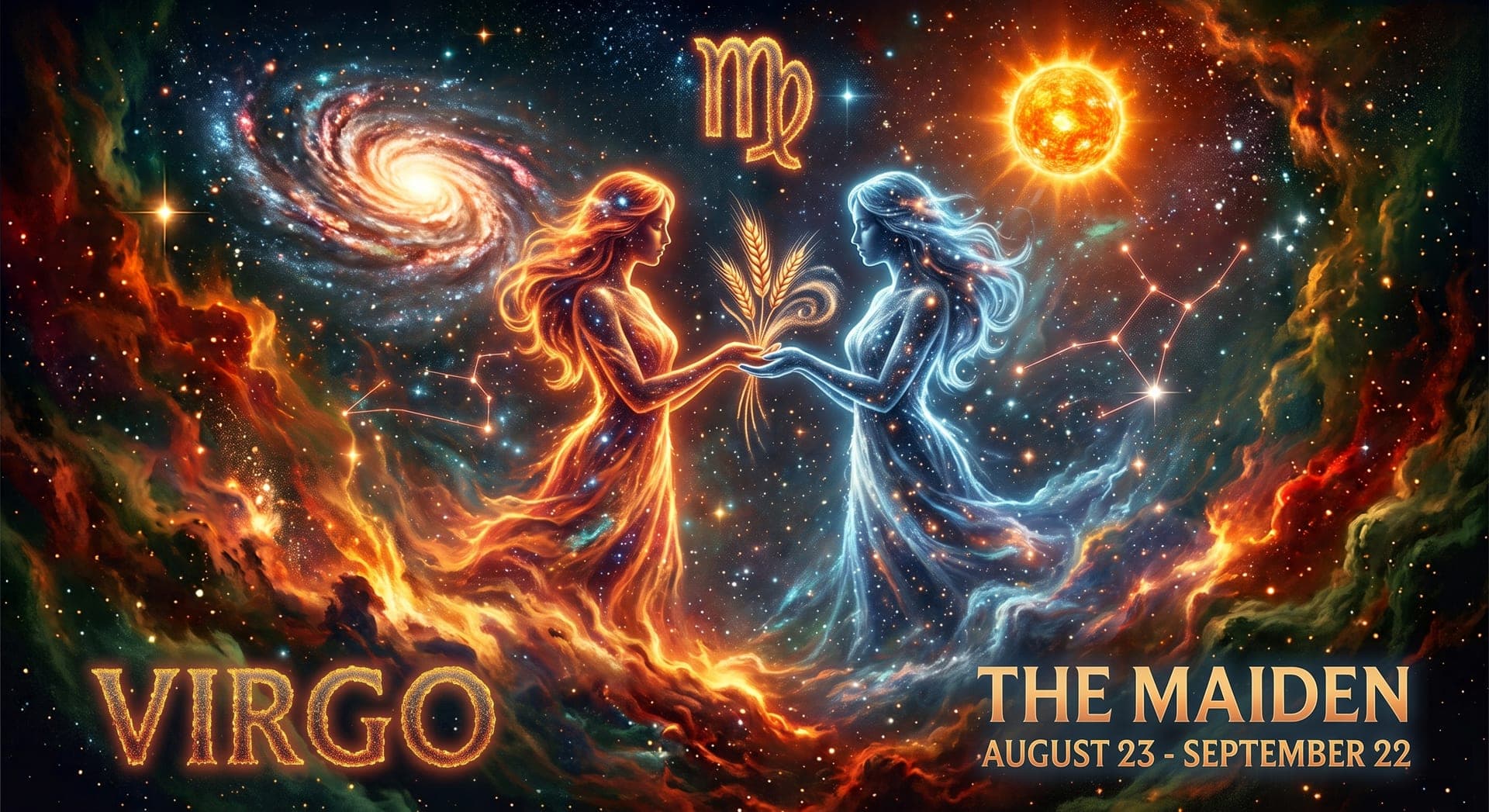
Virgo, the sixth sign of the zodiac, spans August 23 to September 22 and is symbolized by the maiden, often depicted holding a sheaf of wheat, representing purity, meticulous care, and the harvest. Ruled by Mercury, the planet of communication and intellect, Virgo channels its mental energy toward precision, analysis, and practical problem-solving rather than idle chatter. As an Earth sign, Virgo is grounded and detail-oriented, finding genuine satisfaction in organizing, refining, and perfecting the world around it. Its Mutable modality gives Virgo an adaptable, service-oriented nature, often finding purpose in quietly helping others and improving systems rather than seeking the spotlight. People born under this sign are frequently drawn to work requiring precision, research, or care for others, from science and medicine to editing and organization. Virgo's high standards make it an excellent problem-solver and a reliable presence others can count on, though that same perfectionism can turn inward as self-criticism or outward as an exacting, sometimes overly critical, eye toward the people and world around it.
Personality Traits
Strengths
- Highly organized and detail-oriented
- Reliable and hardworking
- Analytical problem-solver
- Genuinely helpful to others
- Modest and unpretentious
Weaknesses
- Prone to overcritical perfectionism
- Tends to worry excessively
- Can be overly critical of others
- Reserved to the point of aloofness
- Struggles to relax
Compatible Signs
Fun Facts
- Virgo's maiden symbol is often associated with Astraea, the Greek goddess of justice and purity, said to have been the last immortal to live among humans.
- Virgo is the only zodiac sign represented by a female human figure.
- Virgo and Gemini share Mercury as their ruling planet, though Virgo channels the planet's communicative energy toward analysis and precision rather than pure talkativeness.
- Notable Virgos include Beyoncé, Michael Jackson, Mother Teresa, and Stephen King.
- Virgo season falls at the tail end of summer, a period traditionally associated with harvest, meticulous preparation, and gathering resources for the colder months ahead.
Born on September 17
- 1857
Konstantin Tsiolkovsky
Russian rocket science pioneer
- 1859
Billy the Kid
American outlaw of the Old West
- 1883
William Carlos Williams
American modernist poet
- 1901
Francis Chichester
English yachtsman and aviator who became the first person to sail single-handedly around the world via the clipper route with only one stop
- 1907
Warren E. Burger
15th Chief Justice of the United States
- 1908
John Creasey
English crime writer, an extraordinarily prolific author of detective fiction published under many pseudonyms
- 1916
Mary Stewart
English novelist known for blending romance, suspense, and Arthurian legend in novels including The Crystal Cave
- 1920
Dinah Sheridan
English actress best remembered for her starring role in the film Genevieve
- 1923
Hank Williams
American country music singer-songwriter
- 1928
Roddy McDowall
English-American actor known for roles in Planet of the Apes and How Green Was My Valley
- 1929
Stirling Moss
English racing driver widely regarded as one of the greatest Formula One drivers never to win the world championship
- 1934
Maureen Connolly
American tennis champion
- 1935
Ken Kesey
American novelist known for "One Flew Over the Cuckoo's Nest"
- 1947
Tessa Jowell
English Labour politician who served as UK Culture Secretary and helped secure the 2012 London Olympics
- 1950
Narendra Modi
Prime Minister of India
- 1960
Damon Hill
English racing driver who won the Formula One World Championship in 1996

On This Day in History
- 1176
Seljuk Turks defeat Byzantine forces at the Battle of Myriokephalon, ending Byzantine hopes of recovering central Anatolia.
Byzantine Emperor Manuel I Komnenos led an army into Anatolia attempting to reassert control over former Byzantine territory but suffered a devastating ambush by Seljuk Turkish forces at Myriokephalon, a defeat that permanently ended meaningful Byzantine hopes of reclaiming the Anatolian heartland from Turkish control.
- 1462
Polish forces defeat the Teutonic Order at the Battle of Swiecino.
Polish and allied forces decisively defeated the Teutonic Order near the village of Swiecino in Pomerania during the Thirteen Years' War, a prolonged conflict fought over control of the Baltic coastal region. The defeat ultimately weakened the once-powerful crusading military order's territorial holdings and financial resources, contributing to Poland's eventual gains under the subsequent peace settlement that concluded the war.
- 1543
The Abckiria, the first book published in the Finnish language, is printed in Stockholm.
Bishop Mikael Agricola's translation of a basic primer combining the alphabet, prayers, and catechism became the first book ever printed in the Finnish language, a foundational milestone in establishing Finnish as a written literary language distinct from Swedish, the region's dominant administrative tongue.
- 1630
The city of Boston, Massachusetts, is founded by Puritan settlers.
Puritan colonists led by John Winthrop established a settlement on the Shawmut Peninsula that they named Boston, after a town in Lincolnshire, England, from which several early settlers had emigrated. The settlement rapidly grew into one of colonial America's most influential religious, intellectual, and commercial centers, later playing a central role in the events leading up to the American Revolution.
- 1683
Dutch scientist Antonie van Leeuwenhoek writes to the Royal Society of London describing the 'animalcules', microorganisms, he observed through his handmade microscopes.
Leeuwenhoek's meticulously ground lenses allowed him to see bacteria and protozoa for the first time in recorded history, though he lacked any formal scientific training. The Royal Society's decision to read, translate, and publish his letters gave his discoveries wide scientific credibility and helped establish the field that would become microbiology.
- 1787
Delegates to the Constitutional Convention sign the United States Constitution in Philadelphia.
After a demanding summer of debate and compromise among delegates representing the thirteen states, the Constitutional Convention concluded with 39 delegates signing the newly drafted United States Constitution in Philadelphia, establishing the fundamental framework of American federal government still in use today.
- 1787
Delegates to the Constitutional Convention sign the United States Constitution in Philadelphia, establishing the framework of American federal government.
The document, drafted over several months of secretive debate, replaced the weak Articles of Confederation with a stronger federal government built on separation of powers among executive, legislative, and judicial branches. After a contentious ratification process across the states, it took effect in 1789 and remains the world's oldest still-functioning written national constitution.
- 1862
The Battle of Antietam is fought in Maryland, remaining the bloodiest single day in American military history.
Union and Confederate forces clashed along Antietam Creek in Maryland in a single day of fighting that produced roughly 23,000 combined casualties, the bloodiest day in American military history, a costly tactical draw that nonetheless gave President Lincoln the political opening to issue the Emancipation Proclamation.
- 1862
Union and Confederate forces clash at the Battle of Antietam in Maryland, in what remains the bloodiest single day in American military history.
Roughly 23,000 soldiers were killed, wounded, or went missing in a single day of fighting near Sharpsburg, as Union forces under George McClellan halted Confederate General Robert E. Lee's first invasion of the North. Though tactically inconclusive, the battle gave President Abraham Lincoln the political opening to issue the preliminary Emancipation Proclamation days later, reshaping the purpose of the war.
- 1901
Boer commandos inflict a sharp defeat on British forces at the Battle of Blood River Poort during the Second Boer War.
A mounted Boer force led by Jan Smuts ambushed and overwhelmed a British column in the eastern Cape Colony, capturing prisoners, weapons, and supplies in one of the last significant Boer victories of the war. The engagement came during the guerrilla phase of the conflict, as British forces struggled to contain highly mobile Boer raiding columns.
- 1914
Following their defeat at the Marne, German and Allied armies, including the British Expeditionary Force, begin a series of outflanking maneuvers along the Western Front known as the Race to the Sea.
Neither side succeeded in outflanking the other as both extended their lines northward, and by mid-October the fighting had reached the Belgian coast, leaving a continuous line of trenches stretching from the English Channel to the Swiss border. The stalemate that resulted defined the static, grinding character of trench warfare for the rest of the First World War.
- 1920
The National Football League is organized in Canton, Ohio.
Representatives from several professional football clubs met in Canton, Ohio, to establish the American Professional Football Association, which was renamed the National Football League two years later, laying the foundation for what became the most-watched professional sports league in the United States.
- 1939
The Soviet Union invades Poland from the east, weeks after Germany's invasion from the west.
Fulfilling the secret provisions of the Molotov-Ribbentrop Pact signed with Germany weeks earlier, Soviet forces invaded Poland from the east, completing the country's partition between the two totalitarian powers and effectively eliminating Poland as an independent state for the remainder of the war.
- 1939
The German submarine U-29 torpedoes and sinks the Royal Navy aircraft carrier HMS Courageous in the Atlantic, killing more than 500 of her crew.
Courageous was on an anti-submarine patrol, a mission for which large aircraft carriers proved dangerously ill-suited, when she was struck while recovering aircraft. It was one of the first major Royal Navy losses of the Second World War and forced the Admiralty to withdraw its fleet carriers from such patrols for the remainder of the conflict.
- 1940
Adolf Hitler postpones Operation Sea Lion, Nazi Germany's planned invasion of Britain, after the Luftwaffe fails to defeat the Royal Air Force and establish air superiority.
The decision followed days of intense aerial combat over southern England, including the massive raids of Battle of Britain Day two days earlier, in which RAF Fighter Command inflicted heavy losses on German bombers and their escorts. Sea Lion was never carried out, and Britain's survival preserved a base from which the Allies would later launch the liberation of Western Europe.
- 1944
Allied airborne forces, including Britain's 1st Airborne Division, are dropped behind German lines in the Netherlands as Operation Market Garden begins.
The ambitious operation aimed to seize a chain of bridges culminating at Arnhem, opening a route into Germany's industrial heartland and potentially shortening the war. British paratroopers held out at Arnhem far longer than planned but were ultimately overwhelmed without relief, and the operation's failure, later dramatized as 'a bridge too far', became one of the war's costliest Allied setbacks.
- 1978
Israeli Prime Minister Menachem Begin and Egyptian President Anwar Sadat sign the Camp David Accords, brokered by US President Jimmy Carter.
Negotiated over thirteen days of secluded talks at the US presidential retreat, the accords laid the groundwork for the 1979 Egypt-Israel Peace Treaty, the first formal peace agreement between Israel and an Arab state. Sadat and Begin shared the Nobel Peace Prize for the breakthrough, though the deal drew fierce criticism from much of the Arab world and contributed to Sadat's assassination in 1981.
- 1980
The Polish trade union Solidarity is formally established following strikes at the Lenin Shipyard in Gdansk.
Following widespread strikes protesting economic conditions and demanding independent labor representation, the Solidarity trade union was formally established at the Lenin Shipyard in Gdansk, becoming the first independent labor union recognized within the Soviet-aligned Eastern Bloc and a major catalyst for the eventual collapse of Communist rule in Poland.
- 1991
Finnish student Linus Torvalds releases version 0.01 of Linux, the free operating system kernel that would grow into one of the most widely used pieces of software in the world.
Torvalds, a 21-year-old computer science student in Helsinki, initially developed the kernel as a personal project and hobby, posting it publicly and inviting other programmers to contribute. Linux went on to underpin everything from Android smartphones to the majority of the world's web servers and supercomputers, becoming one of the most successful examples of open-source collaborative software development.
- 2011
The Occupy Wall Street movement begins in Zuccotti Park, New York City.
Protesters against economic inequality and corporate influence in politics established an encampment in Manhattan's Zuccotti Park, launching the Occupy Wall Street movement, which popularized the phrase "We are the 99 percent" and inspired similar protest movements in cities around the world.