What’s Observed on September 15
Born on September 15: Virgo ♍
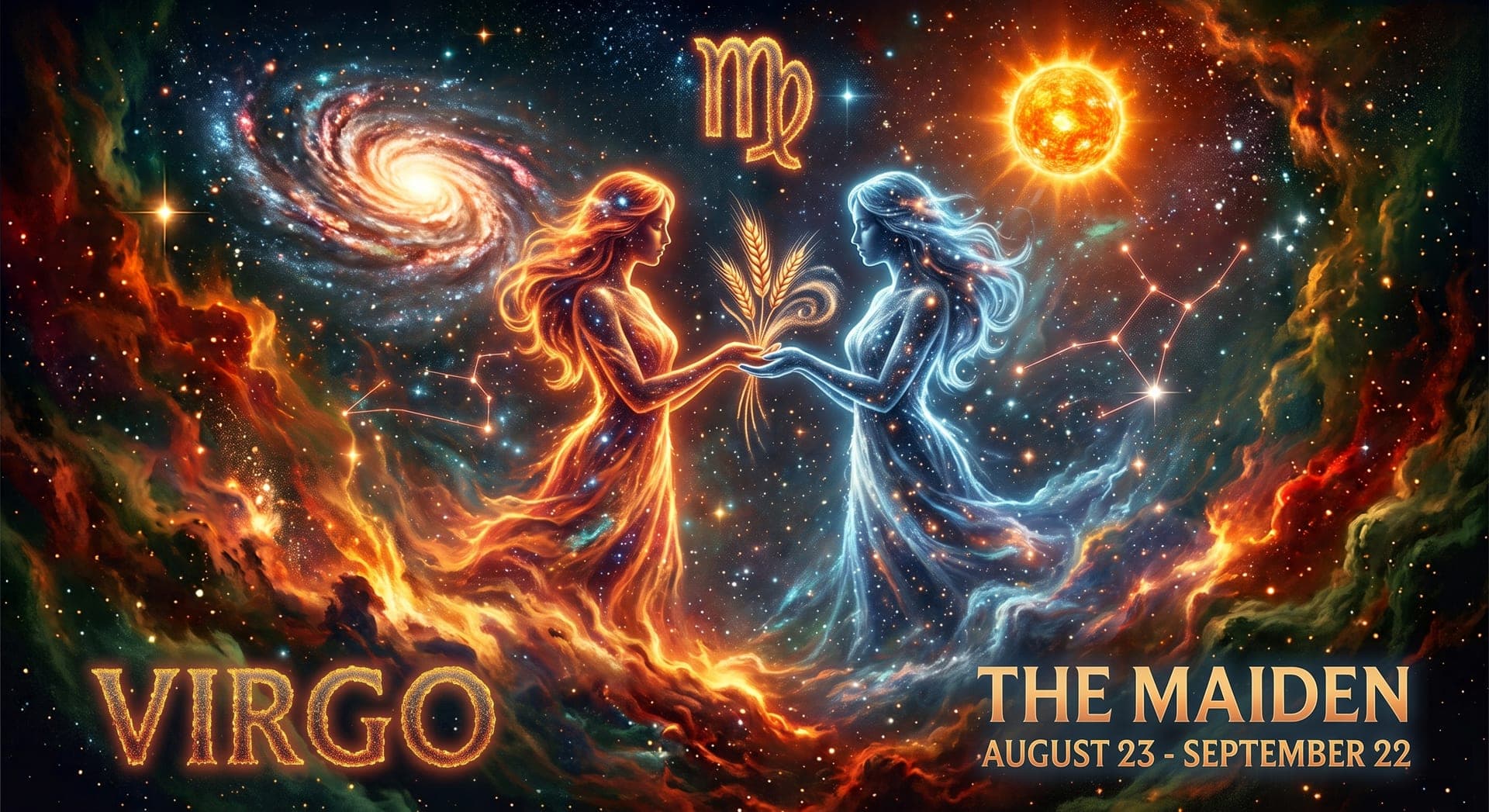
Virgo, the sixth sign of the zodiac, spans August 23 to September 22 and is symbolized by the maiden, often depicted holding a sheaf of wheat, representing purity, meticulous care, and the harvest. Ruled by Mercury, the planet of communication and intellect, Virgo channels its mental energy toward precision, analysis, and practical problem-solving rather than idle chatter. As an Earth sign, Virgo is grounded and detail-oriented, finding genuine satisfaction in organizing, refining, and perfecting the world around it. Its Mutable modality gives Virgo an adaptable, service-oriented nature, often finding purpose in quietly helping others and improving systems rather than seeking the spotlight. People born under this sign are frequently drawn to work requiring precision, research, or care for others, from science and medicine to editing and organization. Virgo's high standards make it an excellent problem-solver and a reliable presence others can count on, though that same perfectionism can turn inward as self-criticism or outward as an exacting, sometimes overly critical, eye toward the people and world around it.
Personality Traits
Strengths
- Highly organized and detail-oriented
- Reliable and hardworking
- Analytical problem-solver
- Genuinely helpful to others
- Modest and unpretentious
Weaknesses
- Prone to overcritical perfectionism
- Tends to worry excessively
- Can be overly critical of others
- Reserved to the point of aloofness
- Struggles to relax
Compatible Signs
Fun Facts
- Virgo's maiden symbol is often associated with Astraea, the Greek goddess of justice and purity, said to have been the last immortal to live among humans.
- Virgo is the only zodiac sign represented by a female human figure.
- Virgo and Gemini share Mercury as their ruling planet, though Virgo channels the planet's communicative energy toward analysis and precision rather than pure talkativeness.
- Notable Virgos include Beyoncé, Michael Jackson, Mother Teresa, and Stephen King.
- Virgo season falls at the tail end of summer, a period traditionally associated with harvest, meticulous preparation, and gathering resources for the colder months ahead.
Born on September 15
- 1254
Marco Polo
Italian merchant and explorer
- 1857
William Howard Taft
27th President of the United States
- 1890
Agatha Christie
English crime novelist and playwright whose detective creations Hercule Poirot and Miss Marple made her one of the best-selling authors in history
- 1894
Jean Renoir
French film director
- 1901
Donald Bailey
English engineer who invented the Bailey bridge, a portable prefabricated bridge that proved vital to Allied forces during the Second World War
- 1904
Umberto II of Italy
Last King of Italy
- 1907
Fay Wray
Canadian-American actress known for "King Kong"
- 1922
Mary Soames
English author and the youngest daughter of Winston Churchill, who wrote acclaimed biographies of her parents
- 1929
John Julius Norwich
English historian and travel writer best known for his sweeping histories of Venice and the Byzantine Empire
- 1944
Graham Taylor
English football manager who led Watford, Aston Villa, and the England national team
- 1972
Jimmy Carr
English stand-up comedian and television host known for his deadpan delivery and dark humor
- 1977
Tom Hardy
English actor known for roles in films including Bronson, Locke, and Mad Max: Fury Road
- 1984
Prince Harry, Duke of Sussex
British royal, younger son of King Charles III, known for his military service and charitable work through the Invictus Games
On This Day in History
- 1440
Gilles de Rais, a French nobleman and early documented serial killer, is arrested following accusations from a local bishop.
French nobleman and former companion of Joan of Arc, Gilles de Rais was arrested after a local bishop accused him of kidnapping, torturing, and murdering dozens of children on his estates, a case that culminated in his execution and remains one of history's most notorious documented cases of serial killing.
- 1556
Former Holy Roman Emperor Charles V departs the Netherlands to retire in Spain following his abdication.
Having formally abdicated his vast holdings in favor of his son Philip II and brother Ferdinand, the exhausted former emperor sailed from the Netherlands to Spain, where he spent his final years in a monastery, ending one of the largest personal empires in European history.
- 1776
British forces land at Kip's Bay in Manhattan, forcing a Continental Army withdrawal during the American Revolutionary War.
British warships landed troops at Kip's Bay on Manhattan's East River, catching American defenders by surprise and forcing General Washington's Continental Army to abandon New York City, a significant early setback in the war that nonetheless allowed the bulk of Washington's forces to escape northward.
- 1776
British forces under General William Howe land at Kip's Bay on Manhattan Island, routing American militia and opening the way for the British occupation of New York City.
A heavy naval bombardment preceded the landing, and the inexperienced American defenders fled in disorder despite General George Washington's furious efforts to rally them. The setback forced Washington to hastily retreat his main army northward up Manhattan, and New York City would remain under British control for the rest of the Revolutionary War.
- 1794
Arthur Wellesley, the future Duke of Wellington, sees his first combat action commanding British troops against French revolutionary forces at the Battle of Boxtel in the Netherlands.
As a young lieutenant colonel leading the 33rd Regiment of Foot during the Flanders Campaign, Wellesley helped cover the retreat of allied forces under pressure from a larger French army. Though a minor engagement in a largely unsuccessful campaign, it marked the start of the military career that would culminate two decades later in his defeat of Napoleon at Waterloo.
- 1795
British forces capture the Dutch Cape Colony at the southern tip of Africa, taking advantage of the Netherlands' occupation by revolutionary France.
The seizure gave Britain control of the strategically vital sea route around Africa to India, safeguarding trade and communications with its most valuable colonial possession. Although briefly returned to the Dutch in 1803, the colony was permanently retaken by Britain in 1806 and remained under British rule until South African independence over a century later.
- 1830
The Liverpool and Manchester Railway opens, and British MP William Huskisson becomes the first widely reported railway passenger fatality.
England's first inter-city passenger railway opened between Liverpool and Manchester, but the celebratory occasion turned tragic when prominent MP William Huskisson was struck and killed by an oncoming locomotive, becoming the first widely publicized railway fatality and a sobering reminder of the new technology's dangers.
- 1830
The Liverpool and Manchester Railway, the world's first inter-city railway to rely exclusively on steam locomotives, opens to the public.
Engineered by George Stephenson, the line proved that railways could profitably carry passengers as well as freight between major cities, launching the railway age in earnest. The opening ceremony was marred by tragedy when the sitting MP William Huskisson was struck and fatally injured by Stephenson's locomotive Rocket, becoming one of the first widely reported railway fatalities in history.
- 1835
HMS Beagle, with Charles Darwin aboard, reaches the Galapagos Islands.
The British survey ship HMS Beagle, carrying the young naturalist Charles Darwin, arrived at the remote volcanic Galapagos Islands, where Darwin's observations of the unique wildlife found there later proved crucial to his development of the theory of evolution by natural selection.
- 1835
The British survey ship HMS Beagle, carrying naturalist Charles Darwin, arrives at the Galapagos Islands.
Darwin spent about five weeks exploring the islands, collecting specimens and studying the distinct variations among finches, tortoises, and mockingbirds found on different islands within the archipelago. Those observations later proved central to the development of his theory of evolution by natural selection, published a quarter-century later in On the Origin of Species.
- 1862
Confederate forces capture Harpers Ferry, Virginia, during the Civil War's Maryland Campaign.
Confederate forces under Stonewall Jackson captured the federal arsenal town of Harpers Ferry along with over 12,000 Union soldiers during General Lee's first invasion of the North, a significant Confederate success that occurred just days before the pivotal Battle of Antietam.
- 1916
Tanks are used in battle for the first time, at the Battle of the Somme.
British forces deployed the newly developed tank in combat for the first time during the ongoing Battle of the Somme, an experimental armored vehicle intended to break the grinding stalemate of trench warfare, though early mechanical unreliability limited its immediate tactical impact.
- 1916
Tanks are used in combat for the first time, deployed by British forces during the Battle of the Somme in France.
Roughly four dozen Mark I tanks advanced alongside British infantry near Flers-Courcelette, and though mechanically unreliable and prone to breaking down, they achieved tactical surprise against German defenders. The experiment demonstrated the potential of armored vehicles to break the deadlock of trench warfare, permanently changing the future conduct of land warfare.
- 1940
The Luftwaffe launches its largest attack during the Battle of Britain, a day still commemorated as Battle of Britain Day.
The German Luftwaffe launched its largest and most concentrated bombing raid against London during the Battle of Britain, a decisive engagement in which the Royal Air Force inflicted heavy losses on the attacking force, a turning point now commemorated annually in Britain as Battle of Britain Day.
- 1940
RAF Fighter Command repels the Luftwaffe's largest daylight raids of the Battle of Britain, a decisive clash now commemorated annually as Battle of Britain Day.
German bombers targeting London were intercepted by British fighter squadrons in fierce dogfights that inflicted heavy losses on the Luftwaffe. The scale of the RAF's success convinced the German high command that air superiority over Britain could not be achieved, and within days Hitler indefinitely postponed Operation Sea Lion, the planned invasion of Britain.
- 1944
US President Franklin D. Roosevelt and British Prime Minister Winston Churchill meet in Quebec City for the second Quebec Conference to coordinate Allied wartime and postwar strategy.
The two leaders discussed plans for the final defeat of Germany, the continued war against Japan, and controversial proposals for the postwar treatment of a defeated Germany. The conference reinforced the close wartime partnership between Britain and the United States as the Allies pressed toward victory in Europe.
- 1950
U.S. forces land at Inchon during the Korean War, a turning point in the conflict.
General Douglas MacArthur orchestrated a daring amphibious landing behind North Korean lines at the port city of Inchon, a high-risk operation that succeeded in cutting off North Korean forces and dramatically reversing the momentum of the early Korean War in favor of United Nations forces.
- 2008
Lehman Brothers files for Chapter 11 bankruptcy, the largest bankruptcy filing in U.S. history and a defining moment of the global financial crisis.
The collapse of the major investment bank Lehman Brothers, unable to secure a bailout or buyer amid the unfolding subprime mortgage crisis, marked the largest bankruptcy filing in American history and triggered a severe worsening of the global financial crisis, plunging markets into turmoil worldwide.
- 2011
Four miners are killed when the drift mine they are working in floods at the Gleision Colliery in the Swansea Valley, Wales.
The men became trapped underground after an explosive charge apparently breached a wall into an adjacent, flooded section of the disused mine. It was one of the worst mining disasters in Wales in recent decades and prompted renewed scrutiny of safety standards and inspection regimes at small, privately operated drift mines.
- 2017
A homemade bomb partially detonates on a London Underground train at Parsons Green station, injuring dozens of commuters during the morning rush hour.
The device, concealed in a bucket, failed to fully explode, but the resulting fire and the panicked crush of passengers fleeing the train caused numerous injuries. An 18-year-old Iraqi-born asylum seeker was later convicted of attempted murder for planting the bomb, part of a wave of terrorist attacks that struck Britain during 2017.