What’s Observed on September 14
Born on September 14: Virgo ♍
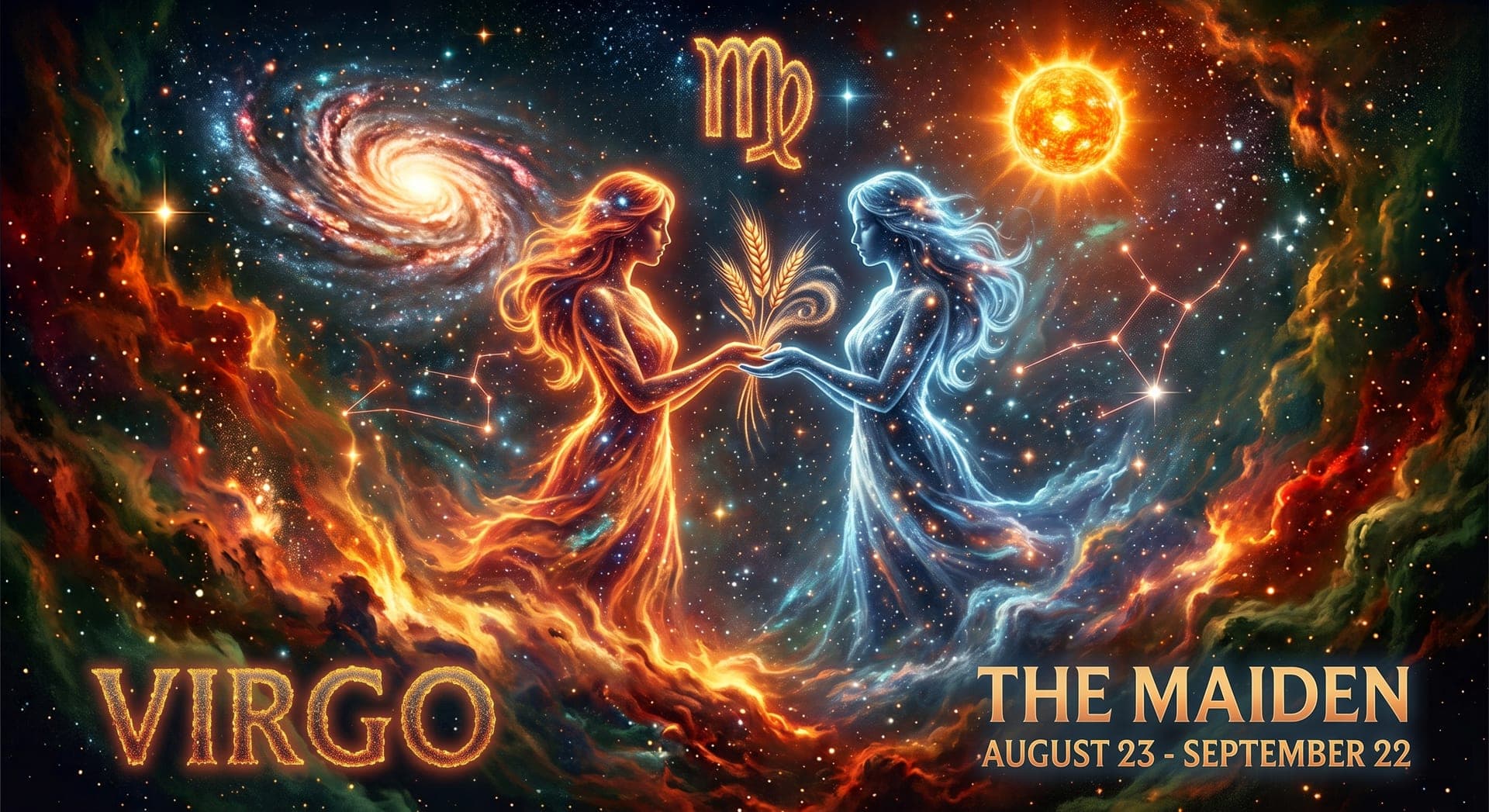
Virgo, the sixth sign of the zodiac, spans August 23 to September 22 and is symbolized by the maiden, often depicted holding a sheaf of wheat, representing purity, meticulous care, and the harvest. Ruled by Mercury, the planet of communication and intellect, Virgo channels its mental energy toward precision, analysis, and practical problem-solving rather than idle chatter. As an Earth sign, Virgo is grounded and detail-oriented, finding genuine satisfaction in organizing, refining, and perfecting the world around it. Its Mutable modality gives Virgo an adaptable, service-oriented nature, often finding purpose in quietly helping others and improving systems rather than seeking the spotlight. People born under this sign are frequently drawn to work requiring precision, research, or care for others, from science and medicine to editing and organization. Virgo's high standards make it an excellent problem-solver and a reliable presence others can count on, though that same perfectionism can turn inward as self-criticism or outward as an exacting, sometimes overly critical, eye toward the people and world around it.
Personality Traits
Strengths
- Highly organized and detail-oriented
- Reliable and hardworking
- Analytical problem-solver
- Genuinely helpful to others
- Modest and unpretentious
Weaknesses
- Prone to overcritical perfectionism
- Tends to worry excessively
- Can be overly critical of others
- Reserved to the point of aloofness
- Struggles to relax
Compatible Signs
Fun Facts
- Virgo's maiden symbol is often associated with Astraea, the Greek goddess of justice and purity, said to have been the last immortal to live among humans.
- Virgo is the only zodiac sign represented by a female human figure.
- Virgo and Gemini share Mercury as their ruling planet, though Virgo channels the planet's communicative energy toward analysis and precision rather than pure talkativeness.
- Notable Virgos include Beyoncé, Michael Jackson, Mother Teresa, and Stephen King.
- Virgo season falls at the tail end of summer, a period traditionally associated with harvest, meticulous preparation, and gathering resources for the colder months ahead.
Born on September 14
- 1736
Robert Raikes
English philanthropist and newspaper publisher who pioneered the Sunday school movement to educate working-class children
- 1769
Alexander von Humboldt
German naturalist and explorer
- 1804
John Gould
English ornithologist and illustrator renowned for his lavishly illustrated bird books, including studies of Charles Darwin's Galapagos finches
- 1864
Robert Cecil, 1st Viscount Cecil of Chelwood
English lawyer and statesman who helped establish the League of Nations and won the Nobel Peace Prize
- 1879
Margaret Sanger
American birth control activist
- 1886
Jan Masaryk
Czechoslovak diplomat and foreign minister
- 1909
Peter Scott
English ornithologist, artist, and conservationist who co-founded the World Wildlife Fund
- 1910
Jack Hawkins
English actor known for authoritative leading roles in films such as The Bridge on the River Kwai and Ben-Hur
- 1921
Constance Baker Motley
American civil rights lawyer and federal judge
- 1936
Terence Donovan
English photographer who helped define the look of 1960s fashion photography alongside contemporaries like David Bailey
- 1937
Renzo Piano
Italian architect who designed The Shard
- 1947
Sam Neill
New Zealand actor known for "Jurassic Park"
- 1956
Ray Wilkins
English footballer who captained Chelsea, Manchester United, and the England national team
- 1968
Grant Shapps
English Conservative politician who has held numerous UK cabinet posts, including Defence Secretary and Home Secretary
On This Day in History
- 81
Domitian becomes Roman emperor following the death of his brother Titus.
Following the sudden death of his elder brother Titus, Domitian assumed the imperial throne, going on to rule Rome for fifteen years with an increasingly autocratic and, according to many ancient sources, tyrannical style of governance that ultimately led to his assassination.
- 786
Harun al-Rashid becomes Abbasid caliph upon his brother's death, in an episode known as the Night of the Three Caliphs.
In a rapid and unusual succession, the Abbasid caliphate saw its throne pass through three different claimants within a single day following the death of Caliph al-Hadi, before Harun al-Rashid emerged as the recognized ruler, beginning a reign later celebrated as a golden age of Islamic civilization.
- 919
Irish High King Niall Glundub is killed fighting Viking forces at the Battle of Islandbridge.
Niall Glundub, High King of Ireland, was killed leading Irish forces against a Viking army near Dublin, a defeat that nonetheless became memorialized in Irish poetry and legend, with Niall's descendants later founding one of medieval Ireland's most prominent royal dynasties.
- 1115
Crusader forces under Roger of Salerno defeat a larger Seljuk army at the Battle of Sarmin.
Crusader forces led by Roger of Salerno, prince of Antioch, achieved an unexpected victory over a numerically superior Seljuk Turkish army near Sarmin in northern Syria, temporarily securing the Principality of Antioch's borders during the ongoing Crusader presence in the Levant.
- 1180
Minamoto no Yoritomo suffers defeat at the Battle of Ishibashiyama during Japan's Genpei War.
During Japan's chaotic Genpei War between rival samurai clans, Minamoto no Yoritomo suffered an early defeat at Ishibashiyama, forcing him to flee, though he later regrouped and ultimately triumphed, establishing the Kamakura shogunate that governed Japan for over a century.
- 1226
The Catholic practice of perpetual Eucharistic adoration formally begins in Avignon, France.
In Avignon, France, a continuous, unbroken tradition of Eucharistic adoration, the Catholic practice of venerating consecrated bread believed to be the body of Christ, formally began, a devotional practice that has continued in various forms and locations within the Church for centuries since.
- 1402
English forces led by Henry 'Hotspur' Percy and George Dunbar rout a Scottish raiding army under Archibald, Earl of Douglas, at the Battle of Homildon Hill in Northumberland.
English longbowmen decimated the Scottish ranks before close combat even began, killing several nobles and capturing Douglas and others for ransom. The battle, later dramatized in Shakespeare's Henry IV, Part 1, was followed by a bitter dispute between King Henry IV and the Percy family over the captured prisoners, contributing to the Percys' subsequent rebellion.
- 1682
Bishop Gore School in Swansea, one of the oldest schools in Wales, is founded under the will of Hugh Gore, former Bishop of Waterford and Lismore.
Gore, a Welsh-born clergyman who had spent much of his career in Ireland, left money in his will specifically to fund a free school for children in his home town. The school has operated continuously in various forms for over three centuries and remains one of Swansea's oldest educational institutions.
- 1752
Great Britain and its colonies officially switch from the Julian to the Gregorian calendar, with the day after September 2 becoming September 14.
The Calendar (New Style) Act 1750 corrected an eleven-day drift that had built up between Britain's old calendar and the Gregorian system already used across most of Catholic Europe since 1582. The abrupt jump caused public confusion and gave rise to a lasting, though largely apocryphal, legend of crowds rioting to demand 'give us our eleven days back.'
- 1763
Seneca warriors ambush a British army supply train and its military escort near Niagara Falls, killing most of the soldiers in what became known as the Devil's Hole Massacre.
The attack, part of Pontiac's War, destroyed a wagon train and wiped out two companies of British troops sent from Fort Niagara to relieve the survivors, who were themselves ambushed and largely killed. It was among the costliest defeats British forces suffered during the widespread Native American uprising against Britain's postwar policies in the Great Lakes region.
- 1901
President William McKinley dies from gunshot wounds inflicted eight days earlier, and Theodore Roosevelt succeeds him.
President McKinley succumbed to gangrene from gunshot wounds suffered over a week earlier, and Vice President Theodore Roosevelt was sworn in as his successor at just 42 years old, becoming the youngest president in American history and ushering in an era of progressive reform.
- 1901
US President William McKinley dies from gunshot wounds inflicted by an assassin eight days earlier, and Vice President Theodore Roosevelt is sworn in as his successor.
McKinley was shot by anarchist Leon Czolgosz while greeting the public at the Pan-American Exposition in Buffalo, New York. At 42, Roosevelt became the youngest president in American history, and his energetic, reform-minded administration reshaped the presidency and American foreign policy in the years that followed.
- 1960
The Organization of Petroleum Exporting Countries is established as an international coalition of oil-producing nations.
Representatives from Iran, Iraq, Kuwait, Saudi Arabia, and Venezuela met in Baghdad to establish an organization aimed at coordinating petroleum production policy and prices among major oil-exporting nations, a coalition that grew to wield enormous influence over global energy markets in subsequent decades.
- 1960
Representatives of Iran, Iraq, Kuwait, Saudi Arabia, and Venezuela meet in Baghdad to found the Organization of the Petroleum Exporting Countries, OPEC.
The organization was created to coordinate its members' petroleum policies and secure fairer prices from the Western oil companies that had long dominated the industry. OPEC's influence grew enormously over subsequent decades, most dramatically during the 1973 oil embargo, and it remains a major force in global energy markets today.
- 1975
Pope Paul VI canonizes Elizabeth Ann Seton, making her the first person born in the United States to be declared a saint by the Catholic Church.
Seton, a widow who converted to Catholicism and founded the Sisters of Charity of St. Joseph's in Emmitsburg, Maryland, established one of the first American religious congregations and helped pioneer the American parochial school system. Her canonization, decades after her death in 1821, was seen as a milestone for the Catholic Church in the United States.
- 1982
Lebanese president-elect Bachir Gemayel is assassinated before taking office.
Lebanon's Christian president-elect was killed when a bomb destroyed his political party's headquarters just weeks before he was due to take office, a killing that triggered a notorious massacre of Palestinian refugees by allied militias in the following days amid Lebanon's ongoing civil war.
- 2007
Customers of the British bank Northern Rock queue outside branches to withdraw their savings, in the first run on a UK bank in over 150 years.
Northern Rock's business model relied heavily on borrowing from wholesale money markets rather than customer deposits, leaving it exposed when those markets seized up during the early stages of the global credit crunch. Despite a government guarantee on deposits, panic continued, and the lender was nationalized in February 2008, becoming an early and visible symbol of Britain's banking crisis.
- 2015
The LIGO observatories in the United States make the first direct detection of gravitational waves, ripples in spacetime produced by the collision of two black holes over a billion years earlier.
The discovery, publicly announced in February 2016, confirmed a key prediction of Albert Einstein's general theory of relativity made a century earlier. It opened an entirely new way of observing the universe, launching the field of gravitational-wave astronomy and earning the LIGO project's founders the Nobel Prize in Physics.
- 2022
Queen Elizabeth II's coffin is ceremonially processed to Westminster Hall to begin her four-day lying in state.
Following her death at Balmoral Castle, Queen Elizabeth II's coffin was transported to London and processed through the streets to Westminster Hall, where it lay in state for four days, drawing enormous crowds of mourners who queued for many hours to pay their respects.
- 2022
The coffin of Queen Elizabeth II is carried in a solemn procession from Buckingham Palace to Westminster Hall, where it lies in state ahead of her funeral.
Enormous crowds lined the London streets to watch the cortege, which was followed by days in which members of the public queued for hours, at times overnight, to file past the coffin. The Queen had died at Balmoral Castle on 8 September 2022 after seventy years on the throne, the longest reign in British history.