
What’s Observed on July 20
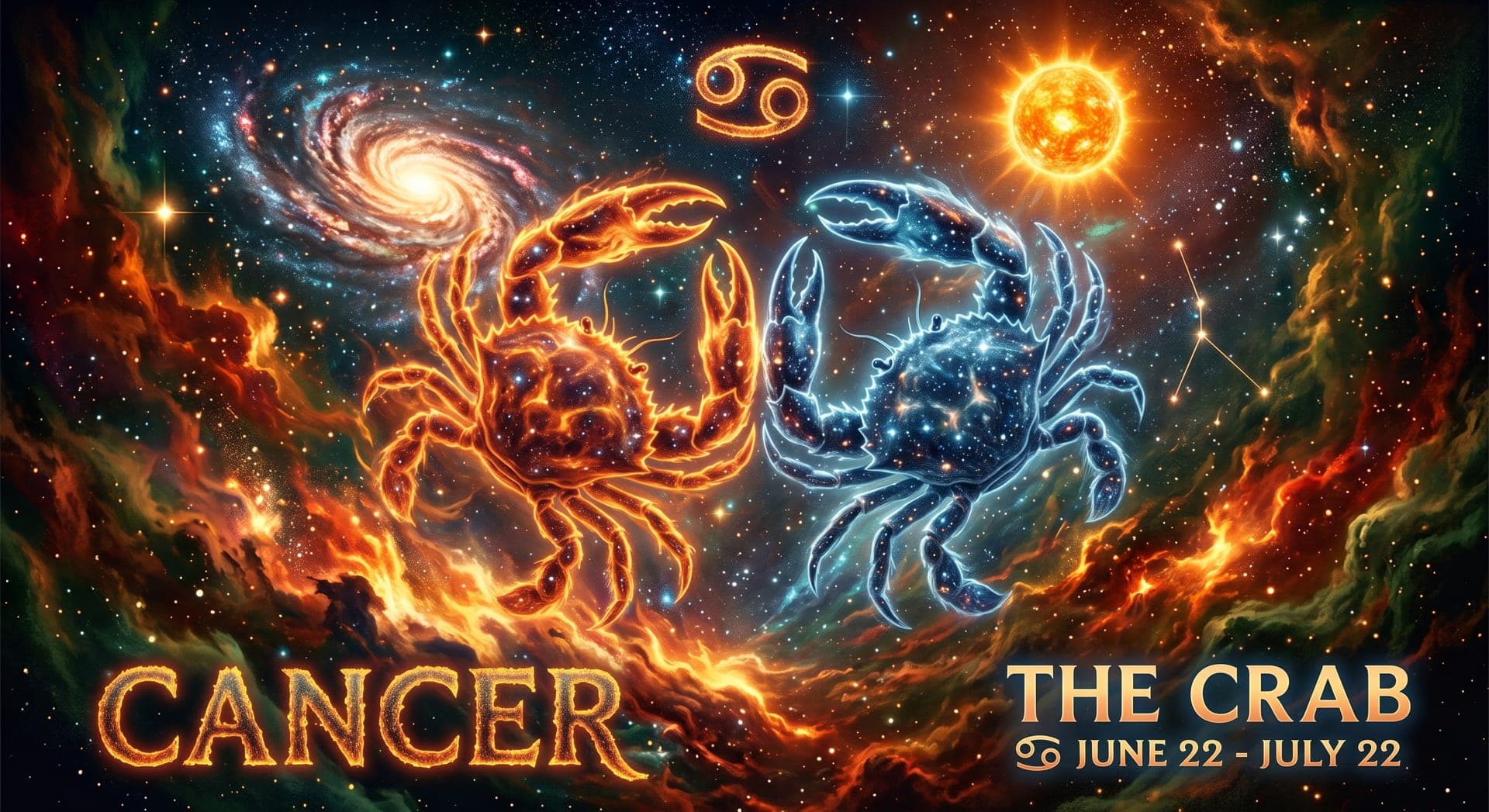
Born on July 20: Cancer ♋
Cancer, the fourth sign of the zodiac, spans June 21 to July 22 and is symbolized by the crab, an animal known for carrying a protective shell while remaining soft and vulnerable underneath. Ruled by the Moon, the celestial body long associated with emotion, intuition, and the subconscious, Cancer is widely regarded as one of the most nurturing and emotionally attuned signs of the zodiac. As a Water sign, Cancer navigates the world through deep feeling, often forming strong emotional bonds and an acute sensitivity to the moods of others. Its Cardinal modality places it at the start of summer, beginning right at the June solstice, reflecting an instinct to initiate and create, especially around home and family. People born under this sign tend to be deeply loyal, protective of loved ones, and drawn to creating a comfortable, secure home environment. Cancer's emotional depth is a genuine strength, but it can also make the sign prone to moodiness or withdrawal when hurt, retreating like a crab into its shell until it feels safe enough to re-emerge.
Personality Traits
Strengths
- Deeply caring and nurturing
- Highly intuitive
- Fiercely loyal and protective
- Strong sense of family and tradition
- Emotionally perceptive
Weaknesses
- Prone to moodiness
- Overly sensitive to criticism
- Can be clingy
- Tends to hold grudges
- Retreats when hurt
Compatible Signs
Fun Facts
- Cancer's crab symbol comes from Greek mythology, where the goddess Hera placed a crab that had fought Hercules among the stars.
- Cancer is ruled by the Moon, the only zodiac sign ruled by a celestial body other than a planet.
- As a Cardinal sign, Cancer initiates summer, beginning at the June solstice, the longest day of the year in the Northern Hemisphere.
- Notable Cancers include Princess Diana, Tom Hanks, Ariana Grande, and Nelson Mandela.
- The crab's hard shell and soft interior are often used as a metaphor for Cancer's protective exterior guarding a deeply sensitive emotional core.
Born on July 20
- 1304
Petrarch
Italian poet and Renaissance scholar
- 1804
Richard Owen
English biologist and paleontologist who coined the term 'Dinosauria' and helped establish the Natural History Museum in London.
- 1816
Sir William Bowman
English surgeon and histologist whose research on the kidney and eye identified the structure now known as Bowman's capsule.
- 1822
Gregor Mendel
Austrian monk and founder of modern genetics
- 1889
John Reith
Scottish broadcaster and the first Director-General of the BBC, whose vision shaped the ethos of British public service broadcasting.
- 1919
Edmund Hillary
New Zealand mountaineer, first to summit Mount Everest
- 1925
Jacques Delors
French politician and President of the European Commission
- 1933
Cormac McCarthy
American novelist
- 1938
Natalie Wood
American actress
- 1938
Roger Hunt
English footballer who scored twice in England's 1966 World Cup final victory and starred for Liverpool during the 1960s.
- 1938
Diana Rigg
English actress celebrated for playing Emma Peel in The Avengers and Olenna Tyrell in Game of Thrones.
- 1947
Carlos Santana
Mexican-American guitarist
- 1956
Paul Cook
English drummer for the punk rock band the Sex Pistols.
- 1987
Nicola Benedetti
Scottish violinist celebrated as one of the leading classical soloists of her generation.
- 1987
Niall McGinn
Northern Irish footballer known for his long international career as a winger for the Northern Ireland national team.

On This Day in History
- 1189
Richard I of England formally becomes Duke of Normandy.
Richard succeeded to the Duchy of Normandy following the death of his father, King Henry II of England, receiving the ducal investiture at Rouen weeks before his formal coronation as King of England that September. As Duke of Normandy, Richard inherited one of the wealthiest and most strategically important territories of the sprawling Angevin realm, which stretched from the British Isles to the Pyrenees.
- 1189
Richard I of England was formally invested as Duke of Normandy at Rouen.
Richard, soon to be crowned King of England following his father Henry II's death earlier that month, received the ducal ceremony confirming his authority over Normandy. The investiture reinforced the vast cross-Channel Angevin territories he was inheriting, which stretched from the Scottish borders to the Pyrenees. Richard was crowned King of England two months later, in September 1189, before departing on the Third Crusade.
- 1398
Roger Mortimer, 4th Earl of March and heir presumptive to the English throne, was killed fighting Irish forces led by Art Mór MacMurrough Kavanagh.
Mortimer, a great-grandson of Edward III and next in line to succeed the childless Richard II, died in a skirmish in County Carlow during renewed English efforts to subdue Gaelic resistance in Ireland. His death removed a major rival to the crown and destabilized the English succession, contributing to the political crisis that allowed Henry Bolingbroke to seize the throne as Henry IV the following year.
- 1807
Inventor Nicephore Niepce receives a patent from Napoleon for the Pyreolophore, an early internal combustion engine.
French inventor Nicephore Niepce secured official recognition for an early internal combustion engine design that used controlled dust explosions for propulsion, intended initially to power a boat. Though never widely adopted, the device represents one of the earliest documented attempts at internal combustion technology, predating more practical engines by decades.
- 1810
Citizens of Bogotá rose up against Spanish colonial rule, an event commemorated as Colombia's independence day.
The uprising, sparked by a dispute over a borrowed flower vase that became a symbol of colonial resentment, led to the establishment of a local governing junta that rejected Spanish viceregal authority. Although full independence took years more of fighting to secure, the day is celebrated in Colombia as the beginning of its break from Spain. The event was part of a broader wave of independence movements across Spanish America.
- 1848
The first Women's Rights Convention concludes in Seneca Falls, New York, launching the organized American women's suffrage movement.
A landmark gathering of women's rights advocates, organized substantially by Elizabeth Cady Stanton and Lucretia Mott, concluded in upstate New York after adopting the Declaration of Sentiments, which called for expanded legal, social, and political rights for women, including suffrage. The convention is widely regarded as the launching point of the organized American women's rights movement.
- 1864
Confederate forces under John Bell Hood launch an unsuccessful attack on Union troops at the Battle of Peachtree Creek near Atlanta.
Confederate General John Bell Hood launched an aggressive but unsuccessful assault against Union forces advancing on Atlanta, suffering heavy casualties in the process. The failed attack was one of several costly offensives Hood ordered in a desperate effort to break the Union siege of the vital Southern rail and manufacturing hub.
- 1871
British Columbia joined the Canadian confederation as its sixth province.
The former British Crown colony agreed to join Canada after receiving commitments including a transcontinental railway linking it to the rest of the country. The union extended Canadian territory to the Pacific coast, fulfilling a vision of a nation stretching from the Atlantic to the Pacific. British Columbia's entry was a key step in consolidating Britain's remaining North American colonies into the growing Dominion of Canada.
- 1885
England's Football Association voted to legalize professionalism, allowing clubs to pay their players.
The decision ended years of resistance from the sport's amateur establishment, which had fought to keep football a gentleman's pastime rather than a paid occupation. Legalizing professional pay reflected the reality that many working-class players were already being compensated informally, and it paved the way for the formation of the Football League three years later. The ruling is considered a foundational moment in the development of modern professional football.
- 1906
Finland ratifies a new electoral law, making Finnish women the first in Europe to gain the right to vote.
Following a landmark ruling, Finland's newly reformed parliament granted women both the right to vote and the right to stand for election, making Finnish women the first in Europe to gain full political suffrage. Finland's parliamentary elections the following year saw nineteen women elected, another world first.
- 1944
Adolf Hitler survives an assassination attempt led by Colonel Claus von Stauffenberg, known as the July 20 Plot.
A group of German military officers and civilian conspirators attempted to kill Hitler with a briefcase bomb during a meeting at his Wolf's Lair headquarters, but he survived with only minor injuries after the blast was partially deflected. The plot's failure led to brutal reprisals, with thousands of suspected conspirators executed in the aftermath.
- 1944
German officers led by Claus von Stauffenberg attempted to assassinate Adolf Hitler with a briefcase bomb at his Wolf's Lair headquarters.
The bomb detonated during a military briefing but Hitler survived with only minor injuries, thanks to the heavy conference table that partially shielded him from the blast. The plotters, part of a resistance movement within the German military, had hoped to seize control of the government and negotiate an end to the war. The failed coup led to a brutal crackdown, with thousands arrested and many conspirators, including Stauffenberg, executed.
- 1969
Apollo 11 achieves the first crewed Moon landing, with Neil Armstrong and Buzz Aldrin becoming the first humans to walk on the lunar surface.
Lunar Module pilot Buzz Aldrin and mission commander Neil Armstrong guided the Apollo 11 lunar module Eagle to a landing on the Moon's Sea of Tranquility, fulfilling President Kennedy's decade-old goal of a crewed lunar landing. Armstrong's radio message, "The Eagle has landed," was heard by hundreds of millions around the world.
- 1969
Apollo 11 astronauts Neil Armstrong and Buzz Aldrin became the first humans to land on the Moon.
Armstrong piloted the lunar module Eagle to a landing in the Sea of Tranquility, fulfilling President Kennedy's goal of reaching the Moon before the end of the 1960s. The landing marked the high point of the Cold War space race between the United States and the Soviet Union. Hundreds of millions of people worldwide watched the moment on live television, with Armstrong's first steps following hours later.
- 1974
Turkish forces invade Cyprus following a coup against President Makarios, leading to the island's lasting division.
Turkish military forces invaded the northern part of Cyprus following a Greek-backed coup attempting to unite the island with Greece. The invasion led to the island's lasting partition between a Turkish-administered north and Greek-Cypriot south, a division that remains unresolved and internationally contested to this day.
- 1976
NASA's Viking 1 lander successfully touches down on Mars.
NASA's Viking 1 spacecraft achieved the first fully successful landing of a functioning probe on the Martian surface, transmitting images and conducting experiments designed to search for signs of microbial life. Though the biological results proved ambiguous, the mission dramatically expanded scientific understanding of the Martian environment.
- 1976
NASA's Viking 1 spacecraft successfully landed on Mars, becoming the first American probe to operate on the planet's surface.
The lander touched down on the Chryse Planitia plain and began transmitting the first close-up photographs ever taken from the Martian surface. Viking 1 also carried instruments designed to search for signs of microbial life, though results were inconclusive. The mission operated for more than six years, far exceeding its planned lifespan, and provided a wealth of data about Martian geology and climate.
- 1982
IRA bombs exploded in London's Hyde Park and Regent's Park, killing eleven soldiers and several horses in coordinated attacks.
The first bomb detonated as mounted soldiers of the Household Cavalry rode through Hyde Park, and the second struck bandsmen performing a concert in Regent's Park hours later. The attacks, carried out by the Provisional IRA as part of its campaign against British rule in Northern Ireland, shocked the public, partly due to the deaths of several cavalry horses. The bombings intensified British security measures during the Troubles.
- 2005
Canada's Civil Marriage Act takes effect, legalizing same-sex marriage nationwide.
Canada's Civil Marriage Act came into force, extending legal marriage rights nationwide to same-sex couples after a series of provincial court rulings had already legalized it in most of the country. The law made Canada the fourth country in the world, and the first outside Europe, to legalize same-sex marriage nationally.
- 2012
A gunman opened fire inside a crowded movie theater in Aurora, Colorado, killing 12 people and injuring dozens more.
The attack occurred during a midnight screening of a Batman film, when the shooter entered through an emergency exit and released tear gas before opening fire on the audience. It became one of the deadliest mass shootings in United States history at the time and reignited national debate over gun control and mental health policy. The perpetrator was later convicted and sentenced to life in prison.