What’s Observed on July 19
Born on July 19: Cancer ♋
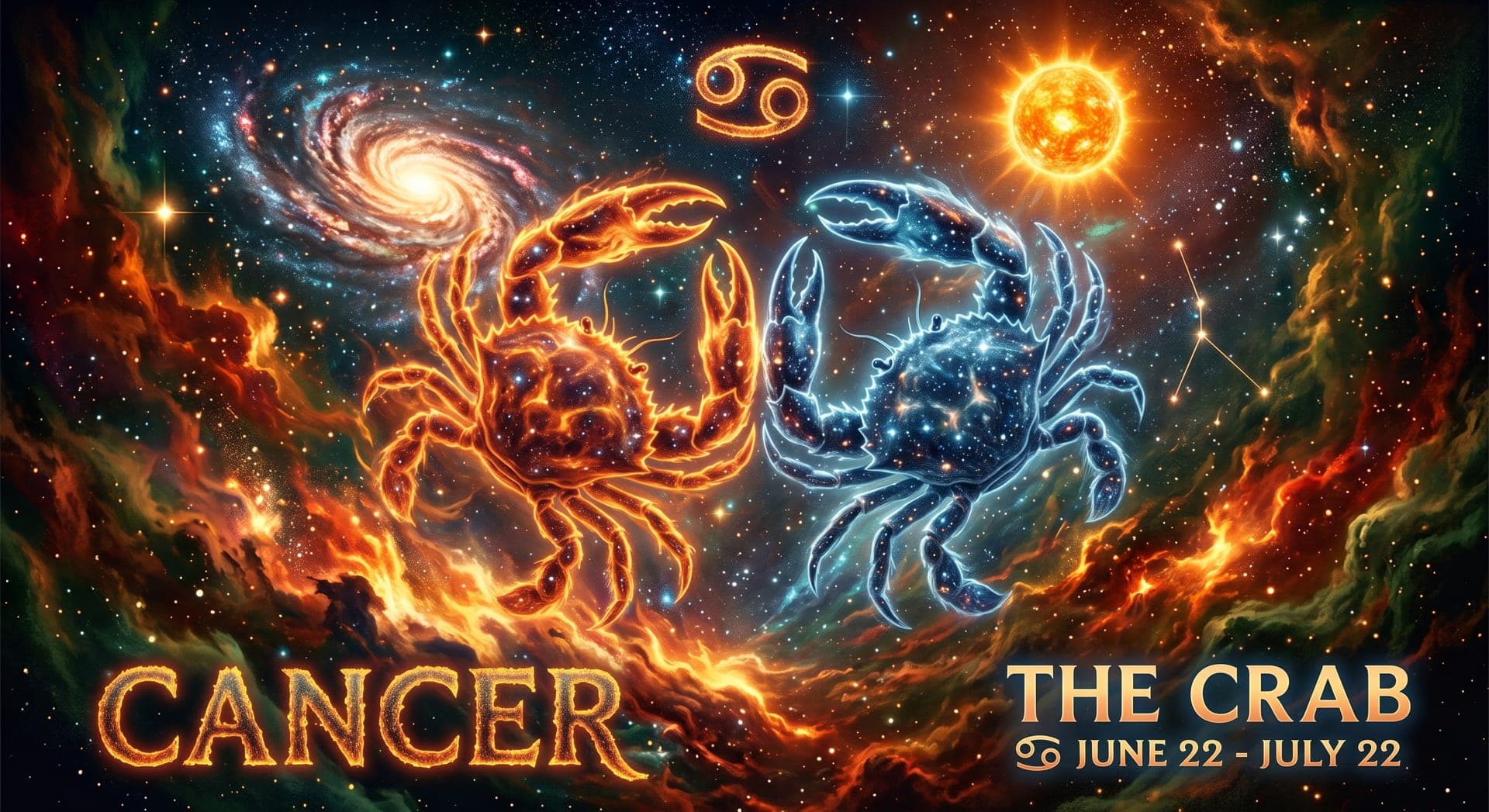
Cancer, the fourth sign of the zodiac, spans June 21 to July 22 and is symbolized by the crab, an animal known for carrying a protective shell while remaining soft and vulnerable underneath. Ruled by the Moon, the celestial body long associated with emotion, intuition, and the subconscious, Cancer is widely regarded as one of the most nurturing and emotionally attuned signs of the zodiac. As a Water sign, Cancer navigates the world through deep feeling, often forming strong emotional bonds and an acute sensitivity to the moods of others. Its Cardinal modality places it at the start of summer, beginning right at the June solstice, reflecting an instinct to initiate and create, especially around home and family. People born under this sign tend to be deeply loyal, protective of loved ones, and drawn to creating a comfortable, secure home environment. Cancer's emotional depth is a genuine strength, but it can also make the sign prone to moodiness or withdrawal when hurt, retreating like a crab into its shell until it feels safe enough to re-emerge.
Personality Traits
Strengths
- Deeply caring and nurturing
- Highly intuitive
- Fiercely loyal and protective
- Strong sense of family and tradition
- Emotionally perceptive
Weaknesses
- Prone to moodiness
- Overly sensitive to criticism
- Can be clingy
- Tends to hold grudges
- Retreats when hurt
Compatible Signs
Fun Facts
- Cancer's crab symbol comes from Greek mythology, where the goddess Hera placed a crab that had fought Hercules among the stars.
- Cancer is ruled by the Moon, the only zodiac sign ruled by a celestial body other than a planet.
- As a Cardinal sign, Cancer initiates summer, beginning at the June solstice, the longest day of the year in the Northern Hemisphere.
- Notable Cancers include Princess Diana, Tom Hanks, Ariana Grande, and Nelson Mandela.
- The crab's hard shell and soft interior are often used as a metaphor for Cancer's protective exterior guarding a deeply sensitive emotional core.
Born on July 19
- 1789
John Martin
English Romantic painter celebrated for his dramatic, large-scale depictions of apocalyptic and biblical scenes.
- 1814
Samuel Colt
American businessman who founded Colt's Manufacturing Company
- 1834
Edgar Degas
French Impressionist painter and sculptor
- 1860
Lizzie Borden
American woman tried and acquitted in an infamous 1892 murder case
- 1896
A. J. Cronin
Scottish physician turned novelist whose bestselling books, including The Citadel, inspired the creation of Britain's National Health Service.
- 1941
Carole Jordan
English astrophysicist known for her research on the solar corona, and the first woman to serve as president of the Royal Astronomical Society.
- 1946
Alan Gorrie
Scottish singer and bassist, a founding member of the funk and soul band the Average White Band.
- 1947
Brian May
English guitarist and songwriter for the rock band Queen, and an accomplished astrophysicist.
- 1953
Howard Schultz
American businessman who built Starbucks
- 1965
Evelyn Glennie
Scottish percussionist renowned as one of the world's leading solo classical performers despite being profoundly deaf.
- 1970
Nicola Sturgeon
Scottish politician who served as First Minister of Scotland and leader of the Scottish National Party.
- 1976
Benedict Cumberbatch
English actor known for playing the title role in the television series Sherlock and for portraying Doctor Strange in the Marvel Cinematic Universe.
- 1982
Jared Padalecki
American actor known for "Supernatural"
- 1987
Jon Jones
American mixed martial artist
On This Day in History
- 64
The Great Fire of Rome breaks out, raging for six days and destroying much of the city, an event later blamed by Emperor Nero on the Christian community.
A fire broke out in Rome and burned for six days, destroying large portions of the city. Ancient historians differ on its cause, with some suggesting Emperor Nero deliberately set it to clear land for his planned palace, while Nero himself blamed the small Christian community, launching a wave of brutal persecution against them.
- 711
Umayyad forces under Tariq ibn Ziyad defeat the Visigoths at the Battle of Guadalete, beginning the Muslim conquest of the Iberian Peninsula.
Umayyad forces under the general Tariq ibn Ziyad crossed from North Africa and decisively defeated the Visigothic King Roderic near the Guadalete River in southern Spain. The victory shattered Visigothic resistance and opened the way for the rapid Muslim conquest of most of the Iberian Peninsula over the following years.
- 1333
English forces win a decisive victory over the Scots at the Battle of Halidon Hill.
During the ongoing conflict between England and Scotland, English forces employing longbowmen decisively defeated a Scottish army attempting to relieve the besieged Berwick Castle. The victory temporarily strengthened English control over the Scottish borderlands during the Second War of Scottish Independence.
- 1333
English forces under Edward III won a decisive victory over a Scottish army at the Battle of Halidon Hill.
The Scots had gathered to relieve the English siege of Berwick-upon-Tweed but were cut down attempting an uphill assault into English longbowmen and men-at-arms. The battle inflicted heavy losses on the Scottish nobility and secured Berwick's surrender to England. It marked a major English success during the Second War of Scottish Independence and briefly strengthened Edward Balliol's rival claim to the Scottish throne.
- 1545
The Tudor warship Mary Rose sinks off Portsmouth; the wreck was later salvaged in 1982 in a landmark maritime archaeology project.
King Henry VIII's prized warship, recently refitted for battle, capsized and sank in the Solent strait while engaging a French invasion fleet, in full view of the horrified king watching from shore. The wreck lay largely forgotten until its remarkable 1982 salvage, which yielded thousands of Tudor-era artifacts and became a major maritime archaeology achievement.
- 1545
Henry VIII's flagship warship Mary Rose sank in the Solent while engaging a French invasion fleet, within sight of the king.
The carrack capsized during the Battle of the Solent, taking most of her crew of several hundred down with her, likely after open gun ports let in water as she turned. Henry VIII reportedly watched the disaster from Southsea Castle on the Portsmouth shore. The wreck was rediscovered in 1971 and famously raised from the seabed in 1982, becoming one of Britain's most important maritime archaeological finds.
- 1553
The brief reign of Lady Jane Grey collapses after just nine days as Mary Tudor asserts her claim to the English throne.
The teenage Lady Jane Grey, who had been proclaimed queen following the death of Edward VI as part of a succession plot, was deposed after just nine days when popular and noble support rallied behind the legitimate heir, Mary Tudor. Jane was later executed for treason, becoming known to history as the "Nine Days' Queen."
- 1553
Lady Jane Grey's brief reign as Queen of England ended after just nine days when the Privy Council proclaimed Mary I queen instead.
Jane had been proclaimed queen on July 10 as part of a scheme by the Duke of Northumberland to keep the crown Protestant and bypass Henry VIII's Catholic daughter Mary. Public support rapidly swung behind Mary, and the council abandoned Jane's cause once Mary's forces gathered strength. Jane was later imprisoned in the Tower of London and executed the following February, remembered ever since as the 'Nine Days' Queen.'
- 1588
The Spanish Armada is first sighted in the English Channel, beginning the naval campaign against England.
English scouts spotted the approaching Spanish Armada off the coast of Cornwall, prompting the lighting of a chain of coastal beacons to alert the country of the impending invasion attempt. The subsequent naval campaign, aided by weather and English tactics, resulted in a major defeat for Spain's ambitions against England.
- 1588
The Spanish Armada was first sighted off the English coast, triggering a chain of warning beacons across the country.
The huge Spanish fleet, sent by Philip II to overthrow Elizabeth I and support a Catholic invasion of England, appeared off Cornwall's coast before being tracked up the English Channel. The sighting set off a beacon relay system that alerted the country to the coming battle. England's subsequent naval campaign against the Armada became a defining moment in Elizabethan history and English national identity.
- 1821
George IV was crowned King of the United Kingdom in a lavish ceremony at Westminster Abbey.
The coronation was one of the most extravagant and expensive in British history, featuring elaborate costumes and a lavish banquet in Westminster Hall. His estranged wife, Caroline of Brunswick, attempted to attend but was turned away from the doors, adding public scandal to the occasion. The event reflected George's taste for spectacle and came amid widespread unpopularity stemming from his personal conduct and the Queen Caroline affair.
- 1843
Isambard Kingdom Brunel's SS Great Britain is launched, the first ocean-going ship built of iron with a screw propeller.
Designed by engineer Isambard Kingdom Brunel, the SS Great Britain was launched as the largest ship afloat at the time and the first to combine an iron hull with screw-propeller propulsion, technologies that would come to define modern shipbuilding. The vessel later served in various roles before being preserved as a museum ship in Bristol.
- 1843
Isambard Kingdom Brunel's SS Great Britain, the first large ocean-going ship built of iron and driven by a screw propeller, was launched at Bristol.
The vessel represented a revolutionary leap in shipbuilding, combining an iron hull with steam-powered screw propulsion rather than the paddle wheels common at the time. Prince Albert attended the launch ceremony on the River Avon. The ship later carried passengers and cargo across the Atlantic and to Australia, and today survives as a preserved museum ship in Bristol's dry dock.
- 1848
The Seneca Falls Convention opened in New York, launching the organized women's rights movement in the United States.
Organized by Elizabeth Cady Stanton and Lucretia Mott, the two-day gathering produced the Declaration of Sentiments, which called for women's suffrage and legal equality using language modeled on the Declaration of Independence. It was the first major convention dedicated to women's rights in the United States. The gathering is widely regarded as the symbolic starting point of the American women's suffrage movement.
- 1870
France declares war on Prussia, beginning the Franco-Prussian War.
Tensions over the succession to the Spanish throne and long-simmering rivalry between the two powers culminated in France's declaration of war against Prussia. The conflict ended in a swift and humiliating French defeat, leading to the unification of Germany under Prussian leadership and the fall of Napoleon III's Second Empire.
- 1952
The Summer Olympic Games open in Helsinki, Finland.
Held in the aftermath of World War II reconstruction, the Helsinki Games marked Finland's long-delayed opportunity to host the Olympics after its original 1940 Games were canceled due to war. The event notably included the first-ever Olympic appearance of the Soviet Union, adding a new dimension of Cold War sporting rivalry.
- 1969
Senator Edward Kennedy's car crashes at Chappaquiddick Island, resulting in the death of passenger Mary Jo Kopechne.
Senator Edward Kennedy drove a car off a bridge on Chappaquiddick Island in Massachusetts, resulting in the drowning death of campaign aide Mary Jo Kopechne. Kennedy's delayed reporting of the accident to authorities generated lasting controversy and is widely believed to have damaged his subsequent presidential ambitions.
- 1972
A small British SAS team helped repel a large-scale assault by rebel fighters on the town of Mirbat in Oman.
Roughly nine SAS soldiers, alongside local Omani gendarmerie and government forces, held off several hundred communist-backed guerrillas attacking the Dhofar coastal town, calling in air support to turn back the assault. The battle became one of the SAS's most celebrated actions, credited with helping to shift momentum in the Dhofar Rebellion in favor of the Sultan of Oman. It remains a landmark case study in special forces history.
- 1980
The Summer Olympic Games opened in Moscow, held amid a Western-led boycott over the Soviet invasion of Afghanistan.
Dozens of countries, including the United States, boycotted the Games in protest of the Soviet Union's 1979 invasion of Afghanistan, significantly reducing the level of competition in several sports. Despite the political tensions, more than 80 nations still participated, with many athletes competing under the Olympic flag rather than their national flags. The Games are remembered as one of the most politically charged Olympics of the Cold War era.
- 1997
The Provisional IRA announced the restoration of its ceasefire in Northern Ireland, reviving the peace process.
The renewed ceasefire came after a period of violence following the collapse of an earlier 1994 truce, and it cleared the way for Sinn Féin to join all-party negotiations later that year. Those talks ultimately produced the Good Friday Agreement in April 1998, which established a framework for power-sharing government in Northern Ireland. The 1997 announcement is regarded as a crucial turning point toward ending the Troubles.