What’s Observed on April 1
Born on April 1: Aries ♈
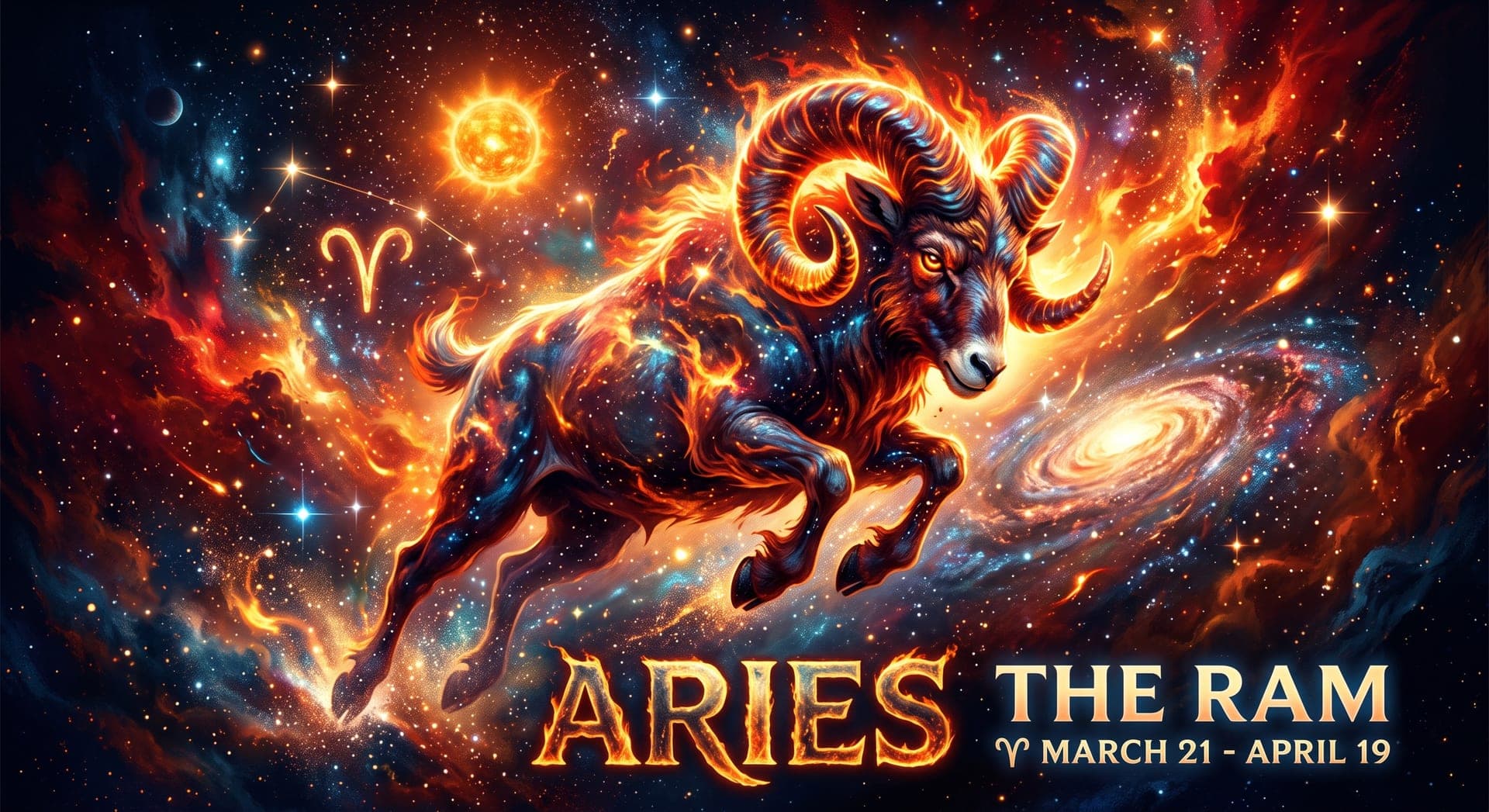
Aries, the first sign of the zodiac, spans March 21 to April 19 and is represented by the ram, an animal known for its boldness, stubborn determination, and willingness to charge forward. Ruled by Mars, the planet of action, drive, and war, Aries is often characterized as one of the most energetic and assertive signs in the zodiac, comfortable taking initiative and leading the way into new territory. As a Fire sign, Aries burns with passion and enthusiasm, approaching life with an instinctive, competitive edge and a low tolerance for hesitation. Its Cardinal modality reflects its role as an initiator, the sign that kicks off the astrological year at the spring equinox and each new season's start. People born under this sign are frequently drawn to leadership roles, sports, entrepreneurship, or any pursuit that rewards courage and quick decision-making. Direct and refreshingly honest, Aries individuals tend to say exactly what they think and rarely shy away from a challenge worth having.
Personality Traits
Strengths
- Courageous and determined
- Natural-born leader
- Honest and direct
- Enthusiastic and optimistic
- Quick to act on opportunities
Weaknesses
- Impatient and quick-tempered
- Impulsive, acts before thinking
- Can be overly competitive
- Struggles with follow-through
- Prone to selfishness
Compatible Signs
Fun Facts
- Aries is the first sign of the zodiac, marking the start of the astrological year at the spring equinox.
- The ram symbol is tied to the Greek myth of the golden-fleeced ram that rescued Phrixus, whose fleece later became the prize sought by Jason and the Argonauts.
- Mars, Aries' ruling planet, was the Roman god of war, reflecting the sign's associations with boldness, drive, and aggression.
- As a Cardinal sign, Aries is one of four signs, along with Cancer, Libra, and Capricorn, that initiate a new season.
- Notable Aries include Lady Gaga, Robert Downey Jr., Mariah Carey, and Leonardo da Vinci.
Born on April 1
- 1578
William Harvey
English physician who was the first to correctly describe the circulation of blood pumped by the heart
- 1815
Otto von Bismarck
First Chancellor of the German Empire, architect of German unification
- 1873
Sergei Rachmaninoff
Russian composer, pianist, and conductor
- 1875
Edgar Wallace
English novelist and playwright known for prolific crime thrillers and for co-writing the original story that became King Kong
- 1885
Clementine Churchill
English political hostess and philanthropist, wife and close confidante of Prime Minister Winston Churchill
- 1908
Abraham Maslow
American psychologist known for the hierarchy of needs
- 1920
Toshiro Mifune
Japanese actor known for collaborations with director Akira Kurosawa
- 1932
Debbie Reynolds
American actress and singer known for "Singin' in the Rain"
- 1939
Ali MacGraw
American actress known for "Love Story"
- 1946
Ronnie Lane
English rock musician and songwriter, bassist for the Small Faces and Faces
- 1957
David Gower
English cricketer and former England captain celebrated for his elegant batting style
- 1961
Susan Boyle
Scottish singer who rose to fame after an acclaimed audition on Britain's Got Talent
- 1966
Chris Evans
English radio and television presenter known for hosting Top Gear and major BBC and Virgin Radio shows
- 1997
Asa Butterfield
English actor known for starring roles in Hugo and Ender's Game
On This Day in History
- 1082
Byzantine general Alexios I Komnenos overthrows Emperor Nikephoros III Botaneiates, founding the Komnenian dynasty.
Byzantine general Alexios I Komnenos led a successful revolt against the increasingly unpopular Emperor Nikephoros III, entering Constantinople and seizing the throne. His accession founded the Komnenian dynasty, which restored a measure of stability and military strength to the Byzantine Empire after decades of decline, and Alexios later played a key role in launching the First Crusade by appealing to Western Europe for military assistance.
- 1572
Dutch rebels known as the Watergeuzen capture the town of Brielle from Spanish forces, establishing the first foothold of what became the Dutch Republic.
A fleet of Dutch privateers known as the Watergeuzen, or "Sea Beggars," seized the small port town of Brielle from Spanish Habsburg forces, catching the garrison unprepared. The surprise capture gave Dutch rebels their first permanent territorial foothold in their revolt against Spanish rule, and the town's fall is traditionally regarded as the founding spark of what became the independent Dutch Republic.
- 1789
The U.S. House of Representatives achieves its first quorum and elects Frederick Muhlenberg as its first Speaker.
After a slow start caused by travel delays among newly elected representatives, the first United States Congress finally achieved a quorum in the House and elected Pennsylvania's Frederick Muhlenberg as its inaugural Speaker. The milestone allowed the young federal government, established under the recently ratified Constitution, to begin functioning and move forward with organizing the executive and judicial branches.
- 1865
Union cavalry under Philip Sheridan defeat Confederate forces at the Battle of Five Forks, cutting off the Army of Northern Virginia's last supply line.
Union cavalry commander Philip Sheridan decisively defeated Confederate forces at the Battle of Five Forks in Virginia, severing the last rail supply line into the besieged city of Petersburg. The defeat forced General Robert E. Lee to abandon both Petersburg and the Confederate capital of Richmond within days, setting the stage for his surrender at Appomattox Court House just over a week later.
- 1867
Singapore becomes a British crown colony, transferring control from the East India Company to direct rule by the British Crown.
The Straits Settlements, which also included Penang and Malacca, had been administered by the East India Company since the 1820s. After the Company's dissolution following the Indian Rebellion of 1857, Britain gradually assumed direct colonial administration across its Asian territories. Singapore's new status placed it under the Colonial Office in London, an arrangement that lasted until Japanese occupation during the Second World War and eventual self-governance in 1959.
- 1908
The Territorial Force is formed as a new part-time volunteer reserve component of the British Army.
Created under the Haldane Reforms led by Secretary of State for War Richard Haldane, the Territorial Force merged the old Volunteer Force and the Yeomanry into a single, better-organised reserve. It was intended primarily for home defence, freeing the regular army for service overseas. The force later became famous for its role in the First World War, when Territorial divisions fought alongside regular units on the Western Front.
- 1918
The Royal Air Force is created by merging the Royal Flying Corps and the Royal Naval Air Service, becoming the world's first independent air force.
The British government merged the army's Royal Flying Corps with the Royal Naval Air Service to create the Royal Air Force, the world's first military aviation branch established as an independent service rather than a division of an army or navy. The reorganization reflected growing recognition of air power's strategic importance during World War I and set a model later followed by other nations.
- 1918
The Royal Air Force is formed through the merger of the Royal Flying Corps and the Royal Naval Air Service, becoming the world's first independent air force.
The new service was created partly in response to German air raids on London, which exposed the drawbacks of splitting military aviation between the Army and Navy. Major General Hugh Trenchard, later known as the 'Father of the RAF,' became its first Chief of the Air Staff. Within decades the RAF would play a decisive role in the Battle of Britain during the Second World War.
- 1922
Six Catholic men are shot dead in their homes on Arnon Street in Belfast during a night of sectarian violence.
The killings occurred amid the intense communal violence that gripped Belfast during the turbulent period surrounding the partition of Ireland. Gunmen entered several houses on the street and shot the occupants, with police officers among those later implicated in accounts of the attack. The Arnon Street killings became one of the more notorious episodes of the sectarian bloodshed that claimed hundreds of lives in the city during this period.
- 1937
Aden becomes a British crown colony, separated from British India and placed under direct rule from London.
Britain had controlled the port of Aden, on the southern coast of the Arabian Peninsula, since 1839, administering it as part of British India. The 1937 change reflected Aden's growing strategic importance for shipping routes to and from the Suez Canal and British possessions in East Africa and Asia. Aden remained a crown colony until it joined independent South Yemen in 1967 following years of insurgency.
- 1939
The Spanish Civil War ends as Francisco Franco announces the surrender of the last Republican forces.
General Francisco Franco announced the final surrender of the last organized Republican forces, bringing an end to the brutal three-year Spanish Civil War that had killed several hundred thousand people and drawn intervention from Nazi Germany, Fascist Italy, and the Soviet Union. Franco's Nationalist victory installed an authoritarian dictatorship that would rule Spain for nearly four decades until his death in 1975.
- 1955
The EOKA rebellion against British colonial rule begins in Cyprus with a wave of bomb attacks.
Led by George Grivas, the National Organisation of Cypriot Fighters launched an armed campaign demanding the end of British rule and union of Cyprus with Greece. The four-year insurgency involved guerrilla attacks, bombings and assassinations, prompting a large British military and police response. The conflict eventually led to Cyprus gaining independence in 1960, though not the union with Greece that EOKA had sought.
- 1964
The historic British Admiralty, War Office and Air Ministry are formally replaced by a single unified Defence Council within the new Ministry of Defence.
The reform, championed by Defence Secretary Peter Thorneycroft, ended centuries of separate administration for the Royal Navy, British Army and Royal Air Force, bringing them under one integrated department for the first time. The change was intended to improve coordination between the services and streamline defence policy and spending decisions, reflecting the reduced scale of Britain's post-imperial military commitments.
- 1969
The Hawker Siddeley Harrier, the world's first operational vertical/short take-off and landing jet, enters service with the Royal Air Force.
Developed from the earlier Hawker P.1127 experimental aircraft, the Harrier could take off and land vertically using its distinctive swivelling engine nozzles, freeing it from dependence on conventional runways. It gave the RAF, and later the Royal Navy's Sea Harrier variant, a uniquely flexible close-support aircraft that proved decisive in establishing air superiority during the 1982 Falklands War.
- 1974
The Local Government Act 1972 comes into effect, reorganising the structure of local government across England and Wales.
The Act abolished many historic counties and county boroughs, replacing them with a new two-tier system of larger counties and metropolitan and non-metropolitan districts. It represented the most sweeping reform of English and Welsh local administration in a century, sparking lasting controversy over the loss of traditional county identities such as Rutland and Huntingdonshire, several of which were later partially restored.
- 1976
Steve Jobs and Steve Wozniak found Apple Computer, Inc. in a California garage.
College dropouts Steve Jobs and Steve Wozniak, along with a third partner, Ronald Wayne, founded Apple Computer in the Jobs family garage in Los Altos, California, to sell Wozniak's hand-built personal computer, the Apple I. The modest startup grew within a few years into one of the defining companies of the personal computing revolution and later became one of the most valuable corporations in the world.
- 1979
Iran officially becomes an Islamic republic after a nationwide referendum overwhelmingly approves the change following the ousting of the Shah.
Following the overthrow of Shah Mohammad Reza Pahlavi earlier that year, Iranian voters overwhelmingly approved a referendum establishing the Islamic Republic of Iran under the leadership of Ayatollah Ruhollah Khomeini. The vote formalized the transformation of Iran's government from a Western-backed monarchy into a theocratic state governed according to Islamic law, reshaping the country's politics and its relations with the West for decades.
- 1989
Margaret Thatcher's Community Charge, widely known as the poll tax, is introduced in Scotland a year ahead of England and Wales.
The flat-rate charge replaced the old rates system based on property values, requiring nearly every adult resident to pay the same amount regardless of income. Its early introduction in Scotland, seen by critics as a test case, fuelled deep resentment and accusations that Scots were being used as guinea pigs. Widespread non-payment and protests followed, and the deeply unpopular tax contributed significantly to Thatcher's political downfall in 1990.
- 2001
The Netherlands becomes the first country in the world to legalize same-sex marriage.
The Netherlands became the first country in the world to legally recognize same-sex marriage, with four couples marrying in a ceremony held just after midnight in Amsterdam. The landmark law extended full marriage rights, rather than a separate civil union status, to same-sex couples, and it helped spur a wave of similar legalization efforts in other countries over the following two decades.
- 2004
Google launches its Gmail email service, offering then-unprecedented amounts of free storage.
Google launched its Gmail email service, surprising the tech industry by offering one gigabyte of free storage per account at a time when competing services typically offered only a few megabytes. Announced on April Fools' Day, the offer initially struck some observers as an elaborate prank, but Gmail's generous storage and clean interface quickly made it one of the most widely used email platforms in the world.