
What’s Observed on March 31
Born on March 31: Aries ♈
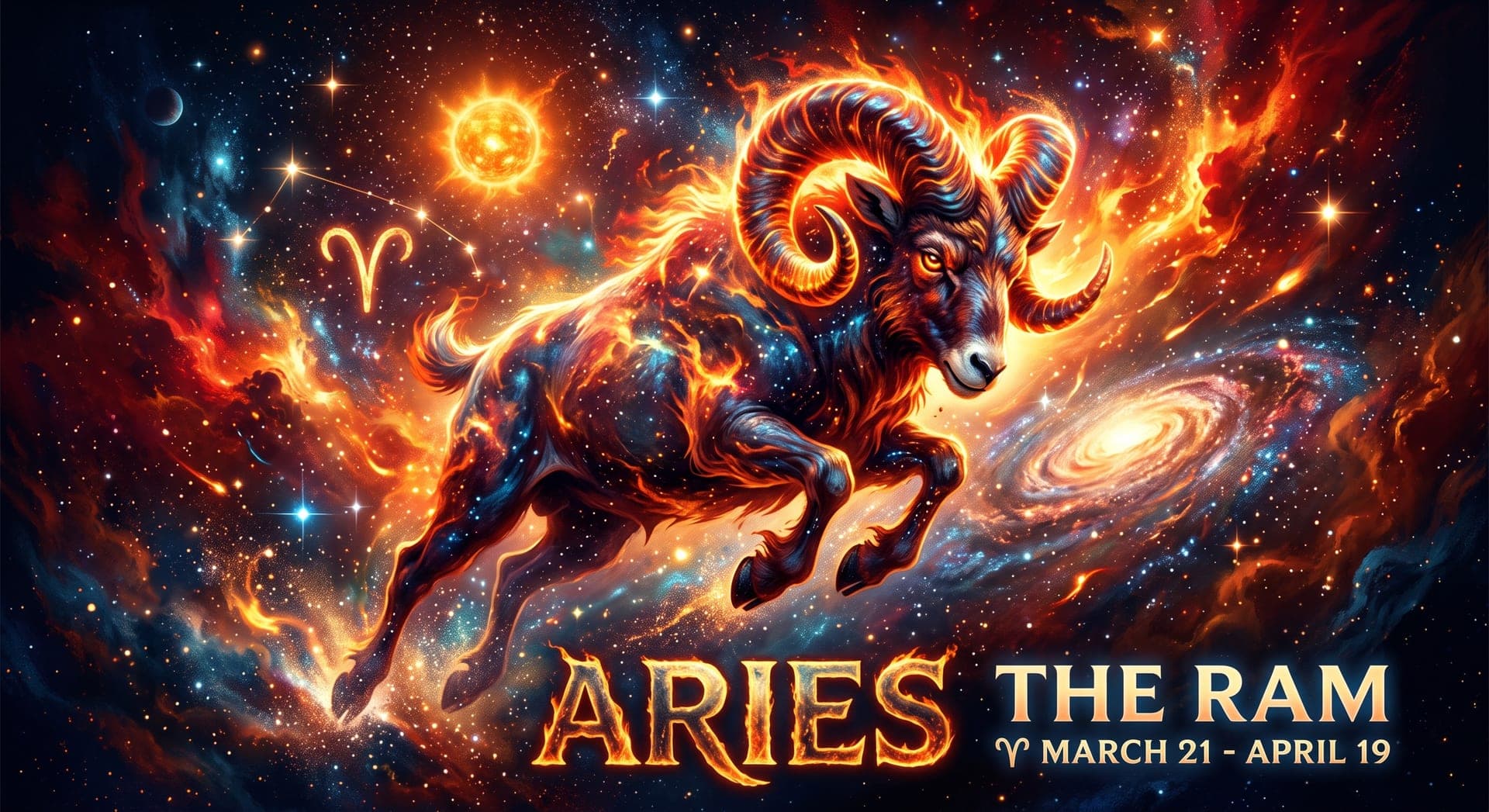
Aries, the first sign of the zodiac, spans March 21 to April 19 and is represented by the ram, an animal known for its boldness, stubborn determination, and willingness to charge forward. Ruled by Mars, the planet of action, drive, and war, Aries is often characterized as one of the most energetic and assertive signs in the zodiac, comfortable taking initiative and leading the way into new territory. As a Fire sign, Aries burns with passion and enthusiasm, approaching life with an instinctive, competitive edge and a low tolerance for hesitation. Its Cardinal modality reflects its role as an initiator, the sign that kicks off the astrological year at the spring equinox and each new season's start. People born under this sign are frequently drawn to leadership roles, sports, entrepreneurship, or any pursuit that rewards courage and quick decision-making. Direct and refreshingly honest, Aries individuals tend to say exactly what they think and rarely shy away from a challenge worth having.
Personality Traits
Strengths
- Courageous and determined
- Natural-born leader
- Honest and direct
- Enthusiastic and optimistic
- Quick to act on opportunities
Weaknesses
- Impatient and quick-tempered
- Impulsive, acts before thinking
- Can be overly competitive
- Struggles with follow-through
- Prone to selfishness
Compatible Signs
Fun Facts
- Aries is the first sign of the zodiac, marking the start of the astrological year at the spring equinox.
- The ram symbol is tied to the Greek myth of the golden-fleeced ram that rescued Phrixus, whose fleece later became the prize sought by Jason and the Argonauts.
- Mars, Aries' ruling planet, was the Roman god of war, reflecting the sign's associations with boldness, drive, and aggression.
- As a Cardinal sign, Aries is one of four signs, along with Cancer, Libra, and Capricorn, that initiate a new season.
- Notable Aries include Lady Gaga, Robert Downey Jr., Mariah Carey, and Leonardo da Vinci.
Born on March 31
- 1596
René Descartes
French philosopher and mathematician, "father of modern philosophy"
- 1621
Andrew Marvell
English metaphysical poet and politician remembered for works such as 'To His Coy Mistress' and for his service as a Member of Parliament for Hull.
- 1732
Joseph Haydn
Austrian composer known as the "Father of the Symphony"
- 1809
Edward FitzGerald
English poet and translator best known for his free English translation of the Rubaiyat of Omar Khayyam, which became one of the most quoted works of Victorian literature.
- 1872
Sergei Diaghilev
Russian art critic and founder of the Ballets Russes
- 1878
Jack Johnson
American boxer, first Black world heavyweight champion
- 1890
William Lawrence Bragg
Australian-born British physicist who shared the 1915 Nobel Prize in Physics with his father for pioneering the field of X-ray crystallography
- 1920
Deborah Cavendish, Duchess of Devonshire
English aristocrat and author, the youngest of the famous Mitford sisters, who transformed the Chatsworth estate into one of Britain's most successful stately home enterprises.
- 1926
John Fowles
English novelist known for The French Lieutenant's Woman and The Magus, whose postmodern experiments with narrative made him one of the most influential British writers of his generation.
- 1927
Cesar Chavez
American labor leader and civil rights activist
- 1948
Al Gore
45th Vice President of the United States, Nobel Peace Prize laureate
- 1955
Angus Young
Scottish-born guitarist and co-founder of the rock band AC/DC, celebrated for his high-energy stage performances and schoolboy-uniform stage persona.
- 1966
Roger Black
English sprinter who won Olympic and World Championship medals in the 400 metres, later becoming a television athletics commentator.
- 1971
Ewan McGregor
Scottish actor known for roles in Trainspotting, the Star Wars prequel trilogy as young Obi-Wan Kenobi, and a wide range of film and television work.
On This Day in History
- 1657
The Long Parliament presents the Humble Petition and Advice to Oliver Cromwell.
The document offered Cromwell an expanded constitutional settlement, including the option to take the title of king, in an attempt to place his rule on a more stable, traditional footing after years of military government. Cromwell ultimately declined the crown but accepted a revised version establishing a second parliamentary chamber and a formal successor.
- 1717
A sermon by Benjamin Hoadly ignites the Bangorian Controversy within the Church of England.
Preaching before King George I, the Bishop of Bangor argued that Christ's kingdom was purely spiritual and had no basis in earthly ecclesiastical authority, directly challenging the Church's claims to temporal power. The ensuing pamphlet war was so fierce that the Convocation of Canterbury was prevented from meeting again for over a century.
- 1774
The Boston Port Act closes the port of Boston to trade.
Passed by the British Parliament in retaliation for the Boston Tea Party, the act cut off the city's vital seaborne commerce until damages for the destroyed tea were paid. It was the first of the punitive 'Intolerable Acts' and helped galvanize colonial opposition that led directly toward the American Revolution.
- 1814
Sixth Coalition forces occupy Paris, forcing the capitulation of Napoleon's Grande Armée.
Russian, Prussian, and Austrian troops entered the French capital after Napoleon's marshals negotiated its surrender, a decisive blow that led directly to his abdication days later. The fall of Paris marked the effective end of Napoleon's first reign and set the stage for his exile to the island of Elba.
- 1854
The United States and Japan sign the Convention of Kanagawa, opening Japanese ports to American trade after centuries of isolation.
Commodore Matthew Perry and Japanese officials signed the Convention of Kanagawa, opening two Japanese ports to American ships and ending over two centuries of Japan's largely isolationist foreign policy, a pivotal moment that set Japan on a path toward rapid modernization.
- 1885
The United Kingdom establishes the Bechuanaland Protectorate in southern Africa.
Declared partly to block Boer and German expansion and to secure the 'Road to the North' toward British interests in central Africa, the protectorate covered territory that is now Botswana. It remained under British administration for eighty years until achieving independence in 1966 as the Republic of Botswana.
- 1889
The Eiffel Tower officially opens in Paris as the entrance arch to the 1889 World's Fair.
The Eiffel Tower, designed by engineer Gustave Eiffel as the entrance arch for that year's World's Fair, officially opened in Paris after roughly two years of construction. Initially criticized by many artists and intellectuals, it became one of the world's most recognized landmarks.
- 1918
The United States adopts daylight saving time for the first time, as a wartime measure to conserve fuel.
The United States implemented daylight saving time nationally for the first time, shifting clocks forward to extend evening daylight hours as a wartime energy conservation measure during World War I, a practice later repealed and reinstated multiple times over the following century.
- 1930
The Motion Picture Production Code, which governed content standards in Hollywood films for decades, is formally adopted.
The Motion Picture Producers and Distributors of America formally adopted the Motion Picture Production Code, a set of moral guidelines restricting depictions of violence, sexuality, and crime in Hollywood films that governed American cinema content for decades until its replacement by the modern rating system.
- 1931
An earthquake devastates Managua, Nicaragua, killing thousands and destroying much of the capital.
A massive earthquake struck Managua, the capital of Nicaragua, destroying much of the city center and killing an estimated several thousand people, one of the deadliest natural disasters in the country's history and a significant blow to its infrastructure and economy.
- 1939
Prime Minister Neville Chamberlain pledges British military support to Poland against aggression.
Delivered in the House of Commons after Germany's occupation of the remainder of Czechoslovakia broke the Munich Agreement, the guarantee committed Britain to defend Polish independence. When Germany invaded Poland five months later, the pledge became the trigger for Britain's declaration of war and its entry into the Second World War.
- 1942
Japanese forces invade Christmas Island, then a British possession in the Indian Ocean.
A small garrison of British Indian troops offered little resistance before a mutiny among the defenders hastened the island's capture, which Japan valued for its phosphate deposits. The occupation lasted for the remainder of the war until Allied forces reclaimed the island, which later transferred to Australian administration.
- 1949
Newfoundland joins Canada as its tenth province, ending its status as a separate British dominion.
After a closely fought referendum campaign, Newfoundlanders narrowly voted to join Canadian Confederation rather than remain an independent dominion or return to direct British rule, both options Newfoundland had cycled through since financial collapse in the 1930s. The union formally ended over four centuries of separate British colonial governance on the island.
- 1959
The Dalai Lama crosses into India and is granted political asylum after fleeing Tibet.
After an arduous two-week journey through the Himalayas following his flight from Lhasa, the 14th Dalai Lama crossed the border into India, where the Indian government granted him political asylum, allowing him to establish a Tibetan exile community in Dharamshala.
- 1966
The Labour Party under Harold Wilson wins a landslide victory in the UK general election.
Wilson's government, which had governed with a razor-thin majority since 1964, secured a commanding majority of 96 seats, giving it a strong mandate to pursue economic modernization and social reform. The decisive victory confirmed Wilson's position as one of the dominant British political figures of the 1960s and reshaped the following years of policy.
- 1968
President Lyndon B. Johnson announces he will not seek reelection, amid growing opposition to the Vietnam War.
In a televised address about the Vietnam War, President Lyndon B. Johnson unexpectedly announced he would not seek reelection, a stunning decision reflecting the political toll of the war and growing domestic unrest, reshaping the trajectory of that year's presidential race.
- 1980
Olympic track legend Jesse Owens, who won four gold medals at the 1936 Berlin Games, dies of lung cancer in Tucson, Arizona.
Jesse Owens, whose four gold medals at the 1936 Berlin Olympics famously undercut Nazi claims of Aryan racial superiority in front of Adolf Hitler, died of lung cancer in Tucson, Arizona, having remained a celebrated symbol of athletic achievement and civil rights progress.
- 1990
Around 200,000 protesters march through London against the Community Charge, sparking riots.
The demonstration against the deeply unpopular flat-rate 'poll tax,' which replaced local property-based rates, descended into some of the worst rioting seen in central London for decades, with clashes centered on Trafalgar Square. The backlash badly damaged Margaret Thatcher's premiership and contributed to her resignation later that year.
- 1991
The Warsaw Pact, the Soviet-led military alliance, formally dissolves as Eastern Bloc nations pursue independent paths.
The Warsaw Pact, the Soviet-led military alliance that had bound Eastern Bloc nations together in a counterweight to NATO since 1955, formally dissolved its military command structures as former member states pursued independent foreign policies following the collapse of Soviet-imposed communist governments across the region the previous year. The alliance's full political dissolution followed just months later.
- 2020
Detroit becomes one of the hardest-hit U.S. cities in the early COVID-19 pandemic, straining its hospital system.
As COVID-19 case counts climbed sharply across the United States, Detroit emerged as one of the hardest-hit American cities in the pandemic's early wave, with hospitals overwhelmed by patients and the virus disproportionately affecting Black residents already burdened by underlying health disparities. The city's struggles highlighted stark racial and economic inequities in health outcomes that drew national attention.