
What’s Observed on February 9
Born on February 9: Aquarius ♒
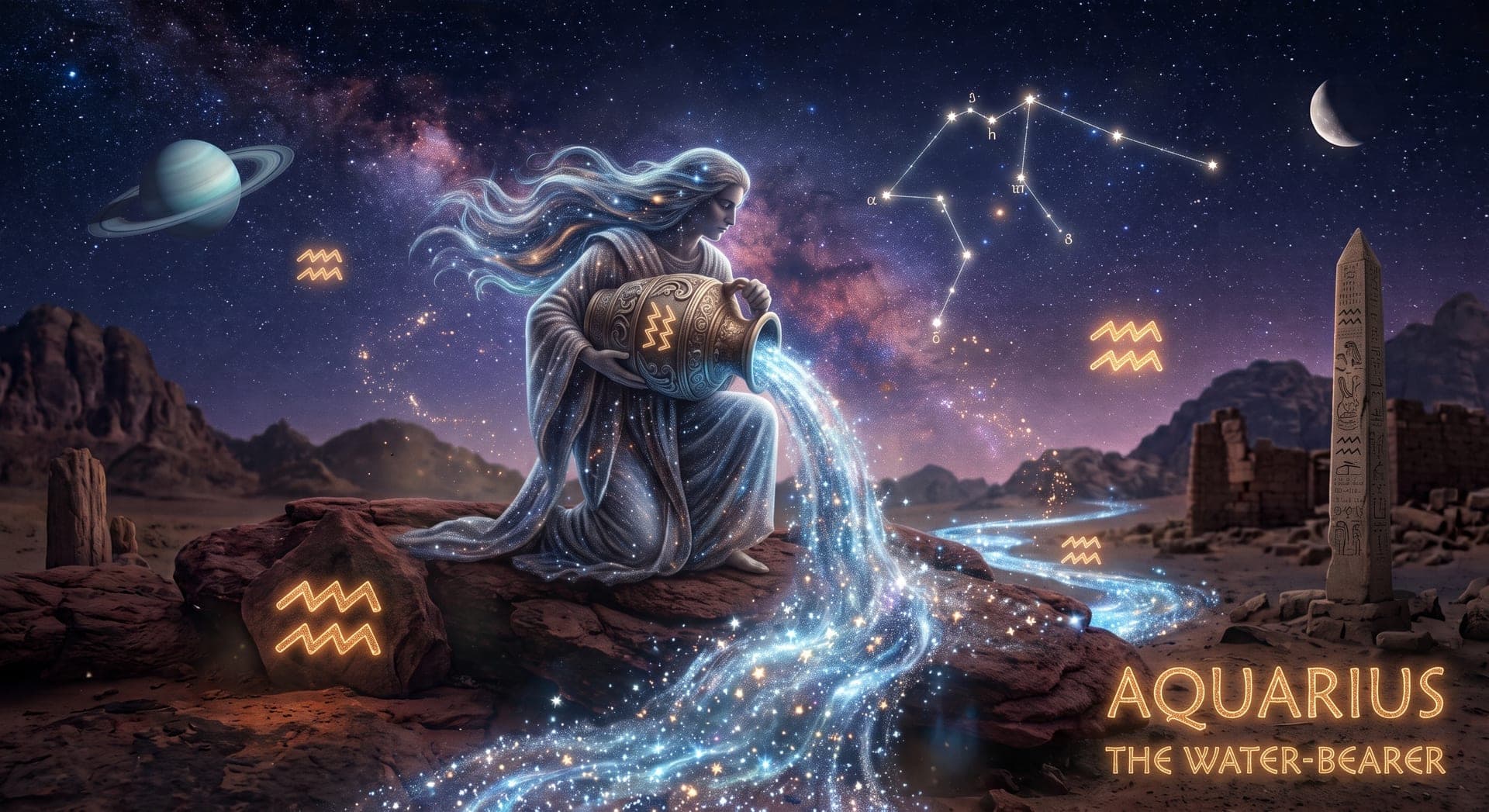
Aquarius, the eleventh sign of the zodiac, spans January 20 to February 18 and is symbolized by the water bearer, an image of someone pouring out knowledge and life-giving ideas to the world, despite Aquarius actually being an air sign rather than a water sign. Traditionally ruled by disciplined Saturn and, in modern astrology, by unpredictable Uranus, the planet of innovation and rebellion, Aquarius carries a distinctive blend of structure and originality. People born under this sign are often described as independent thinkers, forward-looking, and drawn to humanitarian causes, valuing the collective good over convention. As a Fixed sign, Aquarius can be famously stubborn once its mind is made up, even while championing change for everyone else. Intellectually curious and sometimes emotionally guarded, Aquarians tend to value friendship and community deeply, often serving as the visionary of their social circle, more comfortable debating ideas than discussing feelings.
Personality Traits
Strengths
- Original and forward-thinking
- Strong sense of fairness and justice
- Independent and self-sufficient
- Loyal to friends and causes alike
- Sees the bigger picture others miss
Weaknesses
- Can run from emotional expression
- Uncompromising once a position is fixed
- Prone to aloofness or detachment
- Sometimes contrarian just to stand apart
- Can prioritize ideas over people's feelings
Compatible Signs
Fun Facts
- Despite its watery name and imagery, Aquarius is classified as an air sign, grouped with Gemini and Libra as a sign of thought and communication rather than emotion.
- Aquarius has two ruling planets: Saturn in classical astrology, and Uranus, discovered in 1781, in the modern system most Western astrologers use today.
- The water bearer symbol traces back to Ganymede in Greek mythology, a cupbearer to the gods said to pour out a life-giving stream from the heavens.
- Notable Aquarians include Oprah Winfrey, Abraham Lincoln, Charles Darwin, Thomas Edison, and Bob Marley.
- Aquarius is one of the rarer signs to be represented by a person rather than an animal or object, alongside Gemini, Virgo, and Sagittarius's centaur half.
Born on February 9
- 1863
Anthony Hope
English novelist and playwright best known for writing the adventure novel The Prisoner of Zenda
- 1922
Jim Laker
English cricketer renowned for taking a record 19 wickets in a single Test match against Australia in 1956
- 1940
J. M. Coetzee
South African-Australian novelist and Nobel Prize laureate
- 1942
Carole King
Grammy-winning singer-songwriter behind "Tapestry"
- 1943
Joe Pesci
Academy Award-winning American actor
- 1944
Alice Walker
Pulitzer Prize-winning author of "The Color Purple"
- 1945
Mia Farrow
American actress and humanitarian
- 1953
Ciarán Hinds
Northern Irish actor known for television roles including Rome and film roles including Belfast
- 1957
Gordon Strachan
Scottish footballer and manager who starred for Aberdeen and Manchester United before managing clubs including Celtic
- 1958
Sandy Lyle
Scottish golfer who won The Open Championship and the Masters Tournament during a dominant run in the 1980s
- 1960
Holly Johnson
English singer-songwriter best known as the frontman of the band Frankie Goes to Hollywood
- 1981
Tom Hiddleston
English actor known for playing Loki in the Marvel Cinematic Universe
- 1987
Rose Leslie
Scottish actress known for playing Ygritte in the television series Game of Thrones

On This Day in History
- 1098
Crusader forces led by Bohemond of Taranto defeat a relieving Seljuk army during the prolonged siege of Antioch.
The First Crusade's prolonged siege of the heavily fortified city of Antioch nearly collapsed the crusader army through starvation and disease before this victory over a relieving Muslim army allowed the crusaders to finally capture the city, a crucial step on their path toward Jerusalem.
- 1539
The earliest recorded horse race takes place at the Roodee in Chester, England, marking the beginnings of what is now the world's oldest racecourse still in use.
The race was reportedly instituted by Chester's mayor as an alternative to the rowdier football matches traditionally held in the city around Shrovetide. Run on a flat meadow beside the River Dee, the Roodee has hosted horse racing continuously in some form since, and Chester Racecourse remains a fixture of the British racing calendar.
- 1555
John Hooper, the Protestant Bishop of Gloucester, is burned at the stake in Gloucester, England, for heresy under the Catholic reign of Queen Mary I.
Hooper was one of the most prominent Protestant reformers executed during Mary's attempt to restore Catholicism in England after the death of Edward VI. He was burned near his own cathedral before a large crowd, and his slow death by a poorly built fire, taking nearly 45 minutes, made him one of the most remembered martyrs of the Marian persecutions.
- 1654
English forces capture Fort Rocher on Tortuga during the Anglo-Spanish War, briefly seizing the Caribbean pirate stronghold from Spanish control.
Tortuga, off the coast of modern Haiti, was a haven for buccaneers and privateers and had changed hands repeatedly between European powers. The English capture came amid a broader Caribbean campaign during the Anglo-Spanish War under Oliver Cromwell's Commonwealth, part of England's efforts to challenge Spanish dominance in the West Indies.
- 1775
The British Parliament declares the Province of Massachusetts Bay to be in a state of rebellion, authorising the Crown to use force to suppress colonial resistance.
The declaration came amid escalating tensions following the Boston Tea Party and the Intolerable Acts, and effectively pushed the American colonies closer to armed conflict. Fighting broke out just two months later at Lexington and Concord, marking the start of the American Revolutionary War against British rule.
- 1825
With no candidate winning an Electoral College majority, the U.S. House of Representatives elects John Quincy Adams president in a contingent election.
With four candidates splitting the popular and electoral vote in the 1824 election, none achieved a majority, throwing the decision to the House of Representatives under the Twelfth Amendment. Adams's selection, aided by rival Henry Clay, was denounced by Andrew Jackson supporters as a "corrupt bargain" and fueled Jackson's successful campaign four years later.
- 1861
Jefferson Davis is elected provisional president of the newly formed Confederate States of America.
Davis, a former U.S. senator and secretary of war, was chosen as a compromise candidate by delegates from the newly seceded Southern states, reflecting his military credentials and moderate reputation among secessionists. He would lead the Confederacy throughout the Civil War until its defeat in 1865.
- 1893
Giuseppe Verdi's final opera, the comic masterpiece "Falstaff," premieres at Milan's La Scala to great acclaim.
Composed when Verdi was nearly 80 years old, "Falstaff" marked a striking late-career shift from the composer's earlier tragic operas toward comic brilliance, drawing on Shakespeare's Falstaff character. It's widely regarded as one of the greatest comic operas ever written.
- 1895
Physical education instructor William G. Morgan invents a new game called Mintonette, soon renamed volleyball.
Morgan, a YMCA instructor, designed the game as a less physically demanding alternative to basketball for older or less athletic members. Adopted internationally within years, especially by the military during World War I, it grew into one of the most widely played team sports in the world.
- 1907
Around three thousand women march through London in the 'Mud March', one of the first large-scale public demonstrations for women's suffrage in Britain.
Organised by the National Union of Women's Suffrage Societies under Millicent Fawcett, the procession took its nickname from the poor, muddy weather participants endured while walking from Hyde Park to Exeter Hall. The peaceful, non-militant demonstration helped establish mass public marches as a central tactic of the British suffrage movement in the years that followed.
- 1920
Representatives of several nations, including the United Kingdom, sign the Svalbard Treaty in Paris, recognising Norwegian sovereignty over the Svalbard archipelago.
The treaty resolved decades of uncertainty over the Arctic archipelago's status, granting Norway sovereignty while guaranteeing signatory nations, Britain among them, equal rights to conduct commercial activities such as coal mining there. It also established Svalbard as a demilitarised zone, a status that has remained largely intact ever since.
- 1945
The Royal Navy submarine HMS Venturer sinks the German submarine U-864 off the coast of Norway, in history's only known submarine-versus-submarine sinking while both vessels were submerged.
U-864 was en route to Japan carrying advanced weapons technology and mercury when Venturer's crew detected it and fired a spread of torpedoes without the aid of sonar tracking systems, relying instead on manual calculation. All 73 men aboard the German submarine were killed. The wreck's mercury cargo later became an environmental hazard off the Norwegian coast.
- 1961
The Beatles perform for the first time under that name at the Cavern Club in Liverpool, the venue that would become synonymous with the band's early rise.
The group had gone through several earlier names, including the Quarrymen and the Silver Beetles, before settling on the Beatles. Their lunchtime and evening sets at the small, sweaty Cavern Club built a devoted local following and caught the attention of Brian Epstein, who became their manager and helped secure their first record deal.
- 1964
The Beatles make their American television debut on The Ed Sullivan Show before a record-breaking audience of 73 million viewers.
The Beatles' Ed Sullivan Show appearance drew an estimated 73 million viewers, at the time one of the largest audiences in American television history, and is often cited as a defining moment that ignited full-blown Beatlemania across the United States.
- 1964
The Beatles make their first appearance on The Ed Sullivan Show in the United States, watched by an estimated 73 million television viewers.
The performance came just two days after the band's arrival in New York and is widely regarded as a defining moment of the British Invasion of American music. The Beatles played five songs, including 'She Loves You' and 'I Want to Hold Your Hand', and the broadcast is often credited with inspiring a generation of American musicians to pick up instruments.
- 1971
The magnitude 6.6 Sylmar earthquake strikes greater Los Angeles, killing 64 people and prompting major reforms to California building codes.
The Sylmar earthquake struck early in the morning, collapsing hospital buildings and a dam spillway and prompting California to adopt stricter seismic building standards, particularly for hospitals, which had suffered severe structural failures during the quake.
- 1986
Halley's Comet makes its closest approach to the sun during its most recent visit to the inner solar system, visible from Earth for the first time since 1910.
Halley's Comet, visible from Earth roughly every 76 years, made its closest approach on this 1986 pass, though poor viewing conditions left many observers disappointed compared to its more spectacular 1910 appearance. Several spacecraft, including Europe's Giotto probe, made close flybys to study the comet directly for the first time.
- 1996
The Provisional IRA detonates a large truck bomb at Canary Wharf in London, killing two people and ending a 17-month ceasefire in the Northern Ireland conflict.
The bomb caused an estimated £150 million in damage to the docklands financial district and injured over a hundred people. It ended the IRA's 1994 ceasefire and marked a return to violence that continued until the Good Friday Agreement was signed in 1998, establishing a lasting framework for peace in Northern Ireland.
- 2018
The opening ceremony of the Winter Olympics is held in Pyeongchang, South Korea, notably featuring a unified Korean delegation.
The Pyeongchang ceremony notably featured North and South Korean athletes marching together under a unified flag and fielding a joint women's ice hockey team, a symbolic diplomatic gesture amid otherwise tense relations between the two countries.
- 2021
The second impeachment trial of former President Donald Trump begins in the U.S. Senate, following the January 6 Capitol attack.
The Senate trial, an unprecedented second impeachment proceeding against a president who had already left office, centered on charges that Trump incited the January 6 Capitol riot. He was acquitted after the vote to convict fell short of the required two-thirds majority.