
What’s Observed on February 8
Born on February 8: Aquarius ♒
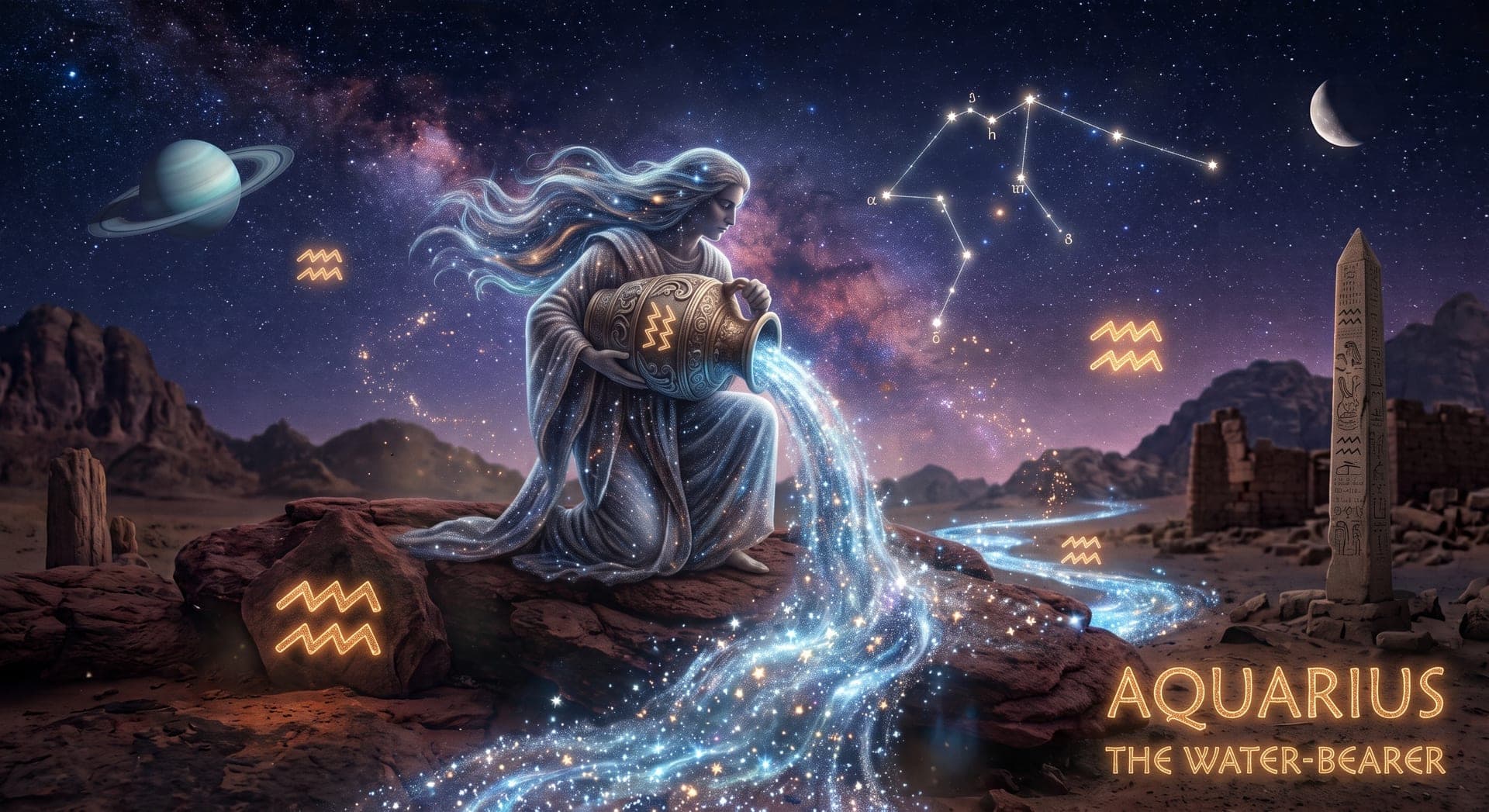
Aquarius, the eleventh sign of the zodiac, spans January 20 to February 18 and is symbolized by the water bearer, an image of someone pouring out knowledge and life-giving ideas to the world, despite Aquarius actually being an air sign rather than a water sign. Traditionally ruled by disciplined Saturn and, in modern astrology, by unpredictable Uranus, the planet of innovation and rebellion, Aquarius carries a distinctive blend of structure and originality. People born under this sign are often described as independent thinkers, forward-looking, and drawn to humanitarian causes, valuing the collective good over convention. As a Fixed sign, Aquarius can be famously stubborn once its mind is made up, even while championing change for everyone else. Intellectually curious and sometimes emotionally guarded, Aquarians tend to value friendship and community deeply, often serving as the visionary of their social circle, more comfortable debating ideas than discussing feelings.
Personality Traits
Strengths
- Original and forward-thinking
- Strong sense of fairness and justice
- Independent and self-sufficient
- Loyal to friends and causes alike
- Sees the bigger picture others miss
Weaknesses
- Can run from emotional expression
- Uncompromising once a position is fixed
- Prone to aloofness or detachment
- Sometimes contrarian just to stand apart
- Can prioritize ideas over people's feelings
Compatible Signs
Fun Facts
- Despite its watery name and imagery, Aquarius is classified as an air sign, grouped with Gemini and Libra as a sign of thought and communication rather than emotion.
- Aquarius has two ruling planets: Saturn in classical astrology, and Uranus, discovered in 1781, in the modern system most Western astrologers use today.
- The water bearer symbol traces back to Ganymede in Greek mythology, a cupbearer to the gods said to pour out a life-giving stream from the heavens.
- Notable Aquarians include Oprah Winfrey, Abraham Lincoln, Charles Darwin, Thomas Edison, and Bob Marley.
- Aquarius is one of the rarer signs to be represented by a person rather than an animal or object, alongside Gemini, Virgo, and Sagittarius's centaur half.
Born on February 8
- 1577
Robert Burton
English scholar and Oxford don best known for The Anatomy of Melancholy, a sprawling study of depression and human psychology
- 1819
John Ruskin
English art critic and writer whose influential essays shaped Victorian ideas about art, architecture, and society
- 1825
Henry Walter Bates
English naturalist and explorer who spent over a decade studying wildlife in the Amazon and identified the phenomenon of Batesian mimicry
- 1828
Jules Verne
French author regarded as a father of science fiction
- 1834
Dmitri Mendeleev
Russian chemist who created the periodic table
- 1888
Edith Evans
English actress celebrated for her stage career, including her performance as Lady Bracknell in The Importance of Being Earnest
- 1921
Lana Turner
Hollywood actress of the studio era's golden age
- 1925
Jack Lemmon
Academy Award-winning American actor
- 1931
James Dean
American actor and enduring 1950s cultural icon
- 1932
John Williams
Composer of iconic film scores including "Star Wars" and "Jaws"
- 1944
Roger Lloyd-Pack
English actor best known for playing Trigger in the sitcom Only Fools and Horses
- 1955
John Grisham
Best-selling author of legal thrillers
- 1964
Trinny Woodall
English fashion designer and television presenter known for the makeover series What Not to Wear
- 1990
Klay Thompson
NBA champion and elite three-point shooter
- 1999
Alessia Russo
English footballer who plays as a forward and was part of England's UEFA Women's Euro 2022-winning squad

On This Day in History
- 1250
Crusader forces led by Robert of Artois clash with Ayyubid troops at the Battle of Al Mansurah in Egypt during the Seventh Crusade.
Louis IX of France led the crusade in an attempt to conquer Egypt as a stepping stone to retaking Jerusalem. After an initial crusader breakthrough, overextended knights including Robert of Artois were cut off and killed in the town's narrow streets. The costly battle weakened the crusader army, which was defeated and captured within weeks, including King Louis himself.
- 1587
Mary, Queen of Scots is executed on suspicion of plotting to assassinate her cousin, Queen Elizabeth I of England.
Mary's execution followed years of imprisonment in England after she fled Scotland, during which she became a focal point for Catholic plots against the Protestant Elizabeth I. Her son, James VI of Scotland, later peacefully inherited the English throne as James I, uniting the two crowns Mary herself had once contested.
- 1587
Mary, Queen of Scots, is beheaded at Fotheringhay Castle in England on the orders of her cousin, Queen Elizabeth I.
Mary had fled to England in 1568 after being forced to abdicate the Scottish throne, but spent nearly two decades in captivity as a rival claimant to Elizabeth's crown. She was convicted of treason for her alleged role in the Babington Plot to assassinate Elizabeth. Her execution removed a major Catholic threat to the English throne and strained relations with Scotland and Catholic Europe.
- 1601
Robert Devereux, 2nd Earl of Essex, leads a failed armed rebellion against Queen Elizabeth I in London.
Once one of Elizabeth's favourite courtiers, Essex had fallen from favour after a disastrous military campaign in Ireland. He and a group of followers marched into the City of London hoping to rally support against the queen's advisers, but Londoners failed to join the uprising and the rebellion collapsed within hours. Essex was tried for treason and executed later that month.
- 1693
The College of William & Mary in Virginia is granted its royal charter, becoming the second-oldest institution of higher learning in what would become the United States.
Chartered by King William III and Queen Mary II, the college educated generations of early American leaders, including Thomas Jefferson and several other founding fathers. It remains a public university in Williamsburg, Virginia, and one of the oldest institutions of higher learning in the United States.
- 1807
Napoleon's forces defeat a combined Russian and Prussian army at the bloody Battle of Eylau.
Fought in brutal winter conditions with heavy snow, the Battle of Eylau produced enormous casualties on both sides without a decisive outcome, foreshadowing the difficulty Napoleon would later face fighting in Eastern Europe. It was one of the bloodiest engagements of the Napoleonic Wars up to that point.
- 1879
A riot breaks out during a cricket match in Sydney after spectators storm the field to protest umpiring decisions against the touring English team captained by Lord Harris.
Tensions had been simmering over contentious umpiring calls during the match between New South Wales and the English touring side. When a local batsman was given out, angry spectators invaded the pitch and jostled players, including Lord Harris, who was struck with a whip. The incident strained relations between English and Australian cricket administrators for years afterward.
- 1904
Japan launches a surprise attack on Russian-held Port Arthur without a formal declaration of war, beginning the Russo-Japanese War.
Japan's surprise naval assault on the Russian Pacific fleet at Port Arthur, launched before a formal declaration of war, crippled Russian naval power in the region and marked the start of a conflict that ended in a stunning Japanese victory. The war shattered European assumptions about Asian military inferiority and boosted Japanese imperial ambitions.
- 1904
Imperial Japanese Navy torpedo boats launch a surprise night attack on the Russian fleet at Port Arthur, opening the Russo-Japanese War.
The attack came without a formal declaration of war and damaged several Russian battleships anchored in the harbour. Japan's success in the ensuing war, the first major modern conflict in which an Asian power defeated a European one, reshaped global perceptions of Japanese military strength and contributed to revolutionary unrest within Russia.
- 1910
The Boy Scouts of America is officially incorporated by publisher William D. Boyce.
Boyce reportedly founded the American branch after being helped by an anonymous British Scout in London and later learning about the growing Scouting movement founded by Robert Baden-Powell. The organization grew rapidly, becoming one of the largest youth development organizations in American history.
- 1942
Japanese forces invade Singapore, leading days later to the largest surrender of British-led troops in history.
Japan's swift invasion of British-held Singapore, a supposedly impregnable fortress, culminated a week later in the largest surrender of British-led forces in history, with roughly 80,000 troops taken prisoner. The humiliating defeat badly damaged British imperial prestige across Asia.
- 1942
Imperial Japanese forces cross the Johor Strait and invade Singapore, then a British Crown colony and one of the empire's most important military bases.
The invasion followed weeks of Japanese advances down the Malay Peninsula against British, Indian, and Australian defenders. Singapore, considered a near-impregnable fortress, fell within a week, and the surrender of roughly 80,000 Allied troops was later called by Winston Churchill the worst disaster and largest capitulation in British military history.
- 1945
British and Canadian forces launch Operation Veritable, a major Allied offensive to clear German troops from the Rhineland.
The operation, one of the largest of the Western European campaign, aimed to push German forces back across the Rhine ahead of the final Allied advance into Germany. British and Canadian troops fought through flooded terrain and fortified German positions over several weeks of heavy fighting before securing the west bank of the Rhine by early March 1945.
- 1950
East Germany establishes the Stasi, its notorious secret police, which would become one of the most pervasive surveillance agencies of the Cold War.
The Stasi grew into one of history's most extensive domestic surveillance operations, employing tens of thousands of officers and hundreds of thousands of informants to monitor East German citizens' daily lives. Its extensive files, opened after German reunification, revealed the staggering scale of state surveillance under communist rule.
- 1950
East Germany establishes the Ministry for State Security, known as the Stasi, as its secret police and intelligence agency.
Modelled partly on the Soviet KGB, the Stasi grew into one of the most pervasive surveillance organisations in history, employing a vast network of informants to monitor East German citizens. Over four decades it amassed extensive files on millions of people before being dissolved following German reunification in 1990.
- 1960
Queen Elizabeth II decrees that her descendants outside the direct royal line will take the surname Mountbatten-Windsor.
The decree resolved a dispute over whether royal descendants should carry the name Windsor, adopted by the family during World War I to sound less German, or incorporate Prince Philip's family name, Mountbatten. The compromise combined both names for descendants without royal titles.
- 1960
Queen Elizabeth II issues an Order-in-Council declaring that her descendants who need a surname will use the name Mountbatten-Windsor.
The declaration resolved a long-running dispute over whether the royal house should retain the name Windsor, established by George V in 1917, or adopt Mountbatten, the family name of the Queen's husband, Prince Philip. The compromise kept House of Windsor as the reigning name while giving descendants without royal titles the combined surname Mountbatten-Windsor.
- 1963
Iraq's Ba'ath Party overthrows the government of Prime Minister Abd al-Karim Qasim in a bloody coup.
The Ba'ath Party coup, which involved a brief but violent power struggle, brought a young Saddam Hussein into a position of growing influence within the security apparatus, setting the stage for his eventual rise to Iraq's presidency over a decade later.
- 1971
South Vietnamese ground troops, backed by American air support, launch an incursion into Laos to disrupt the Ho Chi Minh trail.
Codenamed Operation Lam Son 719, the offensive aimed to cut North Vietnamese supply lines running through neutral Laos into South Vietnam. U.S. ground forces were barred by law from entering Laos, so only air and artillery support was provided. The South Vietnamese force suffered heavy losses and was forced to withdraw, raising doubts about the effectiveness of Vietnamization.
- 2020
A soldier opens fire at a Thai shopping mall and military base, killing dozens in the deadliest mass shooting in the country's history.
A soldier, reportedly enraged over a land dispute, opened fire at a military base and a nearby shopping mall in Nakhon Ratchasima, killing dozens of people during an hours-long standoff before being shot by security forces. It remains the deadliest mass shooting in Thai history.