
What’s Observed on February 7
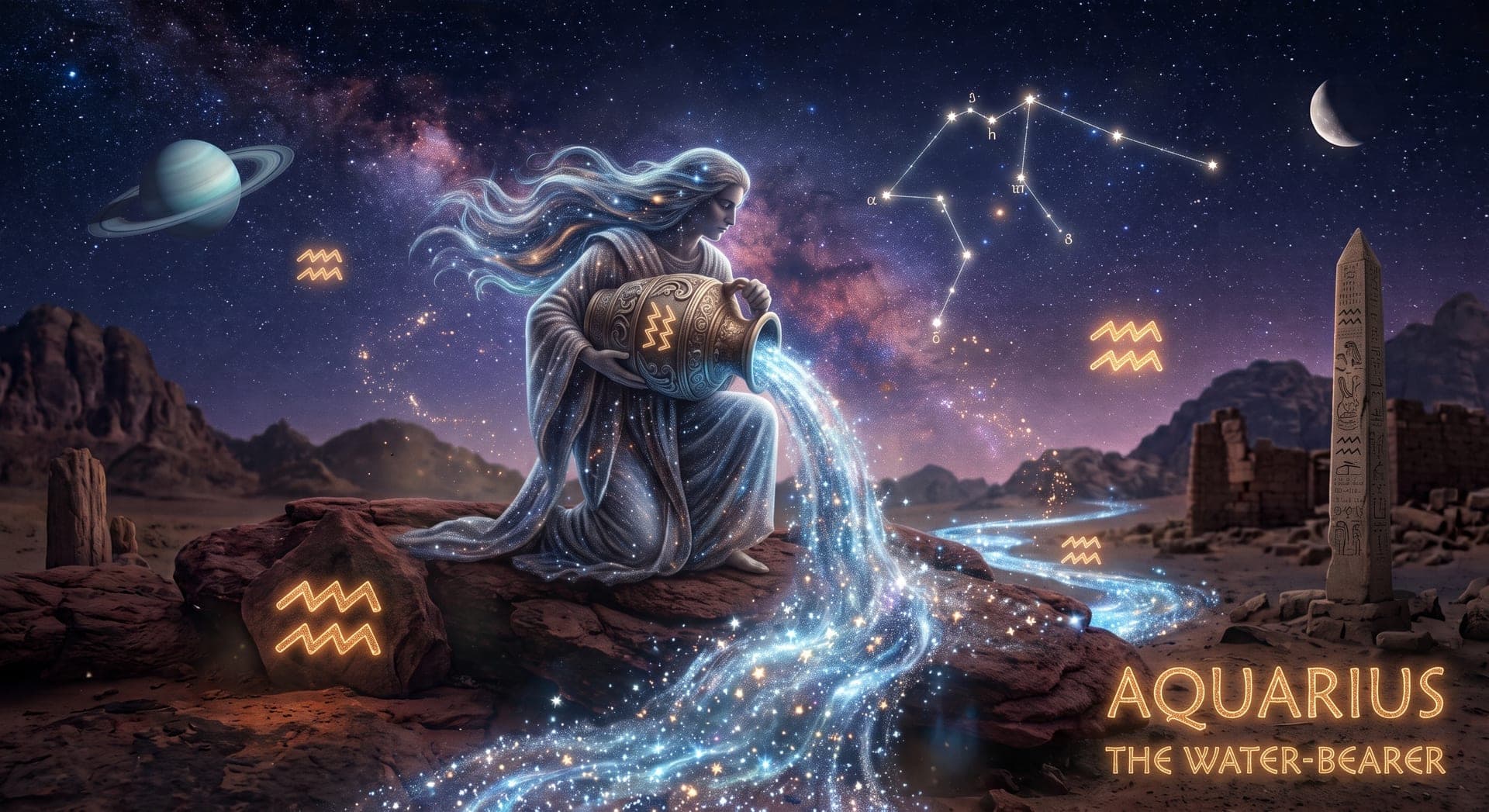
Born on February 7: Aquarius ♒
Aquarius, the eleventh sign of the zodiac, spans January 20 to February 18 and is symbolized by the water bearer, an image of someone pouring out knowledge and life-giving ideas to the world, despite Aquarius actually being an air sign rather than a water sign. Traditionally ruled by disciplined Saturn and, in modern astrology, by unpredictable Uranus, the planet of innovation and rebellion, Aquarius carries a distinctive blend of structure and originality. People born under this sign are often described as independent thinkers, forward-looking, and drawn to humanitarian causes, valuing the collective good over convention. As a Fixed sign, Aquarius can be famously stubborn once its mind is made up, even while championing change for everyone else. Intellectually curious and sometimes emotionally guarded, Aquarians tend to value friendship and community deeply, often serving as the visionary of their social circle, more comfortable debating ideas than discussing feelings.
Personality Traits
Strengths
- Original and forward-thinking
- Strong sense of fairness and justice
- Independent and self-sufficient
- Loyal to friends and causes alike
- Sees the bigger picture others miss
Weaknesses
- Can run from emotional expression
- Uncompromising once a position is fixed
- Prone to aloofness or detachment
- Sometimes contrarian just to stand apart
- Can prioritize ideas over people's feelings
Compatible Signs
Fun Facts
- Despite its watery name and imagery, Aquarius is classified as an air sign, grouped with Gemini and Libra as a sign of thought and communication rather than emotion.
- Aquarius has two ruling planets: Saturn in classical astrology, and Uranus, discovered in 1781, in the modern system most Western astrologers use today.
- The water bearer symbol traces back to Ganymede in Greek mythology, a cupbearer to the gods said to pour out a life-giving stream from the heavens.
- Notable Aquarians include Oprah Winfrey, Abraham Lincoln, Charles Darwin, Thomas Edison, and Bob Marley.
- Aquarius is one of the rarer signs to be represented by a person rather than an animal or object, alongside Gemini, Virgo, and Sagittarius's centaur half.
Born on February 7
- 1102
Empress Matilda
English claimant to the throne whose fight for the crown against King Stephen plunged England into the civil war known as the Anarchy
- 1478
Thomas More
English lawyer and statesman who served as Lord Chancellor and was executed for refusing to accept Henry VIII as head of the Church of England
- 1812
Charles Dickens
English novelist celebrated for works like Oliver Twist, Great Expectations, and A Christmas Carol
- 1837
James Murray
Scottish lexicographer who served as the primary editor of the Oxford English Dictionary for over three decades
- 1867
Laura Ingalls Wilder
Author of the "Little House" book series
- 1873
Thomas Andrews
Irish shipbuilder from what is now Northern Ireland who designed the RMS Titanic and died in its sinking
- 1877
G. H. Hardy
English mathematician known for his work in number theory and mathematical analysis, and for mentoring Srinivasa Ramanujan
- 1885
Sinclair Lewis
First American to win the Nobel Prize in Literature
- 1922
Hattie Jacques
English actress best known for her roles in the long-running Carry On film series
- 1960
James Spader
American actor known for film and television roles
- 1962
Garth Brooks
Best-selling American country music singer
- 1962
Eddie Izzard
English comedian and actor known for surreal stand-up routines and stage and screen performances
- 1965
Chris Rock
American comedian, actor, and film producer
- 1974
Steve Nash
Two-time NBA Most Valuable Player
- 1978
Ashton Kutcher
American actor and technology entrepreneur
On This Day in History
- 1301
King Edward I of England confers the title Prince of Wales upon his son, the future Edward II, making him the first English heir to bear the title.
The title was created after Edward I's conquest of Wales, intended to formally attach the principality to the English crown. Edward of Caernarfon had been born in Wales the previous year, which later gave rise to the legend that his father presented him to the Welsh as a prince born on their own soil. Every English or British monarch's eldest son has customarily held the title since.
- 1497
Followers of preacher Girolamo Savonarola burn cosmetics, art, and books deemed sinful in Florence's famous "Bonfire of the Vanities."
Savonarola, a fiery Dominican friar who had gained enormous influence over Florence after the fall of the Medici, encouraged citizens to burn objects he considered occasions for sin, including mirrors, cosmetics, and secular art and books. His puritanical rule was short-lived; he was excommunicated and executed the following year.
- 1783
French and Spanish forces lift their nearly four-year siege of Gibraltar, one of the longest sieges in British military history.
The Great Siege, part of the American Revolutionary War's wider European theater, saw Spanish and French forces unsuccessfully attempt to retake the British-held territory using massive artillery bombardments and even specially designed floating batteries. Gibraltar's successful defense cemented its lasting status as a British overseas territory.
- 1783
Franco-Spanish forces abandon their nearly four-year siege of the British fortress of Gibraltar, ending one of the longest sieges in British military history.
The siege had begun in 1779, part of France and Spain's attempt to seize Gibraltar from Britain during the American War of Independence. Despite blockade, bombardment, and disease, the garrison under General George Augustus Eliott held out, aided by relief convoys from the Royal Navy. The failed siege confirmed Gibraltar as a permanent British possession, a status it retains today.
- 1812
The strongest in a series of massive earthquakes strikes New Madrid, Missouri, temporarily altering the course of the Mississippi River.
Part of a powerful series of quakes centered near New Madrid, the tremor was so strong that it reportedly rang church bells as far away as Boston and caused sections of the Mississippi River to temporarily flow backward. The New Madrid Seismic Zone remains an area of ongoing concern for future major earthquakes in the central United States.
- 1819
British statesman Thomas Stamford Raffles departs Singapore shortly after establishing a trading post there on behalf of the British East India Company.
Raffles had negotiated with local rulers to found a settlement at the mouth of the Singapore River, recognising its potential as a strategic port along trade routes to China. Left in the hands of a small British garrison, the settlement grew rapidly into one of the empire's most important commercial hubs, and modern Singapore traces its founding to this period.
- 1863
The Royal Navy corvette HMS Orpheus runs aground and sinks on the Manukau Bar near Auckland, New Zealand, killing 189 of the 259 men aboard.
The Orpheus was the flagship of the Australian Squadron and struck a sandbar while attempting to enter Manukau Harbour despite warning signals from the shore. It remains the worst maritime disaster in New Zealand's history. An inquiry found that outdated charts and a misjudgement of the channel by the ship's officers contributed to the wreck.
- 1898
Novelist Émile Zola stands trial for libel after publishing his open letter accusing the French government of antisemitism in the Dreyfus affair.
Zola's trial stemmed directly from his open letter accusing military and government officials of knowingly convicting an innocent man, Alfred Dreyfus, largely because he was Jewish. Zola was found guilty and fled briefly to England to avoid imprisonment, but the trial's publicity kept the Dreyfus affair in the international spotlight.
- 1900
A British relief force is repelled for a third time in its efforts to break the Boer siege of Ladysmith during the Second Boer War.
Ladysmith, a garrison town in Natal, had been surrounded by Boer forces since November 1899 as part of a wider siege strategy. British attempts to relieve the town under General Redvers Buller met repeated setbacks along the Tugela River. The siege was finally lifted later that same month, after Buller's forces broke through the Boer defensive lines.
- 1904
The Great Baltimore Fire breaks out, destroying more than 1,500 buildings across the city within 30 hours.
The fire, likely sparked by a cigar in a warehouse basement, spread rapidly through Baltimore's densely packed downtown, overwhelming local firefighters and even reinforcements from other cities whose hose couplings didn't match Baltimore's equipment. The disaster led to national standardization of firefighting equipment to prevent similar coordination failures.
- 1964
The Beatles land in the United States for the first time, greeted by thousands of screaming fans at New York's newly renamed JFK Airport.
The Beatles' arrival at New York's Kennedy Airport, greeted by roughly 3,000 screaming fans and a media frenzy, marked the start of the British Invasion of American popular music. Their historic appearance on The Ed Sullivan Show two days later cemented full-blown Beatlemania in the United States.
- 1964
The Beatles arrive in New York for their first visit to the United States, greeted by thousands of screaming fans at John F. Kennedy International Airport.
The Liverpool band's arrival marked the start of what became known as the British Invasion of American popular music. Two days later, their appearance on The Ed Sullivan Show drew an estimated 73 million television viewers, and the visit helped transform the Beatles from a British sensation into a global phenomenon.
- 1974
The Caribbean island of Grenada becomes an independent nation, ending its status as a British colony.
Grenada had been under British control since 1763, following its capture from France, and had progressed through stages of self-government before achieving full independence. Eric Gairy became the country's first prime minister. Grenada remained a Commonwealth realm, retaining the British monarch as head of state, a status it holds to this day.
- 1979
Pluto's elongated orbit carries it inside Neptune's, briefly making Neptune the outermost known planet for the first time since either was discovered.
Because Pluto's orbit is more elliptical and tilted than the other planets, it periodically passes closer to the Sun than Neptune does, a roughly 20-year window that last occurred from 1979 to 1999. The unusual orbital overlap was part of the evidence later cited in debates over Pluto's eventual reclassification as a dwarf planet.
- 1986
President Jean-Claude Duvalier flees Haiti, ending 28 years of brutal one-family rule by his father and himself.
Duvalier, known as "Baby Doc," inherited Haiti's brutal dictatorship from his father, François "Papa Doc" Duvalier, continuing a regime notorious for its violent secret police, the Tonton Macoute. Growing unrest and international pressure forced him into exile in France, though Haiti's political instability continued for decades afterward.
- 1991
The Provisional IRA fires mortar shells at 10 Downing Street while Prime Minister John Major is chairing a war cabinet meeting on the Gulf War.
The mortars were launched from a parked van roughly 200 metres away and exploded in the garden of Downing Street, blowing out windows but causing no serious injuries. The attack demonstrated the IRA's continued capability to strike at the heart of the British government during its campaign against British rule in Northern Ireland.
- 1992
European leaders sign the Maastricht Treaty, laying the legal foundation for the creation of the European Union.
The Maastricht Treaty deepened European integration far beyond its origins as a trade bloc, establishing common citizenship, a framework for a shared foreign policy, and the plan for a single currency that became the euro. It formally created the European Union, transforming the relationship between its member states.
- 1992
European Community member states, including the United Kingdom, sign the Maastricht Treaty, formally establishing the European Union.
Negotiated in the Dutch city of Maastricht, the treaty deepened European integration by creating EU citizenship and laying groundwork for a single currency. Britain, under Prime Minister John Major, secured opt-outs from the euro and the Social Chapter before signing. The treaty took effect in November 1993 and remained a touchstone in British debates over Europe for decades.
- 2009
Bushfires sweep through Victoria, Australia, killing 173 people in the country's deadliest natural disaster.
Australia's Black Saturday bushfires were driven by extreme heat, drought, and hurricane-force winds that turned routine fires into unstoppable firestorms overwhelming entire towns with little warning. The catastrophe prompted a major national inquiry into fire warning systems and land management practices.
- 2014
Researchers announce that fossilised footprints discovered on the beach at Happisburgh in Norfolk, England, are more than 800,000 years old, the oldest known human footprints outside Africa.
The prints, uncovered after a storm eroded the coastline, were left in ancient estuary mud by a small group including adults and children, likely early humans of the species Homo antecessor. Before the tide destroyed the exposed surface, researchers used 3D scanning to record the impressions, providing rare direct evidence of the earliest known human occupation of northern Europe.