
What’s Observed on January 20
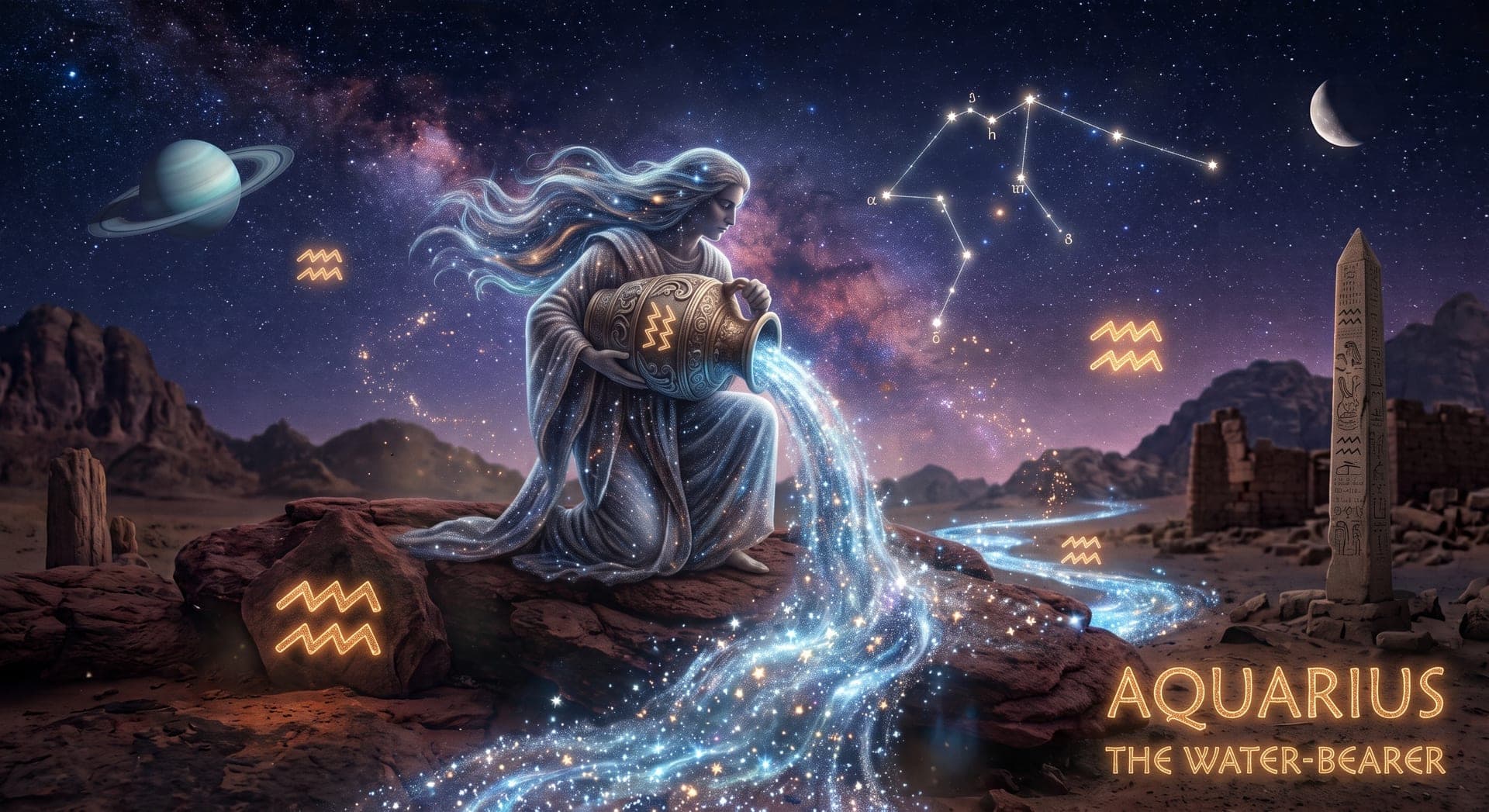
Born on January 20: Aquarius ♒
Aquarius, the eleventh sign of the zodiac, spans January 20 to February 18 and is symbolized by the water bearer, an image of someone pouring out knowledge and life-giving ideas to the world, despite Aquarius actually being an air sign rather than a water sign. Traditionally ruled by disciplined Saturn and, in modern astrology, by unpredictable Uranus, the planet of innovation and rebellion, Aquarius carries a distinctive blend of structure and originality. People born under this sign are often described as independent thinkers, forward-looking, and drawn to humanitarian causes, valuing the collective good over convention. As a Fixed sign, Aquarius can be famously stubborn once its mind is made up, even while championing change for everyone else. Intellectually curious and sometimes emotionally guarded, Aquarians tend to value friendship and community deeply, often serving as the visionary of their social circle, more comfortable debating ideas than discussing feelings.
Personality Traits
Strengths
- Original and forward-thinking
- Strong sense of fairness and justice
- Independent and self-sufficient
- Loyal to friends and causes alike
- Sees the bigger picture others miss
Weaknesses
- Can run from emotional expression
- Uncompromising once a position is fixed
- Prone to aloofness or detachment
- Sometimes contrarian just to stand apart
- Can prioritize ideas over people's feelings
Compatible Signs
Fun Facts
- Despite its watery name and imagery, Aquarius is classified as an air sign, grouped with Gemini and Libra as a sign of thought and communication rather than emotion.
- Aquarius has two ruling planets: Saturn in classical astrology, and Uranus, discovered in 1781, in the modern system most Western astrologers use today.
- The water bearer symbol traces back to Ganymede in Greek mythology, a cupbearer to the gods said to pour out a life-giving stream from the heavens.
- Notable Aquarians include Oprah Winfrey, Abraham Lincoln, Charles Darwin, Thomas Edison, and Bob Marley.
- Aquarius is one of the rarer signs to be represented by a person rather than an animal or object, alongside Gemini, Virgo, and Sagittarius's centaur half.
Born on January 20
- 1873
Johannes V. Jensen
Danish author and Nobel Prize in Literature laureate
- 1874
Steve Bloomer
English footballer regarded as one of the greatest goal-scorers of his era, starring for Derby County and England.
- 1878
Finlay Currie
Scottish character actor known for roles in films including Great Expectations and Ben-Hur.
- 1896
George Burns
American comedian and entertainer with a decades-long career
- 1899
Clarice Cliff
English ceramic artist celebrated for her bold, brightly coloured Art Deco pottery designs.
- 1906
Aristotle Onassis
Greek shipping magnate and business tycoon
- 1920
Federico Fellini
Acclaimed Italian film director
- 1920
DeForest Kelley
Actor who played Dr. McCoy in the original "Star Trek"
- 1930
Buzz Aldrin
NASA astronaut and second person to walk on the Moon
- 1934
Tom Baker
English actor best known for playing the fourth incarnation of the Doctor in Doctor Who.
- 1945
Eric Stewart
English musician, guitarist, and songwriter, a founding member of the bands 10cc and Godley & Creme.
- 1946
David Lynch
Influential American filmmaker known for surreal storytelling
- 1971
Gary Barlow
English singer-songwriter and principal songwriter of the pop group Take That.
- 1972
Nikki Haley
American politician and former U.N. Ambassador
- 1979
Will Young
English singer who rose to fame after winning the first series of Pop Idol.

On This Day in History
- 1265
The first English Parliament to include elected town representatives alongside nobles meets at Westminster.
Summoned by rebel baron Simon de Montfort during a period of conflict with King Henry III, this Parliament broke precedent by including elected representatives, or "burgesses," from towns alongside the traditional nobles and clergy. Though de Montfort was killed in battle later that year, the precedent of including commoners in Parliament endured and gradually evolved into the modern House of Commons.
- 1265
The first English parliament to include elected town representatives meets at the Palace of Westminster.
Convened by Simon de Montfort during his brief control of royal government, the assembly summoned not only barons and clergy but also two knights from each county and, for the first time, representatives from major towns. Though de Montfort's rebellion soon collapsed, the precedent of including commoners in parliament proved lasting and is often cited as a foundation of representative government in England.
- 1356
Edward Balliol formally surrenders his claim to the Scottish throne to King Edward III of England.
After decades as a contested rival claimant backed intermittently by England during the Second War of Scottish Independence, the aging and increasingly marginalised Balliol resigned his crown and regalia to Edward III at Roxburgh in exchange for a pension. The surrender effectively ended English-backed attempts to install a puppet monarch in Scotland, leaving David II as the recognised Scottish king.
- 1649
The High Court of Justice opens proceedings to try King Charles I for treason.
Established by a rump of the English Parliament after the king's defeat in the Civil Wars, the specially convened court charged Charles with waging war against his own people. Charles refused to recognise the court's authority throughout the trial, but was convicted and sentenced to death, becoming the first English monarch executed by his own government days later.
- 1783
Great Britain signs preliminary peace articles with France, paving the way for the end of the American Revolutionary War.
The preliminary peace articles, agreed between British and French negotiators, set the framework for the definitive Treaty of Paris signed later that year, which formally recognized American independence. The lengthy negotiations also had to balance competing interests among Britain, France, Spain, and the Netherlands, all of whom had been drawn into the wider conflict.
- 1783
Great Britain signs preliminary peace articles with France, moving toward an end to the American Revolutionary War.
The preliminary agreement, negotiated alongside similar articles with Spain, set the framework for the wider Peace of Paris that formally concluded the war later that year. It marked Britain's acceptance of American independence and a broader settlement of colonial disputes with France and Spain, who had allied with the American revolutionaries against British rule.
- 1788
The main body of Britain's First Fleet arrives at Botany Bay, beginning the colonization of Australia.
The convict ships of the First Fleet, having earlier landed at Botany Bay, found the site unsuitable for settlement and relocated a short distance north to the superior harbor at Port Jackson, later Sydney. The arrival of roughly 1,400 convicts, marines, and officials marked the beginning of permanent European settlement in Australia and the displacement of its Aboriginal inhabitants.
- 1788
Governor Arthur Phillip selects Port Jackson as the site for Britain's first Australian settlement.
Having found Botany Bay poorly suited for a permanent colony, Phillip sailed a small party north along the coast and identified the deep, sheltered harbour of Port Jackson as a far superior anchorage. The decision led directly to the founding of Sydney days later, establishing the location that would grow into Australia's oldest and largest city.
- 1841
British forces occupy Hong Kong Island during the First Opium War.
British forces seized Hong Kong Island during the First Opium War, fought after China attempted to suppress the illegal but highly profitable British opium trade. The occupation was formalized the following year under the Treaty of Nanking, beginning over 150 years of British colonial rule that lasted until Hong Kong's handover back to China in 1997.
- 1841
British naval forces occupy Hong Kong Island during the First Opium War.
Commodore Gordon Bremer raised the British flag at Possession Point after negotiating a preliminary cession with Qing officials seeking to end hostilities. Although the agreement was later repudiated by both governments, Britain retained the island under the subsequent Treaty of Nanking, beginning more than 150 years of colonial rule over what became one of the world's major financial centres.
- 1874
Britain and the Sultan of Perak sign the Pangkor Treaty, extending British influence over the Malay Peninsula.
The agreement installed a British Resident whose advice the sultan was obliged to follow on all matters except religion and custom, establishing the model of indirect colonial rule Britain would apply across the Malay states. The treaty marked the beginning of formal British political control in Malaya, laying groundwork for the later Federated Malay States.
- 1887
The U.S. Senate authorizes the Navy to lease Pearl Harbor in Hawaii as a naval base.
The Senate's authorization allowed the U.S. Navy exclusive rights to establish a coaling and repair station at Pearl Harbor in exchange for trade concessions to the Kingdom of Hawaii. The base grew over subsequent decades into a major Pacific naval stronghold, one whose surprise attack by Japan in 1941 would draw the United States into World War II.
- 1921
The Royal Navy submarine HMS K5 sinks in the English Channel during exercises, killing all 56 crew.
The K-class steam-powered submarine, part of a troubled design plagued by accidents throughout its service history, went down during fleet manoeuvres for reasons never conclusively established, as the wreck was not located until decades later. The loss added to the K-class's grim reputation and hastened the Royal Navy's move away from steam-powered submarine designs.
- 1942
Senior Nazi officials meet at the Wannsee Conference near Berlin to coordinate the "Final Solution."
Senior Nazi officials gathered at a villa in the Berlin suburb of Wannsee to coordinate the logistics of what they termed the "Final Solution to the Jewish Question," the systematic deportation and murder of Europe's Jewish population. The meeting, chaired by Reinhard Heydrich, did not initiate the Holocaust, which was already underway, but formalized bureaucratic cooperation across Nazi ministries to carry it out on an industrial scale.
- 1942
Nazi officials meet at the Wannsee Conference to coordinate the deportation and murder of European Jews.
Senior German government and SS officials gathered at a villa outside Berlin to discuss logistics for implementing what they termed the Final Solution to the Jewish Question. The meeting did not initiate the genocide, which was already underway, but formalised interdepartmental cooperation for the systematic deportation of Jews across occupied Europe to extermination camps.
- 1981
Minutes after Ronald Reagan's presidential inauguration, Iran releases the 52 American hostages it had held for 444 days.
Iran's release of the American hostages, held for 444 days after the seizure of the U.S. embassy in Tehran, came within minutes of Reagan's swearing-in, a timing widely believed to be a deliberate final snub to outgoing President Carter, who had spent much of his final year in office trying to negotiate their freedom.
- 1981
Ronald Reagan is inaugurated as US President as Iran releases the 52 American hostages held since 1979.
Minutes after Reagan took the oath of office, Iran freed the American diplomats and citizens seized during the storming of the US embassy in Tehran 444 days earlier. The carefully timed release, following months of negotiation under the outgoing Carter administration, closed one of the defining crises of American foreign policy in the 1970s.
- 1986
Martin Luther King Jr. Day is observed as a U.S. federal holiday for the first time.
The federal holiday's first observance came three years after Congress passed the legislation establishing it in 1983, following years of advocacy and a petition drive that included millions of signatures and a hit song by Stevie Wonder. Arizona and New Hampshire were among the last states to fully adopt the holiday, doing so only in the 1990s.
- 2001
Philippine President Joseph Estrada is ousted in a nonviolent uprising and succeeded by Gloria Macapagal Arroyo.
Mass protests known as the EDSA Revolution or "People Power II" erupted after senators blocked evidence in Estrada's corruption impeachment trial, prompting the military and public to withdraw support from the president. The Supreme Court declared the presidency vacant, and Vice President Gloria Macapagal Arroyo was sworn in, continuing a Philippine tradition of removing leaders through mass civil unrest rather than formal elections.
- 2018
Gunmen attack the Intercontinental Hotel in Kabul, Afghanistan, sparking a lengthy battle with security forces.
Gunmen stormed the heavily guarded hotel popular with foreign visitors, killing at least 22 people, including foreign nationals, in an attack claimed by the Taliban. The assault, one of several high-profile attacks on Kabul hotels and guesthouses during the war, underscored the Afghan government's continued struggle to secure even fortified locations in the capital.