
What’s Observed on January 21
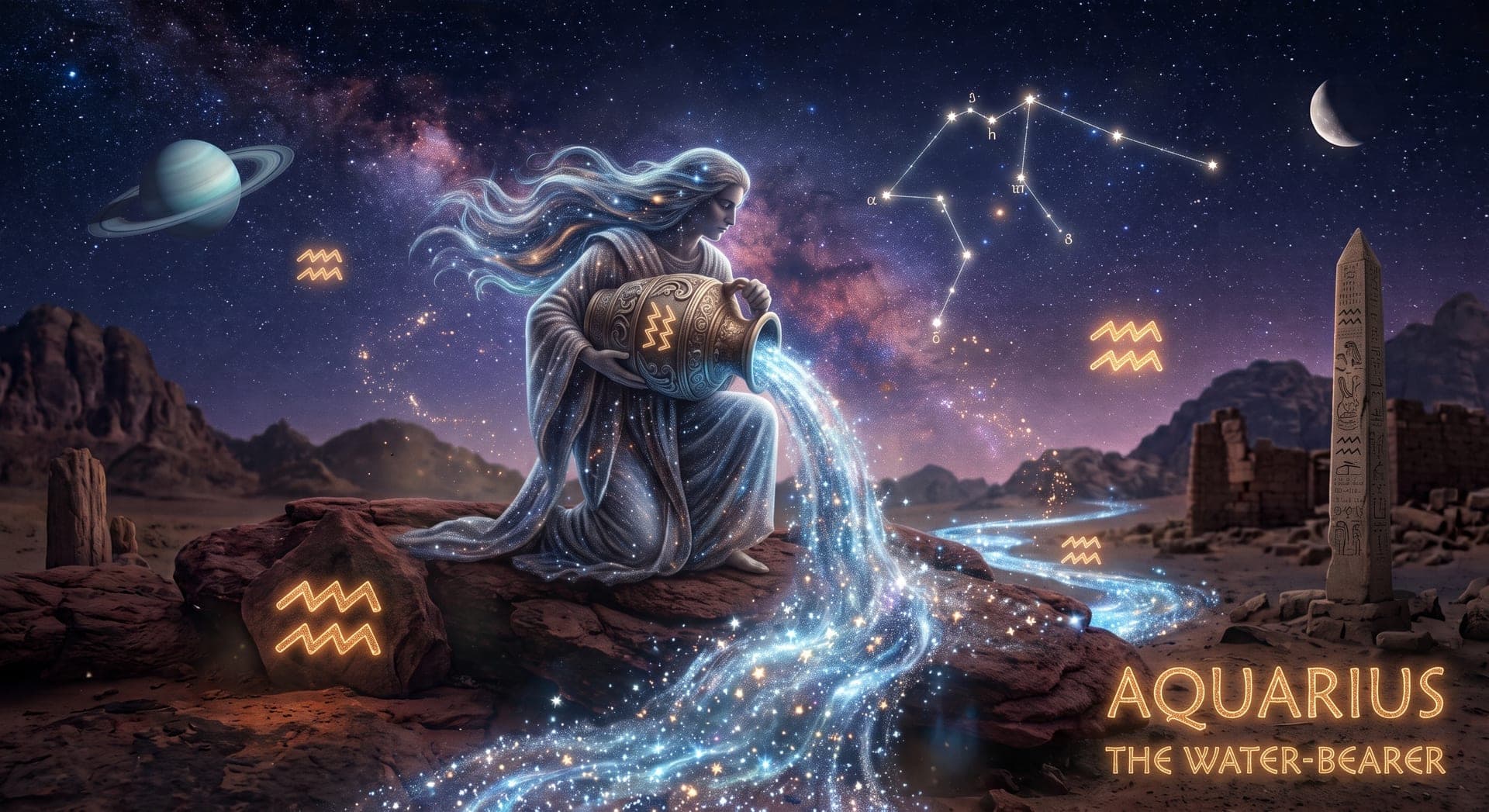
Born on January 21: Aquarius ♒
Aquarius, the eleventh sign of the zodiac, spans January 20 to February 18 and is symbolized by the water bearer, an image of someone pouring out knowledge and life-giving ideas to the world, despite Aquarius actually being an air sign rather than a water sign. Traditionally ruled by disciplined Saturn and, in modern astrology, by unpredictable Uranus, the planet of innovation and rebellion, Aquarius carries a distinctive blend of structure and originality. People born under this sign are often described as independent thinkers, forward-looking, and drawn to humanitarian causes, valuing the collective good over convention. As a Fixed sign, Aquarius can be famously stubborn once its mind is made up, even while championing change for everyone else. Intellectually curious and sometimes emotionally guarded, Aquarians tend to value friendship and community deeply, often serving as the visionary of their social circle, more comfortable debating ideas than discussing feelings.
Personality Traits
Strengths
- Original and forward-thinking
- Strong sense of fairness and justice
- Independent and self-sufficient
- Loyal to friends and causes alike
- Sees the bigger picture others miss
Weaknesses
- Can run from emotional expression
- Uncompromising once a position is fixed
- Prone to aloofness or detachment
- Sometimes contrarian just to stand apart
- Can prioritize ideas over people's feelings
Compatible Signs
Fun Facts
- Despite its watery name and imagery, Aquarius is classified as an air sign, grouped with Gemini and Libra as a sign of thought and communication rather than emotion.
- Aquarius has two ruling planets: Saturn in classical astrology, and Uranus, discovered in 1781, in the modern system most Western astrologers use today.
- The water bearer symbol traces back to Ganymede in Greek mythology, a cupbearer to the gods said to pour out a life-giving stream from the heavens.
- Notable Aquarians include Oprah Winfrey, Abraham Lincoln, Charles Darwin, Thomas Edison, and Bob Marley.
- Aquarius is one of the rarer signs to be represented by a person rather than an animal or object, alongside Gemini, Virgo, and Sagittarius's centaur half.
Born on January 21
- 1824
Stonewall Jackson
Confederate general in the American Civil War
- 1840
Sophia Jex-Blake
English physician and educator who led the campaign to open medical education to women in Britain.
- 1864
Israel Zangwill
English author and playwright known for novels of Jewish immigrant life and for coining the phrase 'melting pot.'
- 1885
Duncan Grant
Scottish painter and designer associated with the Bloomsbury Group.
- 1905
Christian Dior
French fashion designer who founded the Dior fashion house
- 1922
Telly Savalas
American actor known for the TV series "Kojak"
- 1922
Paul Scofield
English actor renowned for his stage and screen portrayal of Sir Thomas More in A Man for All Seasons.
- 1924
Benny Hill
English comedian and actor famous for his slapstick television sketch series The Benny Hill Show.
- 1925
Eva Ibbotson
Austrian-born British children's author known for fantasy novels such as "Journey to the River Sea" and "The Secret of Platform 13"
- 1940
Jack Nicklaus
Legendary professional golfer
- 1941
Placido Domingo
Renowned Spanish operatic tenor and conductor
- 1945
Martin Shaw
English actor known for television roles including The Professionals and Judge John Deed.
- 1947
Pye Hastings
English singer-songwriter and guitarist, a founding member of the progressive rock band Caravan.
- 1953
Paul Allen
Co-founder of Microsoft
- 1956
Geena Davis
American actress and producer
- 1963
Hakeem Olajuwon
Basketball Hall of Famer and two-time NBA champion
- 1965
Robert Del Naja
British musician and artist, founding member of Massive Attack, known as the band's principal vocalist and producer

On This Day in History
- 1793
King Louis XVI of France is executed by guillotine after being convicted of treason during the French Revolution.
Louis XVI was executed in the Place de la Révolution before a large crowd, having been convicted by the National Convention on charges of treason against the state. His death, following the abolition of the monarchy the previous year, marked a point of no return in the French Revolution and provoked several European monarchies to escalate their war against revolutionary France.
- 1793
King Louis XVI of France is executed by guillotine after being convicted of treason.
Following the fall of the French monarchy and his trial by the National Convention, the deposed king was beheaded in Paris before a large crowd. His execution radicalised the French Revolution further, alarmed monarchies across Europe, and helped draw Britain into the wars against revolutionary France that would dominate the continent for the next two decades.
- 1824
Ashanti forces defeat a British expedition on the Gold Coast, killing the British governor.
Sir Charles MacCarthy led a poorly prepared column against Ashanti forces near the Pra River during the First Anglo-Ashanti War, only to be overwhelmed and killed, with his skull reportedly kept as an Ashanti trophy. The stinging defeat shocked British opinion and marked an early setback in Britain's long and costly struggle to dominate the powerful Ashanti Empire in West Africa.
- 1854
The emigrant ship RMS Tayleur sinks off Lambay Island on her maiden voyage, killing around 380 people.
Bound for Australia with hundreds of emigrants aboard, the new iron clipper ran into a storm and, hampered by compass errors and an inexperienced crew, struck rocks off the Irish coast just days after leaving Liverpool. The disaster, among the deadliest British maritime losses of the era, exposed serious flaws in the rushed construction and crewing of emigrant vessels.
- 1919
Irish nationalists convene the first Dáil Éireann and declare the independence of the Irish Republic.
The first Dáil convened in Dublin's Mansion House, made up largely of Sinn Féin politicians who had won the 1918 general election but refused to take their seats in the British Parliament. Its declaration of independence and adoption of a provisional constitution effectively launched the Irish War of Independence, which led to the creation of the Irish Free State three years later.
- 1919
Irish Volunteers ambush and kill two policemen at Soloheadbeg, marking the start of the Irish War of Independence.
On the same day newly elected Irish republican MPs convened as the first Dail Eireann and declared independence from Britain, a Volunteer unit in County Tipperary ambushed a police patrol guarding explosives, killing two constables. The coinciding events are traditionally taken as the opening of the guerrilla conflict against British rule that led to Irish independence three years later.
- 1954
The USS Nautilus, the world's first nuclear-powered submarine, is launched in Groton, Connecticut.
The Nautilus, powered by a compact nuclear reactor rather than diesel engines, could remain submerged for weeks at a time instead of surfacing frequently to recharge batteries, a revolutionary capability for submarine warfare. It later became the first vessel to reach the geographic North Pole while submerged, and its success launched the widespread adoption of nuclear propulsion across major naval fleets.
- 1954
The USS Nautilus, the world's first nuclear-powered submarine, is launched in Groton, Connecticut.
Christened by First Lady Mamie Eisenhower, Nautilus used a nuclear reactor to remain submerged far longer than any conventional diesel-electric submarine, and later became the first vessel to reach the geographic North Pole while submerged. Its launch opened a new era in naval propulsion and intensified the Cold War arms race beneath the world's oceans.
- 1968
The Battle of Khe Sanh, one of the most fiercely contested engagements of the Vietnam War, begins.
North Vietnamese forces besieged a remote U.S. Marine base at Khe Sanh for over two months in a battle that drew intense media coverage and comparisons to France's earlier defeat at Dien Bien Phu. Though American forces ultimately held the base, the fighting, launched just before the wider Tet Offensive, further eroded U.S. public support for the war.
- 1968
A US B-52 bomber carrying nuclear weapons crashes near Thule Air Base in Greenland.
A fire aboard the aircraft forced the crew to eject before it crashed onto sea ice, rupturing the conventional explosives in its four hydrogen bombs and scattering radioactive material across the site. The accident triggered a massive cleanup operation and long-running controversy over nuclear weapons secretly stationed in Danish territory, straining relations between Denmark and the United States.
- 1968
North Vietnamese forces begin the Battle of Khe Sanh, laying siege to a US Marine base in South Vietnam.
Thousands of North Vietnamese troops surrounded the remote combat base near the Laotian border, beginning a siege that would last 77 days and draw comparisons to the French defeat at Dien Bien Phu. The battle, fought alongside the wider Tet Offensive, became one of the most closely watched engagements of the Vietnam War.
- 1971
The rebuilt Emley Moor transmitting station in England begins UHF television broadcasts.
The concrete tower, constructed after its predecessor collapsed under ice loading two years earlier, became one of the tallest freestanding structures in the United Kingdom and a key hub for broadcasting television across Yorkshire. Its completion restored television service to millions of viewers and remains a landmark of British broadcasting infrastructure.
- 1976
Commercial supersonic passenger service begins as the Concorde enters service on London–Bahrain and Paris–Rio routes.
The Anglo-French Concorde, capable of flying at twice the speed of sound, cut transatlantic flight times roughly in half but never achieved commercial success due to its high operating costs, limited passenger capacity, and restrictions on supersonic flight over land because of its loud sonic boom. It remained a prestige service for wealthy travelers until being retired permanently in 2003.
- 1976
Concorde begins commercial passenger service, flying the London-Bahrain route.
Developed jointly by Britain and France, the supersonic airliner entered scheduled service simultaneously from London and Paris, cutting flight times dramatically for wealthy travellers able to afford tickets. British Airways' inaugural flight to Bahrain marked the start of more than a quarter-century of supersonic passenger travel, a technological achievement never since matched in commercial aviation.
- 1981
Production of the DeLorean sports car begins at a purpose-built factory in Northern Ireland.
American entrepreneur John DeLorean's gull-winged stainless-steel sports car began rolling off the line at Dunmurry, near Belfast, in a factory heavily subsidised by the British government eager to bring jobs to Northern Ireland during the Troubles. The venture collapsed within two years amid financial scandal, though the car later achieved lasting fame through the Back to the Future films.
- 1997
The U.S. House of Representatives votes to formally reprimand Speaker Newt Gingrich for ethics violations.
The House vote followed an ethics investigation into Gingrich's use of tax-exempt organizations for political purposes and inaccurate statements made to investigators. Though he remained Speaker, the reprimand and accompanying $300,000 penalty were a significant blow to his standing, and he resigned from Congress entirely less than two years later after his party lost seats in the 1998 midterms.
- 2009
Israel completes its withdrawal from the Gaza Strip, ending a three-week war with Hamas.
Israel's withdrawal came after a three-week military offensive, Operation Cast Lead, launched in response to rocket fire from Gaza-based militant groups into Israeli territory. The conflict killed over a thousand Palestinians and 13 Israelis and drew widespread international criticism over the humanitarian toll, though it did little to permanently resolve the underlying conflict between Israel and Hamas.
- 2017
Millions join Women's Marches in cities across the United States and around the world.
Held the day after Donald Trump's first presidential inauguration, the Women's March became one of the largest single-day protests in U.S. history, drawing an estimated three to five million participants across hundreds of cities worldwide. It launched a broader wave of political activism and became an annual tradition in subsequent years, focused on women's rights and social justice issues.
- 2023
A mass shooting at a dance studio in Monterey Park, California, kills eleven people.
A gunman opened fire at a dance studio during Lunar New Year celebrations in the predominantly Asian American city of Monterey Park, killing eleven people, mostly elderly dance enthusiasts. The shooting, one of several mass shootings that struck California in quick succession that January, reignited national debate over gun control and violence targeting Asian American communities.
- 2025
A fire at a hotel in Turkey's Kartalkaya ski resort kills dozens of people.
A fire broke out overnight at a ski resort hotel in northwestern Turkey, spreading rapidly through the wooden structure while many guests were asleep, trapping people in upper floors. The tragedy, one of Turkey's deadliest hotel fires in decades, prompted investigations into building safety violations and fire code enforcement at tourist facilities.