
What’s Observed on January 22
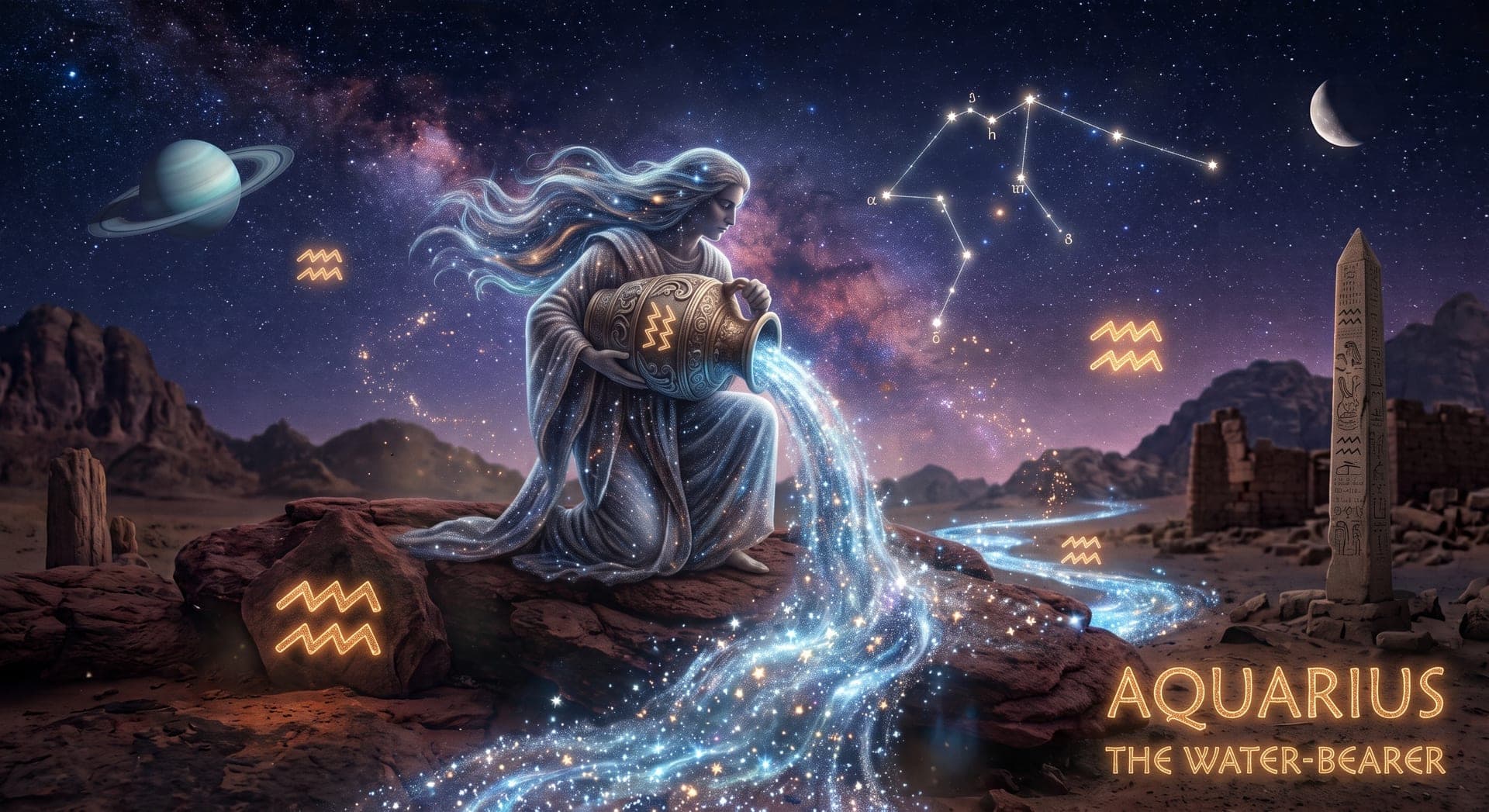
Born on January 22: Aquarius ♒
Aquarius, the eleventh sign of the zodiac, spans January 20 to February 18 and is symbolized by the water bearer, an image of someone pouring out knowledge and life-giving ideas to the world, despite Aquarius actually being an air sign rather than a water sign. Traditionally ruled by disciplined Saturn and, in modern astrology, by unpredictable Uranus, the planet of innovation and rebellion, Aquarius carries a distinctive blend of structure and originality. People born under this sign are often described as independent thinkers, forward-looking, and drawn to humanitarian causes, valuing the collective good over convention. As a Fixed sign, Aquarius can be famously stubborn once its mind is made up, even while championing change for everyone else. Intellectually curious and sometimes emotionally guarded, Aquarians tend to value friendship and community deeply, often serving as the visionary of their social circle, more comfortable debating ideas than discussing feelings.
Personality Traits
Strengths
- Original and forward-thinking
- Strong sense of fairness and justice
- Independent and self-sufficient
- Loyal to friends and causes alike
- Sees the bigger picture others miss
Weaknesses
- Can run from emotional expression
- Uncompromising once a position is fixed
- Prone to aloofness or detachment
- Sometimes contrarian just to stand apart
- Can prioritize ideas over people's feelings
Compatible Signs
Fun Facts
- Despite its watery name and imagery, Aquarius is classified as an air sign, grouped with Gemini and Libra as a sign of thought and communication rather than emotion.
- Aquarius has two ruling planets: Saturn in classical astrology, and Uranus, discovered in 1781, in the modern system most Western astrologers use today.
- The water bearer symbol traces back to Ganymede in Greek mythology, a cupbearer to the gods said to pour out a life-giving stream from the heavens.
- Notable Aquarians include Oprah Winfrey, Abraham Lincoln, Charles Darwin, Thomas Edison, and Bob Marley.
- Aquarius is one of the rarer signs to be represented by a person rather than an animal or object, alongside Gemini, Virgo, and Sagittarius's centaur half.
Born on January 22
- 1561
Francis Bacon
English philosopher, statesman, and pioneer of the scientific method who served as Lord Chancellor under James I.
- 1788
Lord Byron
English Romantic poet renowned for works including Don Juan and Childe Harold's Pilgrimage.
- 1858
Beatrice Webb
English sociologist and economist who co-founded the London School of Economics and helped shape early British social policy.
- 1904
George Balanchine
Choreographer who co-founded the New York City Ballet
- 1907
Dixie Dean
English footballer who still holds the record for most goals scored in an English top-flight season, set with Everton in 1927-28.
- 1920
Alf Ramsey
English footballer and manager who led the England national team to victory at the 1966 World Cup.
- 1931
Sam Cooke
Singer-songwriter known as the "King of Soul"
- 1940
John Hurt
English actor known for roles in Alien, The Elephant Man, and Harry Potter.
- 1946
Malcolm McLaren
English musician and impresario who managed the Sex Pistols and helped shape the British punk movement.
- 1960
Michael Hutchence
Lead singer of the rock band INXS
- 1965
Diane Lane
American actress with a career spanning decades of film
- 1990
Logic
American rapper and hip-hop artist

On This Day in History
- 871
A Viking army defeats the West Saxons at the Battle of Basing.
Fought during the intense year of battles that opened King Alfred the Great's reign, the Viking Great Heathen Army overcame West Saxon defenders at Basing in Hampshire. The defeat was one of several setbacks that year for Wessex, part of the sustained Viking onslaught against Anglo-Saxon kingdoms that Alfred would eventually turn back later in his reign.
- 1517
Ottoman forces under Selim I defeat the Mamluk Sultanate at the Battle of Ridaniya, gaining control of Egypt.
Ottoman Sultan Selim I's decisive victory over the Mamluk Sultanate, which had ruled Egypt and much of the Levant for over two and a half centuries, brought Egypt, along with the holy cities of Mecca and Medina, under Ottoman control. The conquest significantly expanded Ottoman territory and prestige, positioning the sultan as protector of the two holiest sites in Islam.
- 1689
England's Convention Parliament convenes to resolve the succession crisis following James II's flight.
Summoned after James II fled to France amid the Glorious Revolution, the specially assembled parliament debated how to fill the vacant throne. Its eventual decision to declare the throne vacant and offer the crown jointly to William III and Mary II established the constitutional precedent that parliament, not divine right alone, determined the succession.
- 1808
The Portuguese royal family arrives in Brazil after fleeing the Napoleonic invasion of Portugal.
Fleeing Napoleon's invading army, the Portuguese royal family and court, escorted by the British navy, relocated the seat of the Portuguese empire across the Atlantic to Rio de Janeiro, an unprecedented transfer of a European monarchy to its colony. The relocation elevated Brazil's status and set in motion the political developments that led to Brazilian independence in 1822.
- 1849
British and allied Sikh forces capture Multan after a nine-month siege during the Second Anglo-Sikh War.
The fortified city fell after prolonged bombardment breached its walls, ending a rebellion by its governor that had helped trigger the wider war between the British East India Company and the Sikh Empire. The eventual British victory in the conflict led directly to the annexation of the Punjab, extending Company rule to the subcontinent's northwestern frontier.
- 1879
Zulu forces defeat British troops at the Battle of Isandlwana during the Anglo-Zulu War.
Vastly outnumbered Zulu warriors annihilated a British camp at Isandlwana using traditional "horns of the buffalo" encirclement tactics, killing over 1,300 British and colonial troops in one of the worst defeats ever inflicted on a modern European army by an indigenous force. The stunning loss shocked Britain and led to a massive escalation of the war effort against the Zulu kingdom.
- 1879
Zulu forces inflict a devastating defeat on British troops at the Battle of Isandlwana.
A Zulu army of some 20,000 warriors overwhelmed a British camp in present-day South Africa, killing over 1,300 British and colonial troops in the worst defeat inflicted on a modern European army by indigenous forces in the nineteenth century. The disaster shocked Britain and prompted a hastily reinforced campaign that eventually crushed the Zulu Kingdom later that year.
- 1879
A small British garrison repels repeated Zulu attacks at the Battle of Rorke's Drift.
Hours after the catastrophe at Isandlwana, roughly 150 British and colonial troops defended a mission station against thousands of Zulu warriors through a night of close combat. The successful defence, for which eleven Victoria Crosses were awarded, became one of the most celebrated actions in British military history and helped offset the shock of the earlier defeat.
- 1901
Edward VII is proclaimed King following the death of his mother, Queen Victoria.
Victoria died the previous day at Osborne House after a reign of more than 63 years, and her eldest son was proclaimed king at St James's Palace amid nationwide mourning. His accession ended the Victorian era and ushered in the shorter Edwardian period, marked by a more relaxed royal style than his mother's long widowhood.
- 1905
Troops fire on peaceful demonstrators in St. Petersburg on "Bloody Sunday," helping trigger the 1905 Russian Revolution.
Troops fired on unarmed workers marching peacefully toward the Winter Palace to present a petition for better conditions and political reforms to Tsar Nicholas II, killing and wounding hundreds. "Bloody Sunday" shattered popular faith in the tsar as a benevolent protector and sparked widespread strikes and unrest that became known as the 1905 Russian Revolution, a precursor to the larger revolutions of 1917.
- 1917
President Woodrow Wilson calls for "peace without victory" in a speech to the U.S. Senate regarding World War I.
Wilson's speech to the Senate proposed a postwar settlement based on equality among nations rather than a punitive peace imposed by the victors, foreshadowing themes he would later develop in his Fourteen Points. His idealistic vision contrasted sharply with the harsher reparations ultimately imposed on Germany at the Paris Peace Conference following the war's end.
- 1924
Ramsay MacDonald becomes the United Kingdom's first Labour Prime Minister.
Forming a minority government with Liberal support after an inconclusive general election, MacDonald became the first head of government from the Labour Party, a milestone for the British labour movement founded to represent working-class interests. His first government lasted less than a year, but it broke the two-party dominance of Conservatives and Liberals and established Labour as a party of government.
- 1927
The BBC broadcasts the first live radio commentary of a football match in England.
Commentator Teddy Wakelam described the Arsenal versus Sheffield United match at Highbury for BBC listeners, using a numbered-grid system printed in the Radio Times to help audiences follow play-by-play action they could not see. The broadcast launched a new form of sports journalism that transformed how the British public followed football.
- 1941
British and Commonwealth forces capture the Libyan port of Tobruk from Italian defenders.
As part of Operation Compass, British, Australian, and Indian troops stormed Italian defensive positions around Tobruk, taking tens of thousands of prisoners in a rapid advance across North Africa. The victory was a major early success against Italy in the Second World War, though the port would change hands again in fierce fighting with German forces later in the conflict.
- 1963
France and West Germany sign the Élysée Treaty, formalizing postwar reconciliation between the two nations.
Signed by French President Charles de Gaulle and West German Chancellor Konrad Adenauer, the treaty formalized reconciliation between two nations that had fought three major wars against each other within living memory. It established regular consultations between the two governments and became a cornerstone of the deepening European integration that eventually produced the European Union.
- 1970
The Boeing 747 enters commercial service, inaugurating the era of the "jumbo jet."
Pan Am's inaugural 747 flight from New York to London launched the era of mass long-haul air travel, as the aircraft's much larger capacity dramatically reduced the cost per seat on international routes. Its distinctive hump-backed design became instantly recognizable worldwide, and variants of the aircraft remained in production for passenger and cargo use for decades.
- 1971
Commonwealth leaders adopt the Singapore Declaration, setting out shared principles for the organisation.
Meeting in Singapore, heads of government from across the Commonwealth, including Britain, agreed a statement affirming commitments to world peace, individual liberty, and racial equality, partly in response to tensions over apartheid South Africa. The declaration became a foundational document guiding the Commonwealth's conduct and membership standards in the decades that followed.
- 1973
The U.S. Supreme Court issues its decision in Roe v. Wade, legalizing abortion nationwide.
The Supreme Court's 7-2 decision established a constitutional right to abortion based on an implied right to privacy, striking down restrictive state laws across the country. The ruling became one of the most contested in American legal history, fueling decades of political and social conflict, until it was overturned by the Court's 2022 Dobbs decision, returning abortion regulation to individual states.
- 2006
Evo Morales is inaugurated as President of Bolivia, becoming the country's first Indigenous head of state.
Morales, a former coca farmer and union leader of Aymara descent, took office as Bolivia's first Indigenous president in a country where the majority of the population is Indigenous but had long been politically marginalized. His presidency pursued nationalization of natural resources and new rights protections for Indigenous communities, though it later grew increasingly controversial over extended term limits.
- 2024
The Ram Mandir temple in Ayodhya, India, is inaugurated after a centuries-long religious and legal dispute.
The temple's construction followed a decades-long, often violent legal and religious dispute over the site, which Hindu nationalists claimed was the birthplace of the god Rama and where a 16th-century mosque had stood until it was demolished by a mob in 1992. India's Supreme Court awarded the site to Hindu groups in 2019, clearing the way for the temple's construction.