
What’s Observed on January 23
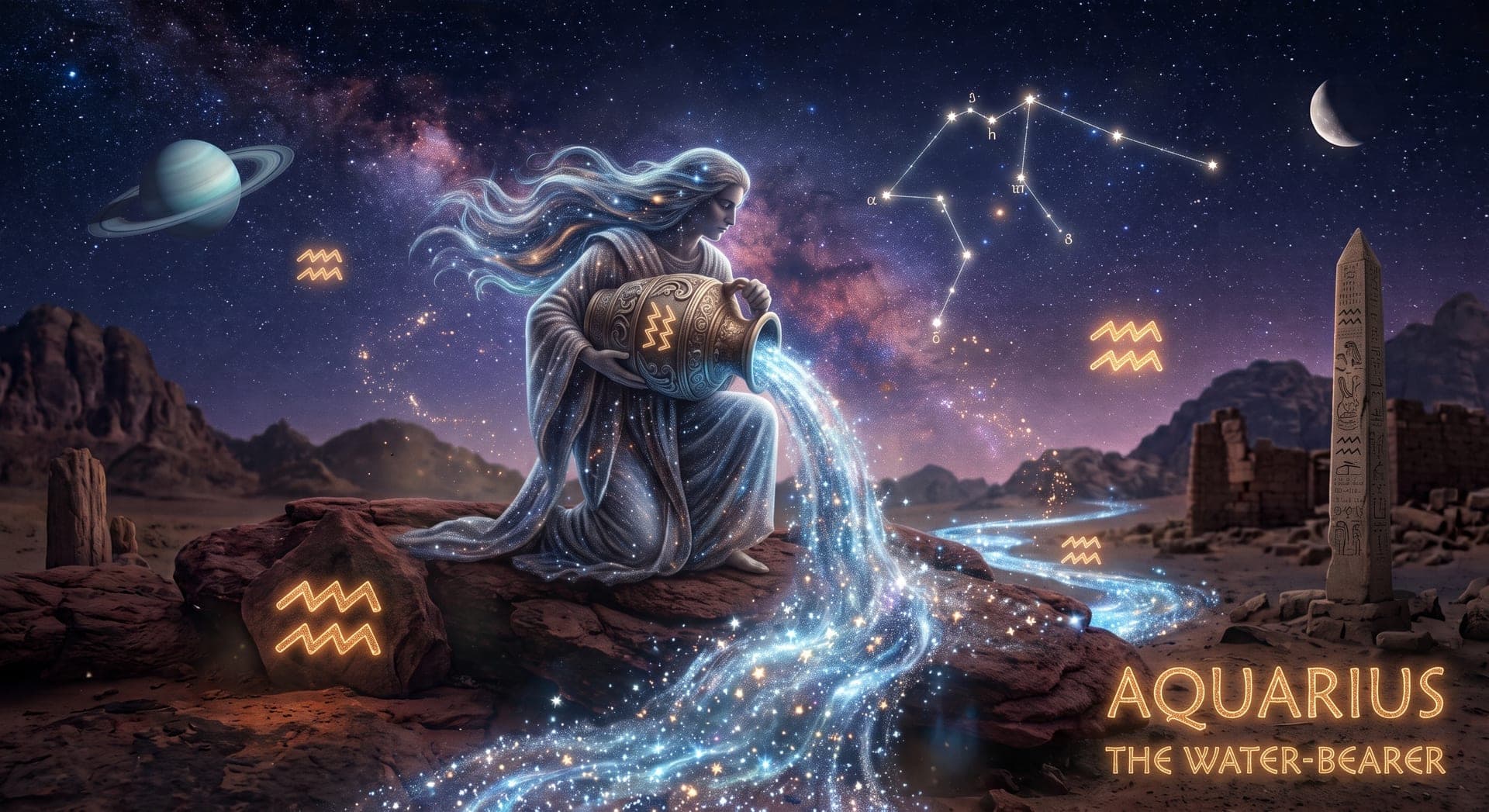
Born on January 23: Aquarius ♒
Aquarius, the eleventh sign of the zodiac, spans January 20 to February 18 and is symbolized by the water bearer, an image of someone pouring out knowledge and life-giving ideas to the world, despite Aquarius actually being an air sign rather than a water sign. Traditionally ruled by disciplined Saturn and, in modern astrology, by unpredictable Uranus, the planet of innovation and rebellion, Aquarius carries a distinctive blend of structure and originality. People born under this sign are often described as independent thinkers, forward-looking, and drawn to humanitarian causes, valuing the collective good over convention. As a Fixed sign, Aquarius can be famously stubborn once its mind is made up, even while championing change for everyone else. Intellectually curious and sometimes emotionally guarded, Aquarians tend to value friendship and community deeply, often serving as the visionary of their social circle, more comfortable debating ideas than discussing feelings.
Personality Traits
Strengths
- Original and forward-thinking
- Strong sense of fairness and justice
- Independent and self-sufficient
- Loyal to friends and causes alike
- Sees the bigger picture others miss
Weaknesses
- Can run from emotional expression
- Uncompromising once a position is fixed
- Prone to aloofness or detachment
- Sometimes contrarian just to stand apart
- Can prioritize ideas over people's feelings
Compatible Signs
Fun Facts
- Despite its watery name and imagery, Aquarius is classified as an air sign, grouped with Gemini and Libra as a sign of thought and communication rather than emotion.
- Aquarius has two ruling planets: Saturn in classical astrology, and Uranus, discovered in 1781, in the modern system most Western astrologers use today.
- The water bearer symbol traces back to Ganymede in Greek mythology, a cupbearer to the gods said to pour out a life-giving stream from the heavens.
- Notable Aquarians include Oprah Winfrey, Abraham Lincoln, Charles Darwin, Thomas Edison, and Bob Marley.
- Aquarius is one of the rarer signs to be represented by a person rather than an animal or object, alongside Gemini, Virgo, and Sagittarius's centaur half.
Born on January 23
- 1585
Mary Ward
English Catholic religious founder who established the Institute of the Blessed Virgin Mary, pioneering education for girls.
- 1737
John Hancock
American statesman famous for his bold signature on the Declaration of Independence
- 1832
Edouard Manet
French painter who bridged Realism and Impressionism
- 1878
Rutland Boughton
English composer best known for the opera The Immortal Hour and his efforts to found a Wagnerian-style festival at Glastonbury.
- 1897
Subhas Chandra Bose
Indian independence leader
- 1898
Freda Utley
English journalist and author known for her writings on Soviet Russia and later Cold War-era China.
- 1899
Glen Kidston
English aviator and racing driver famed for setting a record-breaking flight time from Britain to South Africa.
- 1900
William Ifor Jones
Welsh-born conductor and organist who led choral and orchestral ensembles in the United States.
- 1910
Django Reinhardt
Pioneering jazz guitarist
- 1916
Airey Neave
English soldier and politician, the first British prisoner to escape from Colditz Castle during the Second World War, later assassinated by the INLA.
- 1919
Bob Paisley
English football manager who led Liverpool to three European Cup titles in the 1970s and 1980s.
- 1928
Jeanne Moreau
Acclaimed French actress of classic cinema
- 1944
Rutger Hauer
Dutch actor known for "Blade Runner"
- 1950
Richard Dean Anderson
American actor known for "MacGyver" and "Stargate SG-1"
- 1984
Arjen Robben
Dutch footballer known for his speed and technique

On This Day in History
- 1264
King Louis IX of France issues the Mise of Amiens, an arbitration ruling favouring King Henry III of England in his dispute with rebel barons.
Asked to arbitrate the conflict between Henry III and barons led by Simon de Montfort over the Provisions of Oxford, the French king ruled largely in Henry's favour, annulling the reforms that had limited royal power. The rejected ruling failed to end the dispute and instead triggered the Second Barons' War just months later.
- 1368
Zhu Yuanzhang proclaims himself the Hongwu Emperor, founding China's Ming dynasty.
Zhu Yuanzhang, a former Buddhist monk and peasant rebel leader, overthrew the Mongol-led Yuan dynasty and founded the Ming dynasty, taking the reign name Hongwu, meaning "vastly martial." His nearly 30-year reign restored Han Chinese rule and reorganized the empire's administration, laying foundations for a dynasty that would govern China for the next 276 years.
- 1368
Zhu Yuanzhang proclaims himself the Hongwu Emperor, founding China's Ming dynasty.
A former peasant and Buddhist monk who rose through rebel ranks to overthrow the Mongol-led Yuan dynasty, Zhu Yuanzhang declared a new imperial era at Nanjing. His Ming dynasty would rule China for nearly three centuries, restoring native Han Chinese rule and overseeing major projects including the reconstruction of the Great Wall.
- 1556
The Shaanxi earthquake strikes central China, killing an estimated 830,000 people in the deadliest earthquake in recorded history.
The Shaanxi earthquake struck a densely populated region where many residents lived in cave dwellings carved into soft loess soil cliffs, which collapsed catastrophically during the shaking. The resulting death toll, estimated at over 800,000, remains the highest ever recorded from a single earthquake, a grim record attributed largely to the vulnerable construction common in the region at the time.
- 1556
An earthquake devastates Shaanxi province in China, killing an estimated 830,000 people.
The quake, centred in the densely populated Wei River valley, remains the deadliest earthquake ever recorded, its extreme toll driven partly by the region's cave dwellings carved into loess cliffs, which collapsed on residents en masse. The disaster prompted lasting changes in Chinese building and settlement practices in earthquake-prone regions.
- 1570
James Stewart, Earl of Moray and Regent of Scotland, is assassinated in Linlithgow.
Moray, the illegitimate half-brother of Mary, Queen of Scots, was shot by a supporter of the deposed queen while riding through the town, becoming the first head of government in history recorded to have been killed with a firearm. His death deepened the civil conflict between supporters of the infant James VI and adherents of his exiled mother.
- 1571
The Royal Exchange, London's first purpose-built commercial trading centre, opens to merchants.
Financed by the wealthy merchant Sir Thomas Gresham, the Exchange provided London traders with a covered venue for business, modelled on similar bourses in Antwerp. Queen Elizabeth I visited and granted it royal status shortly after opening, and it became a central hub of English commerce, rebuilt twice after fires over the following centuries.
- 1579
The Union of Utrecht forms a Protestant confederation of Dutch provinces, a founding step toward the modern Netherlands.
Dutch provinces in the northern Low Countries, seeking to resist Spanish Habsburg rule and religious persecution during the Eighty Years' War, formed a defensive alliance that became the foundation for the later Dutch Republic. The union's principles of provincial autonomy and religious tolerance influenced the political structure of the independent Netherlands that emerged decades later.
- 1793
Russia and Prussia carry out the Second Partition of Poland, seizing large areas of Polish territory.
Responding to reforms adopted by the Polish-Lithuanian Commonwealth that threatened their influence, Russian and Prussian troops occupied and annexed substantial portions of Polish land, drastically shrinking the once-powerful state. The partition provoked the Kosciuszko Uprising the following year and set the stage for Poland's complete disappearance from the map in the Third Partition of 1795.
- 1846
Slavery is formally abolished in Tunisia.
Tunisia's abolition of slavery came under reforming ruler Ahmad I ibn Mustafa, making it one of the earlier nations in the region to formally end the practice, decades before it was outlawed in many other parts of the world. The decree was part of broader modernizing reforms Ahmad pursued to strengthen Tunisia's autonomy and standing relative to European powers.
- 1899
The Malolos Constitution establishes the First Philippine Republic under President Emilio Aguinaldo.
The Malolos Congress adopted a constitution establishing Asia's first democratic republic, following the Philippine declaration of independence from Spain the previous year. The fledgling republic's independence proved short-lived, however, as the United States, having acquired the Philippines from Spain, moved to suppress it in the brutal Philippine-American War that followed within months.
- 1900
British forces suffer a heavy defeat at the Battle of Spion Kop during the Second Boer War.
Attempting to break the Boer siege of Ladysmith, British troops seized the hilltop of Spion Kop under cover of night but found themselves trapped in poorly dug trenches under murderous Boer artillery and rifle fire through the following day. The costly withdrawal that followed became one of the most infamous British failures of the war.
- 1909
The stricken liner RMS Republic sends the first CQD wireless distress signal after a collision at sea.
Following a collision with another vessel off Nantucket, the White Star Line steamer's wireless operator transmitted the CQD distress call using Marconi equipment, summoning rescue ships that saved nearly all aboard despite Republic later sinking. The successful rescue demonstrated the life-saving value of shipboard wireless telegraphy, a British-pioneered technology that would prove crucial to maritime safety.
- 1943
Britain's Eighth Army captures Tripoli from German and Italian forces in North Africa.
Advancing westward after their victory at El Alamein, General Bernard Montgomery's forces entered the Libyan capital, ending Italian colonial rule there and securing a major port for Allied supply lines. The capture marked a significant milestone in the North African campaign, which concluded with the final Axis surrender in Tunisia a few months later.
- 1950
Israel's Knesset declares Jerusalem the country's capital.
The Knesset's declaration affirmed Jerusalem's status despite the city being divided between Israel and Jordan at the time, with Israel controlling only the western portion. The declaration remains a source of enduring international controversy, since many countries maintain embassies in Tel Aviv rather than Jerusalem, reflecting unresolved disputes over the city's final status.
- 1957
Inventor Walter Frederick Morrison sells the rights to his flying disc to Wham-O, which later renames it the Frisbee.
Morrison had been selling his aerodynamic plastic disc, originally called the "Pluto Platter," for a few years before the toy company Wham-O bought the rights and rebranded it. The company reportedly renamed it "Frisbee" after college students who had been throwing pie tins from the Frisbie Pie Company, and the toy became a cultural phenomenon and the namesake for the modern sport of disc golf.
- 1964
The 24th Amendment to the U.S. Constitution, banning poll taxes in federal elections, is ratified.
The amendment ended poll taxes as a requirement for voting in federal elections, a practice that had been used, particularly in Southern states, to disenfranchise poor and Black voters since the end of Reconstruction. It was a significant milestone of the civil rights era, and the Supreme Court extended the ban to state elections as well two years later.
- 1967
Milton Keynes is designated a new town in Buckinghamshire, England.
Established under Britain's post-war New Towns programme to relieve overcrowding in London, Milton Keynes was planned around a distinctive grid of boulevards and roundabouts on a scale unlike earlier new towns. It grew rapidly from a scattering of villages into one of England's largest urban centres, becoming a byword for ambitious post-war town planning.
- 1986
The Rock and Roll Hall of Fame inducts its first class, including Elvis Presley and Chuck Berry.
The first class of inductees, chosen by a panel of music industry professionals, honored ten pioneering rock and roll performers whose work in the 1950s helped define the genre. The Rock and Roll Hall of Fame, headquartered in Cleveland, Ohio, has since become the industry's most prestigious institution for recognizing influential musicians and figures.
- 1997
Madeleine Albright is confirmed as U.S. Secretary of State, the first woman to hold the position.
Albright, who had fled Czechoslovakia as a child refugee from Nazi and later communist rule, was confirmed by the Senate and sworn in as the highest-ranking woman in the history of the U.S. government up to that point. Her tenure was marked by prominent roles in NATO expansion, the Kosovo intervention, and Middle East diplomacy under President Bill Clinton.