
What’s Observed on January 24
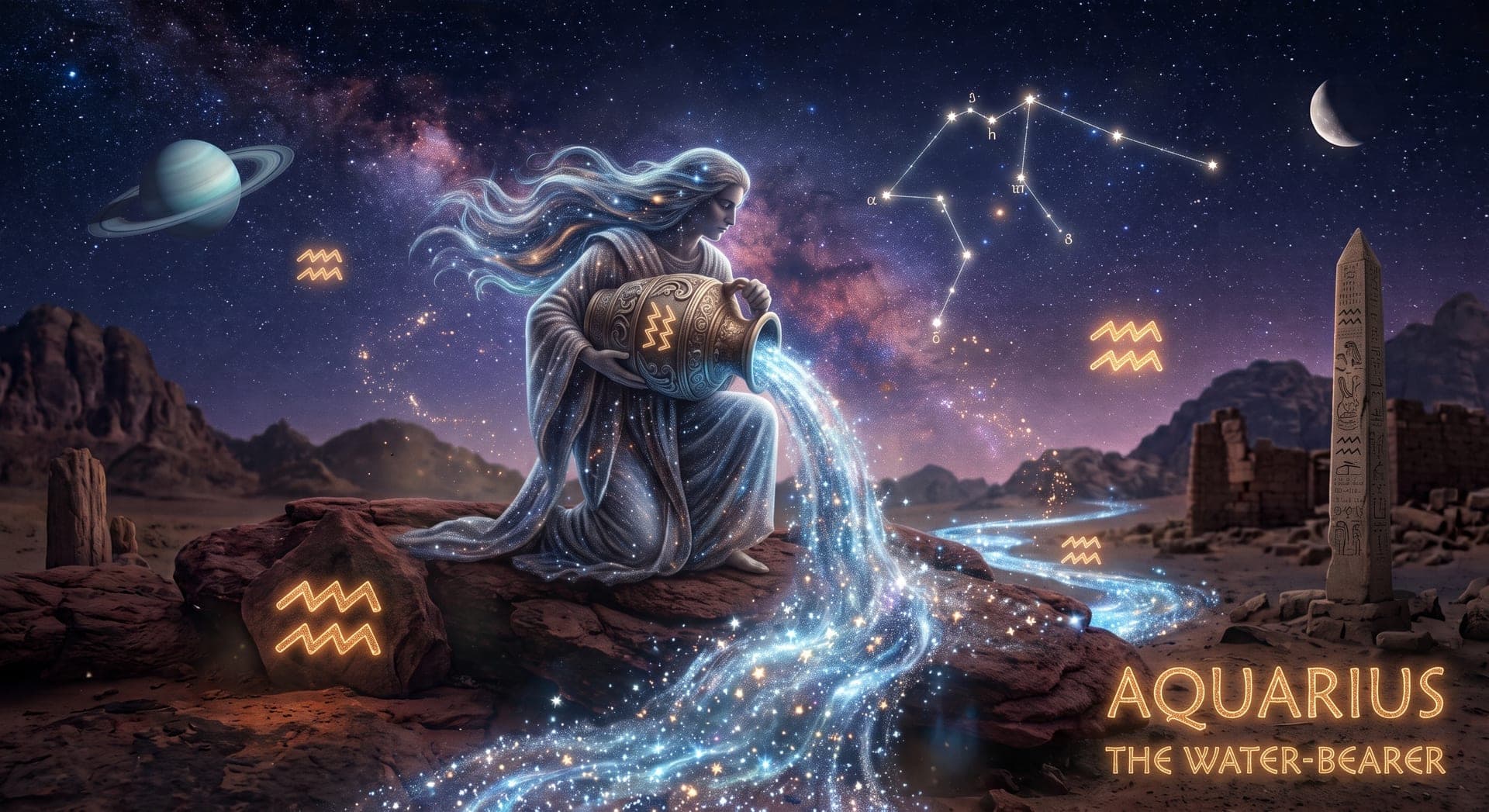
Born on January 24: Aquarius ♒
Aquarius, the eleventh sign of the zodiac, spans January 20 to February 18 and is symbolized by the water bearer, an image of someone pouring out knowledge and life-giving ideas to the world, despite Aquarius actually being an air sign rather than a water sign. Traditionally ruled by disciplined Saturn and, in modern astrology, by unpredictable Uranus, the planet of innovation and rebellion, Aquarius carries a distinctive blend of structure and originality. People born under this sign are often described as independent thinkers, forward-looking, and drawn to humanitarian causes, valuing the collective good over convention. As a Fixed sign, Aquarius can be famously stubborn once its mind is made up, even while championing change for everyone else. Intellectually curious and sometimes emotionally guarded, Aquarians tend to value friendship and community deeply, often serving as the visionary of their social circle, more comfortable debating ideas than discussing feelings.
Personality Traits
Strengths
- Original and forward-thinking
- Strong sense of fairness and justice
- Independent and self-sufficient
- Loyal to friends and causes alike
- Sees the bigger picture others miss
Weaknesses
- Can run from emotional expression
- Uncompromising once a position is fixed
- Prone to aloofness or detachment
- Sometimes contrarian just to stand apart
- Can prioritize ideas over people's feelings
Compatible Signs
Fun Facts
- Despite its watery name and imagery, Aquarius is classified as an air sign, grouped with Gemini and Libra as a sign of thought and communication rather than emotion.
- Aquarius has two ruling planets: Saturn in classical astrology, and Uranus, discovered in 1781, in the modern system most Western astrologers use today.
- The water bearer symbol traces back to Ganymede in Greek mythology, a cupbearer to the gods said to pour out a life-giving stream from the heavens.
- Notable Aquarians include Oprah Winfrey, Abraham Lincoln, Charles Darwin, Thomas Edison, and Bob Marley.
- Aquarius is one of the rarer signs to be represented by a person rather than an animal or object, alongside Gemini, Virgo, and Sagittarius's centaur half.
Born on January 24
- 1664
John Vanbrugh
English architect and playwright who designed Blenheim Palace and Castle Howard.
- 1670
William Congreve
English playwright and poet celebrated for Restoration comedies including The Way of the World.
- 1749
Charles James Fox
English Whig statesman known for his opposition to King George III and his advocacy for parliamentary reform and the abolition of the slave trade.
- 1858
Constance Naden
English poet and philosopher known for combining scientific themes with verse.
- 1885
Marjory Stephenson
British biochemist and a founder of the field of microbial biochemistry, among the first women elected Fellow of the Royal Society.
- 1917
Ernest Borgnine
Academy Award-winning American actor
- 1928
Desmond Morris
English zoologist and author known for popular science works including The Naked Ape.
- 1941
Neil Diamond
Singer-songwriter known for hits like "Sweet Caroline"
- 1941
Dan Shechtman
Israeli chemist who won the Nobel Prize for discovering quasicrystals
- 1941
Aaron Neville
American R&B and soul singer
- 1943
Sharon Tate
American actress whose life was tragically cut short in 1969
- 1947
Warren Zevon
Singer-songwriter known for "Werewolves of London"
- 1953
Moon Jae-in
19th President of South Korea
- 1958
Jools Holland
English musician and broadcaster, known as a founding member of Squeeze and host of Later... with Jools Holland.
On This Day in History
- 41
Following the assassination of Emperor Caligula, the Praetorian Guard proclaims his uncle Claudius as the new Roman emperor.
Following the assassination of the erratic and widely despised Caligula by his own guard officers, soldiers reportedly discovered his uncle Claudius hiding behind a curtain in the palace, fearing for his own life. Rather than killing him, the Praetorian Guard proclaimed Claudius emperor, largely because they wanted a family member of the imperial line who would owe them loyalty and reward their support.
- 1536
King Henry VIII of England suffers a serious jousting injury that historians believe may have contributed to his later erratic behavior.
Henry VIII was thrown from his horse during a jousting tournament and reportedly lay unconscious for two hours, suffering a leg wound that never fully healed and worsened over the following years. Some historians theorize the resulting brain injury contributed to the dramatic personality changes, mood swings, and paranoia that marked the final years of his reign.
- 1536
King Henry VIII is seriously injured in a jousting accident at Greenwich, possibly suffering a brain injury.
Thrown from his horse when both rider and mount fell during a tournament, Henry was unconscious for around two hours, and some historians link the accident to the marked change in his temperament, health, and judgment in the years that followed. The injury also aggravated a leg wound that troubled him for the rest of his life.
- 1679
King Charles II dissolves the Cavalier Parliament after nearly eighteen years in session.
First elected in 1661 shortly after the Restoration of the monarchy, the strongly royalist parliament had grown increasingly divided over issues including the succession of Charles's Catholic brother James. Its dissolution amid the Exclusion Crisis led to a series of short-lived parliaments and heightened political tension between the crown and its opponents.
- 1848
James W. Marshall discovers gold at Sutter's Mill in California, setting off the California Gold Rush.
Marshall, a carpenter building a sawmill for John Sutter, spotted flakes of gold in a river near Coloma, California, a discovery that initially he and Sutter tried to keep quiet. News leaked out anyway, and within a year, roughly 300,000 people from around the world had rushed to California, dramatically accelerating the territory's path to statehood and reshaping the American West.
- 1848
James W. Marshall discovers gold at Sutter's Mill in California, triggering the Gold Rush.
While building a sawmill for John Sutter, Marshall spotted flakes of gold in the tailrace, a discovery that, once word spread, drew hundreds of thousands of prospectors to California within a few years. The resulting Gold Rush transformed California's economy and population and accelerated its admission to the United States as a state.
- 1857
The University of Calcutta is formally established, becoming British India's first modern university.
Modelled on the University of London and created by the colonial government, Calcutta became one of the first fully-fledged Western-style universities in Asia, soon joined by sister institutions in Bombay and Madras. It educated generations of Indian administrators, lawyers, and reformers, and played an outsized role in shaping the intellectual life of British-ruled India.
- 1900
British forces under General Redvers Buller abandon their attempt to break through at Spion Kop, ending the battle in Boer victory.
After a day and night of brutal fighting on the exposed hilltop, British commanders concluded their position was untenable and withdrew under cover of darkness, conceding the field to the Boers. The failed assault, part of the campaign to relieve besieged Ladysmith, added to a string of embarrassing British reverses early in the Second Boer War.
- 1908
Robert Baden-Powell organises the first Boy Scout troop in England.
Building on the success of his book Scouting for Boys and an experimental camp on Brownsea Island the previous year, Baden-Powell formalised the scouting movement in England, emphasising outdoor skills, citizenship, and self-reliance. The movement spread rapidly across the British Empire and then worldwide, becoming one of the largest youth organisations in history.
- 1915
British and German battlecruiser fleets clash at the Battle of Dogger Bank during World War I.
The naval battle in the North Sea saw British forces intercept and heavily damage a German battlecruiser squadron attempting a raid on English coastal towns, sinking one German ship. The engagement led Germany to become more cautious with its surface fleet for the remainder of World War I, shifting greater emphasis toward submarine warfare instead.
- 1915
The Royal Navy defeats a German battlecruiser squadron at the Battle of Dogger Bank in the North Sea.
British battlecruisers, alerted by decrypted German radio signals, intercepted a raiding force under Admiral Franz von Hipper and sank the armoured cruiser Blucher after a fierce pursuit and gunnery duel. The engagement, one of the few major surface actions of the naval war, prompted Germany to become more cautious about further raids against the British coast.
- 1943
Franklin D. Roosevelt and Winston Churchill conclude the Casablanca Conference, agreeing to pursue the "unconditional surrender" of the Axis powers.
Meeting in Casablanca, Morocco, Roosevelt and Churchill finalized Allied strategy for the coming year, including plans to invade Sicily, while also working around the ongoing rivalry between French leaders Charles de Gaulle and Henri Giraud. The conference's unconditional surrender policy shaped Allied war aims for the conflict's remainder.
- 1943
Franklin Roosevelt and Winston Churchill conclude the Casablanca Conference, agreeing on Allied wartime strategy.
Meeting in French Morocco over ten days, the American and British leaders coordinated plans for the invasion of Sicily and agreed on the policy of demanding unconditional surrender from Germany, Italy, and Japan. The conference cemented the close Anglo-American wartime partnership and set the broad strategic direction the Allies followed for the rest of the war.
- 1961
A B-52 bomber breaks apart over Goldsboro, North Carolina, accidentally dropping two hydrogen bombs that narrowly avoid detonating.
A B-52 carrying two hydrogen bombs broke apart in mid-air due to a structural failure, dropping both weapons near Goldsboro, North Carolina. Declassified documents later revealed that one bomb came dangerously close to detonating, with only a single safety switch preventing a catastrophic nuclear explosion, an incident that remained classified for decades.
- 1961
A US B-52 bomber breaks up in mid-air over Goldsboro, North Carolina, dropping two nuclear bombs.
Suffering a structural failure during a routine flight, the bomber disintegrated and released its two hydrogen bombs, one of which came dangerously close to detonating after several of its safety mechanisms failed. The other bomb's uranium core was never recovered from the swampy ground where it landed, and remains buried there under a permanent easement.
- 1972
Japanese soldier Shoichi Yokoi is found hiding in the jungles of Guam, having refused to surrender for 28 years after World War II.
Yokoi, a former Japanese soldier, had hidden in the jungles of Guam for nearly three decades after Japan's surrender, unaware or unwilling to believe the war had ended, surviving on local plants and fish. His discovery by local hunters made international headlines, and he was one of several Japanese holdouts found in remote Pacific locations years after World War II's conclusion.
- 1986
NASA's Voyager 2 spacecraft makes its closest approach to Uranus, providing the first close-up images of the planet.
Voyager 2, launched in 1977 on a grand tour of the outer planets, became the only spacecraft ever to visit Uranus, revealing its tilted magnetic field, faint rings, and several new moons. The flyby remains, decades later, humanity's sole close-up encounter with the ice giant, since no dedicated follow-up mission has yet been sent.
- 1986
Voyager 2 makes its closest approach to Uranus, returning the first close-up images of the planet.
The NASA probe passed within about 81,500 kilometres of Uranus's cloud tops, revealing its faint ring system, several new moons, and a strangely featureless atmosphere in unprecedented detail. It remains the only spacecraft ever to have visited Uranus, making the flyby a uniquely important source of data about the ice giant decades later.
- 2003
The U.S. Department of Homeland Security formally begins operations.
Created in response to the September 11 terrorist attacks, the Department of Homeland Security consolidated 22 different federal agencies, including the Coast Guard, Secret Service, and immigration enforcement, into a single cabinet department focused on counterterrorism and domestic security. It represented the largest reorganization of the U.S. federal government since the creation of the Department of Defense.
- 2018
Former USA Gymnastics doctor Larry Nassar is sentenced to up to 175 years in prison for sexual abuse.
Nassar's sentencing followed a week of harrowing victim impact statements from over 150 women and girls, many of them elite gymnasts, who described years of sexual abuse under the guise of medical treatment. The case exposed serious institutional failures at USA Gymnastics and Michigan State University and led to major reforms in athlete safeguarding policies across amateur sports.